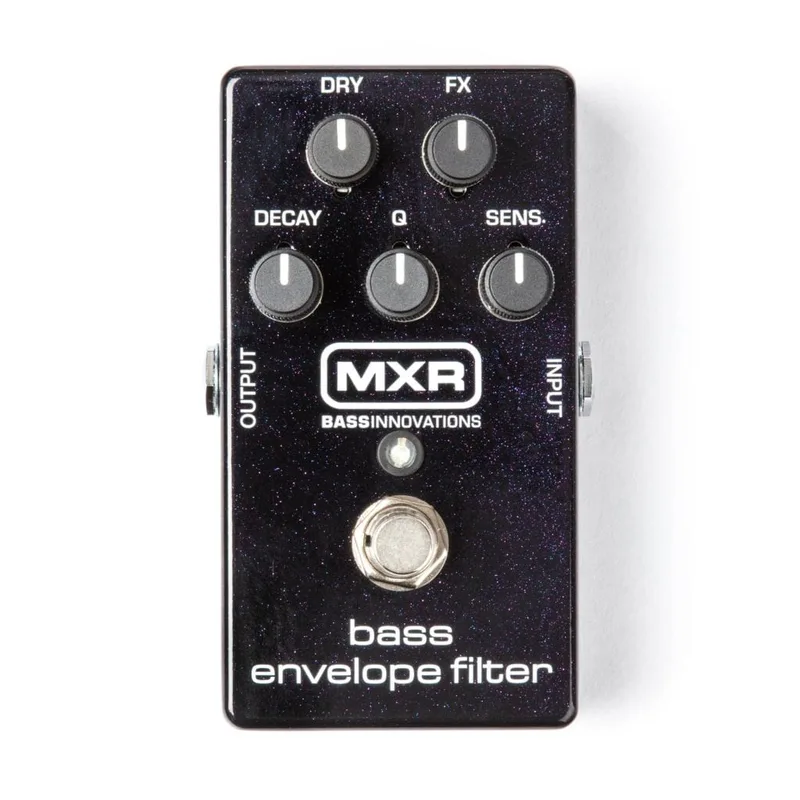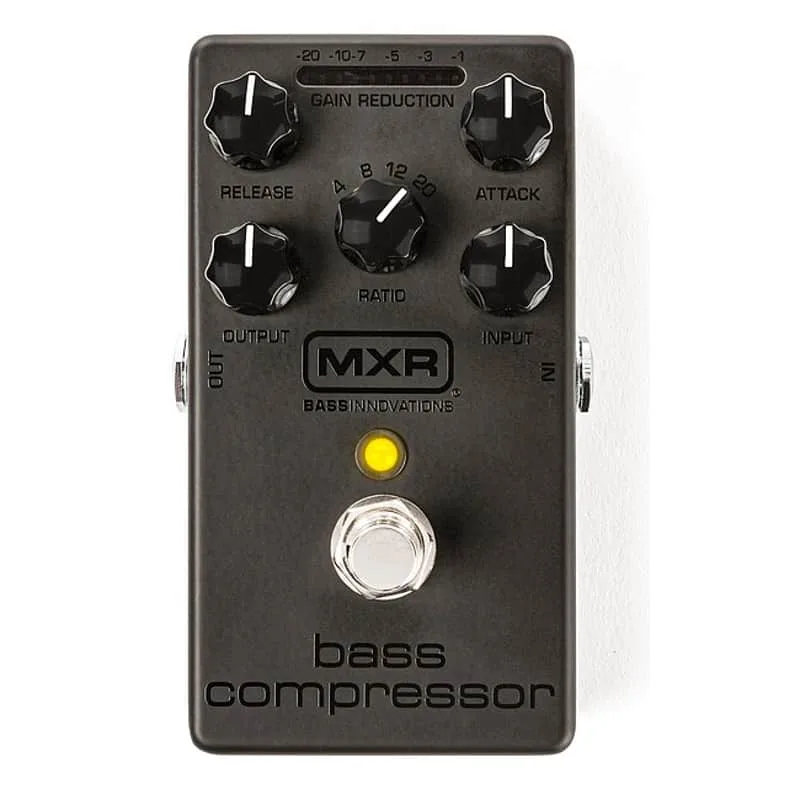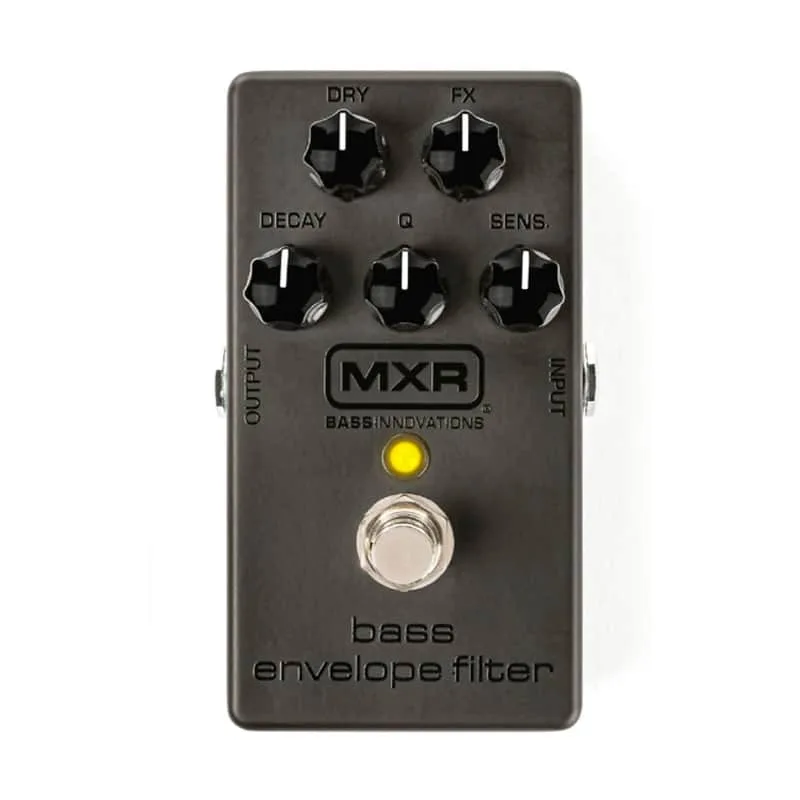

The MXR M82B Bass Envelope Filter is an analog envelope filter pedal for bass, sold as a Blackout Series special edition of the MXR Bass Envelope Filter. MXR describes it as "a special edition version of one of its most popular pedals," produced to "Celebrate 15 years of MXR Bass Innovations with a special edition version of one of its most popular pedals"1. An envelope filter, sometimes called an auto-wah, opens and closes a filter automatically in response to how hard you play, producing the classic analog envelope filter tones MXR names for the pedal1.
Visually, the Blackout treatment is the giveaway: MXR says the pedal "features a stealthy matte black housing with gloss black text and a bright yellow LED"1.
Controls and filter range
The pedal's front panel is simple: one footswitch and one knob. The footswitch toggles the effect on and off, with the yellow LED indicating when it is on. The DECAY knob sets the envelope filter's decay stop frequency, which shapes how far the filter sweeps back down as each note fades1.
MXR's manual gives these specifications for the filter itself1:
| Specification | Value |
|---|---|
| Center frequency range (fc) | 76 Hz to 3.2 kHz |
| Filter sweep (fc) | 76 Hz to 3.2 kHz |
| Decay stop frequency | 76 Hz to 1.3 kHz |
| Sensitivity range | 46 dB |
| Maximum input level | +7.4 dBV |
| Maximum output level | +8 dBV |
| Noise floor | -94 dBV (A-weighted, all controls at mid position) |
| Dry range | -∞ to +6 dB |
| FX range | -∞ to 0 dB (relative to filter gain) |
The filter's gain at its center frequency depends on the Q setting and where the filter sits. At fc = 76 Hz, gain is +8 dB at minimum Q and +18 dB at maximum Q. At fc = 3.2 kHz, it is +8 dB at minimum Q and +26 dB at maximum Q1. MXR also lists a maximum sensitivity figure at 500 Hz: fc = 3.2 kHz at -23 dBV, and fc = 100 kHz at -39 dBV1.
Power and connections
The M82B runs on 9 volts DC and draws 6 mA1. It can be powered by one 9-volt battery, and MXR notes you "remove bottom plate to install" it1. For adapter power, MXR specifies "a 9-volt AC adapter such as the Dunlop ECB003/ECB003EU, or an MXR Brick Series power supply"1.
The M82B is a special edition variant. MXR's own page for the standard version of the pedal is the MXR Bass Envelope Filter, and the Blackout Series treatment also extends to other bass pedals such as the MXR M87B Blackout Series Bass Compressor.
Where it sits in MXR's bass line
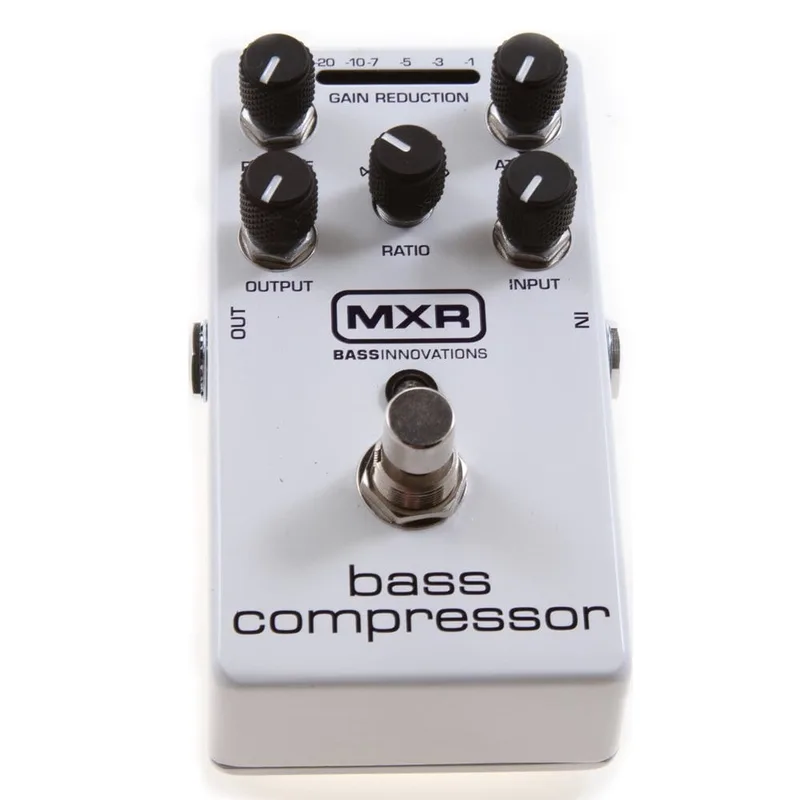
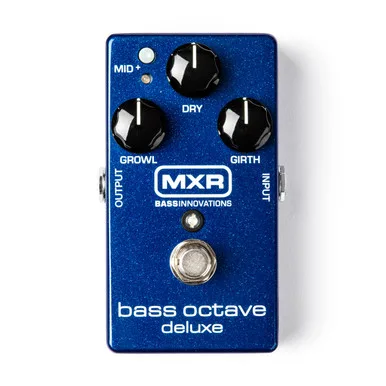
The M82B belongs to MXR's bass range, which spans filter, dynamics, drive and pitch effects. If you are browsing the wider category, see Bass Pedals or the site's Filter Pedals page. Related MXR bass pedals include the MXR Bass Compressor, the MXR Bass Octave Deluxe, the MXR M85 Bass Distortion and the MXR Bass Synth1.
Videos
Gadget Matrix Lab
Questions
Is the MXR M82B true bypass?
Yes. According to MXR's manual, the M82B Bass Envelope Filter uses true bypass, so when the effect is off the pedal switches out of the signal path entirely. A single footswitch toggles the effect on and off, and a bright yellow LED shows when the filter is engaged.
Does the MXR M82B take a battery?
Yes. MXR's manual says the pedal is powered by one 9-volt battery, and you remove the bottom plate to install it. The pedal can also run from a 9-volt DC adapter such as the Dunlop ECB003/ECB003EU or an MXR Brick Series power supply, drawing 6 mA.
How is the M82B different from the standard MXR Bass Envelope Filter?
The M82B is a Blackout Series special edition of the standard MXR Bass Envelope Filter, made to mark 15 years of MXR Bass Innovations. MXR describes it as a special edition version of one of its most popular pedals, with a matte black housing, gloss black text, and a bright yellow LED.
What is the frequency range of the MXR M82B filter?
MXR's manual gives the M82B a center frequency range and filter sweep of 76 Hz to 3.2 kHz, with a decay stop frequency range of 76 Hz to 1.3 kHz. That covers the low fundamentals of a bass up through the upper mids where filter sweeps become pronounced.
What color is the LED on the M82B?
The M82B has a bright yellow LED that indicates when the effect is on. It sits on a stealthy matte black housing with gloss black text, which is the visual signature of the Blackout Series edition.
Sources (1)
- M82B.pdf, Jim Dunlop (jimdunlop.com), 2023