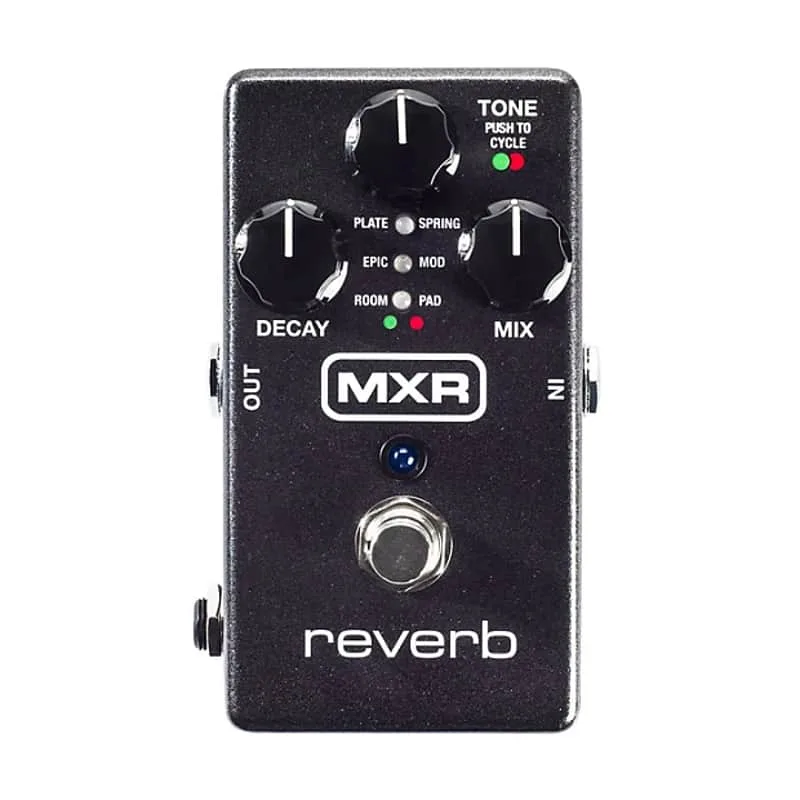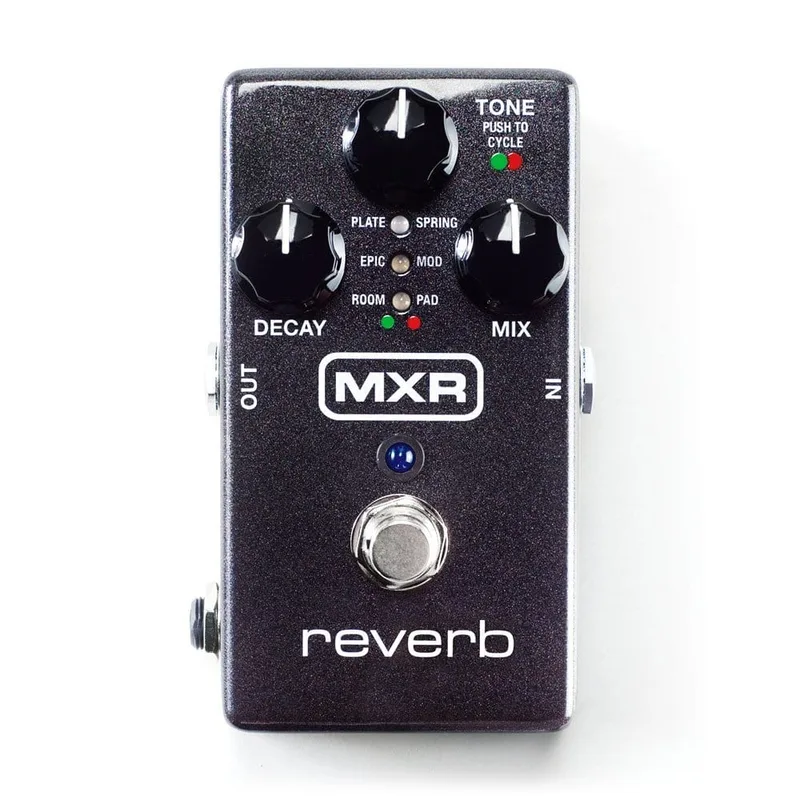
The MXR Reverb is a digital reverb pedal from MXR, the Dunlop-owned brand best known for its compact single-effect boxes. It packs six reverb styles into a standard-sized MXR enclosure with a three-knob setup, and it was first shown to the public at Winter NAMM in January 20161. The pedal carries the model number M300 and lists at $235.99 USD2.
What makes it unusual for its size is the range of sounds. Alongside familiar plate and spring emulations it offers modulated reverbs and a shimmer-style pad, plus stereo input and output, a 100% wet mode, and a choice of true relay or trails bypass3. The dry signal stays analog, with 20 volts of headroom through what MXR calls Constant Headroom Technology3.
Six reverb styles from plate to pad
The six styles are selected by pushing the Tone knob, which steps through the voices one at a time3. Premier Guitar's reviewer called this knob "the key to the wider universe within the MXR Reverb," noting that it "doubles as a push-button voice selector"4.
| Style | What it does |
|---|---|
| Plate | A shimmering, smooth wash of space, a go-to choice from the studio recording world3 |
| Spring | Spring reverb emulation4 |
| Epic | Combines the reflections of multiple modulated reverbs4 |
| Mod | Adds a dose of pitch and phase modulation to the plate reverb sound4 |
| Room | Room reverb3 |
| Pad | Adds octave-up and/or octave-down content in the fashion of a shimmer reverb4 |
The three voices beyond the basics are where the pedal reaches past a conventional studio-style reverb. Epic layers several modulated reverb reflections, Mod puts pitch and phase modulation on top of the plate sound, and Pad brings in octave content above and/or below your playing, the approach shimmer reverbs use4.
Controls and expression
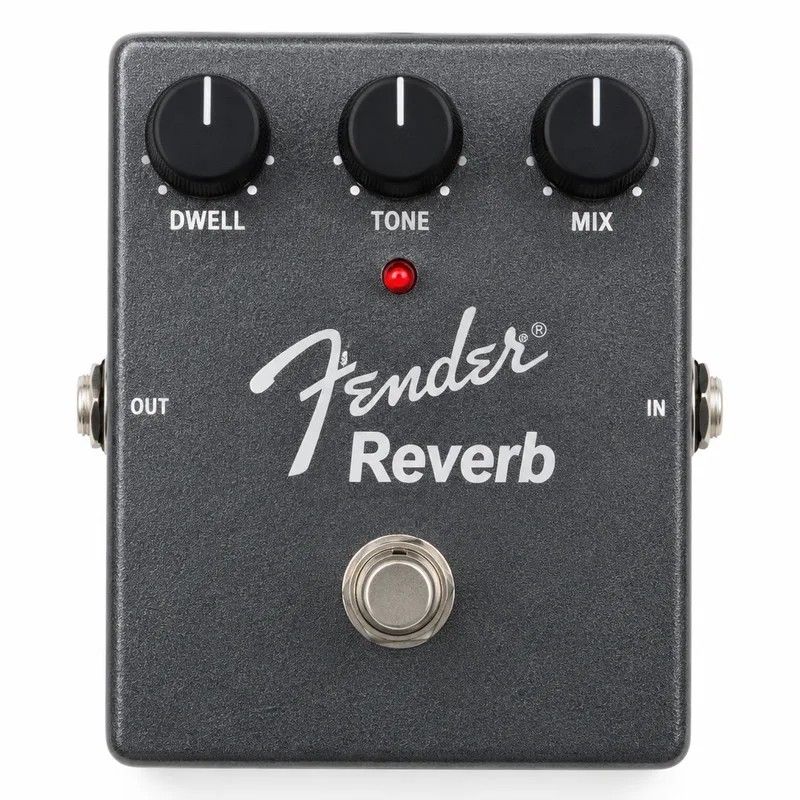
The knob set is deliberately conventional: decay, tone, and mix, which Premier Guitar described as "essentially the same controls you see on a vintage Fender Reverb"4. That familiarity is part of the design. A player who has used an amp's built-in reverb already knows what these three knobs do, and the extra depth sits behind the push-function of the Tone knob rather than in additional controls.
For players who want more flexibility, the expression jack accepts a Dunlop DVP series volume/expression pedal. Connected this way, it toggles and blends between two different knob setting configurations, so you can set two versions of a sound and sweep between them with your foot3.
Power and bypass
The pedal runs on the included Dunlop ECB003 9-volt adapter, and can also be powered by Dunlop's Iso-Brick and Mini Iso-Brick power supplies, which are sold separately3. No battery option is listed.
The bypass is selectable in effect: true relay bypass disconnects the circuit entirely when the pedal is off, while trails bypass lets the reverb tail continue decaying after you switch out3. The 100% wet mode removes the dry signal entirely, useful in parallel loops or for fully wet ambient washes3.
The 100% wet mode and stereo operation matter most in rigs built for them. In a standard mono amp setup the pedal works like any other reverb, but the wet-only mode is intended for parallel routing where the dry sound comes from elsewhere in the chain.
What reviewers said
Premier Guitar reviewed the pedal and found it straightforward to use, with strong emulations and interesting modulation textures. Their verdict on the pedal's strengths4:
"Pros: Simple and easy to navigate. Very nice plate and spring emulations. Cool modulation textures4."
Premier Guitar reviewer4
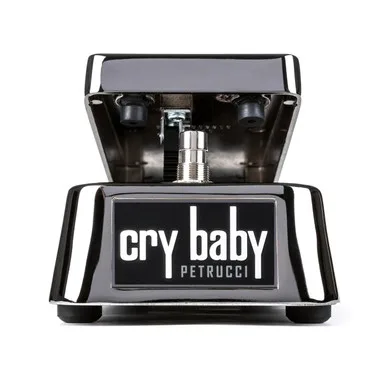
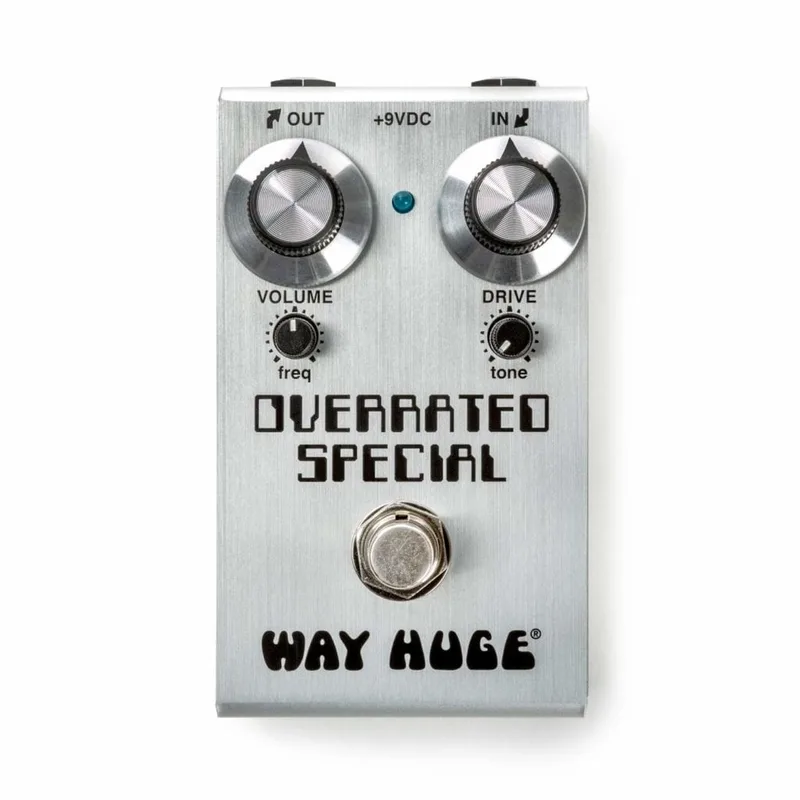
The same review noted that the pedal "betrays its digital origins very rarely," a comment on how the processing stays out of the way of the sound4. The pedal was demoed by Premier Guitar at the Dunlop booth at NAMM 2016, where it appeared alongside the Mini Volume Pedal, the John Petrucci Signature Cry Baby Wah and the Way Huge Overrated Special Overdrive1.
Where it came from
MXR introduced the M300 Reverb at Winter NAMM in January 201612. Dunlop's own site published a history-of-reverb feature built around the pedal in February 2017, tying its six voices to the lineage of studio plate reverbs, spring tanks and the ambient styles that followed5. The pedal remains in the MXR lineup, listed at $235.99 USD2.
Questions
Is the MXR M300 Reverb stereo?
Yes. The pedal has stereo input and output capability, so it can sit in a stereo rig or run into two amps. It also includes a 100% wet mode for use in parallel effects loops or for fully wet ambient sounds.
Does the MXR Reverb have trails bypass?
Yes. The pedal offers true relay or trails bypass, so you can choose whether the reverb tail cuts off instantly when you switch the pedal off, or whether it rings out and decays naturally.
What expression pedal works with the MXR M300?
MXR specifies a Dunlop DVP series volume or expression pedal connected to the expression jack. It lets you toggle and blend between two different knob setting configurations, effectively giving you two saved presets you can sweep between.
Is the MXR Reverb analog or digital?
It is a digital reverb. Premier Guitar's reviewer noted that it betrays its digital origins very rarely. However, the dry signal path is analog, with 20 volts of headroom via MXR's Constant Headroom Technology.
What power supply does the MXR M300 need?
It runs on the included Dunlop ECB003 9-volt adapter. It can also be powered by Dunlop's Iso-Brick and Mini Iso-Brick power supplies, which are sold separately. No battery option is listed.
Sources (5)
- NAMM 2016: Dunlop MXR, Mini Pedal & Signature Demos, Premier Guitar, 2016-01-27
- MXR® TREMOLO, Jim Dunlop (jimdunlop.com)
- MXR® REVERB, Dunlop (jimdunlop.com)
- MXR Reverb Review, Premier Guitar, 2016-09-30
- A History of Reverb and Then Some, Dunlop (lifestyle.jimdunlop.com), 2017-03-01