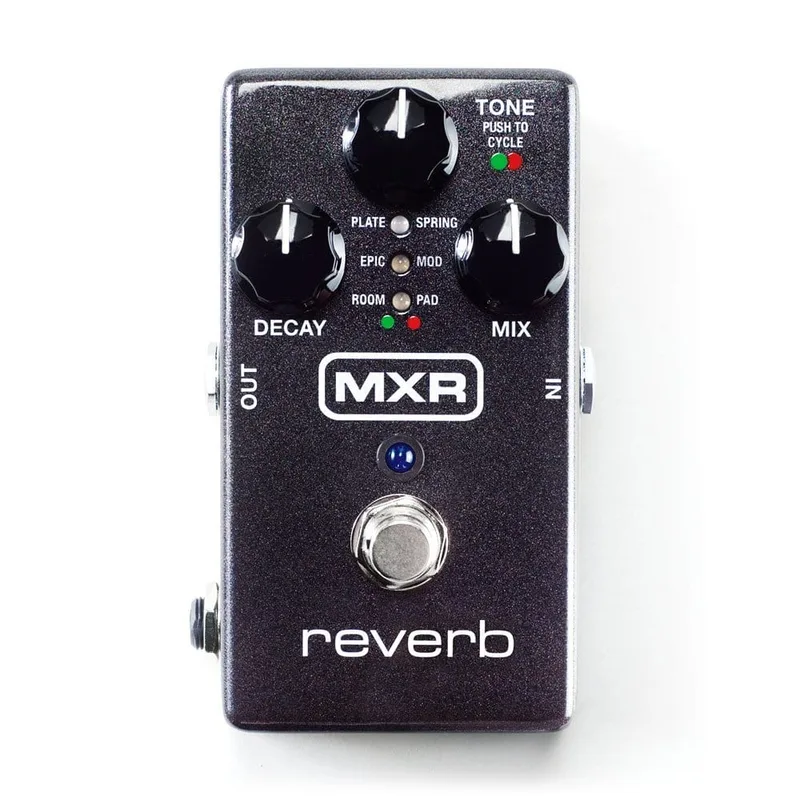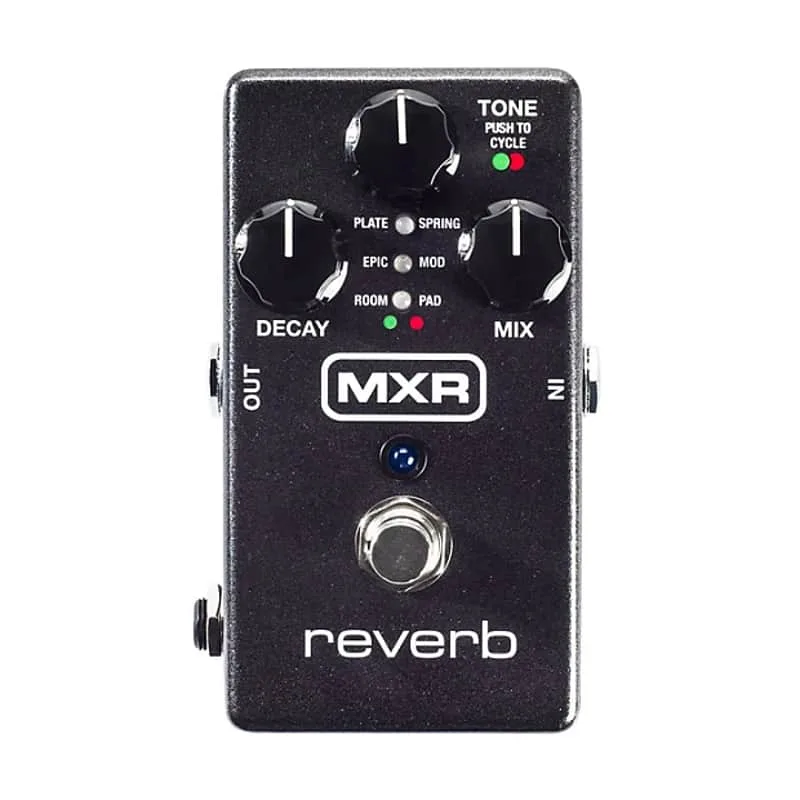


The MXR M300 Reverb is a compact reverb pedal from MXR, built by Dunlop Manufacturing, that packs six reverb types into the classic small MXR box: Plate, Spring, Room, Mod, Epic and Pad12. It runs at a 96 kHz sample rate while keeping your dry signal path 100% analog, so your original guitar tone passes through untouched and only the reverb itself is digital34.
The appeal for most players is the combination of size and range. Gearnews called the form factor "a huge bonus for those players that like to either have a small board or cram lots of pedals onto a larger board," and the pedal still manages stereo output, an expression pedal input, trails bypass and a 100% wet mode41.
The controls: Decay, Tone and Mix
The M300 keeps everything on three knobs, which Pedal of the Day summed up as "Decay, Tone and Mix are all you need to worry about"4. Gearnews praised the "simple three-control layout, making it easy to tweak on the fly"1.
| Control | What it does |
|---|---|
| Decay | Sets the length of the reverb decay. Clockwise increases it, counterclockwise decreases it3 |
| Tone | Shapes the EQ of the effect, or the octave blend in Pad mode. Push the knob in to cycle through the six reverb styles3 |
| Mix | Sets the reverb signal level. Fully clockwise gives an equal 50/50 mix of reverb and dry signals3 |
The reverb types are accessed by pressing the Tone knob rather than by a dedicated switch, and each mode is alternately illuminated by either a red or green LED so you can see which one is active24. MusicRadar flagged one practical drawback: the push-knob type selection "could cause problems with a misplaced foot on a dark stage"2.
The six reverb types
Four of the voices are the familiar ones, and two are less common2:
- Plate: classic studio plate emulation
- Spring: spring reverb emulation
- Room: room ambience
- Mod: a modulated studio plate reverb, indicated by a red LED3
- Epic: MusicRadar describes it as sounding "like a multi-tap delay with added reverb"2
- Pad: adds an octave up and a sub-octave below the original signal1
The Pad mode is the unusual one. Gearnews explains that it "adds an octave up and a sub-octave below the original signal," and MusicRadar compares it to "octave-up shimmer on other pedals"12. In this mode the Tone knob stops being an EQ control and becomes the octave blend instead3.
Stereo, trails and hidden modes
Several of the M300's features live beneath the surface rather than on the knobs. The pedal includes a 100% wet mode, stereo I/O, and both a true relay bypass mode and a trails bypass mode8. The trails mode lets the effect ring out after the pedal is switched off, and the 100% wet mode sends only the wet signal from the pedal to your amp4.
To reach these settings you put the pedal in startup mode: disconnect the power supply, set the decay and mix controls to noon, then push and hold the Tone knob while reconnecting the power source7.
Stereo works, but reviewers found it clumsy. Output is a single TRS stereo jack, and the mono/stereo switch is a tiny switch accessible only on the PCB inside the pedal2. Pedal of the Day notes you can run it in stereo via a TRS splitter cable4. MusicRadar listed the "awkward stereo setup" among its criticisms2.
The expression input is more straightforward. Connect a Dunlop DVP series volume/expression pedal and you can toggle and blend between two different knob setting configurations, manipulating the effect in real time81. MusicRadar called it "a nice feature, allowing you to blend between reverb settings"2.
The M300 cannot run on a battery and draws 240 mA at 9V DC, well above what a typical analog pedal needs36. Plan on a dedicated outlet on a powered pedalboard.
History: from Winter NAMM to release
The M300 Reverb first caught attention at Winter NAMM in January 2016, where Guitar.com's sister publication G&B highlighted it as one of the show's standouts5. Gearnews reported the full announcement that March: six reverb types at an RRP of $199.991. By July 2016 Guitar.com had published a video demo of the new pedal, and its full review followed in Guitarist Vol 28 No 0157. At launch it was priced at £187 in the UK7, and MusicRadar's later buying guide lists the launch price as $1996.
What reviewers said
MusicRadar's review was positive on the core question of sound: "the M300 sounds great and delivers a lot of tones from a small footprint," with sound quality that "puts it firmly among the top shelf of reverb pedals," thanks in part to what the reviewer called a studio-grade 96 kHz sample rate2. The settings themselves were praised as "very usable" and offering "authentic replications of their designated sizes"2.
Guitar.com's verdict, from editor Chris Vinnicombe, was more measured on value but equally positive on tone5:
"It's not the cheapest, nor does it have the most voices in a small stompbox format, but the M300 nails it sonically where it counts5."
Guitar.com's reviewer found that "the M300 sounds great and delivers a lot of tones from a small footprint," and that "the sound quality puts it firmly among the top shelf of reverb pedals," with "all the settings are very usable and offer authentic replications of their designated sizes"52. The same review flagged practical drawbacks: an "awkward stereo setup," and the tone knob's use for reverb type selection, "a feature that could cause problems with a misplaced foot on a dark stage"2.
The pedal placed in Guitar.com's 2016 effects coverage, where the writers noted it was "a good £300 cheaper than some of those high-spec digital reverb machines"5. Pedal of the Day highlighted the analog dry path, kept "analog and pure, too, thanks to the patented Constant Headroom Technology"4.
The criticisms were consistent across reviews: the awkward stereo setup, and the push-knob type selection being easy to hit by accident on a dark stage2.
Specifications
| Specification | Value |
|---|---|
| Input impedance | 1 MΩ3 |
| Output impedance | 100 Ω3 |
| Max input | +5 dBV3 |
| Max output level | +5 dBV3 |
| Sampling rate | 96 kHz3 |
| Current draw | 240 mA3 |
| Noise floor | -107 dBV3 |
| Power | 9V DC, no battery36 |
Videos
ProGuitarShopDemos
Premier Guitar
Reverb
Sources (8)
- MXR M300 Reverb pedal. Six reverbs in a small package., gearnews.com, 2016-03-31
- MXR Reverb M300 review, MusicRadar, 2016-09-13
- M300.pdf, Dunlop Manufacturing, Inc., 2019
- MXR M300 Reverb, Pedal of the Day, 2017-02-06
- Gear Of The Year 2016, Guitar.com, 2016-01
- Best reverb pedals: Top picks from subtle to extreme, MusicRadar, 2022-04-29
- MXR M300 Reverb Review, Guitar.com, 2016-10-05
- 2024 UPDATE: Best Multi Reverb Pedals, Delicious Audio, 2024-10-25