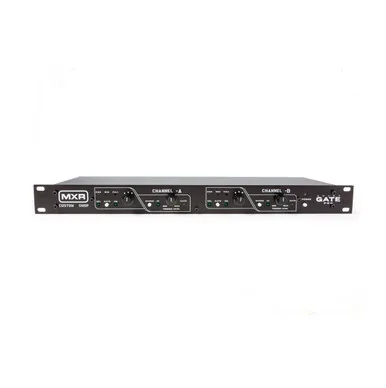


The MXR Smart Gate Pro is a two-channel noise reduction pedal from the MXR Custom Shop. Where a standard noise gate pedal listens to one signal and mutes it when you stop playing, the Smart Gate Pro gives you two discrete channels that can be linked to quiet a stereo signal, each with its own threshold and noise-reduction settings1. MXR's manual describes it as "Precise, intelligent noise reduction," and it is designed to sit in an amplifier's effects loop rather than in front of the amp1.
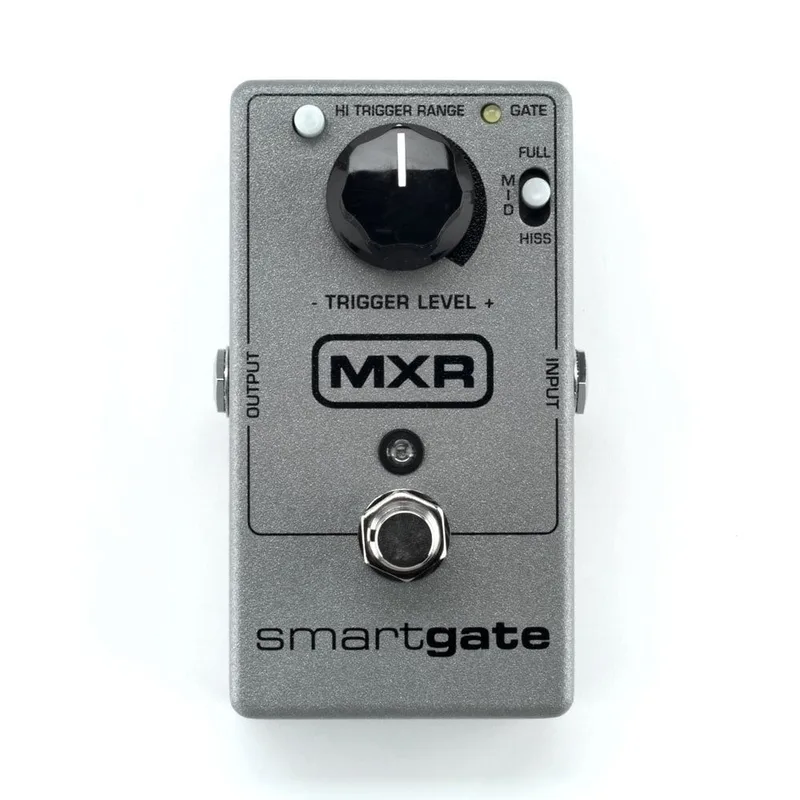
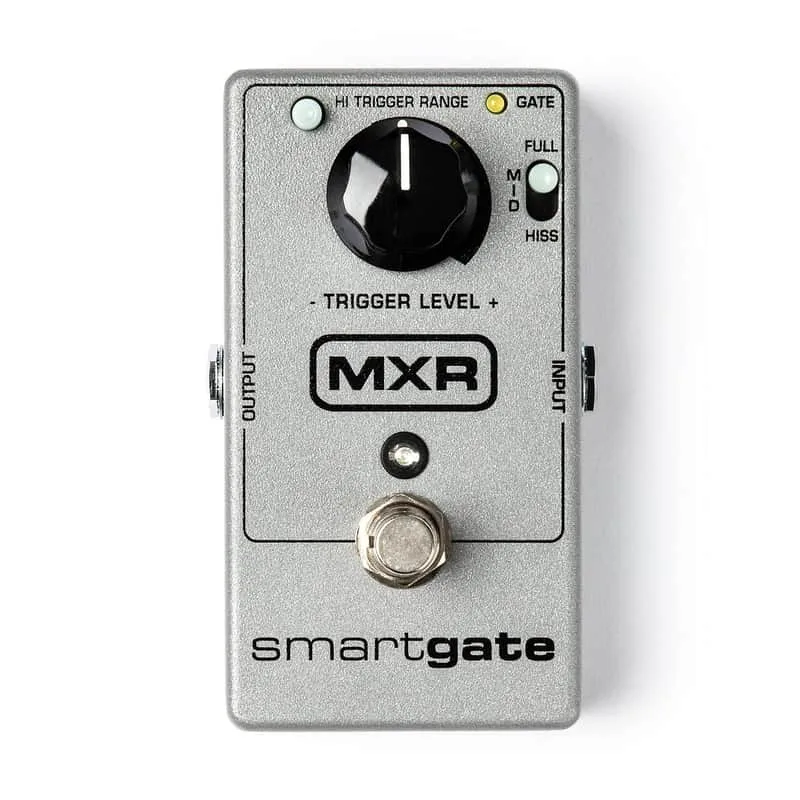
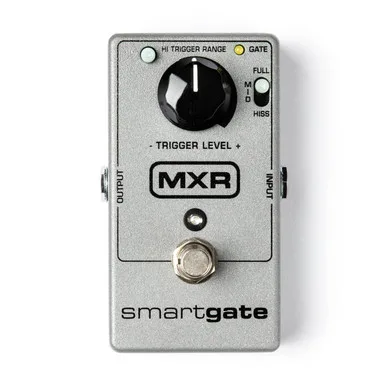
The Pro is the bigger sibling of the MXR Smart Gate (M135), a single-channel pedal that Guitar World named its pick for beginners in its April 2026 noise gate buyer's guide, calling it "simple to use and reasonably priced"23. The Pro keeps the Smart Gate's three-range approach to noise reduction but doubles the channels and adds remote switching1.
A two-channel noise gate for the effects loop
The Smart Gate Pro's job is to sit between your amplifier's effect send and effect return and cut the noise your gain pedals and preamp produce. The manual's setup is a numbered process1:
- Run a cable from the amp's effect send jack to the input jack of Channel A on the Smart Gate Pro1.
- Run another cable from the Smart Gate Pro's output jack to your amplifier's effect return jack1.
With two channels, the Pro can gate a stereo rig, or the channels can run independently, each set for a different level of noise. The Sync switch links channels A and B when you want both sides working as one gate1. This is the main structural difference from the single-channel Smart Gate, whose manual recommends placing it last in the signal chain, just before the amplifier, to quiet a rack of noisy effects4.
The controls for each channel
Each channel carries its own set of controls, so the two sides can be tuned independently1.
| Control | What it does |
|---|---|
| Trigger Level | Allows gate threshold level adjustments for each channel1 |
| Hiss, Mid Range, or Full | Three-position knobs that select the type of noise reduction for each channel1 |
| Range | Selects trigger level sensitivity to accommodate small (switch out) or large (switch in) noise levels for each channel1 |
| Gate LEDs | Show the level of noise reduction for each channel1 |
| Sync | Links channels A and B1 |
The Gate LEDs give you a visual check of how hard each channel is working, which is useful when setting thresholds by ear in a loud room1.
What the Hiss, Mid Range and Full settings do
The three-position knobs choose which band of noise the gate targets. MXR's manual for the smaller Smart Gate explains the ranges in practical terms: the Hiss setting and the Mid setting are both effective on instruments with high gain midrange boosting, such as distorted electric guitars and amplified harmonicas, while the Full setting is most effective on input sources with low-end hum and buzz problems, such as AC line noise, display noise, or light dimmer noise4.
Reviewers of the Smart Gate found the same three ranges cover most situations. Guitar Player's buying guide wrote that "the three settings of 'full', 'mid', and 'hiss' will generally cover all uses," and described the character of the extremes5:
"Full mode offers a really dynamic, quick gate that snaps close and produces a tight sound that is ideal for chugging"
The same guide noted Hiss mode removes any trace of nasty noise5. Guitar World's review of the Smart Gate made the same point about coverage, saying it "is equipped with three selectable types of noise reduction to handle virtually any type of signal"6.
Power: 9V DC adapter
The MXR Smart Gate Pro Rack Unit runs on the included Dunlop ECB003 9-volt adapter7. The MXR Smart Gate Pro is powered by the Dunlop ECB-004 adapter, an 18-volt DC regulated AC adapter1. The MXR Smart Gate and the M135 Smart Gate both run on a 9V DC power supply drawing 15mA4, and the Smart Gate pedal can also be powered by a 9-volt battery or a Dunlop ECB003 9-volt adapter, along with the DC Brick, Iso-Brick, and Mini Iso-Brick power supplies (not included)3.
The Smart Gate Pro cannot run on a battery. The manual states plainly: "An AC adapter must be used to operate the Smart Gate Pro." It also cannot share a standard 9-volt daisy chain, since it needs 18 volts with the opposite polarity of most pedals.
The Smart Gate Pro is powered by the Dunlop ECB-004 adapter, an 18-volt DC regulated AC adapter1. The plug polarity is positive on the barrel and negative on the center, the reverse of the center-negative convention most 9-volt pedals use1. By comparison, the Smart Gate M135 runs on 9 volts DC at 15 mA and can be powered by one 9-volt battery, a Dunlop ECB003 adapter, or Dunlop's DC Brick, Iso-Brick and Mini Iso-Brick power supplies43.
Connections and bypass
Each channel has true hardwire-bypass outputs, so the signal passes without the circuit when the channel is bypassed1. The Pro also has remote switching capabilities, so it can be engaged from elsewhere in a rig rather than only at the unit itself1.
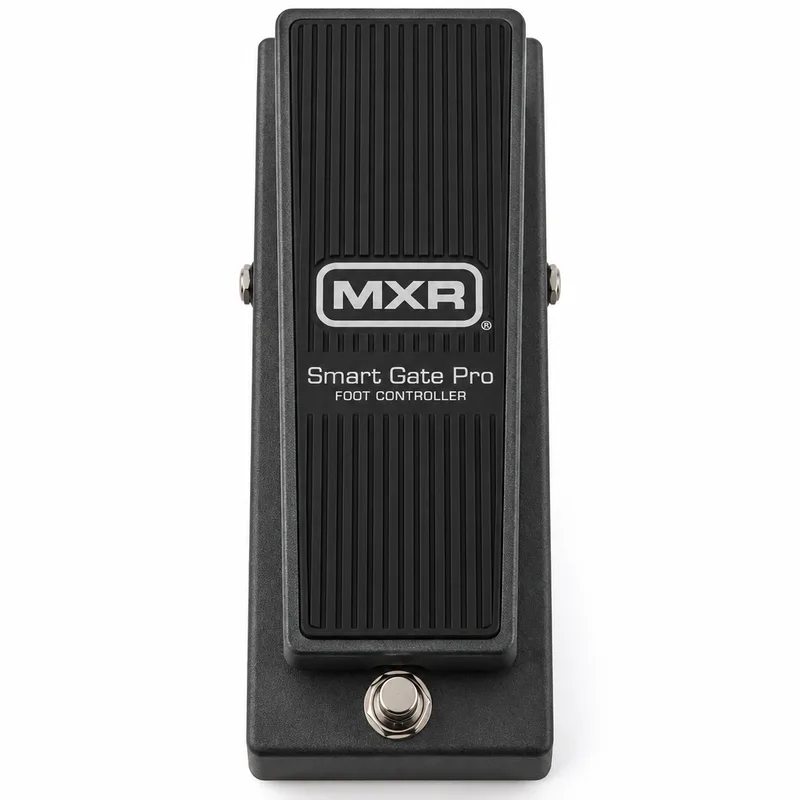
MXR builds two companion pieces around the Pro. The Smart Gate Pro Rack Unit (M235) is described by MXR as "the big brother to the Smart Gate pedal," a noise gate rack unit with the same three selectable ranges (Hiss, Mid, and Full), true hardwire-bypass on each channel, a selectable ground lift, and power from an included Dunlop ECB003 9-volt adapter7. The Smart Gate Pro Foot Controller handles the remote switching from the floor; it can be powered by a 9-volt battery, a Dunlop ECB003 9-volt adapter, or the DC Brick, Iso-Brick, and Mini Iso-Brick power supplies543.
How it differs from the Smart Gate
The Smart Gate (M135) is the single-channel original. Its control set is one Trigger Level knob, a mode selection between Full, Mid and Hiss, and a Hi Trigger switch that extends the trigger range for extremely noisy situations43. It runs on a 9-volt battery or adapter at 15 mA and uses a hardwire bypass43. Guitar World's 2026 buyer's guide positions it as "the smart option for beginners," effectively a single control once the mode is chosen2.
The Pro adds the second channel with independent controls, the Sync link, remote switching, and true hardwire-bypass outputs per channel, at the cost of an 18-volt-only power requirement1. For a player with a stereo rig or a noisy effects loop that needs two gates set differently, the Pro's two channels are the point; for a simple single-chain board, the Smart Gate covers the same three noise ranges in a smaller, battery-capable box165.
Videos
Guitar World
tunnelvisionmusic
Chris Flash
Questions
Does the MXR Smart Gate Pro run on a battery?
No. The manual states that an AC adapter must be used to operate the Smart Gate Pro. It runs on the Dunlop ECB-004, an 18-volt DC regulated adapter, with positive on the barrel and negative on the center, so it cannot share a standard 9-volt pedalboard supply or daisy chain.
Where does the MXR Smart Gate Pro go in the signal chain?
MXR's manual puts it in your amplifier's effects loop: run a cable from the amp's effect send jack to the input jack of Channel A, then another cable from the Smart Gate Pro's output jack to the amplifier's effect return jack. This lets it gate noise from everything upstream of the loop.
What do the Hiss, Mid Range and Full settings do?
They are three-position knobs that select the type of noise reduction for each channel. On the smaller Smart Gate, the manual says Hiss and Mid suit high-gain midrange sources like distorted electric guitars, while Full works best on low-end hum and buzz such as AC line noise, display noise or light dimmer noise.
What does the Sync switch do on the Smart Gate Pro?
Sync links channels A and B. The Smart Gate Pro has two discrete channels that can be linked to quiet a stereo signal, and Sync is the switch that ties them together so both sides open and close as one.
What is the difference between the Smart Gate Pro and the Smart Gate?
The Smart Gate (M135) is a single-channel pedal with one Trigger Level knob, a mode switch and a Hi Trigger switch, running on a 9-volt battery or 9-volt adapter at 15 mA. The Smart Gate Pro adds a second channel with its own controls, a Sync switch, remote switching and true hardwire-bypass outputs on each channel, and it needs an 18-volt adapter.
Can the Smart Gate Pro be switched remotely?
Yes. The manual lists remote switching capabilities among the Smart Gate Pro's features. MXR also makes a Smart Gate Pro Foot Controller, a pedal that runs on a 9-volt battery or a Dunlop ECB003 9-volt adapter.
Sources (7)
- M235, Dunlop Manufacturing, Inc., 2019
- Best noise gate pedals 2026: clean up your signal, Guitar World, 2021-03-19
- MXR® SMART GATE® NOISE GATE, Jim Dunlop (jimdunlop.com)
- M135.pdf, Dunlop Manufacturing, Inc., 2019
- Best noise gate pedals: control your tone, GuitarPlayer (www.guitarplayer.com), 2024-09-24
- Guitar World Recommends: MXR Smart Gate Noise Gate Pedal, Guitar World, 2015-07-17
- MXR® SMART GATE® PRO RACK UNIT, Jim Dunlop (jimdunlop.com)