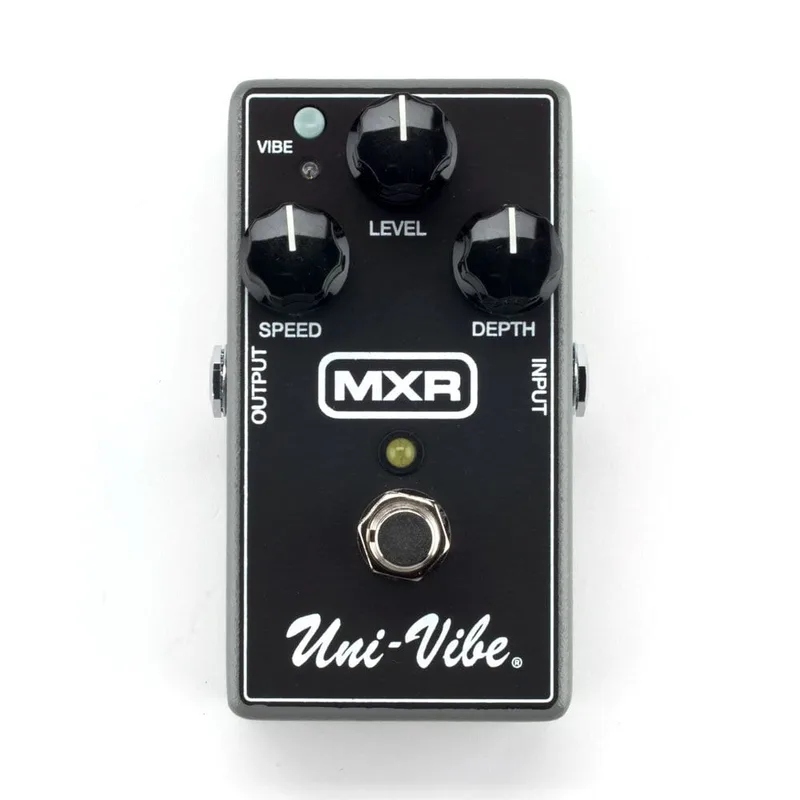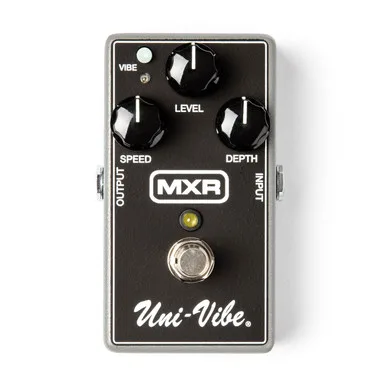


The MXR Uni-Vibe Chorus/Vibrato, model M68, is a compact chorus/vibrato stompbox that puts the classic Uni-Vibe swirl of the late 1960s into a standard MXR housing, a fraction of the size and weight of the original floor unit. Dunlop says it "delivers the same lush, chewy textures that players have used since the late '60s," updated with modern gigging players in mind, with a simple three-knob interface and a switch that toggles between chorus and vibrato123.
It is a pitch-modulated effect: the dry signal is mixed with a pitch-shifted signal in chorus mode, or you hear only the pitch-shifted signal in vibrato mode. Delicious Audio calls it "a bread-and-butter but great-sounding 3-knob stompbox with chorus/vibrato switch in a compact case"4.
Chorus and vibrato in one standard MXR box
The M68 gives you both halves of the Uni-Vibe sound in one pedal. The Vibe switch selects Chorus Mode, where the dry signal is mixed with the pitch-shifted signal, or Vibrato Mode, where you hear only the pitch-shifted signal14. The manual describes the default chorus mode as rich and lush6.
MusicRadar's Alex Lynham explains the difference in practice: in chorus mode the pedal blends the dry signal from the preamp with the wet signal to create its distinctive phased sound, while vibrato mode outputs only the wet signal, which is thinner and quieter, with a more pronounced pitch warble7. Guitar World's review notes the mode selector is "a mini push switch that lets users select chorus or vibe effects, just like the original unit"8.
Pedal of the Day pointed out how far the sounds reach: "In regular (Chorus) mode, you can easily dial up sounds from The Police, Nirvana and Rush"9.
The controls: Speed, Level, Depth and the Vibe switch
The three knobs follow the layout of the original Uni-Vibe, which most Univibe-style pedals share: controls for adjusting the speed and depth of the modulation10. Dunlop's own instructions set the order of operations: use the Vibe switch to pick a mode, then Level for effect volume, Speed for sweep rate, and Depth for overall intensity1.
| Control | What it does |
|---|---|
| SPEED | Sets the sweep rate of the effect, 0.5 Hz to 10.5 Hz6 |
| LEVEL | Sets the overall volume of the effect6 |
| DEPTH | Sets the overall intensity of the effect1 |
| VIBE switch | Toggles between Chorus Mode (default) and Vibrato Mode6 |
The Level knob is worth a note for anyone who has used a vintage-style vibe pedal: Delicious Audio found it "useful in matching the wet sound volume to the dry one," which matters most in vibrato mode, where the wet-only output runs quieter4.
Power: 9V battery or adapter
The M68 runs on 9 volts DC. It can be powered by one 9-volt battery, installed by removing the bottom plate, or by a 9-volt AC adapter such as the Dunlop ECB003/ECB003E, or a DC Brick power supply6. Dunlop's product page also lists the DC Brick, Iso-Brick and Mini Iso-Brick supplies as compatible, though these are not included1.
The battery option means the M68 works on a board without a power supply, but the bottom plate has to come off to swap the battery, so most players will want the adapter for regular gigging.
History: the late-'60s Uni-Vibe behind it
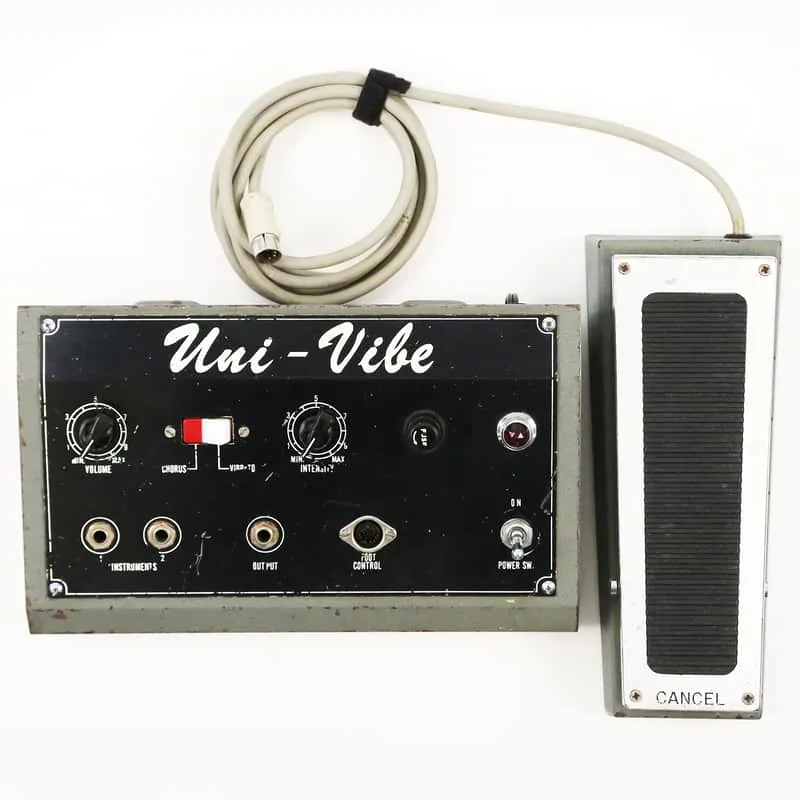
The original Uni-Vibe was introduced in the 1960s by Shin-ei11, made in 1967-6812, and was conceived as a portable Leslie speaker emulator13. Aion FX describes it as "originally designed as a simulation of a Leslie spinning speaker cabinet"14, and Guitar World's review of a later vibe pedal notes the original circuit was "a primitive, early attempt at creating a phase shifter"15. It was most famously used by Jimi Hendrix14, whose use of the effect from 1969 sealed its reputation16.
The original was discontinued after its 1960s debut, but its sound is still much sought after by players3. Dunlop bought the rights to the Uni-Vibe name, and as MusicRadar puts it, "the MXR M68 claims to be a faithful reproduction of the original"7. Dunlop's own history of the MXR brand says the roster now includes the Uni-Vibe Chorus/Vibrato, "recreated with dead-on accuracy"17.
The M68 sits in a longer Uni-Vibe lineage that Dunlop now carries. The original Uni-Vibe was made in 1967-68, introduced by Shin-ei, and was most famously used by Jimi Hendrix from 1969181216. It was conceived in the '60s as a portable Leslie speaker emulator, and the original pedal developed during the late Sixties was a primitive, early attempt at creating a phase shifter1415. Dunlop also sells replacement electronic parts for the M68, intended for qualified technicians19.
What reviewers said
Guitar World reviewed the M68 in September 2014 and was positive on both sound and build, calling it "a rugged, professional-quality pedal" that provides "genuine Uni-Vibe effects with thick, rich swirling textures"8.
"a bread-and-butter but great-sounding 3-knob stompbox with chorus/vibrato switch in a compact case"
The same review noted one omission against the original: the M68 lacks the external foot-controller speed adjustment of the vintage unit, though the reviewer concluded that "most players will probably prefer the cost savings over this rarely used feature"8.
Pedal of the Day's verdict in December 2014 was that "MXR has produced a ton of great pedals over the decades, and the Uni-Vibe® Chorus/Vibrato is right up there with the best"9. Delicious Audio's buying guide lists its compact form factor, intuitive controls and an expression input in its favor, and credits it with a great price/quality ratio, doing a good job without breaking the bank13. The same guide notes the counterpoint from purists, who grumble that it suffers from some of the weaknesses of the original, like a tendency toward thinner sounds with certain settings7.
How it compares
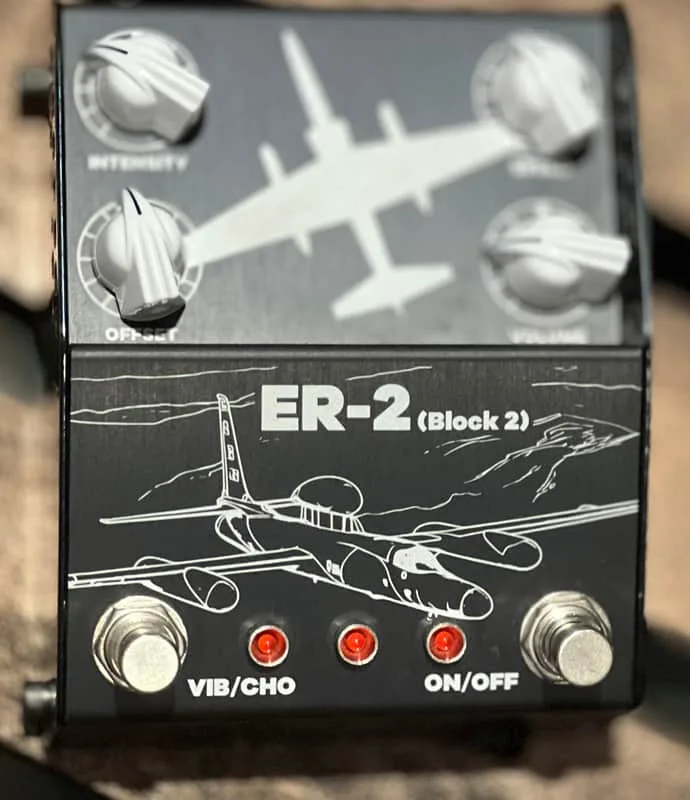
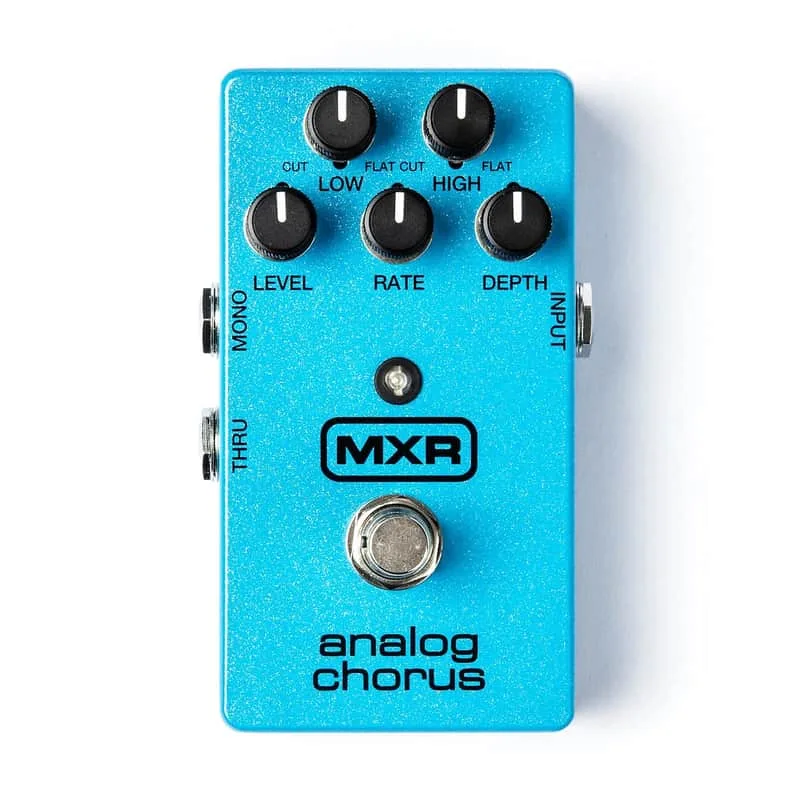
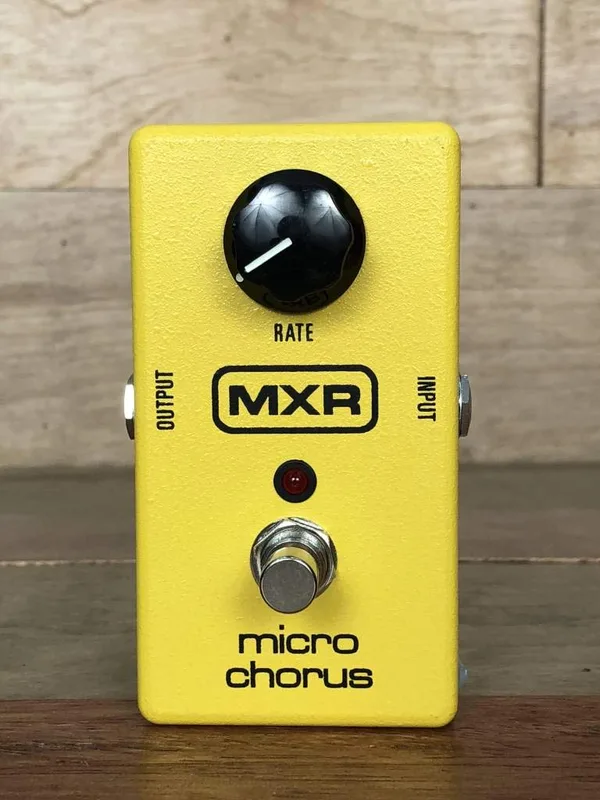
Against other vibe pedals, the M68's pitch is straightforward: the full Uni-Vibe sound in a small, affordable box. Alternatives include the ThorpyFX ER-2 Block 2 Uni-Vibe, which Guitar Pedal X reports sounds identical to the original ER-2 with performance improvements20, and the Shin-ei/Univox Uni-Vibe, the 1960s original itself. Within MXR's own chorus line, players comparing options can also look at the MXR M234 Analog Chorus and the MXR Micro Chorus, though those are conventional chorus pedals rather than Uni-Vibe circuits.
Videos
ProGuitarShopDemos
Sweetwater
Guitar World
Questions
Is the MXR Uni-Vibe true bypass?
Yes. Dunlop's product page and the M68 manual both list true bypass switching, and the manual specifies a True Hardwire bypass. Pedal of the Day noted that with true-bypass switching the malfunction likelihood is next to nothing.
What is the difference between chorus and vibrato mode on the MXR Uni-Vibe?
The Vibe switch selects between two modes. Chorus Mode mixes your dry signal with the pitch-shifted signal for a rich, lush sound. Vibrato Mode outputs only the pitch-shifted signal, which MusicRadar describes as thinner and quieter, with a more pronounced pitch warble.
How fast can the MXR Uni-Vibe M68 sweep?
The Speed control sweeps from 0.5 Hz to 10.5 Hz, according to the Jim Dunlop manual. That range covers slow, swampy swirls through fast rotary-style wobble, and the knob controls the sweep rate of the effect.
Does the MXR Uni-Vibe sound like the original Uni-Vibe?
MusicRadar notes that Dunlop bought the rights to the Uni-Vibe name and that the MXR M68 claims to be a faithful reproduction of the original. Guitar World's reviewer found its expressive and aggressive effects spot on, though purists grumble it shares some of the original's tendency toward thinner sounds at certain settings.
Is the MXR M68 noisy?
The manual lists a noise floor of -94 dBV, A-weighted, with all controls at their mid position, which is quiet for an analog modulation pedal. No reviewer in the sources flagged noise as a problem.
Sources (20)
- MXR® UNI-VIBE® CHORUS/VIBRATO, Dunlop (jimdunlop.com)
- MXR® LAYERS™ PEDAL, Jim Dunlop (jimdunlop.com)
- ThorpyFX ER-2 Uni-Vibe review, Guitar World, 2023-12-13
- MXR Uni-Vibe, Delicious Audio, 2023-05-26
- MXR® FLANGER, Dunlop (www.jimdunlop.com)
- M68.pdf, Jim Dunlop, 2019
- The FX files: Uni-Vibe, MusicRadar, 2019-04-10
- Review: MXR M68 Uni-Vibe Chorus/Vibrato Pedal, Guitar World, 2014-09-26
- Dunlop MXR Uni-Vibe Chorus / Vibrato, Pedal of the Day (pedal-of-the-day.com), 2014-12-20
- The Swirl Start of the Univibe vintage guitar pedal, tru-fi.com
- Retro Corner: Uni-Vibe, Delicious Audio, 2012-11-21
- The Ghost Vibe, tru-fi.com
- The 9 Best Uni-Vibe Pedals In 2024: A Guide To UniVibe Clones, Delicious Audio (delicious-audio.com), 2024-02-16
- Straylight Chorus Vibe / Univox Uni-Vibe®, Aion FX, 2024-07-04
- Review: JHS Pedals Unicorn Uni-Vibe Pedal, Guitar World, 2016-01-18
- J Rockett Uni-Verb review, Guitar World, 2022-11-01
- MXR: A Short History, Dunlop (lifestyle.jimdunlop.com), 2014-03-05
- Dunlop honors Jimi Hendrix's iconic effects with Authentic Hendrix '68 Shrine mini pedals, Guitar World, 2023-02-02
- MXR® UNI-VIBE® CHORUS/VIBRATO, Jim Dunlop (jimdunlop.com)
- Guitar Pedal X, Guitar Pedal X, 2024-11-15