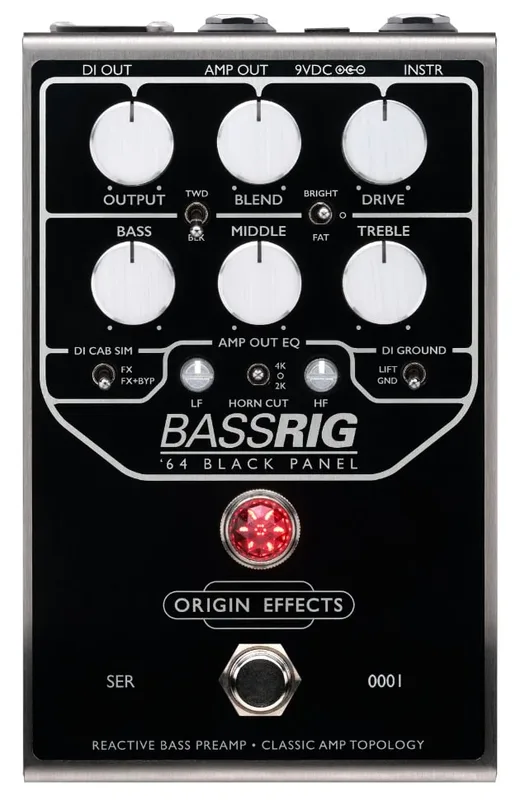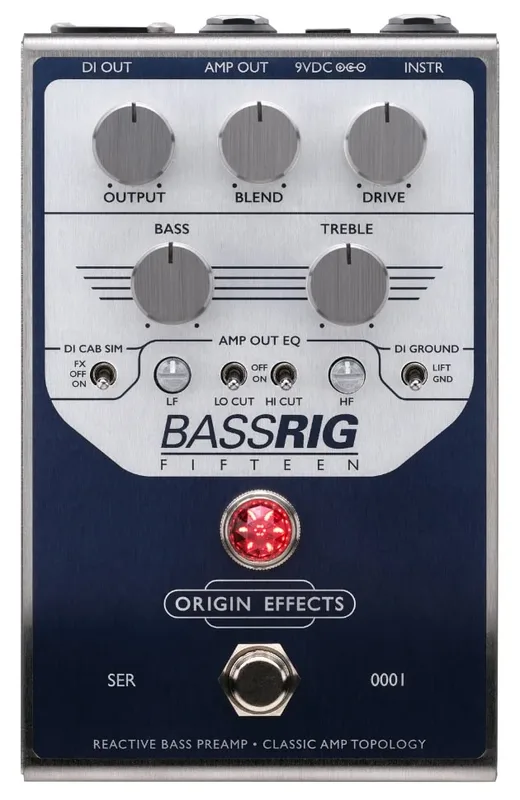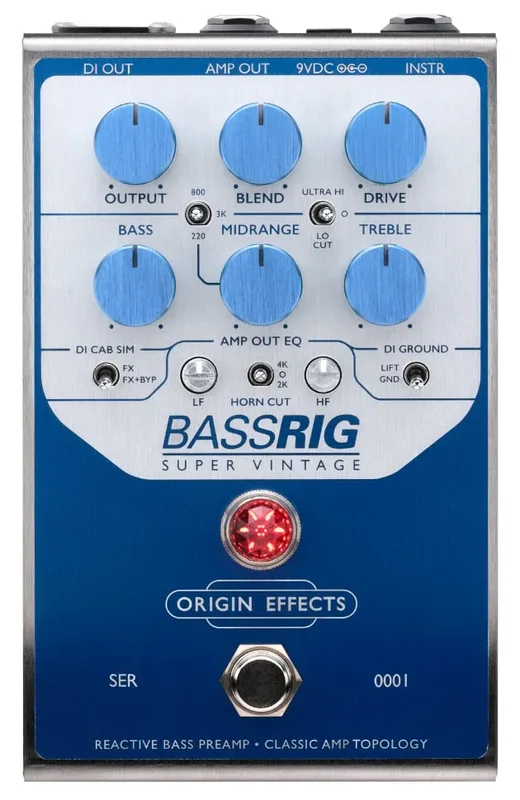


The Origin Effects BASSRIG Super Vintage is an all-analog preamp pedal that recreates a complete vintage Ampeg SVT valve bass amp and its 8x10 cab on a pedalboard. Origin Effects describes it as "a complete vintage bass amp in a pedal," built on the company's Analog Amp Recreation circuitry with a dedicated class-A preamp and a push-pull output stage in the style of the original amp12. It launched alongside the BassRIG '64 Black Panel in February 2022, priced at $4893, and remains part of Origin Effects' bass amp recreation lineup alongside the BassRig Fifteen3.
For a bass player, the pedal covers two jobs at once: it gives you the SVT-style amp and drive sound, and it gives you a direct connection to the desk through an analog cab-sim DI output, so you can go straight to front-of-house when playing live3.
An Ampeg SVT and 8x10 cab recreated in a pedal
The BASSRIG Super Vintage is Origin Effects' recreation of the Ampeg SVT, the amp that defined big-stage bass tone. As the company put it in its 2026 lineup overview: "The BASSRIG SUPER VINTAGE brings this amp and its 8x10″ cab to your pedalboard, with the full suite of tones available"2. The circuit is all-analog and follows a complete valve amp-style signal path, with a dedicated class-A preamp feeding a push-pull output stage1.
The topology mirrors the original non-master-volume SVT in an important way: the overdrive is produced in the output stage, at the end of the chain, so the tone controls come before the drive. Origin Effects' John Dines explains that this ordering is what makes the pedal behave like the amp it recreates5. In practice, that means cranking the drive changes how your EQ settings push the output stage, rather than the EQ shaping an already-distorted signal.
The pedal sits in Origin Effects' bass range alongside the '64 Black Panel, a Fender-style preamp/overdrive launched at the same time, and the Fifteen, a recreation of the Ampeg B-15 Portaflex3.
Controls
MusicRadar's launch coverage listed the front-panel controls: "There are dials for Output, Bass, Midrange, Treble, Drive and Blend"3. The BLEND knob mixes some of your clean signal in parallel with the emulated amp circuit, so you can keep low-end definition while adding drive on top1.
| Control | What it does |
|---|---|
| Output | Sets the overall level |
| Bass, Midrange, Treble | Tone stack, placed before the drive as in the original SVT5 |
| Drive | Pushes the push-pull output stage into overdrive |
| Blend | Mixes clean signal in parallel with the emulated amp circuit1 |
| LO CUT switch | Applies a high-pass filter at the preamp output, cutting the lowest frequencies to maintain clarity5 |
| DI CAB SIM switch | Leaves the DI cabinet simulator active or disabled when the pedal is bypassed6 |
Amp Out EQ and the Horn Cut switch
The quarter-inch Amp Out, for feeding a real amp and cab, has its own post-drive EQ filter with LF and HF trimmers plus a HORN CUT switch. Origin Effects says this filter "can fatten up small combos, tame boominess" and handle harshness from tweeter-equipped rigs1. MusicRadar's Jonathan Horsley noted at launch that the Amp Out EQ filter makes the pedal "suitable for any amp and cab setup"3.
Power and connections: 9V, 150mA
The pedal runs on a 9V DC, 2.1 mm center-negative supply and draws 150 mA1. There is no 9V battery option: Origin Effects says it dropped the battery "both to save space and to allow us to adopt a high-current approach"1. The pedal should only be operated at 9V; the design uses a voltage-doubling circuit internally to reach the higher voltages the amp-style circuit needs1.
The 150 mA draw and the lack of a battery mean the Super Vintage needs a proper 9V power supply. Budget pedalboard supplies with low per-output current limits, and daisy chains shared with other high-current digital pedals, may not keep up.
Connections are straightforward: a 1 MΩ instrument input, and both XLR and 1/4" outputs with a 500 Ω output impedance, which Origin Effects says lets the pedal "fit seamlessly into any signal chain"1.
Using it as a DI
The XLR output carries the analog cab-sim DI signal, so you can send your bass direct to the desk when playing live3. The DI CAB SIM switch decides whether that cabinet simulation stays active when the pedal itself is bypassed, or only sounds when the amp circuit is engaged16. Leaving it always active keeps your direct tone consistent through a whole set even when you switch the amp sound out.
Build and players
The Super Vintage is housed in a hand-polished, brushed stainless steel enclosure with aluminum controls, Neutrik jack sockets and a heavy-duty footswitch, described by Origin Effects as tour-grade1. It is designed and built in England13. Bass tech Trace Foster, who has used it with Aerosmith's Tom Hamilton, called it "an integral part of his rig," with Hamilton's signal split between the pedal and a Fractal unit7. Foster also said of Origin Effects gear generally: "Everything I've ever used from Origin has been amazing and built like a tank"7.
Videos
Origin Effects
Origin Effects
Origin Effects
News
Questions
Does the BassRIG Super Vintage take a battery?
No. Origin Effects left out the usual 9V battery option, both to save space inside the enclosure and to allow a high-current design. The pedal runs only from a 9V DC power supply and draws 150 mA, so it needs a supply capable of that current.
Is the BassRIG Super Vintage true bypass?
No. It uses a high-impedance, buffered bypass with silent switching. The buffer keeps your signal strong through long cable runs, and the switching is silent so you can engage the amp sound without a click or pop.
Can the cab sim stay on when the pedal is bypassed?
Yes. The DI CAB SIM switch lets you choose whether the cabinet simulator on the DI output is always active or only on when the pedal is engaged. Leaving it always active means your direct-to-desk tone stays consistent even with the amp sound switched out.
Can I use the BassRIG Super Vintage as a DI to the desk?
Yes. It has an analogue cab-sim DI output with an XLR connection, so you can send your signal direct to the desk when playing live. There is also a quarter-inch Amp Out for feeding a real amp and cab.
What does the Horn Cut switch do?
It tames harshness when you are running into a rig with a tweeter. It is part of the post-drive Amp Out EQ filter, alongside LF and HF trimmers, which Origin Effects says can fatten up small combos and tame boominess in larger rigs.
Sources (7)
- BASSRIG Super Vintage, Origin Effects, 2026
- 2026 - Our Bass Guitar Amp Recreation Line Up - Origin Effects, Origin Effects, 2026-08-18
- Origin Effects puts vintage bass amp tones at your feet with the BassRIG Super Vintage and '64 Black Panel overdrive and preamp pedals, MusicRadar, 2022-02-22
- Press Release, Origin Effects, 2022-02-22
- TECH TIPS: Modern Bass Tones, Origin Effects, 2022-12-09
- Tech Tips: Three pedals, Two Approaches, One Very Compact Bass Board, Origin Effects, 2023-06-15
- Artist Interview: Trace Foster, Origin Effects, 2023-03-31
 Rex Brown