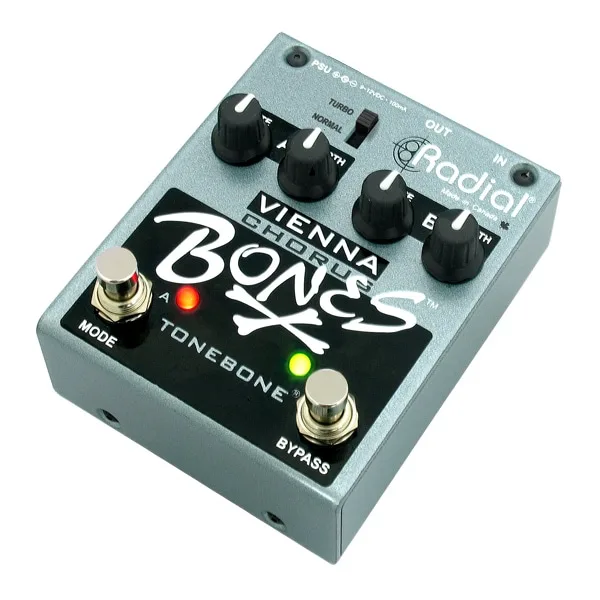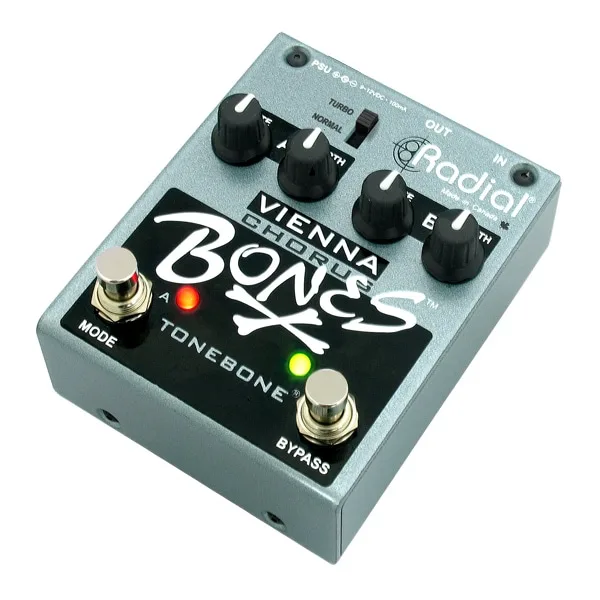


The Radial Engineering Bones Vienna Chorus is a dual-mode analog chorus pedal introduced in January 2010. Radial describes it as a "warm sounding old-school analog chorus in a compact, two channel pedal," with two independent channels, each having its own speed and intensity controls, so a player can set up two very different sounds and toggle between them mid-song12.
The pedal is discontinued: Radial's product page states it "has been discontinued and is no longer shipping"1. It remains of interest to players chasing vintage-style analog chorus, because its circuit is built around the same bucket brigade chip used in the classic designs of the late 1970s and early 1980s.
Two modes: Normal and Turbo
The Vienna's core idea is its two channels. Radial's announcement framed the pedal as letting "the guitarist toggle between a slight choral effect to an exaggerated tone for soloing," with Turbo Mode on hand "to produce extreme chorusing effects"2. Radial's product page describes Turbo mode as introducing "a proprietary oscillator waveform frequency while increasing the range," letting the player move "from a slight choral to extreme warble, tremolo or vibrato"1.
Premier Guitar's review describes the practical layout: a slider switch moves between Normal and Turbo settings, which affect the intensity of the modulation, and two knobs are dedicated to each mode, controlling modulation depth and speed, as on most chorus or vibrato effects3.
| Control | What it does |
|---|---|
| Slider switch | Selects Normal or Turbo mode, affecting modulation intensity3 |
| Four knobs | Two per mode: modulation depth and speed3 |
| Footswitch 1 | Engages and bypasses the effect3 |
| Footswitch 2 | Switches between the two modes3 |
Premier Guitar's reviewer found the pedal "very straightforward and easy to use" despite the busy-looking control set of a slider, four knobs and two footswitches3.
Built on MN3007 bucket brigade chips
The heart of any analog chorus is the bucket brigade chip, the delay line that the modulation circuit wobbles to produce the chorus effect. Radial built the Vienna around new-old-stock Panasonic MN3007 chips, a low-noise part that Radial says has not been made for years and was scrounged from the market for production; the company claimed "thousands in stock" at launch2. Radial's product page dates the chip to circa 19761, while Premier Guitar's review calls the parts NOS Panasonic MN3007 chips "from the early '80s"3.
The chip is socket-mounted for easy replacement2, a practical touch for a pedal built around a discontinued part: when the supply of NOS chips runs out or a chip fails, it can be swapped without soldering.
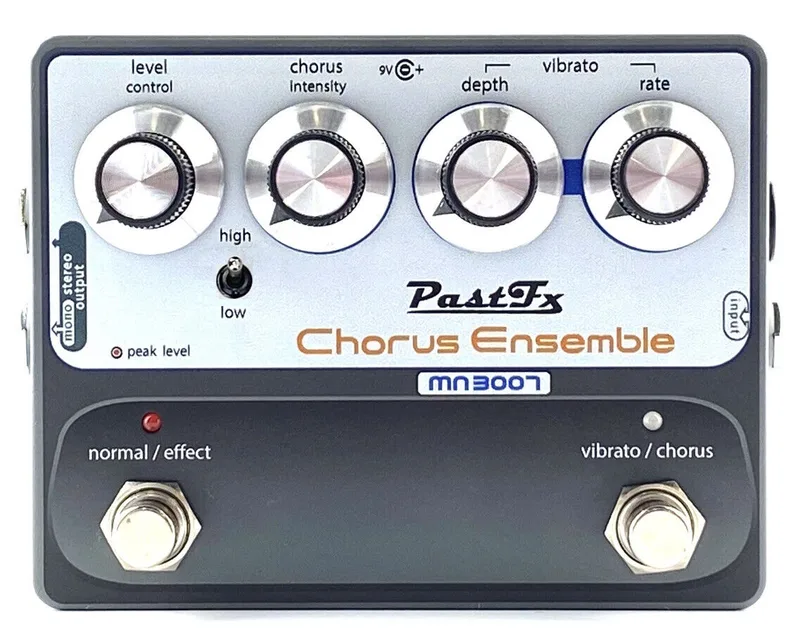
Premier Guitar's reviewer said this chip choice "gives the pedal a genuine analog chorus pedigree"3. Players comparing circuits will recognize the MN3007 as the same chip family used in modern recreations of the classic Japanese ensemble chorus, such as the PastFx Chorus Ensemble MN3007.
Power: 9-volt adapter, no battery
The Vienna runs on a standard 9-volt power supply, the Boss-style adapter common on pedalboards13. Radial says the 9V powering suits the DC power bricks now common with multi-pedal systems, and notes the power supply is not included1. There is no 9-volt battery operation, as Premier Guitar's review points out3, so the pedal needs a spot on a powered board.
The Bones Vienna cannot run on a 9-volt battery3. Plan on a 9V DC output from a power supply or brick, and note that the supply is not included with the pedal1.
Where it came from
Radial Engineering, based in Vancouver, British Columbia, announced the Bones Vienna Chorus on January 12, 2010, with shipping that month at a $159.99 street price2. The pedal was part of Radial's Bones series of compact effects, packaging the company's build quality into stompbox format. Premier Guitar's reviewer noted that "few stompboxes have the heft of a Radial device, and it instills a lot of confidence in the Vienna's roadworthiness"3.
Radial's president Peter Janis said at launch that "top end players prefer the 'tone and feel' of vintage analog chorus pedals," which was the reasoning behind building the pedal around the old MN3007 chip rather than a modern digital emulation2.
Setup options
Radial's product page suggests a few ways to use the pedal1:
- Normal pedalboard setup: guitar into the Vienna Chorus and then an amplifier, with overdrive or distortion pedals placed before the chorus for greater effect.
- Dual amp stage setup: a mono signal path with the signal split after the Vienna Chorus via an ABY switcher such as Radial's Twin City.
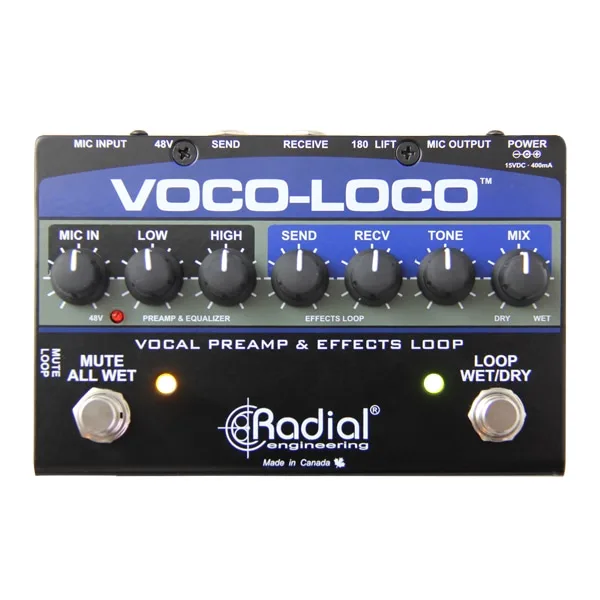
- On other instruments: combining the Vienna with a Radial Voco-Loco makes it possible to add guitar effects to mic'd instruments such as sax or trumpet.
What reviewers said
Premier Guitar reviewed the pedal and found it "an exceptional chorus," with sounds ranging from "pleasing, hazy swirl on slow settings" to "liquid, and delightfully queasy, rotary speaker-like sounds" that the reviewer said "popped out of the mix in brilliant detail," often evocative of tape warble3.
"The dual-mode Vienna Chorus is representative of just how successful that effort has been, and it's an exceptional chorus."
The reviewer tested it with a blackface Fender Tremolux and a Danelectro Hodad 12-string, a Rickenbacker 330 run through a JamMan, and a Gibson Les Paul with a 1966 Fender Bassman on recorded tracks3.
Videos
Premier Guitar
samashop
docSanchezFX
Questions
What is Turbo mode on the Radial Bones Vienna?
Turbo mode is the Vienna's second channel, which Radial says introduces a proprietary oscillator waveform frequency while increasing the range of the modulation. It takes the effect from a subtle chorus for rhythm playing to extreme chorusing, warble, tremolo or vibrato sounds, switchable with a footswitch.
Is the Radial Bones Vienna Chorus still in production?
No. Radial Engineering's product page states the Bones Vienna has been discontinued and is no longer shipping. It was announced in January 2010 and sold for several years before being retired.
What chips does the Radial Bones Vienna use?
It uses new-old-stock Panasonic MN3007 bucket brigade chips, the low-noise part that Radial says has not been made for years and was scrounged from the market for production. The chip is socket-mounted, so it can be replaced without soldering.
How much did the Radial Bones Vienna cost?
At launch in January 2010 it shipped with a street price of $159.99. Premier Guitar's 2026 review listed the street price as $159.
Sources (3)
- Bones Vienna, Radial Engineering, 2021-03-17
- Radial Releases Bones Vienna Dual-Mode Analog Chorus, Premier Guitar, 2010-01-12
- Radial Engineering Bones Vienna Chorus Pedal Review, Premier Guitar, 2010-10-20