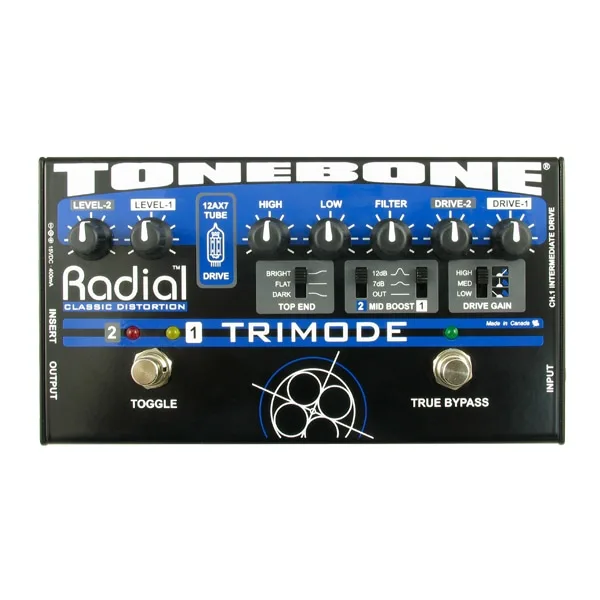


The Radial Trimode is a true-bypass, dual-channel tube distortion pedal from Radial Engineering, built around a 12AX7 tube. Radial describes it as using "the warmth and harmonics from a 12AX7 tube to deliver a wide array of American-style distortion tones"1. It sits in the Tonebone family of tube distortion pedals, alongside the Radial Tonebone Plexitube and the Radial Tonebone Hot British Tube Distortion.
Radial states that the Trimode "has been discontinued and is no longer shipping"1. It is only available secondhand.
What it is and what it does
The Trimode is an analog pedal with a hybrid tube and proprietary circuit3. Radial positions it as a distortion pedal that covers ground from light breakup to heavy gain: on Radial's artist page, Andy Timmons describes it as a tube distortion that "takes you from slight overdrive to full-on distortion"6. The two drive channels let a player set two gain levels and switch between them, and a third solo channel can be toggled with a delay automatically engaged5.
Radial builds the pedal with full-size discrete parts, hand inserted and soldered to a double-sided circuit board with a full-surface ground plane3.
Channels, controls and the insert jack
The pedal's controls, as listed in Radial's specifications3:
| Control | What it does |
|---|---|
| Drive 1 & 2 | Used with the drive gain switch to adjust the overall amount of gain to the overdrive circuit |
| EQ control | Shapes the tone, with a boost available |
| Filter | Reduces high-frequency content to compensate for overly bright amplifiers |
| Top end switch | Three-position switch that sets the overall tonal character to match the amp and guitar |
Channel 2 carries a standard 1/4-inch TRS insert jack that lets you add effects such as a delay pedal to that channel only5. Channel 2 is normalled through the insert jack, so with nothing plugged in the signal passes straight through2. The effects loop sits post-distortion, so anything in the loop hears the already-distorted signal2. Radial's features page highlights a practical use: toggling to the solo channel can bring your delay on automatically5.
Power
The Trimode runs on 15V DC. Radial's specifications page lists 15V DC at 400mA with center pole positive, and describes the supply as a high-output 15-volt, 400-milliamp unit delivering more than twice the power of a typical 9V supply, internally regulated and filtered to eliminate noise3. The RockBoard PedalPedia entry lists 15V DC at 500mA, center negative4. The two sources disagree on polarity and current draw, so check the unit and its original supply rather than assuming either way.
The Trimode cannot run on a standard 9V pedal supply. Radial recommends a 15V outlet from a multi-power supply brick, and says that if you use 18V from a power brick you must supply the correct polarity and sufficient current2.
The tube: changes, voltage and ventilation
The Trimode's 12AX7 runs at low voltage. Radial describes this as "starving" the tube, which it says means the tube lasts a long time and never gets very hot2. Air vents on the side panel provide ventilation to keep the pedal running cool2.
If you want to swap the tube, Radial says the fitted tube is typically a Ruby Tube 12AX7, though the brand can change with supply, and that changing the tube brand affects the sound only slightly2. Complete tube-changing instructions with pictures are in the Plexitube user guide2.
Where it sits in the Tonebone line
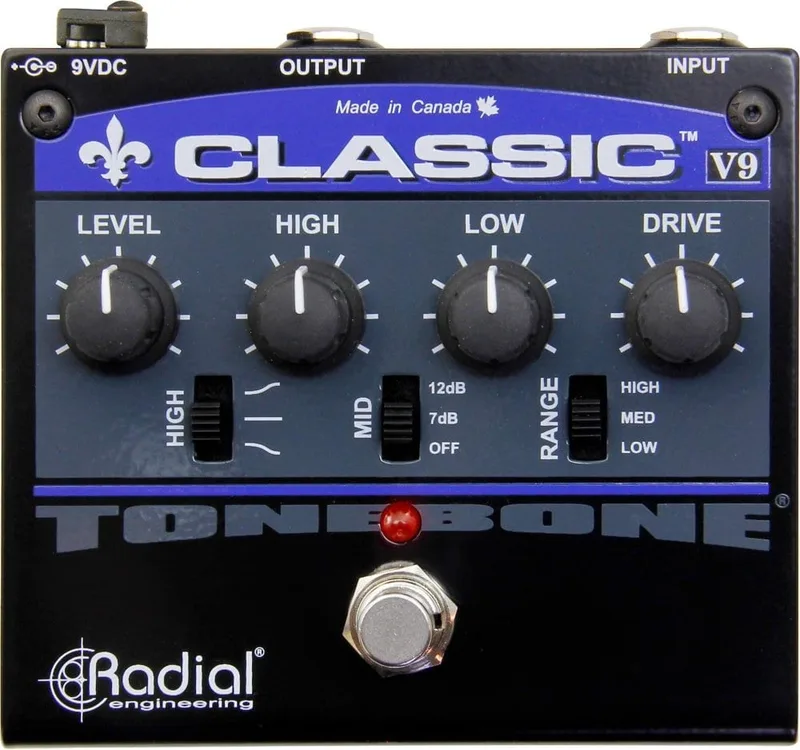
The Trimode belongs to Radial's Tonebone range of 12AX7-powered distortion pedals, which Radial later scaled down into compact, tubeless versions running on 9V supplies, such as the Radial Tonebone Classic-V9 and the Radial Tonebone Hot British V9. Compared with those, the Trimode keeps the full tube circuit, the higher-voltage supply and the channel-2 insert loop. Players after a simpler Radial distortion can also look at the Radial Bones London Distortion and Radial Bones Hollywood Distortion352.
Videos
ProGuitarShopDemos
gearwire
James Mulvaney
Questions
Is the Radial Trimode true bypass?
Yes. Radial describes the Trimode as a true-bypass, dual-channel tube distortion pedal, so with the effect off the guitar signal passes through without the circuit coloring it. This applies to both the Radial product page and the RockBoard PedalPedia listing.
Is the Radial Trimode discontinued?
Yes. Radial Engineering states on its product page that the Trimode has been discontinued and is no longer shipping. It remains covered on the RockBoard PedalPedia, but no new units are being produced, so buyers looking for one are limited to the secondhand market.
What tube does the Radial Trimode use?
The Trimode uses a 12AX7 tube. Radial says the tube fitted is typically a Ruby Tube 12AX7, though the brand can change depending on supply. The tube runs at low voltage, which Radial says keeps it running cool and gives it a long life.
What voltage does the Radial Trimode need?
The Trimode runs on 15V DC. Radial's specifications page lists 15V DC at 400mA with center pole positive, while the RockBoard PedalPedia lists 15V DC center negative at 500mA, so the two sources disagree on polarity and current. Radial recommends a 15V outlet on a multi-power supply brick.
Can I put a delay in the Trimode's effects loop?
Yes. Channel 2 has a standard 1/4-inch TRS insert jack that lets you add effects such as a delay, and Radial notes that switching to the solo channel can bring the delay on automatically. The loop sits post-distortion, so the delay hears the distorted signal.
Does changing the tube change the sound?
Only slightly. Radial says changing the tube brand affects the sound slightly, because the tube is run at low voltage rather than at full amplifier voltage. Complete tube-changing instructions with pictures are in the Plexitube user guide.
Sources (6)
- Trimode - Radial Engineering, Radial Engineering, 2022-07-22
- Trimode FAQ, Radial Engineering, 2018-11-27
- Trimode Specifications, Radial Engineering, 2018-04-26
- ToneBone Trimode by Radial Engineering, RockBoard PedalPedia, 2026
- Trimode Features, Radial Engineering, 2018-04-26
- Andy Timmons, Radial Engineering, 2018-09-18