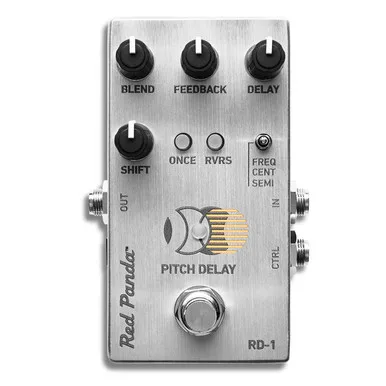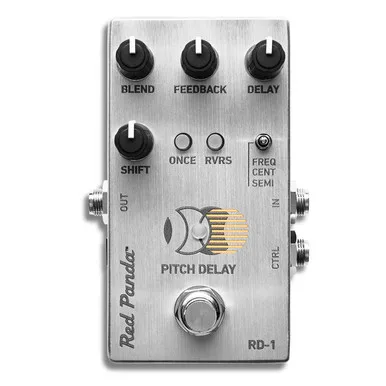


The Red Panda RD-1 Pitch Delay is a digital delay pedal that shifts the pitch of its repeats. Instead of a straight echo, each delayed copy of your note can be bent up or down in frequency, and the Shift knob sets the amount of pitch change applied to the delayed signal1, so the repeats move away from what you played as they decay.
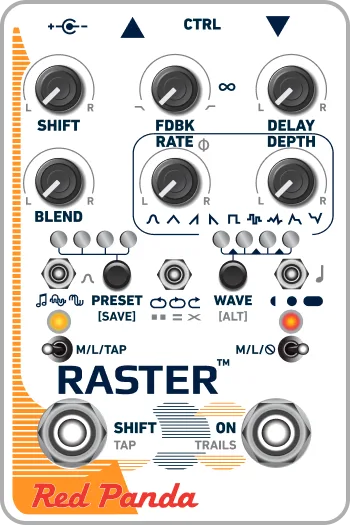
The pedal is a deliberate distillation of the company's Raster line. As Delicious Audio's reviewer put it:
"Enter the Red Panda RD-1. Same DNA. Half the complexity. All the weird."
"The Raster was for architects. The RD-1 is for players. Same sound world, no manual required."1
Guitar.com's review describes it as an alternative to the Raster 2 for more compact pedalboards2, and Pedal of the Day calls it a digital delay with pitch and frequency shifting based on the Raster, built for immediacy and playful experimentation without menus3.
What it does to your sound
The RD-1 is a delay whose repeats are pitch-shifted. A Shift knob sets the amount of pitch change applied to the delayed signal, and the standard delay controls, time, feedback and dry/wet blend, work as on any delay pedal2. Because the pitch shifter sits in the feedback loop, each repeat shifts again on the way through, so the effect compounds as the echoes stack up. That architecture follows the original Raster, which Red Panda's own manual described as "a digital delay with a pitch shifter integrated into the feedback loop"4.
The Shift knob sets the amount of pitch change applied to the delayed signal1, so a small setting keeps the repeats close to the original note while a larger one pushes them further away as they repeat.
The three Shift modes
The pitch behavior is set by three Shift modes, which guitar.com names frequency shift, detune and chromatic transpose2:
| Mode | What it does | Range |
|---|---|---|
| Freq | Frequency shifting | ±500Hz1 |
| Cents | Detuning | down a fourth, up a major third1 |
| Semi | Chromatic transposing | ±12 semitones1 |
Frequency shifting moves all the harmonics of a note by a fixed number of hertz rather than a musical ratio, which detunes the overtone series and gives the repeats a slightly sour, otherworldly character. Detune shifts by small intervals for a chorus-like thickening of the echoes. Chromatic transpose snaps to fixed semitone intervals, which guitar.com's reviewer found especially musical:
"This offers fixed semitone intervals, so perfect harmonies, delivered with a pleasing hint of lo-fi jitteriness..."2
Controls, tap tempo and the CTRL input
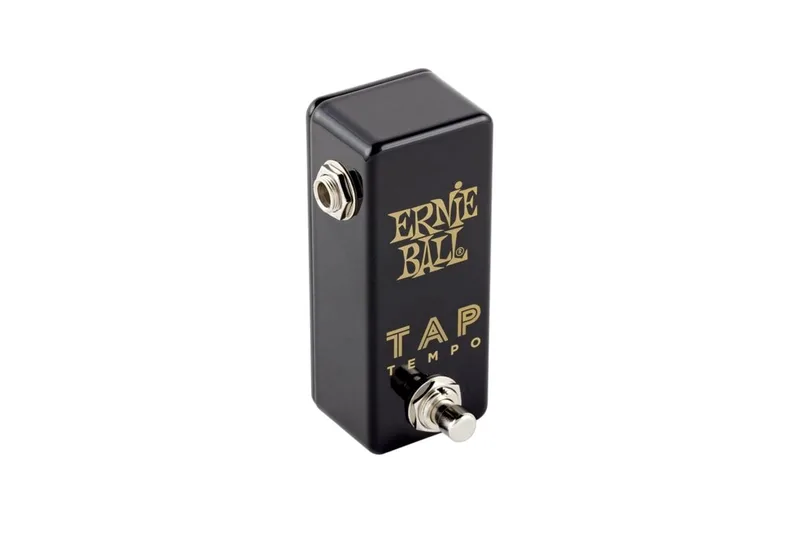
The front panel keeps things knob-driven: time, feedback, dry/wet blend and the Shift knob, plus a mode selector and a hidden tap-tempo option2. The CTRL input takes either an expression pedal or a tap tempo switch1, so you can sweep the pitch shift in real time or lock the delay time to tempo without touching a menu. There is a USB-C port, but it is for firmware updates rather than MIDI1.
The RD-1 is mono, with a single TS output, and has no presets2. Players who need stereo repeats, preset recall or MIDI control are the audience for the Raster 2 instead.
RD-1 versus the Raster
The Raster line is where this circuit comes from. The original Raster, launched in 2015, incorporated micro pitch shifting into the delay signal5, and the Raster 2 expanded it into a stereo delay with a pitch shifter6. The RD-1 keeps the sound world but trims the feature set. Guitar Pedal X's reviewer called it "a more accessible take on pitch-shifting delay" but "less the expansive and fully granular" experience of the full Raster7. Delicious Audio's reviewer framed the split by user type: the Raster for architects, the RD-1 for players1.
What reviewers said
Reviews of the RD-1 focused on its pitch control. The Shift knob, which sets the amount of pitch change applied to the delayed signal1, was central to how reviewers described the pedal's effect on repeats.
Videos
Premier Guitar
Red Panda Lab
collector//emitter
News
Questions
What is the difference between the Red Panda RD-1 and the Raster?
The RD-1 is a mono, simplified alternative to the Red Panda Raster 2, designed for more compact pedalboards. It shares the Raster's pitch-shifting delay sound but drops the menus, presets, stereo output and MIDI in favor of hands-on knob control. Reviewers describe it as the same sound world at half the complexity.
Does the Red Panda RD-1 have MIDI?
No. The RD-1 has a USB-C port for firmware updates but no MIDI. Delicious Audio's reviewer framed it as a pedal for people who want to twist knobs in real time rather than menu-dive, and guitar.com's review notes it has no presets either.
Can the RD-1 use tap tempo?
Yes. Tap tempo is available through the CTRL input, which accepts either an expression pedal or a tap tempo switch. guitar.com's review also mentions a hidden tap-tempo option alongside the standard time, feedback and dry/wet blend controls.
Is the Red Panda RD-1 analog or digital?
It is digital. Red Panda has built its reputation on digital effects, and reviewers describe the RD-1 as a digital delay with pitch and frequency shifting. Delicious Audio notes the company has spent years proving digital does not have to sound cold.
What do the Freq, Cents and Semi modes do on the RD-1?
Freq is a frequency shift mode covering up to ±500Hz, Cents is a detune mode, and Semi is a chromatic transpose mode covering up to ±12 semitones. Each sets how the Shift knob changes the pitch of the delayed signal, from subtle warble to fixed interval harmonies.
Sources (7)
- Red Panda RD-1 Pitch Delay, Delicious Audio, 2026-06-23
- Red Panda RD-1 Pitch Delay review, guitar.com, 2026-08-17
- Red Panda RD-1 Pitch Delay, Pedal of the Day, 2026-07-10
- raster_instructions.pdf, Red Panda Lab, 2017
- Red Panda Raster Delay, Pedal of the Day, 2015-10-13
- Stompbox Delivers Delay With Pitch Shifting, Sonic State, 2015-04-29
- Guitar Pedal X, Guitar Pedal X, 2026-04-02