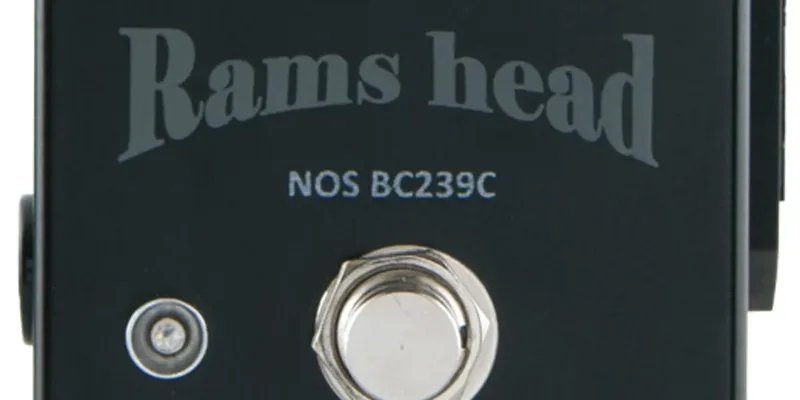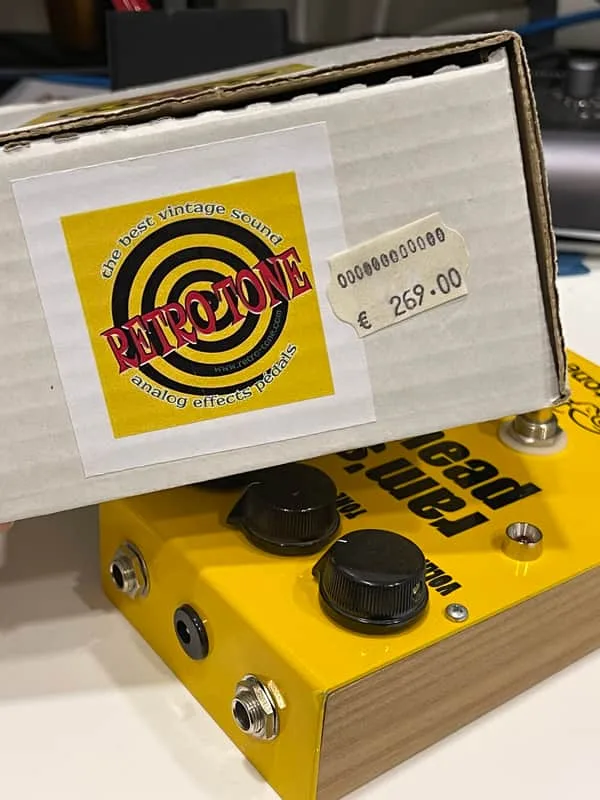


The Retro Tone Ram's Head V2 is a fuzz pedal from Retro Tone, a French builder that focuses on dirt boxes inspired by vintage circuits. It is the company's take on the Ram's Head Big Muff, specifically the version 2 circuit that Electro-Harmonix sold between 1973 and 1977 and later reissued1. Where the original is prized for a scooped, bassier sound, Retro Tone adds a toggle that fills in those scooped mids, giving the player two voices from one box1.
The builder describes the approach as component-level recreation rather than a loose approximation1:
"I recreated this legendary pedal by carefully choosing the components in order to find this so special sound1."
Retro Tone, quoted by Delicious Audio1
What the original Ram's Head V2 sounds like
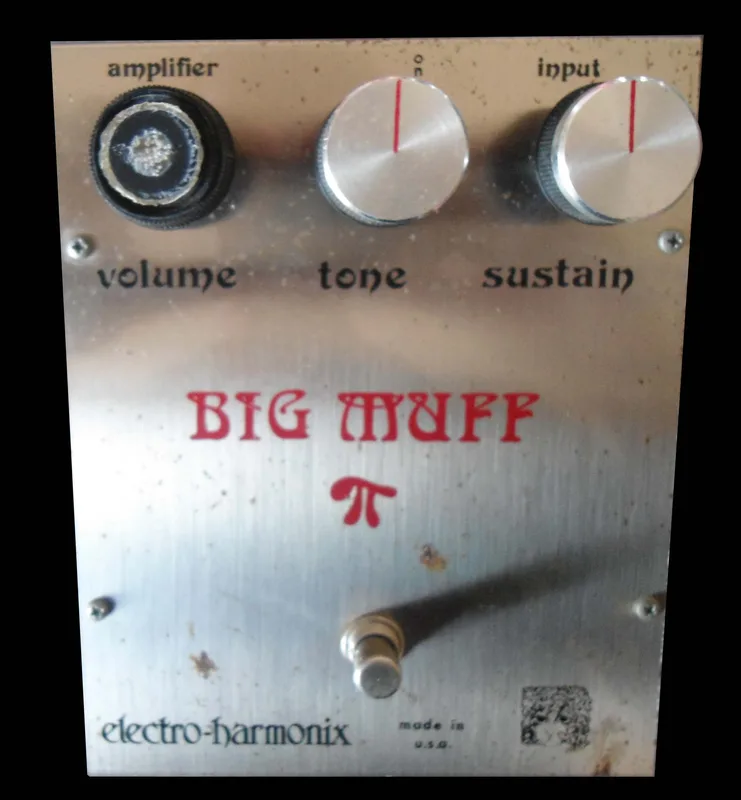
To know what the Retro Tone is chasing, it helps to know what the V2 Big Muff is. The version 2 Muff was produced for a few years from 1973 and picked up the "Ram's Head" nickname from the ram's face printed on the enclosure2. Kit Rae, who has documented the Big Muff family in more depth than anyone, describes the V2 as having a very scooped midrange, exceptional sustain and gain on most units, and a fairly tight, controllable low end that creates a huge sound through a tube amp3.
The V2 was not one circuit but a family of them. Rae counts at least twenty variations of the circuit used in V2 Big Muffs, including the Violet Ram's Head variant found in 1973-74 units and in custom-branded Big Muffs like the Foxey Lady, Marveltone Distortion Sustainer and Lyle Distortion Sustainer4. His measurements of original units show how much the values drifted: feedback caps moved between 470pF, 560pF and 680pF, clipping caps ranged from .047uF up to 1.0uF, and the tone stack resistors varied from 22k to 39k depending on the unit5. That drift is why two original Ram's Heads can sound noticeably different, and why a builder "carefully choosing the components" is making real decisions about which specific variant to recreate.
Stomp Under Foot's Matthew Pasquerella, another maker who has traced the Ram's Head versions, describes the V2 "Blue" variant as evening out some of the extra low end found in V1, resulting in a more balanced voice with smooth, harmonically rich fuzz and violin-like sustain6.
The controls
The Retro Tone keeps the classic three-knob Muff layout rather than redesigning it. Delicious Audio's write-up notes that it "offers the same knob layout of the original"1, which means the familiar Volume / Tone / Sustain arrangement that appears across the Big Muff family and its many recreations7.
| Control | What it does |
|---|---|
| Volume | Sets the output level8 |
| Tone | Tilts the sound between lows and highs, as on the original9 |
| Sustain | Sets the amount of gain and sustain, the fuzz intensity108 |
| Mid switch | 2-position toggle: boosted midrange or the original scooped sound1 |
What the mid boost switch does
The stock Ram's Head circuit scoops the mids, which is a large part of the huge, dark character players associate with it. The trade-off is that a heavily scooped fuzz can disappear behind a band, since guitars live in the midrange. Retro Tone's answer is a 2-position switch that takes you "from a boosted midrange sound to the original sound"1, so the same pedal covers both the classic scooped voice and a fuller, more forward one.
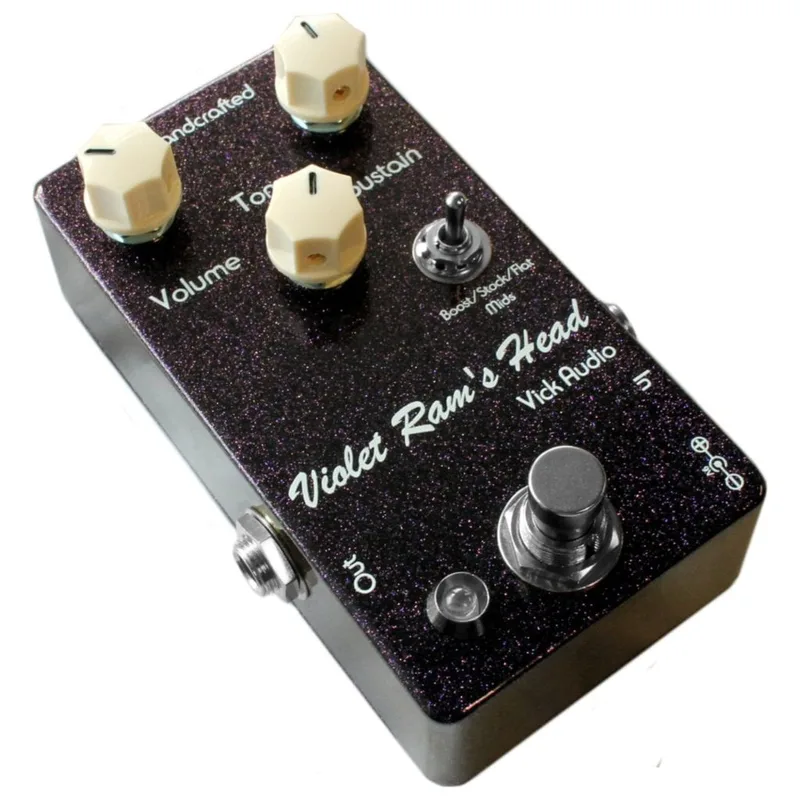
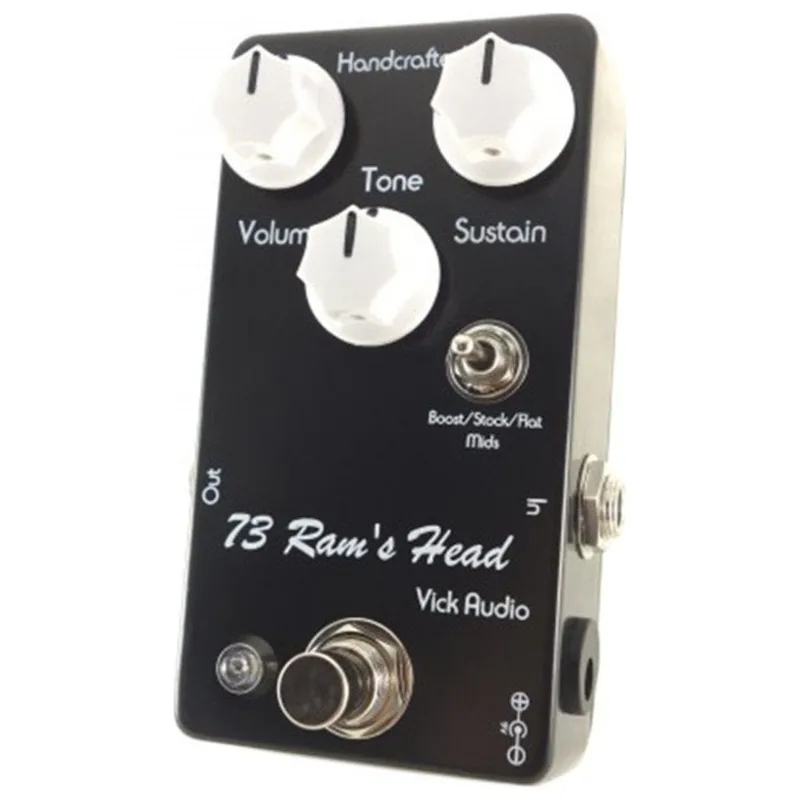
Other builders in the same territory have solved this in different ways. The Vick Audio Violet Ram's Head uses a three-position toggle for scooped, flat and boosted mids8, and the Stomp Under Foot Ultra 47 Ram's Head uses a mids knob with a marked starting point for the classic scoop. Retro Tone's two-position switch is the simplest version of the idea: stock sound, or mids filled in.
How it compares with other Ram's Head recreations
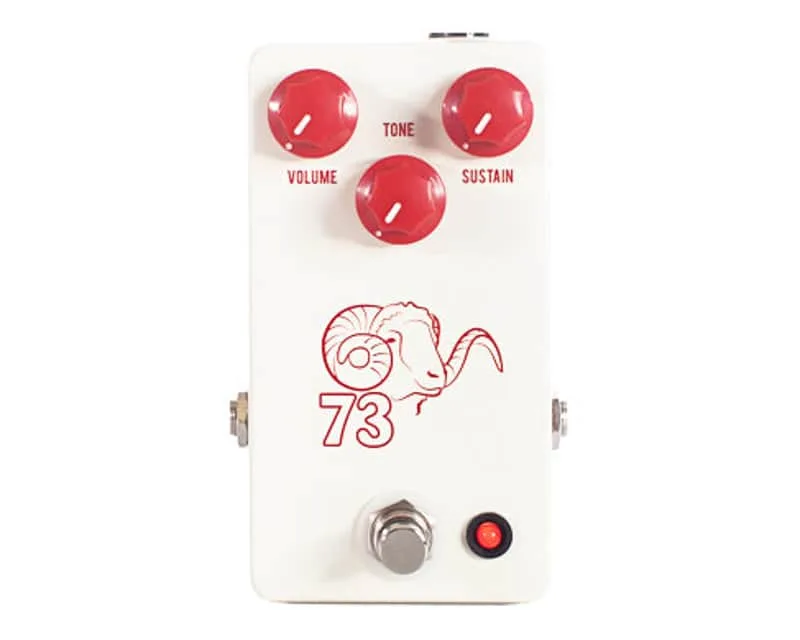
The Ram's Head has been recreated many times, and the Retro Tone sits in a crowded field. The most direct comparison for many players is the official Electro-Harmonix Ram's Head Big Muff Pi reissue, which Kit Rae found "thick and dirty sounding" and an accurate capture of the signature tone of many early to mid 1970s Ram's Heads, though noisy at high gain, as all Big Muffs are4. Other options include the Vick Audio 73 Ram's Head, the Buffalo FX Ram's Head, the JHS Pedals '73 Ram's Head Replica Fuzz, the Castledine Electronics V2 and the Stomp Under Foot Ram's Head.
What distinguishes the Retro Tone is the build and the added switch. It is hand assembled in the Basque Country in a wood and aluminum case, carries a 3 year warranty, and includes reverse polarity protection1, where the official reissue is a mass-produced nano-format pedal. Players comparing circuits rather than build quality will find the Retro Tone targets the same V2 territory as the rest: the scooped, bassier, high-sustain voice that made the original a favorite14.
Videos
HarryAndAGuitar
Martial Allart
Questions
Is the Retro Tone Ram's Head V2 true bypass?
Yes. The pedal uses true bypass switching, so when it is disengaged the signal passes through without the circuit coloring it. This matches the approach of most modern Ram's Head recreations, including the Electro-Harmonix reissue and the Vick Audio 73 Ram's Head.
What voltage does the Retro Tone Ram's Head V2 need?
It runs on a 9V power supply. Delicious Audio's write-up lists a 9v supply among the pedal's features, alongside protection against reverse polarity, so a standard center-negative 9V adapter of the kind used for most pedals is what the builder intends.
Does the Ram's Head V2 have reverse polarity protection?
Yes. Reverse polarity protection is listed as a feature, which means plugging in a power supply with the wrong polarity will not damage the pedal. That is a practical safeguard on a hand-assembled boutique fuzz where a repair is not a simple warranty swap.
Where is the Retro Tone Ram's Head V2 made?
It is hand assembled in the Basque Country. Retro Tone itself is a French pedal builder that focuses on dirt boxes inspired by vintage circuits, and the Ram's Head V2 is its take on the classic Ram's Head Big Muff.
What does the mid boost switch do?
The 2-position switch selects between a boosted midrange sound and the original sound. The stock Ram's Head circuit scoops the mids for a bassier, darker voice, and the boost position fills in that scoop so the pedal cuts through a mix more easily.
Sources (10)
- Retro Tone Ram's Head V2, Delicious Audio, 2021-02-08
- Electro-Harmonix Ram's Head Big Muff Pi review, Guitar World, 2020-05-25
- Big Muff Versions_Quick Identifier, Kit Rae (kitrae.net), 2026
- The Big Muff History of All Versions Part 1, Kit Rae (kitrae.net), 2024-04
- BIG MUFF TRANSISTORS AND OTHER COMPONENTS, Kit Rae (kitrae.net), 2012-07
- 1973 Ram's Head, Stomp Under Foot, 2026-07-18
- Guitar Pedal X, Guitar Pedal X, 2024-06-21
- Vick Audio Violet Ram's Head Fuzz, Pedal of the Day, 2016-08-22
- JHS Pedals '73 Ram's Head Replica Fuzz, Pedal of the Day (www.pedal-of-the-day.com), 2014-08-10
- Gear Review: Vick Audio 73 Ram's Head Pedal, Guitar World, 2015-10-09