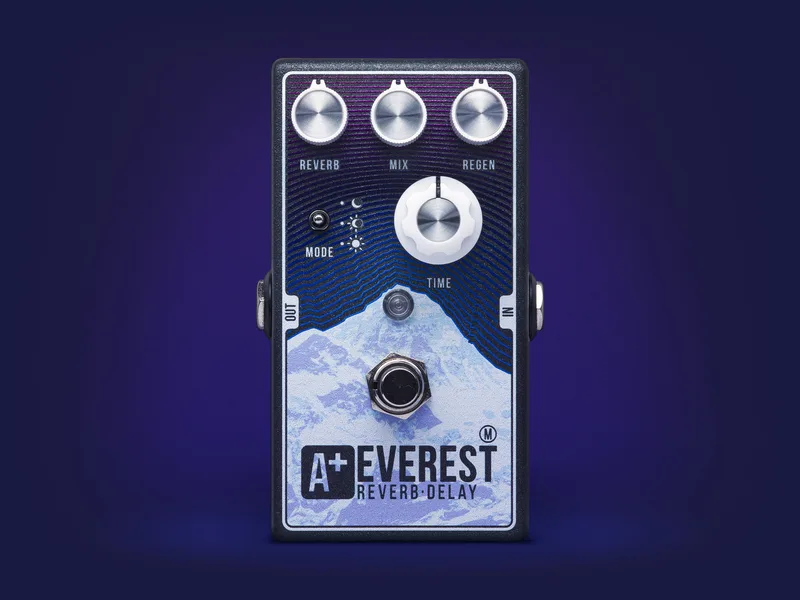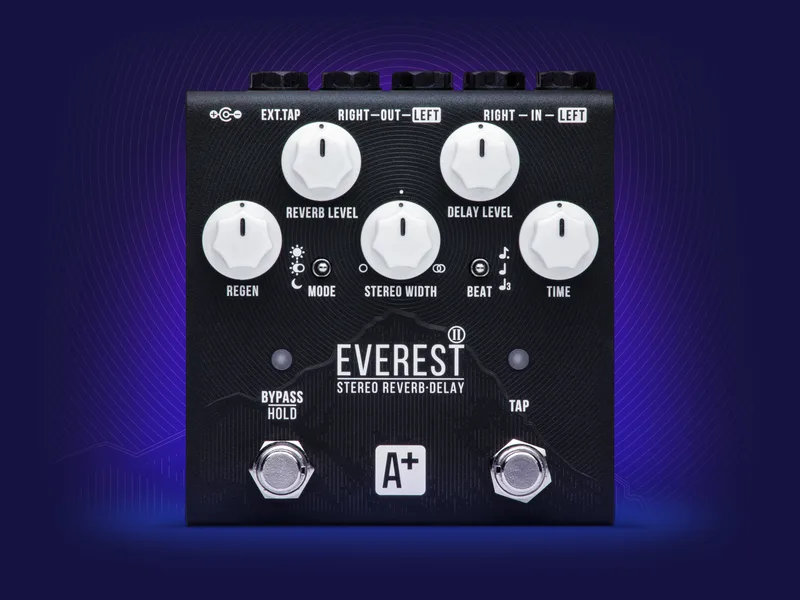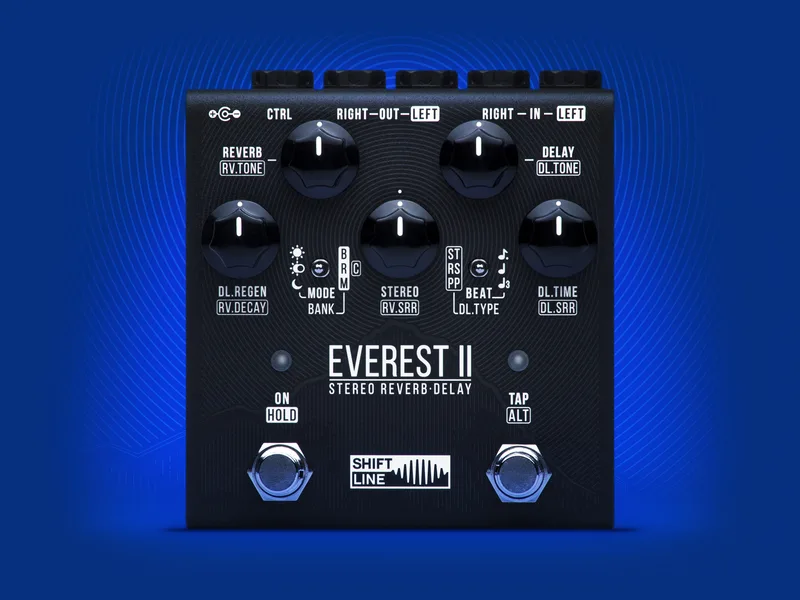



The Shift Line Everest II is a stereo reverb and delay pedal that puts 12 reverb and delay combinations into four banks of three patches each, covering what Shift Line describes as "all the typical use cases for those effects"1. The dry signal path is fully analog, and the pedal grew out of the mono Shift Line A+ Everest M, which offered six reverb and delay algorithms2. Firmware v2.0 can be installed on any Everest II, starting with serial number 0011.
The Everest II was released in November 20203. A related version, the Shift-Line A+ Everest II Black Edition, is discontinued4.
Four banks of patches
The 12 patches are organized into four banks, each holding three patches selected with the MODE switch1. Each patch is a fixed combination of delay and reverb character:
| Bank | Patch | Character |
|---|---|---|
| Red | Digital | Clean delay repeats with no audible degradation, like vintage digital delay machines, with bright reverb reflections6 |
| Red | Tape | Modulated tape-style delay with characteristic repeat degradation, accompanied by dark vintage reverb6 |
| Blue | Moonshine | Delay repeats and reverb reflections accompanied by octave sounds for a weird, otherworldly effect6 |
| Blue | Eclipse | Modulated delay repeats and solemn reverb reflections4 |
| Magenta | Rock | Delay with a resonant filter at around 2500 Hz, punchy modulated repeats, soft shim-down reverb4 |
| Magenta | Iceman | Bright delay and reverb with 80s-style modulation based on flanging and a resonant filter; the reverb omits low frequencies6 |
| Cyan | Stratosphere | Delay with a hint of octave-up; the reverb gradually ascends into the high frequencies for soaring sounds6 |
Shift Line describes the Sunshine patch in its own words:
"The delay and reverb in this mode are so bright and cold they will send shivers down your spine!"1
The Black Edition adds independent volume controls for reverb and delay, with the option to use either effect in separation4. The manual also exposes deep editing through a config file: four reverb algorithms named Grossglockner, Kilimanjaro, McKinley and K2, where a higher number means a more complex algorithm5.
Controls and footswitches
The top panel keeps things compact in an aluminum enclosure with top-mounted jacks1.
| Control | What it does |
|---|---|
| TIME knob | Sets delay time; the first 5% of its range has no effect on delay time, so the delay filters can be used without repeats6 |
| BEAT switch | Selects a subdivision: UP 3/4 (dotted eighth), CENTER 1/1 (quarter note), DOWN 2/3 (quarter note triplet)1 |
| DL.TONE knob | Controls the LPF at the delay output; fully counterclockwise is the darkest delay tone, fully clockwise the brightest1 |
| DELAY LEVEL knob | Controls delay volume in the wet signal; fully counterclockwise disengages the delay6 |
| STEREO WIDTH knob | The 7:00 to 12:00 range controls channel crosstalk: 7:00 is 100% crosstalk (summed to mono), 12:00 is 0% crosstalk6 |
| MODE switch | Selects the bank and patch4 |
The two footswitches each carry several functions:
- ON/HOLD (BYPASS): press once to turn the effect on or off; press and hold for Hold Mode; press twice to recall the Favorite preset or switch back to live control; press and hold while changing MODE to select the bank; press and hold while changing BEAT to select the bypass mode and control Kill Dry6.
- TAP: press at least twice to set delay time; press and hold to access secondary control functions; press and hold while changing MODE to access Bank 4; press and hold while changing BEAT to control the internal channel setup (stereo or ping-pong) for the delay section; press and hold TAP and BYPASS together for 3 seconds to record a Favorite preset6.
The BYPASS/HOLD LED has five functions: on/off, bank, Hold Mode, Favorite and bypass mode indication7.
Bypass modes and Hold
The Everest II uses active bypass rather than true bypass, which Shift Line says means no audible clicking1. Three global bypass modes are selectable via the BEAT switch while holding the BYPASS footswitch, and the LED above the footswitch shows which is active4:
| LED color | Bypass mode |
|---|---|
| Red | "No tails": the effect turns off immediately when BYPASS is pressed7 |
| Blue | "Tails"6 |
| White | "Kill Dry with tails"6 |
Hold Mode is the pedal's freeze function. Press and hold the BYPASS switch for more than 0.3 seconds to simulate turning the REGEN knob to the max: reverbs become infinite or very long (2 to 5 minutes), and delays go into maximum feedback6.
Power
The Everest II runs on a universal 9 to 12V DC power intake with relatively low power consumption1. The connector is 2.1/5.5 mm with a negative tip, and Shift Line specifies a regulated PSU only61.
The Everest II cannot be battery-powered. It needs a regulated 9 to 12V DC supply with a 2.1/5.5 mm center-negative plug12.
Shift Line's product pages give two sets of current draw figures that disagree: 150 mA at 9V DC and 100 mA at 12V DC on one page1, and 100 mA at 9V DC and 75 mA at 12V DC on another7. Either way, it is low by digital device standards4.
Stereo, MIDI and clock input
The Everest II does not support TRS connections. Stereo is achieved by connecting two mono sources to LEFT IN and RIGHT IN and two mono cables to LEFT OUT and RIGHT OUT; LEFT IN and LEFT OUT are the main mono input and output1.
The CTRL input (6.3 mm) accepts MIDI Type A, a normally open momentary button, or a 5V analog trigger (S-trig or V-trig) with up to a 1-second interval between two consecutive signals1. All of the pedal's functions can be controlled via MIDI1. For MIDI Clock, the pedal accepts the Clock parameter from the MIDI System Real Time protocol through a 6.3 mm Type A stereo jack; when MIDI Clock is present, the TIME knob and TAP footswitch are inactive, and no MIDI channel needs to be set6. The Black Edition instead sets its MIDI channel in the config file4.
For external tap clocking, the Everest II is designed for quarter-note clocking (1PPQN) with 0.005 to 1 second intervals between two consecutive signals, and a stable clock rate range of 60 to 300 BPM1. The manual's EXT.TAP setting defaults to a value of 1, an S-trigger 5V short-circuit trigger, which allows the pedal to work with both passive and active external switches; other values cover a passive normally open momentary button, MIDI, and a Favorite on/off switch5.
Firmware and history
Since the release of the Everest II in November 2020, multiple changes have occurred to the device's firmware3. Firmware 1.2 is installed on pedals manufactured after June 16, 20213, and firmware v2.0 can be installed onto any Everest II pedal starting with serial number 0011. The current hardware version is 1.2.78. Editing the config file requires a computer USB port of USB 2.0 or higher5.
The Everest II is a stereo evolution of the mono Everest M, which runs on 9V DC at 80 mA and offers six reverb and delay algorithms with its own Infinity Mode2. Players comparing stereo delay and reverb pedals can find more options on the delay pedals and reverb pedals pages.
Videos
Shift Line
Chords Of Orion
Brett Kingman
Questions
Does the Everest II use TRS stereo jacks?
No. The Everest II does not support TRS connections. Stereo operation is achieved by connecting two mono sources to LEFT IN and RIGHT IN and running two mono cables from LEFT OUT and RIGHT OUT. All jacks are 6.3 mm mono unbalanced, with 1 MOhm input impedance and 100 Ohm output impedance.
Can the Everest II run on a battery?
No. Shift Line states the pedal cannot be battery-powered and must be run from a regulated PSU only, through a 2.1/5.5 mm center-negative connector. It accepts 9 to 12V DC, drawing 100 to 150 mA depending on voltage.
Is the Shift Line Everest II true bypass?
No, it uses active bypass. Shift Line says that because of the active bypass there is no audible clicking, and three global bypass modes are available: No Tails, Tails, and Kill Dry with Tails, each shown by a different LED color above the footswitch.
What is the maximum delay time on the Everest II?
One second of maximum delay time in Stereo mode, and two seconds in Ping Pong mode. The TIME knob also has a blind spot: the first 5 percent of its range has no effect on delay time, which lets you use the delay filters without repeats.
Can the Everest II sync to an external clock?
Yes. It is designed for quarter-note clocking (1PPQN) with 0.005 to 1 second intervals between signals, and a stable clock rate range of 60 to 300 BPM. It also accepts MIDI Clock through a 6.3 mm Type A stereo jack, which deactivates the TIME knob and TAP footswitch.
Sources (8)
- Shift Line Everest II, Shift Line, 2026
- A+ Everest M, Shift Line, 2026
- A+ Everest II, Shift Line, 2026
- A+ Everest II Black Edition, Shift-Line, 2026
- A+ Everest II, Shift Line, 2026
- A+ Everest II Original, Shift-Line, 2026
- A+ Everest II Ver.1, Shift-Line, 2026
- Shift Line Everest II, Shift Line, 2026