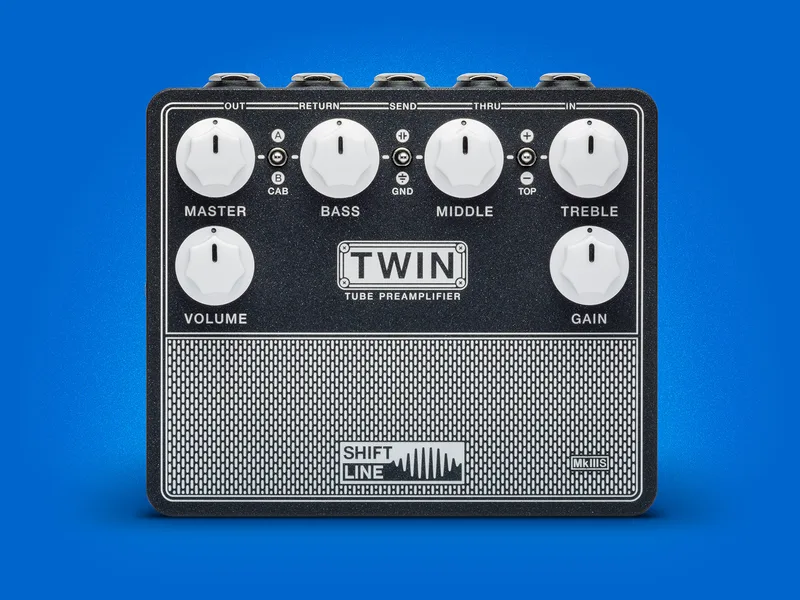


The Shift Line Twin MkIIIS is a tube guitar preamplifier with IR-based cabinet simulation, described by its maker as the third revision of their tube guitar preamplifier1. It runs a 12AX7 tube in the preamp stage, and its dynamic range has been expanded so it can move from its clean sound into crunch and overdrive without external boosting1. The cabinet simulation uses Impulse Response Convolution, with a reported IR latency of 1,2ms1.
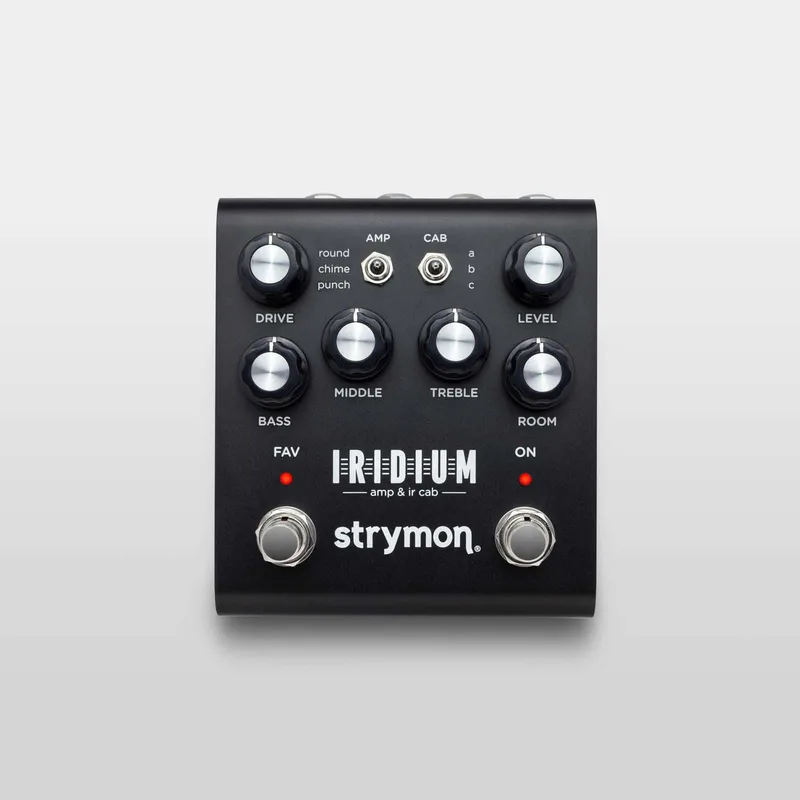
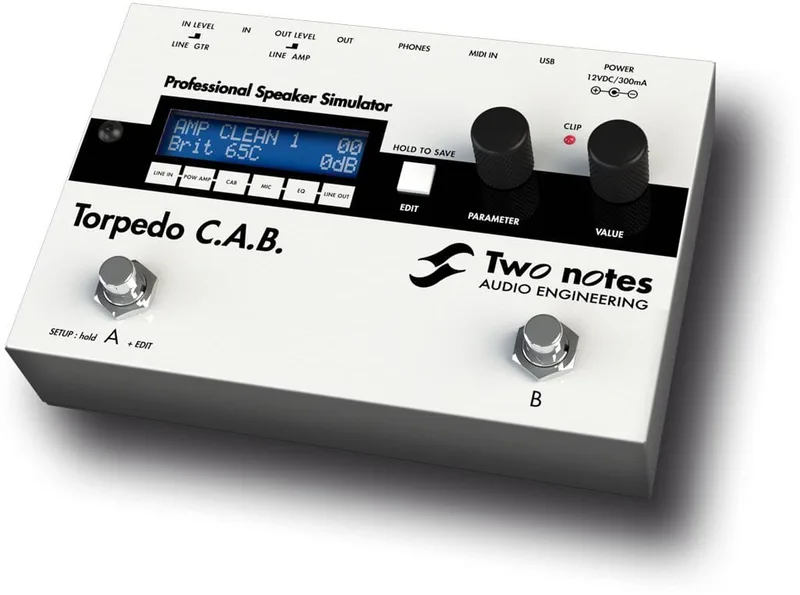
The unit is aimed at players who want a direct solution: a tube front end feeding a virtual power amp and cabinet, with balanced XLR output for a mixing desk, a headphone output for silent practice, and an effects loop for pedals. It sits in the same category as other speaker simulation pedals such as the Strymon Iridium and the Two Notes Torpedo C.A.B., but with a real 12AX7 in the signal path rather than an all-digital preamp1.
The controls
The front panel keeps things simple: two knobs and three switches.
| Control | What it does |
|---|---|
| GAIN | Controls input signal amplification, from a crystal-clear sound to a classic California-style overdrive1 |
| MASTER | Controls the volume of the signal coming from the OUT jack1 |
| VOLUME | Controls the volume of the PHONES and BALANCED OUT jacks; works independently of MASTER1 |
| TOP switch | "+" accentuates the highs and the attack; "-" cuts high frequencies for a milder sound; the neutral position leaves the signal unaffected1 |
| CAB switch | Selects one of the two built-in cabinet impulses, or disengages cabinet simulation in the middle position1 |
| GND switch | Overrides ground loops when using XLR connections: lower position connects grounds, middle disconnects them, upper connects with an additional filter to remove interference1 |
The MASTER and VOLUME knobs working independently is worth noting for direct-rig players: you can set your stage level on MASTER while setting a separate level for headphones or the desk on VOLUME1.
The CAB switch's behavior depends on what is loaded. Out of the box it selects between the two built-in cabinet impulses, both recorded from a Fender Twin combo amplifier with two JBL D120F speakers, with the middle position disengaging cabinet simulation. The switch affects the BALANCED OUT and PHONES outputs but not the main OUT1. Once user patches are uploaded, the CAB switch instead selects between "power amp + cabinet" combos, so you can build a pair of tailored presets and switch between them2.
Power and connections
The Twin MkIIIS runs on 12V DC at 650mA, negative tip, with a 2.1/5.5mm connector, and Shift Line specifies a regulated PSU only. Phantom power (+48V) and battery power are insufficient, though phantom power will not damage the device1.
The 650mA current draw rules out typical pedalboard power supplies and daisy chains. The unit needs its own regulated 12V supply.
The connection set covers a full direct rig1:
| Jack | Type | Level | Impedance |
|---|---|---|---|
| IN | 6,3mm mono unbalanced | -20dB | 1MOhm input |
| THRU | 6,3mm mono unbalanced, buffered split of the IN signal | -20dB | 1kOhm output |
| SEND | 6,3mm mono unbalanced | -10dB | 1kOhm output |
| RETURN | 6,3mm mono unbalanced | -10dB | 1MOhm input |
| AUX | 3,5mm stereo unbalanced | 0dB | 10kOhm input |
| PHONES | 3,5mm stereo unbalanced | +10dB | 10Ohm output |
The SEND and RETURN jacks give you a proper effects loop for time-based pedals, the AUX input lets you play along with backing tracks through the headphone output, and the THRU output passes the unprocessed input signal on to a real amp if you want to run both rigs at once1.
Cabinet impulses and power amp models
The cabinet simulation is based on Impulse Response Convolution technology, which Shift Line says provides a realistic and detailed reproduction of the recorded cabinet1. The two stock impulses come from a Fender Twin combo with two JBL D120F speakers, matching the unit's clean, California-style character1.
Beyond the stock impulses, the Twin MkIIIS includes several virtual power amp models that can be paired with cabinets2:
| Power amp model | Character |
|---|---|
| 6L6PP Classic | Class AB virtual push-pull amplifier, saturated by odd and even harmonics, highlights guitar mids and highs2 |
| 6L6PP Modern | Emulates a silicon diode PSU, with pronounced low frequency detonation and considerable compression; works great with high-gain distortion pedals2 |
| EL84PP California | Second and fifth harmonics very prominent in the lower part of the range, non-linear compression and a mild low shelf at 160Hz; takes fuzz and classic low-gain overdrives extremely well2 |
| EL34PP England | Push-pull EL34 character with substantial overdrive and boosted mids, resonance at 80Hz for a characteristic palm-muted sound; works great for classic rock2 |
| EL34PP Modern | Hot-biased EL34s with a kenotron-based PSU emulation; master volume always at max, gain depends on input level; hard-hitting modern rock2 |
| Neutral | The cleanest and loudest neutral power amp, with a mild rolloff at the extremes (-1dB in the highs, -2dB in the lows), practically impossible to overload with input volume2 |
Loading your own impulses
Impulses are managed through Shift Line's online patch generator, which accepts user-uploaded impulses in WAV PCM format, mono, 24 bit, 48 kHz, uncompressed2. There are two ways to use it.
In standard mode, the Twin MkIIIS applies the built-in neutral power amp simulation to any impulses you upload, so your IRs keep their original character with only the neutral power amp stage in front of them2.
In advanced mode, you build custom HEX patches that combine a power amp model and a cabinet impulse. These go into the SD:\SL_HEX\A\ and SD:\SL_HEX\B\ folders on the microSD card, one HEX file per folder, and the CAB switch then selects between the two "power amp + cabinet" combos2.
Replacing a stock impulse is a matter of swapping files on the card: to replace impulse A, go to SD:\SL_IR\A\ and replace SL_19A19.WAV with an impulse file of your choice2.
Availability
Shift Line can be contacted at sales@shift-line.com for worldwide shipping upon request1.
Videos
Shift Line
Brett Kingman
Max Solo Music
Questions
What tube does the Shift Line Twin MkIIIS use?
The Twin MkIIIS uses a single 12AX7 tube in its preamplifier stage. Shift Line describes the unit as the third revision of their tube guitar preamplifier, with an expanded dynamic range that takes it from clean into crunch and overdrive without external boosting.
Can I load my own IRs into the Shift Line Twin MkIIIS?
Yes. Impulses are managed through Shift Line's online patch generator and stored on a microSD card. You can replace the stock impulse files, for example SL_19A19.WAV in the SD:\SL_IR\A\ folder, with impulse files of your choice.
What IR format does the Twin MkIIIS accept?
User-uploaded impulses must be WAV PCM files, mono, 24 bit, 48 kHz, and uncompressed. Files that meet those requirements can be loaded through the online patch generator and written to the microSD card.
Does the Twin MkIIIS have an effects loop?
Yes. The unit has SEND and RETURN jacks, both 6.3mm mono unbalanced at -10dB, with 1kOhm output impedance on the SEND and 1MOhm input impedance on the RETURN, so time-based effects can be placed after the preamp stage.
Can I use the Twin MkIIIS with headphones for silent practice?
Yes. There is a 3.5mm stereo PHONES jack at +10dB with 10Ohm output impedance, plus a 3.5mm stereo AUX input at 0dB for playing along with backing tracks. The VOLUME knob controls the PHONES and BALANCED OUT level independently of the main OUT.
Sources (2)
- Shift Line Twin MkIIIS, Shift Line, 2026
- Twin MkIIIS, shift-line.com, 2026