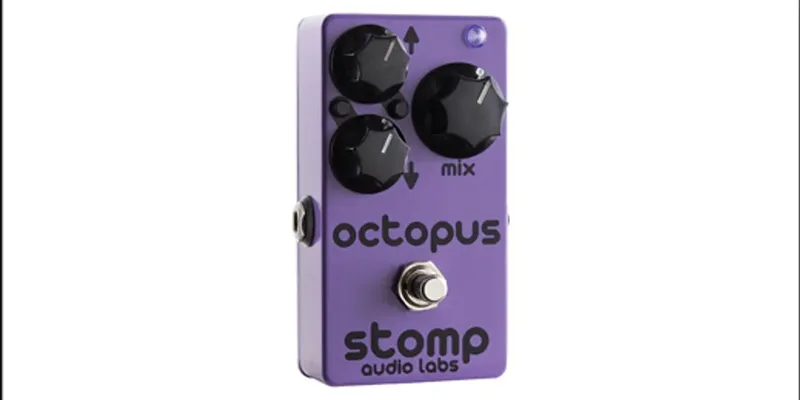

The Stomp Audio Labs Octopus is an all-analog, monophonic octave pedal that runs octave-up and octave-down circuits in parallel, each with its own switchable fuzz, and blends them against your dry signal with a large mix knob1. Stomp Audio Labs unveiled it in December 2016, and Premier Guitar reviewed it in September 2023 at a street price of $19912.
What the Octopus does
Because the Octopus is monophonic, it traces one note at a time, which Stomp Audio Labs noted is especially true when using the lower octave2. That makes it a single-note and riff tool rather than a chord effect: play one line at a time and the octaves follow cleanly, and the design is aimed at players who want octaves under leads and bass lines rather than full strumming.
The two octave engines work in parallel and are blendable, and each carries its own fuzz1. On the octave-up side, pressing the button engages Fuzz mode, which Stomp Audio Labs said generates a lot of gain on that drive, turning the octave into an octafuzz sound2. On the octave-down side, the button engages Synth mode, where the octaved signal becomes a square wave, super compressed and full of harmonics; the company described the Synth mode tone as ranging from a crazy fuzz to an 8-bit video game from the '90s2. Premier Guitar's reviewer heard the same character in the sub-octave fuzz, noting that it utilizes a square wave that evokes gooey analog synth output1.
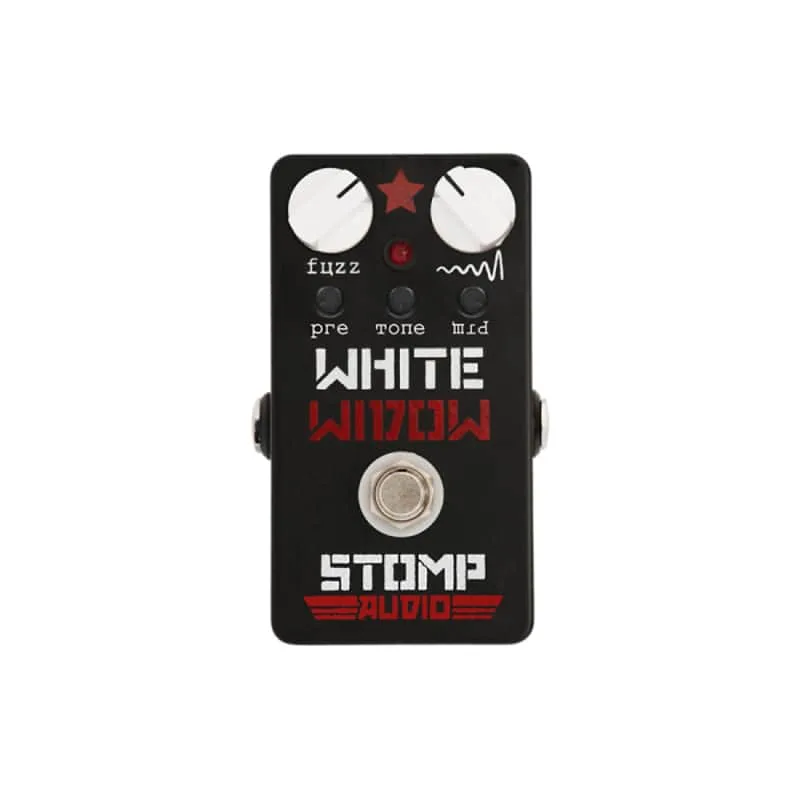
Bass players get a specific callout from the maker: Stomp Audio Labs described the Octopus as a stunner on the bass, generating that sub-grave staggering bass, meaning a strong sub-bass foundation under a bass guitar part2. If you are exploring this corner of the effect world more broadly, the Octave & Pitch Pedals and Fuzz Pedals pages cover the surrounding territory, and Stomp Audio Labs also makes the White Widow Silicon Fuzz.
The controls
The control layout follows the parallel design: one volume control for each octave, plus a mix of the clean signal with the complete octaved signal2. The mix knob is deliberately oversized. Premier Guitar's reviewer wrote that the asymmetrically large mix knob, which blends octave effects with your dry signal, invites expressive, on-the-fly adjustments, so it is sized to be grabbed with a foot mid-song rather than set once and forgotten1.
| Control | What it does |
|---|---|
| Octave-up volume | Sets the level of the octave-up circuit; its button engages Fuzz mode for an octafuzz sound2 |
| Octave-down volume | Sets the level of the octave-down circuit; its button engages Synth mode, a super compressed square wave2 |
| Clean/dry mix | Blends the dry signal with the complete octaved signal2 |
| Mix knob (large) | The same blend, sized for expressive on-the-fly foot adjustments1 |
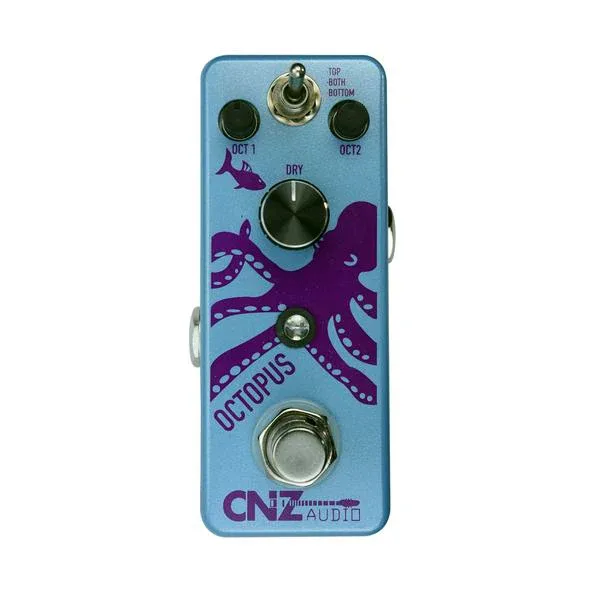
The Octopus name is shared by unrelated pedals: CNZ Audio sells an SOC-10 Octopus octave pedal3, and GuitarPCB offers a Squishy Octopus project4. Specifications for those products do not apply to the Stomp Audio Labs unit described here.
Power
The Octopus runs on either a 9V battery or a side-mounted 9V barrel adapter with center-pin negative polarity1. Center-pin negative is the standard polarity for pedalboard power supplies, so it will sit on a normal supply or daisy chain without adapters. The battery option means it also works away from a board.
What reviewers said
Premier Guitar's reviewer came away impressed by how well the Octopus held up in a modest practice setting: "Octopus, however, sounded clear and detailed with the mix dialed in right, even with a muscular Les Paul1."
"Octopus, however, sounded clear and detailed with the mix dialed in right, even with a muscular Les Paul"
The same review noted that clarity held at bedroom volume through a Fender Champ 600, which matters for players who practice on small amps rather than stage rigs1. The reviewer's overall read was that the parallel, blendable octave-up and octave-down circuits, each with its own switchable fuzz, give the pedal a wide range of octave-fuzz textures to dial between1.
Videos
Sean Gibson
Questions
Is the Stomp Audio Labs Octopus analog or digital?
It is all-analog. Premier Guitar's review describes the Octopus as an all-analog pedal, and Stomp Audio Labs' original press release from 2016 said the same: the Octopus is a monophonic octave pedal that uses an analog circuit to produce lower and higher octaves. There is no digital signal processing or pitch tracking algorithm involved, which is typical of octaver designs that generate octaves by manipulating the incoming signal rather than analyzing it.
Does the Octopus take a 9V battery?
Yes. Premier Guitar's review notes that you can use a 9V battery to power the Octopus, alongside the option of a 9V barrel adapter. Having both means the pedal can sit on a board with a standard supply or run standalone on battery power, which is handy for players who throw it in a bag with a small amp or practice rig.
What polarity does the Octopus power jack use?
The side-mounted 9V barrel adapter uses center-pin negative polarity, the same convention as nearly all modern pedalboard power supplies and daisy chains. Premier Guitar's review specifies a side-mounted 9V barrel adapter with center-pin negative polarity, so a standard center-negative supply is what to reach for.
Can you turn the fuzz off on each octave?
Yes. Premier Guitar's review describes the Octopus as having a switchable fuzz for each octave, so the octave-up and octave-down circuits can each run clean or with their own fuzz engaged. The press release describes the octave-up button's Fuzz mode as generating a lot of gain for an octafuzz sound, and the octave-down button's Synth mode as turning the octaved signal into a super compressed square wave full of harmonics.
Sources (4)
- Stomp Audio Labs Octopus Review, Premier Guitar, 2017-06-13
- Stomp Audio Unveils the Octopus Octaver, Premier Guitar, 2016-12-15
- SOC-10 | Octopus Octave Pedal | CNZ Audio, CNZ Audio
- Squishy Octopus, GuitarPCB