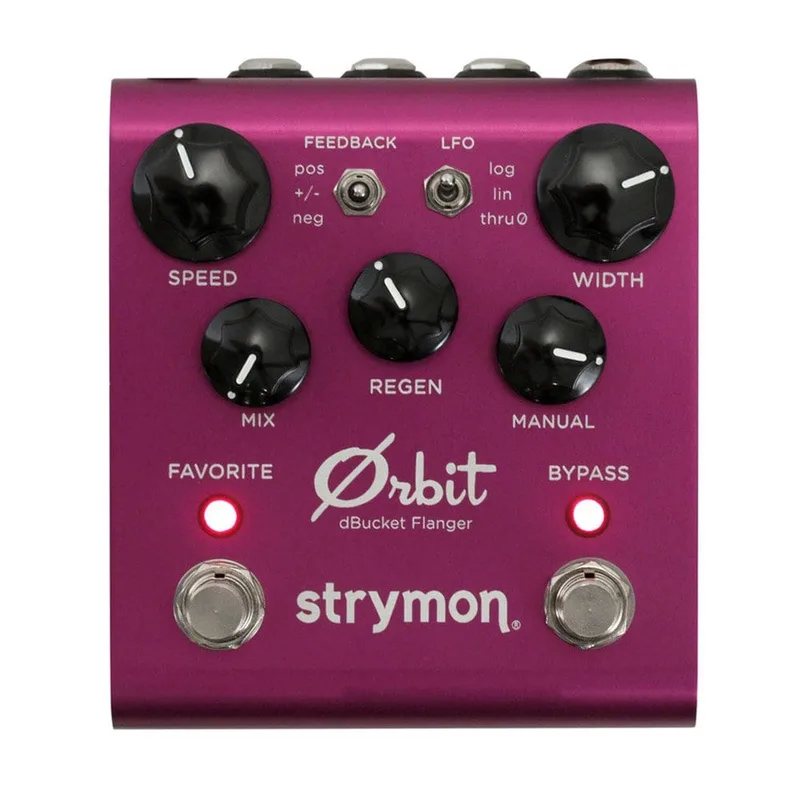


The Strymon Orbit is a flanger pedal from Strymon, first shown in January 2010 and launched that February1. Strymon describes it as a DSP-driven pedal that recreates "every aspect of some of the greatest vintage analog flangers," using a hand-crafted dBucket algorithm that models every stage of an analog bucket brigade chip2. It is a digital pedal with an analog front end and output section, built into a purple anodized aluminum chassis and made in the USA2.
The Orbit is discontinued: Strymon's product page carries a note that it covers a discontinued product2. It sold for $299 US when it launched in June 2010 availability, and Premier Guitar later listed the same $299 direct price34.
What the Orbit does: dBucket flanging in stereo
A flanger works by mixing a delayed copy of your signal back with the original, with the delay time swept by an LFO (low-frequency oscillator). The Orbit's take on this is digital: its dBucket algorithm models the behavior of an analog bucket brigade chip, the circuit at the heart of the vintage analog flangers the pedal sets out to recreate2. Strymon says the DSP "is dedicated entirely to doing one thing and one thing only, delivering the ultimate flanger"2.
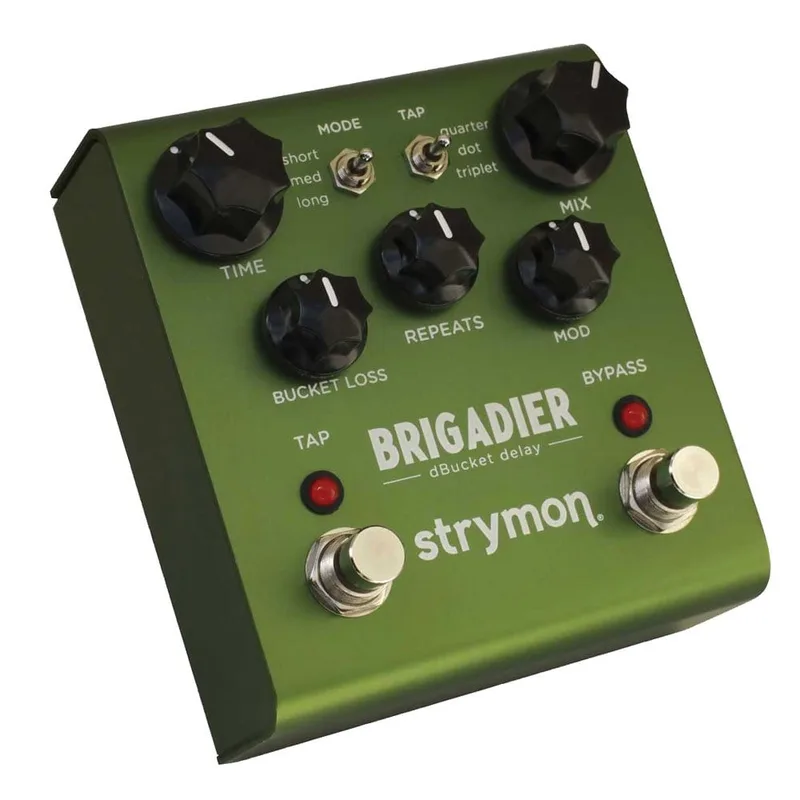
The pedal was built on the dBucket building blocks Strymon developed for its Brigadier delay, and the algorithm carries over that delay lineage into flanging8. Audio quality figures Strymon published include 24-bit 96kHz A/D and D/A converters, a 110dB signal-to-noise ratio, 20Hz to 20kHz frequency response and 32-bit floating point processing9. The launch announcement quoted the same 110dB typical signal-to-noise ratio as keeping the signal "crystal clear"3.
Two toggles set the character of the effect. The Feedback toggle selects Positive, Negative or Positive/Negative feedback, and the LFO toggle selects Logarithmic, Linear or Through Zero shapes310. Strymon's own descriptions of the feedback modes:
- Positive: wet and dry signals in phase, producing a jet-like swish at higher Regen settings9
- Negative: creates "hollow" or "watery" flange sounds9
- Positive/Negative (+/-): frequency dependent feedback combining both modes9
The +/- feedback setting and the Thru 0 LFO setting were both called out as unique to the Orbit in Pedal of the Day's review8. Through-zero flanging, where the delayed signal passes through zero delay relative to the dry signal, is included as a feature Strymon added "to take you where few have ever ventured before"2.
The controls
The front panel carries five knobs, Speed, Width, Mix, Regen and Manual, plus the two toggles and two footswitches3.
| Control | What it does |
|---|---|
| Speed | Adjusts the flanger LFO speed2 |
| Width | Adjusts the LFO's overall depth8 |
| Mix | Varies the amount of dry guitar signal mixed with the wet signal8 |
| Regen | Controls the feedback intensity8 |
| Manual | Sets the delay time for the flanging8 |
| Toggle | Positions |
|---|---|
| Feedback | Positive (jet-engine flange), Negative (watery, shimmery flange), +/- (combines pieces of both)8 |
| LFO | Log (even sweep of the flanger's frequency), Lin (speeds up as frequency rises, slows as it drops), Thru 0 (puts the wet signal ahead of the dry signal)8 |
The Favorite footswitch saves a preset: hold it down to store your favorite setting, stomp it again to recall it42. Holding the Favorite footswitch while plugging in the pedal also assigns the expression pedal to any control4. The expression input lets a foot pedal control any one knob parameter, which Strymon notes "opens up the possibilities for morphing from subdued to wild to even further"2.
Power and connections
The Orbit runs on a maximum of 9 volts DC, center negative, with a minimum of 250mA current, and a 9V center negative DC supply was included with the pedal2. Pedal of the Day's spec listing gives current consumption as 200mA with a 250mA recommended supply8.
At 250mA minimum, the Orbit draws more current than a typical analog pedal, so plan for a dedicated output on a power supply rather than a low-current daisy chain.
Connections are one input and two outputs. The input is high impedance and defaults to mono; on units from June 2012 onward an internal jumper selects between mono and TRS stereo input, and using TRS stereo requires a TRS stereo input adapter26. The Left and Right outputs give stereo output, with Left acting as mono when only one channel is used2.
History and versions
Strymon unveiled the Orbit Flanger on its blog on January 20, 2010, and announced it was shipping on February 3, 20101. The Orbit dBucket Flanger was announced as available on June 10, 2010 at $299 US, sold in North America through the Strymon online store and select authorized dealers3. Pete Celi, Strymon engineer and sound designer, is named as the designer in the launch material, and analog engineer and Strymon co-founder Gregg Stock is named in the unveiling announcement31.
In June 2012, based on customer feedback, Strymon introduced an updated Orbit design with the internal jumper for selectable TRS stereo input and non-click footswitches6. Earlier units, manufactured before June 2012, have a mono input only and are themselves described as discontinued6.
If you are buying an Orbit secondhand, check which version it is: pre-June 2012 units have a fixed mono input, while later units can be jumpered for TRS stereo input6.
To set the input jumper on an updated unit, open the pedal and place the jumper on the left two pins for TRS stereo input, or the right two pins for mono input6.
What reviewers said
Premier Guitar reviewed the Orbit alongside the Strymon Brigadier, Ola and blueSky in its July 2010 issue11. The reviewer's verdict on the Orbit's range:
"But the Orbit opens up a lot more possibilities in the modulation realm."
Pedal of the Day reviewed the Orbit dBucket Flanger in August 2015, covering its controls, toggle modes and dBucket lineage8. Reviewer Mike B found the build and range held up:
"Made from only the highest-quality components, the design and build teams have once again taken no shortcuts, and has created an incredible flanger with loads of options, tons of range and delicious sonic sounds, for a great addition to any rig."
On the sound itself, the same review was direct:
"the sound is just phenomenal, and will put a big grin on your face as soon as you plug it in."
The review also noted how the Regen control works with the other knobs "to produce a marvelous array of flanged tones," and that the +/- feedback setting opens "an entirely new array of tones, great for really seeing what this pedal can produce"8.
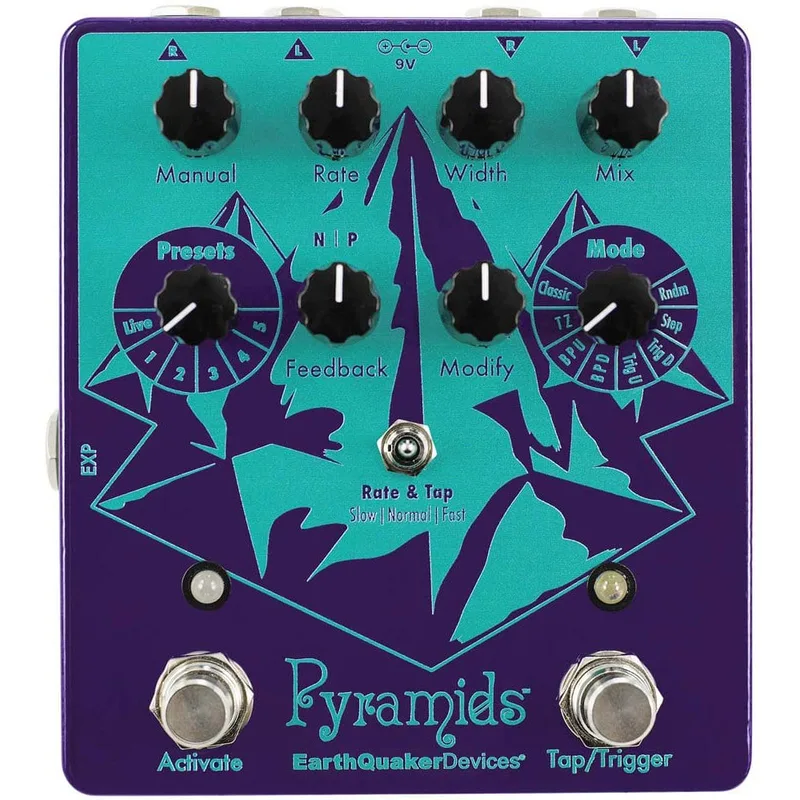
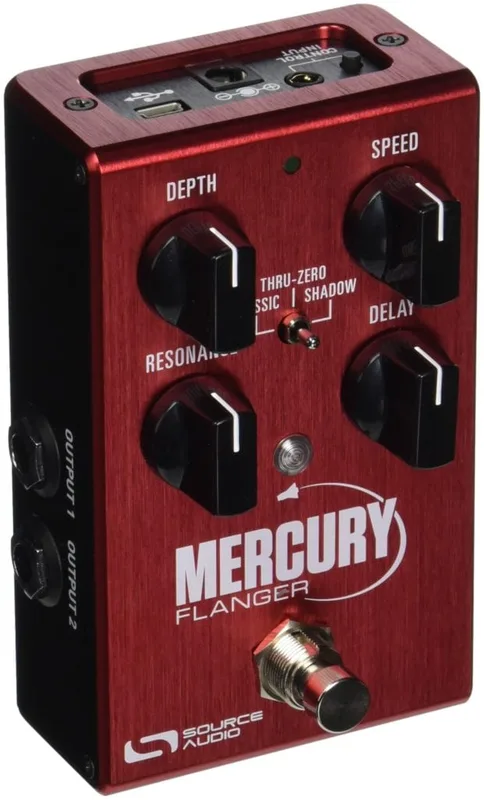
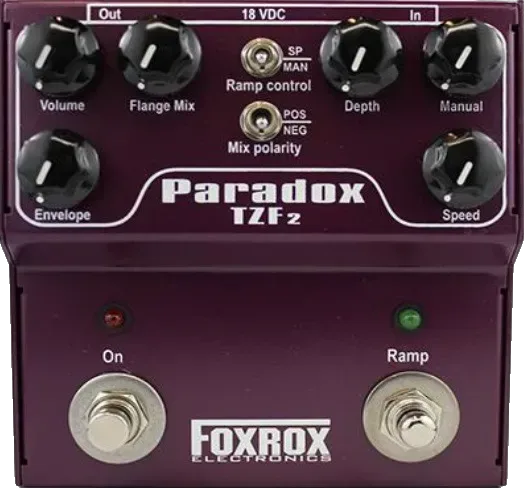
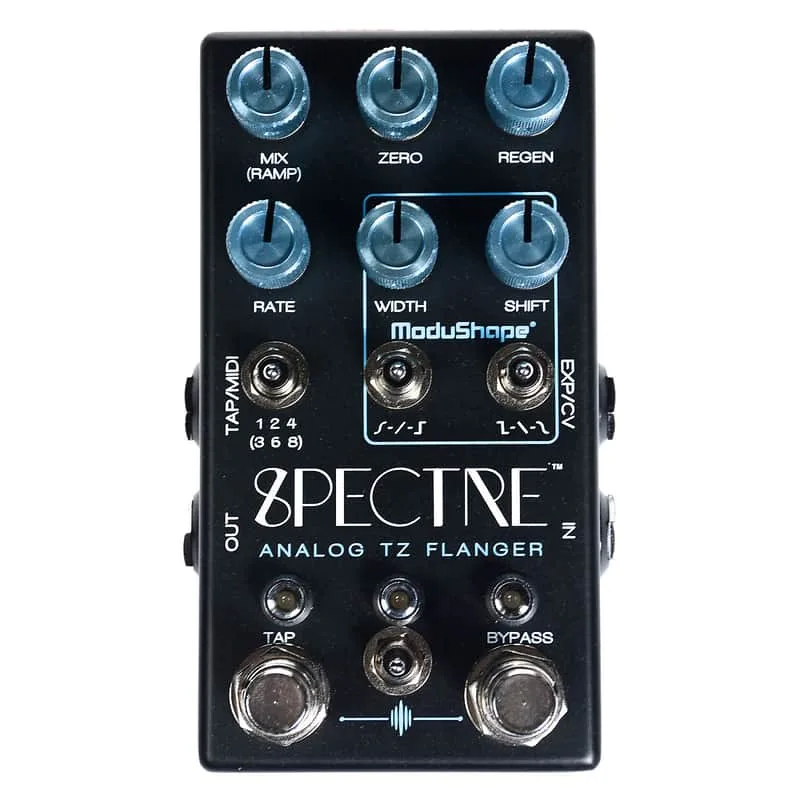
For players comparing flangers today, the Orbit sits among DSP-based stereo options like the EarthQuaker Devices Pyramids Stereo Flanging Device and the Source Audio Mercury, and among through-zero designs like the Foxrox Electronics Foxrox Paradox TZF 2 and the Chase Bliss Audio Spectre Analog TZ Flanger.
Videos
Sweetwater
strymon
strymon
Questions
Is the Strymon Orbit true bypass?
Yes. Strymon specifies true bypass using electromechanical relay switching, so with the pedal off your signal passes without the DSP in the path. The bypass was listed in both the original 2010 launch announcement and the product page specifications.
Can the Strymon Orbit do through-zero flanging?
Yes. Through Zero is one of the three LFO types on the LFO toggle, alongside Logarithmic and Linear. In the Thru 0 setting the wet signal is placed ahead of the dry signal, which creates the unusual and intense flanging that through-zero flanging is known for.
How do I set the Strymon Orbit to stereo input?
On units built from June 2012 onward, open the pedal and move an internal jumper onto the left two pins for TRS stereo input, or the right two pins for mono input. You also need a TRS stereo input adapter to feed both channels through the single input jack.
Can I use an expression pedal with the Strymon Orbit?
Yes. The Orbit has an expression pedal input, and any one knob parameter can be assigned to the expression pedal. Hold the Favorite footswitch while plugging in the pedal to assign the expression pedal to a control.
Is the Strymon Orbit discontinued?
Yes. Strymon's product page carries a note that it is for a discontinued product. The pedal was launched in 2010 at $299 US and received an updated design in June 2012 with selectable TRS stereo input and non-click footswitches.
Does the Strymon Orbit have stereo outputs?
Yes. It has Left and Right outputs, and the Left output acts as a mono output when only one channel is being used. The input can also be set to TRS stereo via an internal jumper on units from June 2012 onward.
Sources (11)
- The Orbit Flanger unveiled!, Strymon, 2010-01-20
- Orbit Brochure, Strymon, 2025-01-31
- Strymon Orbit dBucket Flanger Effect Pedal Now Available, Strymon, 2010-06-10
- Strymon Pedal Reviews: Brigadier, Orbit, Blue Sky, Ola, Premier Guitar, 2010-06-16
- Orbit flanger now shipping, Strymon, 2010-02-04
- How do I enable the TRS input on the Orbit?, Strymon, 2021-07-16
- What are the dimensions of my pedal?, Strymon, 2021-07-20
- Strymon Orbit dBucket Flanger, Pedal of the Day (pedal-of-the-day.com), 2015-08-02
- What is a Flanger?, Strymon (www.strymon.net), 2018-02-01
- Get to know Orbit, our friendly flanger., www.strymon.net, 2010-10-21
- Premier Guitar review of Brigadier, Orbit, Ola and blueSky, Strymon (blog post quoting Premier Guitar), 2010-07-03