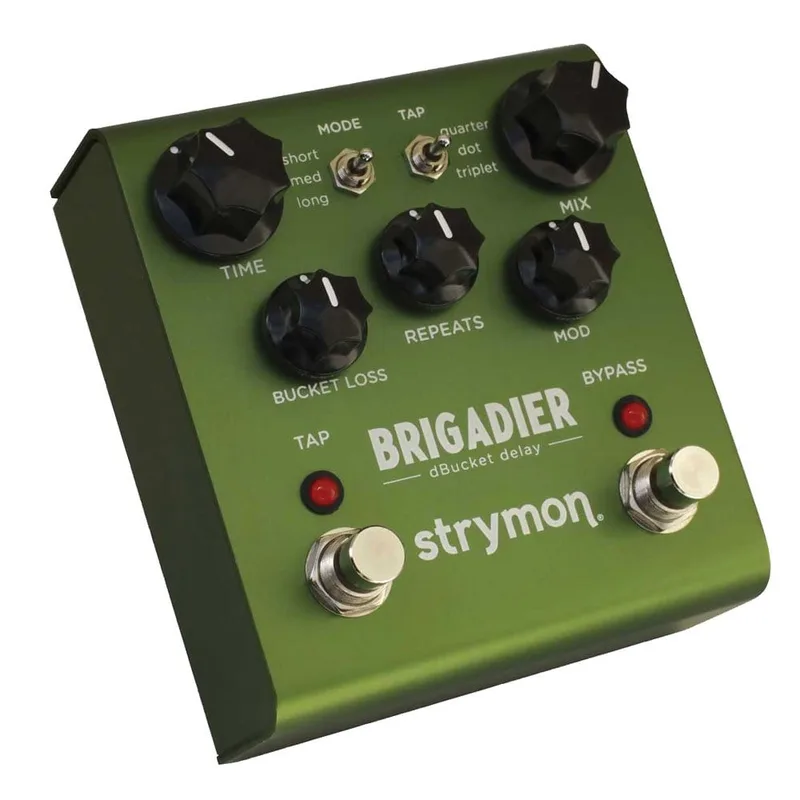



The Strymon Brigadier is a delay pedal from Strymon that models an analog bucket-brigade delay in digital hardware. A bucket-brigade device, or BBD, is the chip at the heart of classic analog delay pedals: it passes your signal along a line of capacitors one step at a time, which gives analog delays their dark repeats and noise as the signal degrades on its way through. The Brigadier runs a hand crafted, computationally intense dBucket algorithm on a SHARC DSP for what Strymon describes as "highly accurate reproduction of every stage of an analog bucket brigade chip and the associated clock driver circuitry"12. The dry signal never goes through the converters at all: it stays on an analog path for zero latency2.
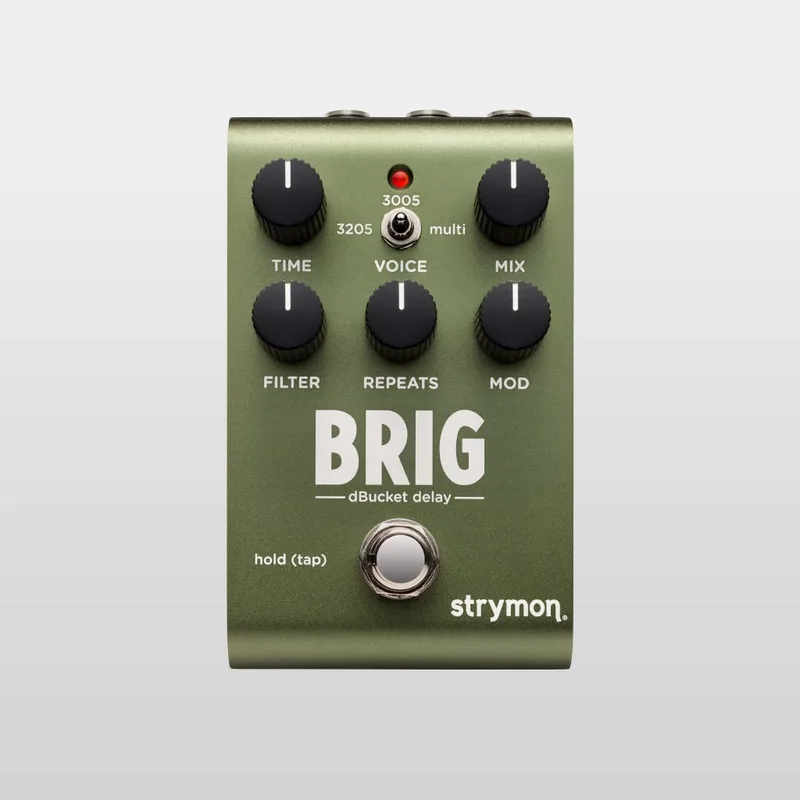
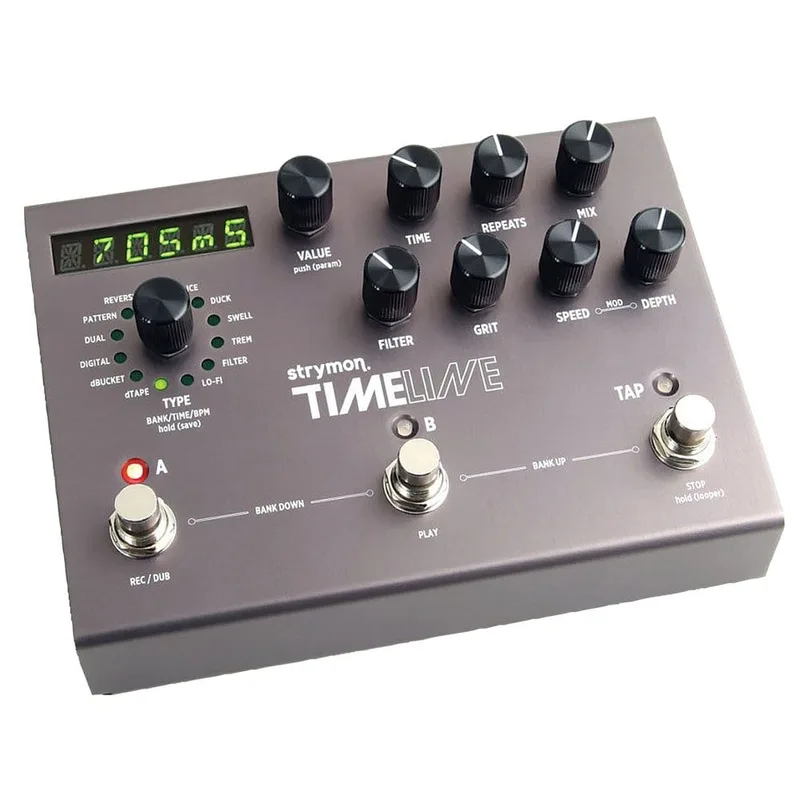
The pedal shipped in 2010 at $299 (US)1, and Strymon has since discontinued it2. Its dBucket approach lives on in the compact Strymon Brig, which Strymon says "shares lineage with our classic Brigadier pedal"3, and in the dBucket delay machine inside the Strymon Timeline4.
What it does: a DSP model of bucket-brigade analog delay
Strymon's pitch for the Brigadier was to "take a super-powerful SHARC DSP and dedicate all of its horsepower to doing one thing and one thing only, delivering the best analog bucket brigade sound ever"2. In practice that means the pedal reproduces what a BBD chip does to a signal, including the losses, and gives you a knob to control how much of that character you want. The Bucket Loss control varies the amount of loss at each stage of the dBucket algorithm, from no loss at minimum to full noisy loss at maximum; Strymon says the 3:00 position gives maximum distortion with just a hint of noise2.
The signal path is built around quality conversion where the wet signal is concerned: 24-bit 96kHz A/D and D/A converters, 115dB typical signal to noise, a +8dBu maximum input level that handles instrument and line signals, and 20Hz to 20kHz frequency response2. Strymon's support pages sum up the concept: "Brigadier is an authentic recreation of analog bucket-brigade style delays with a selectable dBucket 'chip' to choose from short, medium, and long delays of 40ms, 5 seconds"6.
Controls
| Control | What it does |
|---|---|
| Time | Sets delay time within the selected mode's range7 |
| Mode | Three-way switch: adjusts the number of dBucket "chips" to set the delay time range2 |
| Mix | Balances analog dry and wet signal, 100% dry to 100% wet, mixed entirely in analog; 50/50 at 3:002 |
| Repeats | Varies repeats from one to runaway oscillation; at 3:00 a sustained infinite repeat without runaway2 |
| Mod | Adds LFO modulation to the delay time; off at minimum, slow speed in the first half of the knob, fast in the second2 |
| Bucket Loss | Controls bucket loss at each stage of the dBucket, from none to full noisy loss2 |
| Tap | Three-way switch: quarter notes, dotted eighth notes, or eighth note triplets2 |
Two secondary features hide behind a button combination: holding Tap and Bypass while turning the Mix knob gives a plus or minus 3dB boost or cut when the pedal is engaged, and holding them while turning the Bucket Loss knob opens a Filter control that makes the repeats darker or brighter2. Holding the tap footswitch on its own produces infinite repeats2.
The expression jack does double duty. An expression pedal can be assigned to control any one knob with your foot28, or the jack accepts a Favorite switch that saves and recalls a preset2.
Power and connections
The Brigadier runs on a maximum of 9 volts DC, center negative, with a minimum of 250mA of current, and Strymon included a 9V center negative supply with the pedal2. That 250mA draw rules out a standard battery and is worth bearing in mind if you daisy chain pedals on a shared supply.
Connections are straightforward: a high impedance input on one side, Left and Right outputs on the other, with the Left output acting as the mono output when only one channel is used2. There is also an expression pedal input that lets you control any one knob with your foot, or accepts a Favorite switch to save and recall a preset2.
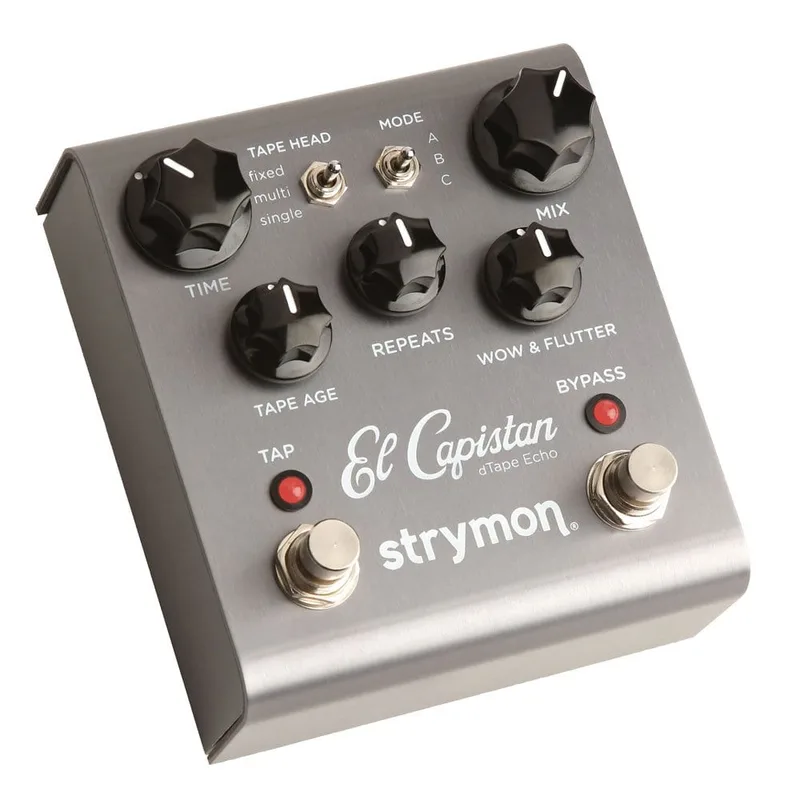
The Brigadier does not support an external tap tempo switch. Strymon's support documentation states that "neither El Capistan nor Brigadier support the use of an external TAP tempo switch"9. Tap in quarter notes on the pedal's own footswitch; the TAP LED flashes to indicate the tempo2.
Mono and stereo input versions
There are two hardware versions of the Brigadier. Units manufactured before May 2012 have a mono input and are now discontinued10. In May 2012 Strymon introduced an updated design "that includes an internal jumper allowing for selectable TRS stereo input, as well as non-click footswitches"10. On the updated pedal, the input can be set for either mono or TRS stereo input10, and both versions have stereo outputs21.
A mono input Brigadier cannot be converted to the TRS stereo version. Strymon's answer is blunt: "Sorry, no. There isn't any way to convert your Brigadier mono input to Brigadier (TRS stereo) specs or upgrade to the silent type switches"11. The designs are different and the parts are not interchangeable.
What reviewers said
Premier Guitar reviewed the Brigadier in its July 2010 issue alongside the Orbit, Ola and blueSky12, and its reviewer found the pedal captured the character of vintage analog delays with a modern edge: "The Brigadier has that cool, lo-fi vibe, but with a much stronger, healthier projection in its repeats"7. The same review confirmed the control layout of two footswitches (Tap Tempo and Bypass), three-way Mode and Tap switches, and the five knobs7, and noted that with Mode set to Long the pedal generates five seconds of delay time7.
Pedal of the Day's 2014 review praised the Mix knob in particular: "I love the Mix knob on just about any pedal, and it works extremely well here, too, letting you blend the Wet and Dry signals as you see fit"5. The same review highlighted the expression pedal input, the stereo output for multi-amp setups, and the range of the three delay modes from 40ms up to 5 seconds5.
Documented players include Tom Bukovac, whose use of the original Brigadier is cited in gearnews' coverage of the Brig13, and Tim Mahoney of 311, who had a Brigadier on his pedalboard14.
Where it sits in Strymon's delay line
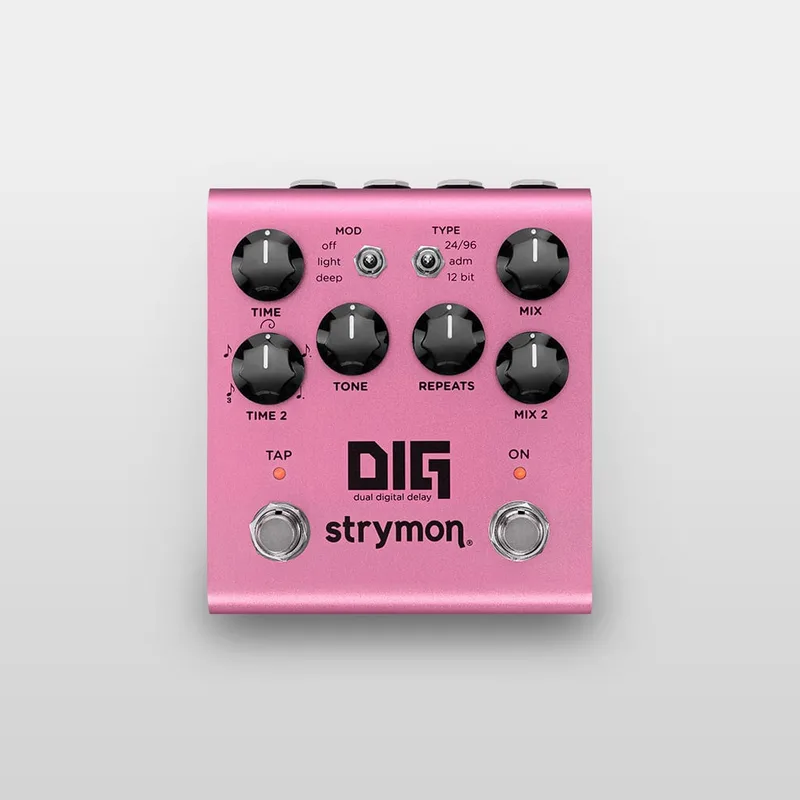
Strymon's delay pedals each model a different delay technology, and the company's support pages describe the DIG, El Capistan and Brigadier as pedals that "all provide delay effects, each with their own tonal characteristics and feature sets"6. The Brigadier is the bucket-brigade model; El Capistan models tape echo, and the DIG models digital delays. The dBucket algorithm also appears as one of the delay machines in the Timeline, where MusicRadar's NAMM 2011 coverage described it as "a deep and nuanced recreation of analog bucket brigade-style delay types" with its own Bucket Loss, Filter and Mod controls4.
After the Brigadier was discontinued, Strymon released the compact Brig dBucket Delay, which Delicious Audio called "the compact evolution of the Californian company's Brigadier"15. Pedal of the Day's verdict on the Brig was enthusiastic: "Strymon has done it once again, folks, go grab a Brig and get creating!!"16. Where the Brigadier used Long, Medium and Short mode names, the Brig uses 3205, 3005 and Multi, named for the BBD chips they model17.
Videos
Sweetwater
strymon
gearwire
Questions
Is the Strymon Brigadier discontinued?
Yes. Strymon's own product page for the Brigadier carries a note that it is a discontinued product. The mono input version, built before May 2012, was discontinued earlier still. Strymon's later Brig dBucket Delay is a compact pedal that shares its lineage and its dBucket approach.
Is the Strymon Brigadier true bypass?
Yes, by default. The Brigadier uses electromechanical relay switching for true bypass. Holding the bypass footswitch while powering up switches it to analog bypass with trails, so the delay persists after you disengage the effect. Strymon describes this trails mode as a high quality, transparent analog buffered bypass.
How long can the Brigadier delay go?
Up to five seconds. The Mode knob selects three delay time ranges: Short runs 40ms to 400ms, Medium runs 100ms to 1000ms, and Long runs 500ms to 5 seconds. Mode works by adjusting the number of dBucket chips modeled in the delay.
Can I convert a mono Brigadier to stereo?
No. Strymon states plainly that there is no way to convert a mono input Brigadier to the TRS stereo input version, and the parts are not interchangeable. The mono version also cannot be upgraded to the silent type footswitches used in the later design.
Does the Brigadier work with an external tap tempo switch?
No. Strymon's support documentation says that neither the Brigadier nor the El Capistan supports an external tap tempo switch. Tap tempo is done on the pedal's own tap footswitch, with the tap LED flashing to indicate the tempo.
Is the Brigadier analog or digital?
It is digital. The Brigadier uses a SHARC DSP running Strymon's dBucket algorithm, which models every stage of an analog bucket brigade chip and its clock driver circuitry. The dry signal, however, stays on an analog path and is never converted to digital.
Sources (17)
- Strymon Brigadier dBucket Delay Effect Pedal Now Available, Strymon, 2010-06-10
- Brigadier Brochure, Strymon, 2023-12-05
- Introducing Brig dBucket Delay, Strymon, 2023-07-14
- NAMM 2011: Strymon TimeLine delay pedal unveiled, MusicRadar, 2011-01-21
- Strymon Brigadier dBucket Delay, Pedal of the Day (www.pedal-of-the-day.com), 2014-09-14
- What is the difference between DIG, El Capistan, and Brigadier?, Strymon, 2021-07-21
- Strymon Pedal Reviews: Brigadier, Orbit, Blue Sky, Ola, Premier Guitar, 2010-06-16
- How to Assign a Parameter to an Expression Pedal (El Capistan, Flint, Brigadier, Orbit, Dig), Strymon, 2021-07-21
- Do either El Capistan or Brigadier support an external TAP tempo switch?, Strymon, 2021-07-20
- How do I enable the TRS stereo input on Brigadier?, www.strymon.net, 2022-05-07
- Can my Brigadier mono input be modded with silent switches and converted to Brigadier (TRS stereo)?, Strymon, 2021-07-21
- Premier Guitar review of Brigadier, Orbit, Ola and blueSky, Strymon (blog post quoting Premier Guitar), 2010-07-03
- Strymon Brig Delay: dBucket Delay pedal, gearnews.com, 2023-07-18
- Featured Pedalboard: Tim Mahoney of 311, Strymon, 2018-11-12
- Strymon Brig DBucket Stereo Delay, Delicious Audio, 2023-12-04
- Strymon Brig dBucket Delay, Pedal of the Day (www.pedal-of-the-day.com), 2023-07-18
- Strymon reveals its new compact delay pedal Brig: and it's all about celebrating the analogue Bucket Brigade sound, MusicRadar, 2023-07-18
 The Edge
 Tim Mahoney