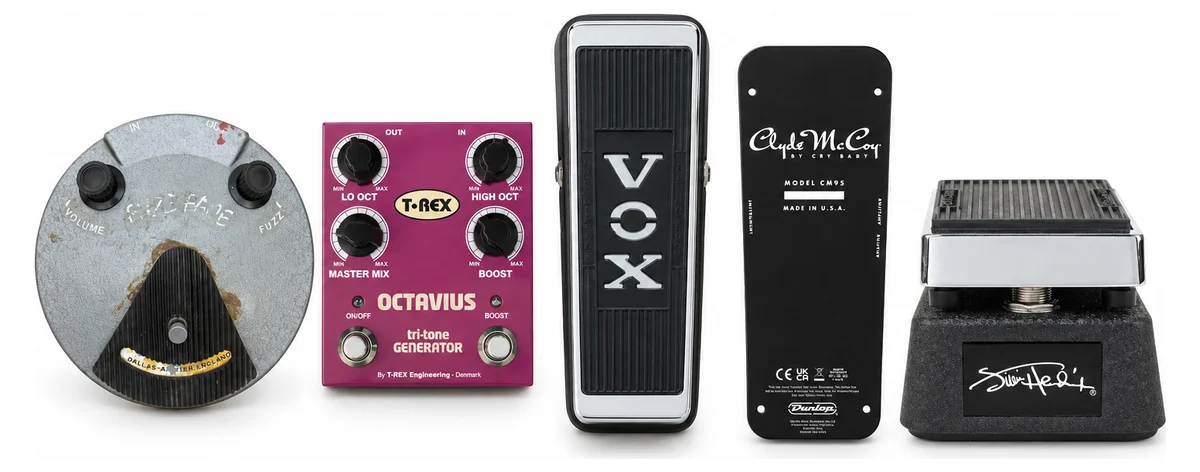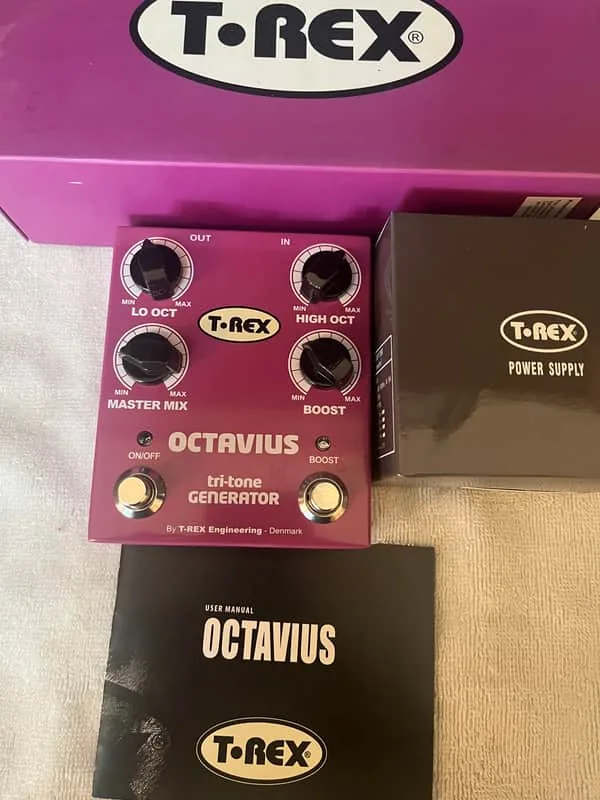


The T-Rex Effects Octavius Tri-Tone Generator is a polyphonic octave divider pedal. It produces an octave above and an octave below your guitar's signal while maintaining the original signal, so you can blend all three sounds together. Premier Guitar's 2010 review describes using that mixing ability to create "a wide assortment of big, fat doubling effects" and thicker guitar lines1.
The pedal was introduced in 2010, when Premier Guitar reviewed it as part of Tone Games 2010, and it was shown alongside the Mudhoney II at Summer NAMM 20101.
What it does to your sound
As an octave divider, the Octavius generates notes an octave above and an octave below what you play, on top of your untouched original signal. Because it is polyphonic, it handles chords as well as single notes. Premier Guitar's reviewer found the tracking seamless: "The coolest thing about this pedal is that you don't have to turn it off to play chords. You can arpeggiate!"1
Controls
The review details one control directly:
| Control | What it does |
|---|---|
| Lo Oct knob | Sets the volume of the lower octave1 |
The pedal's three sounds, the original, the octave above, and the octave below, can be mixed, which is where the "Tri-Tone" name comes from1.
Power
The Octavius ships with an included 1250 mA external power supply rated at 12V DC. The review also states the pedal can run on 9V DC with a 155 mA current draw. At 155 mA, it draws more than many common pedals, so plan your power supply accordingly.
What reviewers said
Premier Guitar's 2010 review is the published verdict on record. The reviewer praised the tracking as seamless enough for chords and arpeggios, found chords and single notes sounded "transparent, clean, and bigger," and called the ability to play chords without switching the pedal off the coolest thing about it1. For other pedals in the same family, see Octave & Pitch Pedals.
Videos
ProGuitarShopDemos
Premier Guitar
T-Rex Effects
Questions
Is the T-Rex Octavius polyphonic?
Yes. Premier Guitar's 2010 review describes the Octavius as a polyphonic octave divider, meaning it can produce its octave-above and octave-below voices alongside chords as well as single notes. The reviewer highlighted that tracking was seamless enough that you could arpeggiate without turning the pedal off, and that chords or single notes sounded transparent, clean, and bigger.
Does the Octavius run on a 9V battery?
The review does not mention battery operation. It states the Octavius can run on 9V DC with a 155 mA current draw, and that the pedal ships with an included 1250 mA external power supply rated at 12V DC. With a current draw of 155 mA, a standard daisy chain with other pedals may not be reliable, so a dedicated supply output is the safer route.
What power supply comes with the Octavius?
The Octavius ships with an included external power supply rated at 1250 mA. According to Premier Guitar's review, that supply is 12V DC. The pedal itself can also run on 9V DC with a 155 mA current draw.
Does the Octavius keep the original signal?
Yes. Premier Guitar describes the Octavius as producing an octave above and below your guitar's signal while maintaining the original signal, so the three sounds can be mixed together. The review notes this mixing ability lets you create a wide assortment of big, fat doubling effects and thicker guitar lines.
Sources (1)
- T-Rex Octavius Tri-Tone Generator Pedal Review, Premier Guitar, 2010-10-28