| Type | Boost / overdrive pedal, silicon transistor circuit78 |
| Maker | Sola Sound (British), around 19711 |
| Designer | Gary Stewart, who later founded Colorsound1 |
| Power | Single 9V battery29 |
| Controls | Treble, Bass, overdrive, and Master Volume10 |
| Status | Vintage units sought after by collectors; widely cloned and reissued1 |
The Colorsound Overdriver is a British boost-and-overdrive pedal built by Sola Sound around 1971. It grew out of the earlier Colorsound Power Boost, an 18-volt pedal from 1969-70, and it kept the same basic circuit while dropping the power requirement to a single 9V battery123. Tru-Fi's history of the pedal describes it as a design by Gary Stewart, who later founded Colorsound, and says vintage units are now sought after by guitar enthusiasts and collectors1.
For a player, the Overdriver matters because it sits between two categories. GuitarPCB, whose ColorTone board is a copy of the circuit, describes the original this way456:
"The classic Colorsound Overdriver™ bridged the gap between Boost & Overdrive recreating many of those popular, but hard to get tones of the 70's"4
At low drive settings it works as a clean-ish boost with bass and treble shaping; pushing the overdrive control drives the transistors into breakup. Users named in the sources include David Gilmour of Pink Floyd, Jeff Beck, Marc Bolan of T. Rex, and Jan Akkerman of Focus24.
Where the Overdriver came from
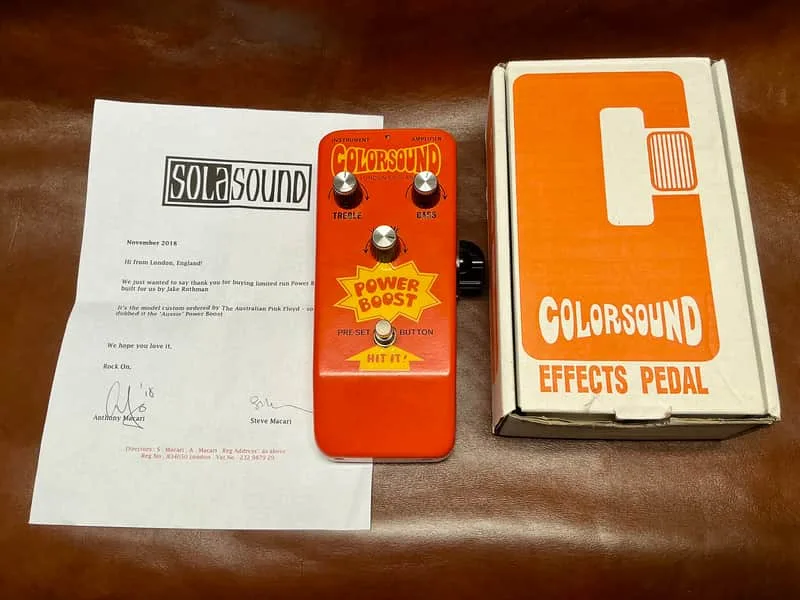
The Overdriver was created by Sola Sound, a British company, around 1971, and was designed by Gary Stewart, who later founded Colorsound1. Tru-Fi's account dates the change precisely: "In 1971 Colorsound changed the Power Boost to the 9V Overdriver"23. The pedal gained popularity in the 1970s and was used by various guitarists of that era1.
Colorsound itself, the company Stewart founded, produced a variety of effects pedals beyond the Overdriver, with its own designs and tonal characteristics1. Analog Man's page on the pedal describes one American-market version as a "1974 era fuzz box made for the American market" in a "thin stamped grey metal case (narrow)," listed at $259 in 201510. That price is Analog Man's own list price for a unit it sold, not the original 1970s retail price.
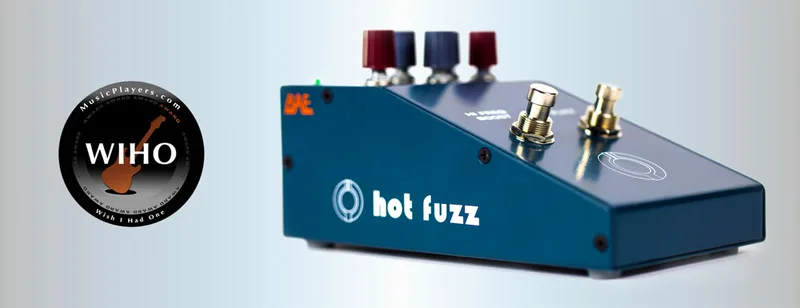
The circuit's reach extends beyond straight reissues. Premier Guitar, reviewing the BAE Hot Fuzz, noted that "BAE says the Hot Fuzz's design has Colorsound Overdriver origins"11, and the pedal's circuit family is one of the most copied British designs among boutique builders and DIY PCB makers.
How it works: three transistors with bass and treble boost
The Overdriver is a three-transistor circuit, not an op-amp or clipping-diode design like the Tube Screamer. Its original units came with BC169C transistors in the Q1 and Q2 positions and a BC184C in Q312.
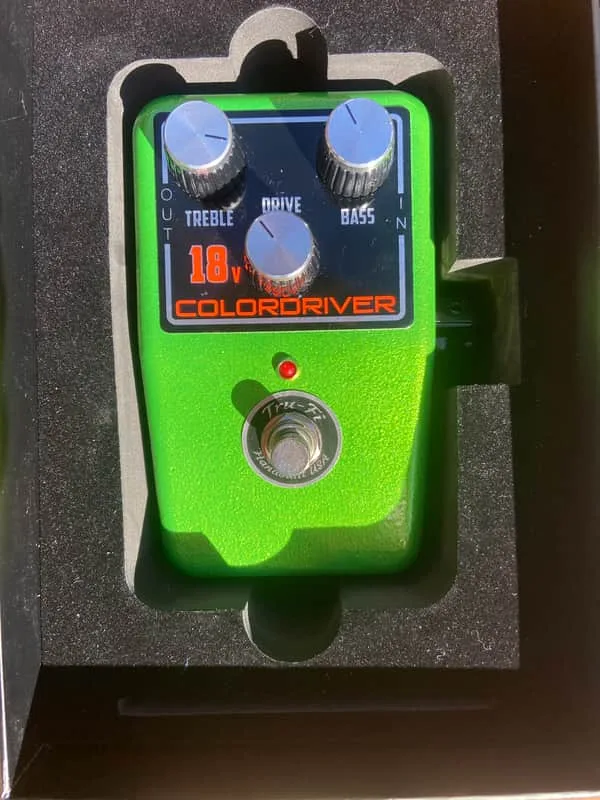
The original transistors were BC169C in the first two positions (Q1 and Q2) with a BC184C in the third (Q3)312. Tru-Fi, building its 18V Colordriver as "a true Power Boost replica," says it is "done to the correct BC184 Transistors"3. The circuit is a three-stage silicon design, and the original transistors are now the hard-to-source part of any faithful build.
The tone shaping is the other half of the character. The pedal carries separate bass and treble controls, which allow a wide range of tonal options, including a full-on treble boost, rather than a single rolled-off treble cut like a classic treble booster such as the Rangemaster. This distinctive bass and treble boost is part of what marks it as an overdrive pedal rather than purely a boost8.
The Power Boost connection: same circuit at 18V
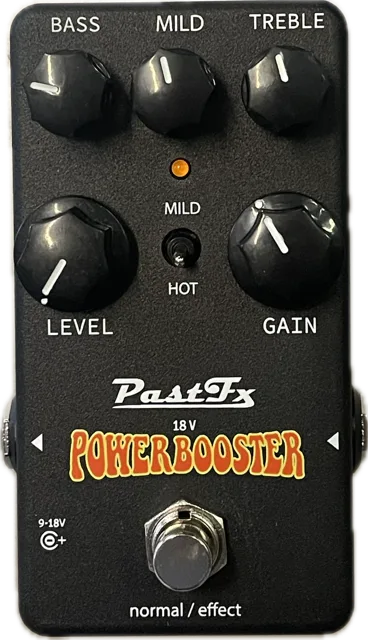
The Overdriver is really the second act of one circuit. The Colorsound Power Boost, an 18-volt pedal from 1969-70, came first3. Aion FX describes the lineage: "The Power Booster ran at 18V using two batteries in series," and "The Colorsound Overdriver was an updated version of this circuit, a third revision from 1972"9. PastFx calls the Power Booster "one of the first overdrive effects pedals made available to the masses"13, and its own 18V Power Booster is "inspired by the legendary Colorsound Power Booster circuit"14.
The reason for the change, according to Tru-Fi, was volume:
"This was to tame the Power Booster as before the master volume mod the pedal was TOO LOUD at 18V so the 9V version was released"2
So the story of the two pedals runs in two steps. First, the master volume was added to the 18V Power Boost circuit to make its overdrive usable at reasonable levels. Then the power supply was dropped to a single 9V battery, which tamed the pedal further and became the Overdriver29. Aion FX's summary of the Overdriver is that it "dropped the power requirement down to a single battery"9.
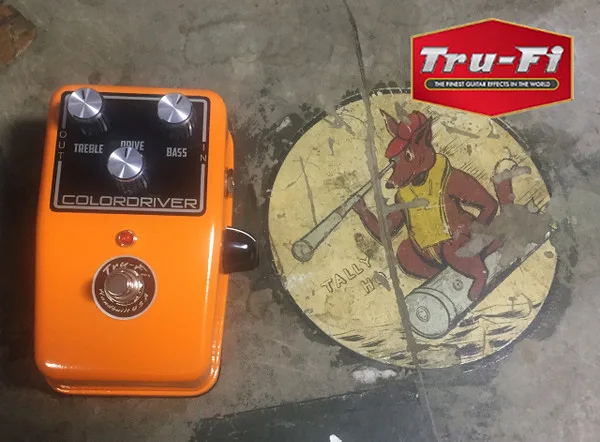
For players comparing the two today, the practical difference is headroom. The 18V versions have more clean boost range before the transistors break up; the 9V version distorts earlier. Builders offer both: Tru-Fi makes a 9V Colordriver based on the 9V Overdriver and an 18V Colordriver based on the Power Boost23, and PastFx builds its 18V Power Booster on the original circuit1413.
The controls and the master volume
Analog Man lists the control set as four knobs: Treble, Bass, overdrive, and Master Volume, with the "Master Volume added to allow overdrive at useable volumes"10.
| Control | What it does |
|---|---|
| Treble | Boosts the high end |
| Bass | Boosts the low end |
| Overdrive | Sets the amount of push into the transistors |
| Master Volume | Sets the output level, added so overdrive is usable at reasonable volumes10 |
The master volume is the control that defines the pedal's place in history. Before it, the Power Boost at 18V was simply too loud to use its overdrive at band volumes2. After it, the same circuit became a practical overdrive pedal. GuitarPCB's ColorTone v3 board adds the same idea to its copy: "We have added some modifications to the original by adding a Master volume control"5.
One thing the master volume does not do is turn the pedal all the way down to silence. Its job is trimming a loud circuit to a usable level, not acting as a full attenuator, which is why reissues and clones built the same way cannot be dialed down to zero output15.
Versions and reissues
Tru-Fi's history notes that "Over the years, there have been different variations and reissues of the Colorsound Overdriver. Some versions featured slight modifications to the circuit or enclosure design"1. Aion FX identifies the Overdriver itself as "a third revision from 1972" of the Power Boost circuit9, so even within the original run the circuit was revised.
Current production options include:
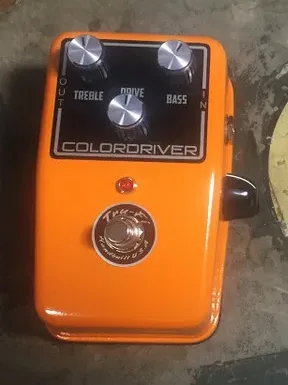
- Tru-Fi Colordriver 9V: a hand-made recreation of the 9V Overdriver2
- Tru-Fi Colordriver 18V: a Power Boost replica built with BC184 transistors3
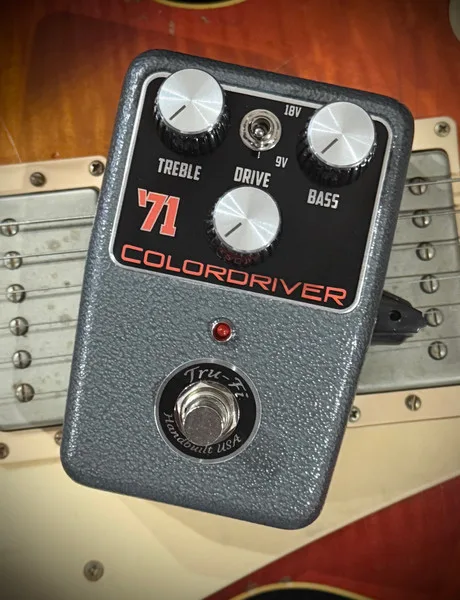
- Tru-Fi ColorDriver '71 Mini: the 1971 Sola Sound circuit in a smaller, modern enclosure16
- PastFx 18V Power Booster: the earlier 18V circuit, built by PastFx1413
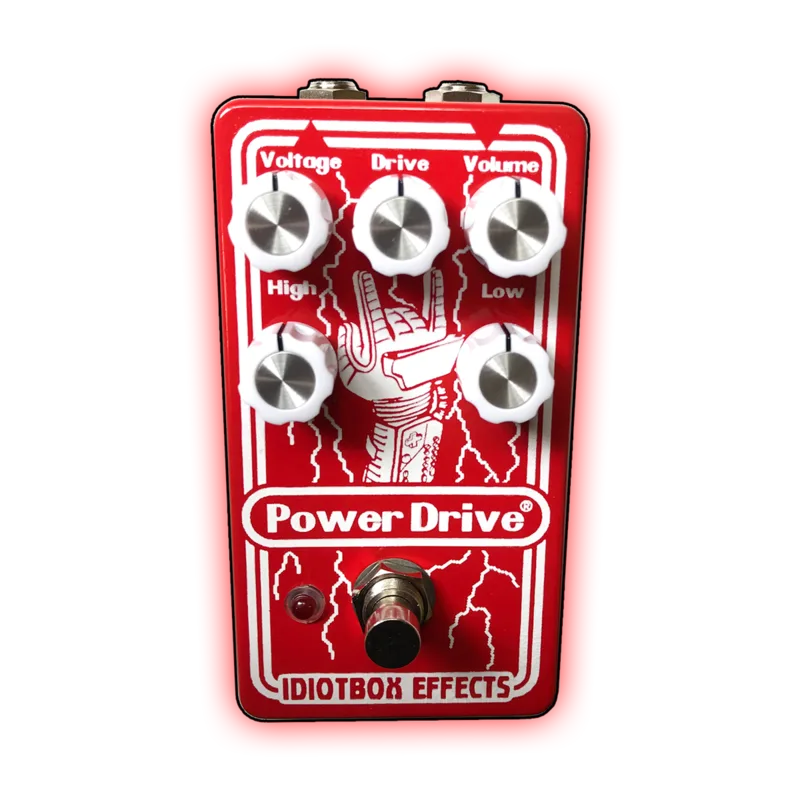
- IdiotBox Power Drive: based around the old Colorsound Power Boost17
- Dr. No Effects PowerDriver & Booster: a two-in-one take, with the overdrive side giving "raw but clear overdrive" for rhythm and a booster side for lead18
RockBoard's PedalPedia describes the Tru-Fi Colordriver as "a handmade recreation of the vintage Colorsound Power Booster / Overdriver circuit"19, which captures the point that modern builders treat the two pedals as one circuit family.
Pedals and DIY layouts based on it
The Overdriver is a favorite among DIY builders because the circuit is simple, documented, and built from ordinary parts. The main options:
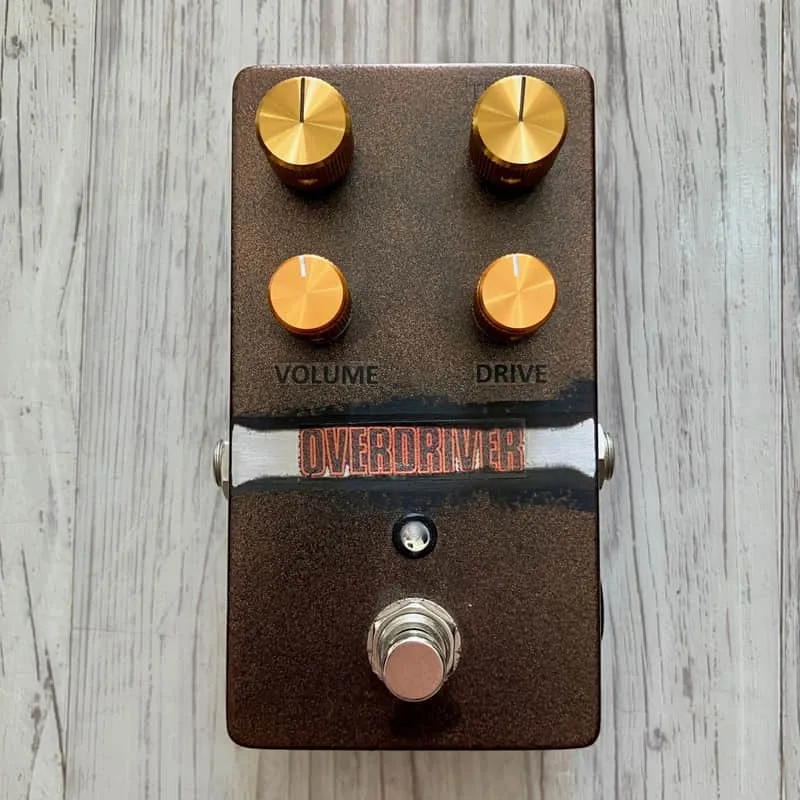
- GuitarPCB ColorTone Overdrive v3: a DIY PCB for building a similar circuit, with a master volume added to the original design45. The v2 build document, written by Bruce R, describes the same circuit and the same boost-to-overdrive character6.
- Aion FX Plasma: Aion FX offers the Overdriver circuit as one of its own projects, called the Plasma9.
- PedalPCB Powersound Overdrive: a DIY PCB listed for comparison to the Colorsound Overdriver.
GuitarPCB's pitch for its board is straightforward:
"Now you to can build a similar style circuit without overpaying"6
That is the practical appeal of the circuit today. Vintage units are collector pieces1, but the design uses a handful of transistors and passive parts, so a builder can reproduce the boost-and-overdrive character for the cost of a PCB and components. The one challenge is the original transistors: the BC169 family is described as difficult to obtain and expensive, so most builds substitute modern silicon parts12.
For a player who wants the sound without a soldering iron, the reissues above cover both voltages: 9V versions voiced like the Overdriver and 18V versions voiced like the Power Boost2314.
Pedals on this page
Questions
Who designed the Colorsound Overdriver?
The Overdriver was designed by Gary Stewart, who later founded Colorsound. The pedal itself was created by Sola Sound, a British company, around 1971. Colorsound, the company Stewart founded, went on to produce a variety of effects pedals beyond the Overdriver.
Did David Gilmour use a Colorsound Overdriver?
Yes. Tru-Fi's history of the circuit names David Gilmour of Pink Floyd, Jeff Beck, and T. Rex's Marc Bolan as users of the 9V Overdriver, and GuitarPCB lists Gilmour and Jan Akkerman of Focus among its fans. Gilmour is also associated with the earlier 18V Power Boost that shares the same circuit family.
What transistors are in the Colorsound Overdriver?
The original units used silicon bipolar transistors. Sources disagree on the exact types: some identify BC169C in the first two positions with a BC184C in the third, while others describe the BC169 family as the difficult-to-obtain parts. Tru-Fi builds its 18V replica with BC184 transistors to match the original Power Boost.
Why can't the reissue Overdriver turn down to zero volume?
The master volume on the Overdriver was added to let the pedal produce overdrive at usable volumes, not to act as a full attenuator. The design goal was taming a circuit that was too loud at 18 volts, so the volume control trims the output rather than shutting it off completely.
Is the Colorsound Overdriver a boost or an overdrive?
It sits between the two. GuitarPCB describes the classic Overdriver as having bridged the gap between boost and overdrive, recreating popular but hard-to-get 1970s tones. At low drive settings it works as a boost; pushing the overdrive control pushes the transistors into breakup.
Does the Colorsound Overdriver run on a single battery?
Yes. The 1971 Overdriver dropped the power requirement down to a single 9V battery, unlike the earlier Power Boost, which ran at 18 volts from two batteries in series. That voltage change is the main practical difference between the two pedals.
Sources (19)
- The Colordriver Overdriver, Tru-Fi (tru-fi.com)
- Tru-Fi Colordriver 9V version, loved by guitar pedal fuzz lovers worldwide, used by Jeff Beck and David Gilmour in the 70s, Tru-Fi
- Tru-Fi Colordriver 18 Volt Guitar Pedal like the original Colorsound Power Booster, Tru-Fi, 1971
- ColorTone Overdriver v3, GuitarPCB
- CTO-v3-2021.pdf, GuitarPCB.com, 2021-01
- BD_ColorTone-OVERDRIVE-v2.pdf, GuitarPCB.com, 2018-06
- TONEHOME, TONEHOME - the World of Vintage Guitar Effects Pedals
- TONEHOME, TONEHOME - the World of Vintage Guitar Effect Pedals
- Nucleus Vintage Boost / Colorsound Power Booster, Aion FX, 2020-07-03
- Colorsound vintage reissue effects pedals, Analog Man Vintage guitar effects (analogman.com), 2015
- Quick Hit: BAE Hot Fuzz, Premier Guitar, 2017-02-23
- Guitar FX Layouts: ColorSound Overdriver, Guitar FX Layouts (tagboardeffects.blogspot.com), 2026-05-15
- 18V Power Booster, PastFx, 2026
- 18V Power Booster by PastFx, RockBoard PedalPedia, 2026
- Plasma Vintage Drive / Colorsound Overdriver - Aion FX, Aion FX, 2020-07-03
- NEW Compact '71 Colordriver Overdrive Guitar Pedal in smaller and modern enclosure, tru-fi.com
- Power Drive, IdiotBox Effects
- PowerDriver & Booster, Dr. No effects webshop
- Colordriver by Tru-Fi Pedals, RockBoard PedalPedia, 2026