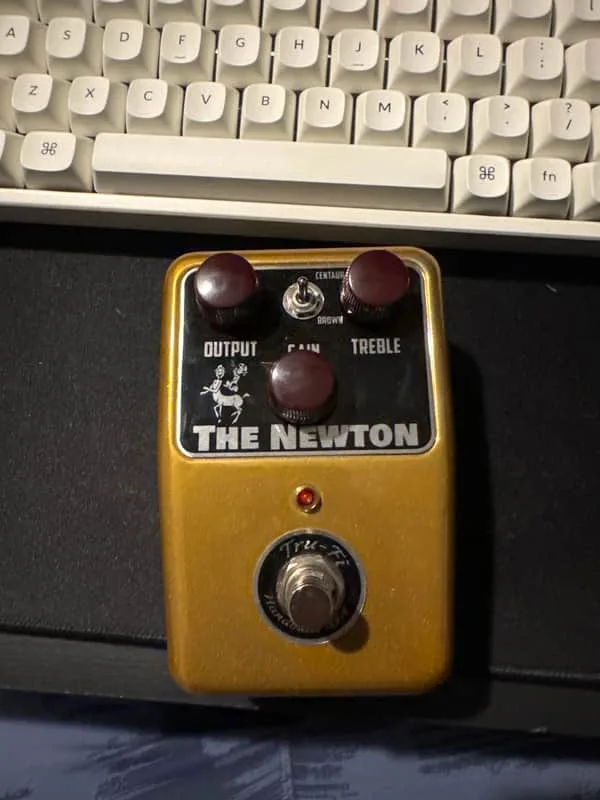


The Tru-Fi Newton is a mini pedal that works as both an overdrive and a clean boost, built on a Centaur type circuit. Tru-Fi's designer says the Centaur type pedal's reputation is "legendary" but wanted to add features that let players "tweak and debate over them," so the Newton adds internal DIP switches for diode and treble choices and a top-mounted mode switch. It was released on December 4, 2025, in a smaller and modern compact enclosure1.
Controls and setup
The Newton keeps its face simple and puts its options inside and on top1:
- Top switch (Centaur/Brown): selects between Centaur mode and Brown mode. Tru-Fi says Brown gives about 20% more gain1.
- Internal diode DIP switch: position 1 is the stock 1N34A germanium diode, position 2 is no diode, and position 3 is asymmetrical silicon1.
- Internal treble DIP switch: set to stock treble1.
The diode and treble DIP switches are inside the enclosure, so changing the clipping character means opening the pedal rather than turning a knob.
The three diode options
The diode DIP switch is the Newton's main departure from a straightforward Centaur type pedal, giving three clipping characters1:
| DIP position | Diode | Character |
|---|---|---|
| 1 | Stock 1N34A germanium | Old school big glass diode, close to the originals1 |
| 2 | No diode | Open and FAT, especially with the top switch on Brown1 |
| 3 | Asymmetrical silicon | A sweeter, bit mellower but biting tone1 |
On the stock germanium setting, Tru-Fi's designer says he "went down the rabbit hole" chasing not just ordinary diodes but the old school big glass type close to the originals1. With no diode engaged, he says he "really like[s]" it with the top switch on Brown, calling the result "just really open and FAT"1.
Power
The Newton runs on a 9V power supply or a 9V battery. Tru-Fi states that all of its mini pedals are 9V PS or 9V battery operated1.
Where it sits in the Tru-Fi range
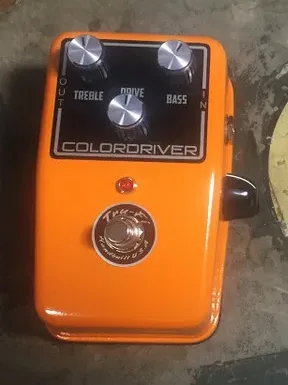
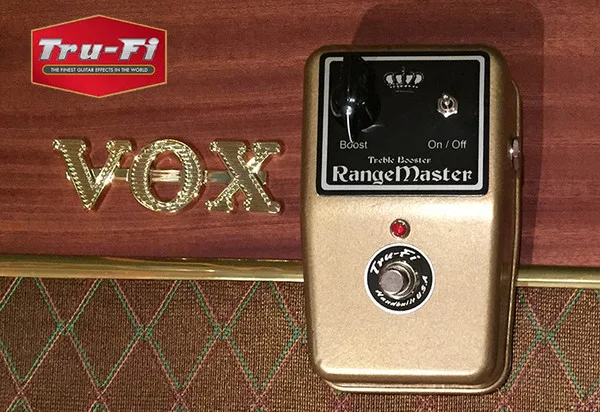
The Newton is Tru-Fi's compact take on the Centaur type overdrive and clean boost, sitting alongside other Tru-Fi pedals such as the Tru-Fi Colordriver, an 18-volt overdrive and fuzz design, and the Tru-Fi Treble Boost Rangemaster. Players comparing it with other drives can also see the wider field on the Overdrive Pedals and Boost Pedals pages.
Videos
GregsGuitars - Gregor Hilden
Alberto Barrero
Questions
Does the Tru-Fi Newton run on a battery?
Yes. Tru-Fi states that all of its mini pedals, the Newton included, run on a 9V power supply or a 9V battery. That makes it straightforward to power on a pedalboard or to run standalone, since no special supply voltage or adapter is required.
What is the difference between Centaur and Brown mode on the Newton?
The Newton has a switch on top that selects between Centaur mode and Brown mode. According to Tru-Fi, Brown mode gives about 20% more gain than Centaur mode, pushing the pedal further into drive territory. Players who want a more open, fatter response are pointed toward combining Brown mode with the no-diode setting.
What clipping diode does the Tru-Fi Newton come with?
The stock setting is a 1N34A germanium diode. Tru-Fi says it went out of its way to source old school big glass germanium diodes close to the originals. Two other diode options, no diode and asymmetrical silicon, are selectable with an internal DIP switch.
Can the Newton run with no clipping diode?
Yes. Position 2 on the internal diode DIP switch removes the diode from the circuit entirely. Tru-Fi's maker says this setting sounds really open and FAT, especially with the top switch set to Brown, and describes it as a favorite combination.
Where are the DIP switches on the Tru-Fi Newton?
The DIP switches are inside the pedal. One DIP switch selects the clipping diode: position 1 is the stock 1N34A germanium, position 2 is no diode, and position 3 is asymmetrical silicon. The other DIP switch is for stock treble. You need to remove the back plate to reach them.