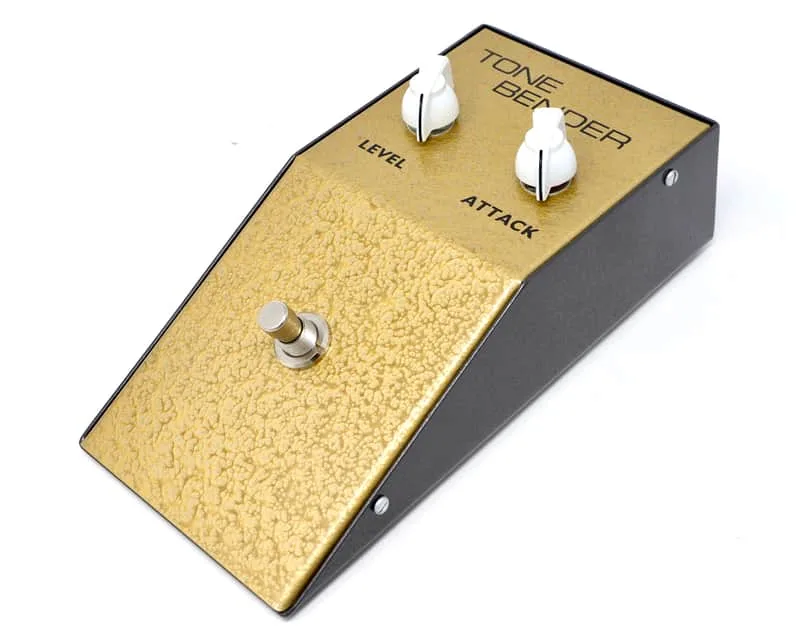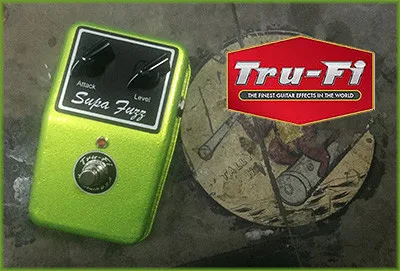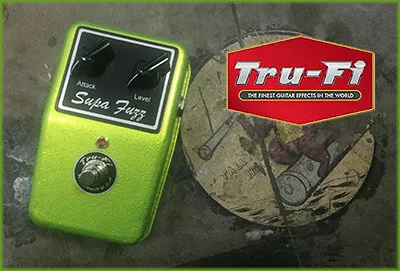


The Tru-Fi Supa Fuzz is a hand-made recreation of the famous Marshall Supa Fuzz, built in the USA with three vintage Mullard OC75 germanium transistors1. Tru-Fi describes the circuit as very similar to the Vox Tonebender, with only three components of difference, but with a voicing that tends to be a bit more bassy than standard Tonebenders1. It keeps the two-control format of the original, with Level and Attack knobs, and adds an LED indicator and true bypass switching1.
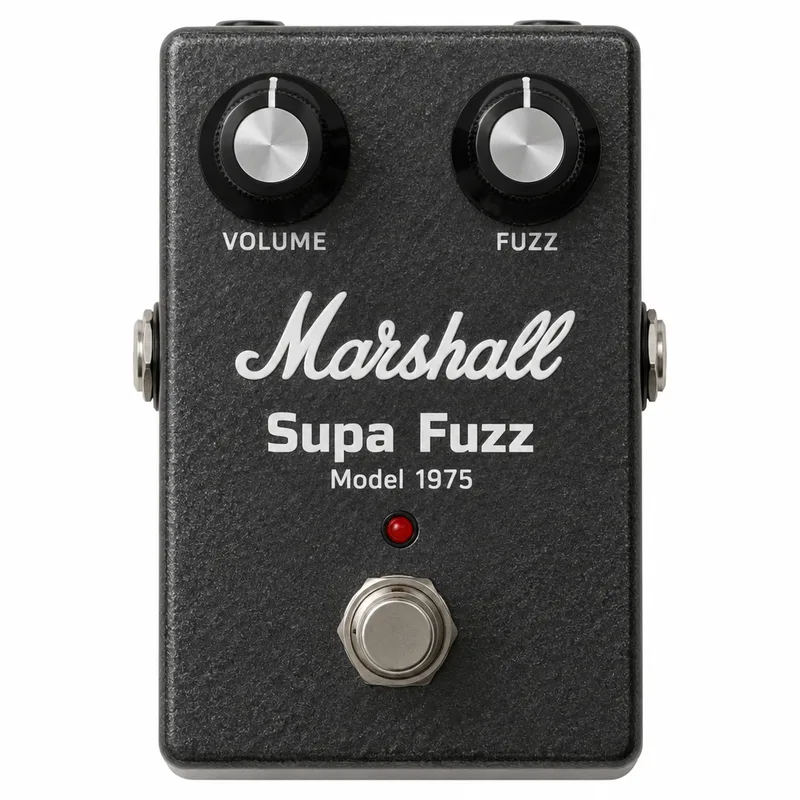
The pedal it recreates has a long history. The Marshall Supa Fuzz was created in 1966 by Gary Hurst for Jim Marshall's amplifier company, based on Sola Sound's Tone Bender circuits2. Typical units built by Sola Sound between 1966 and 1968, and by Marshall from 1968 until the mid-1970s, use a three-transistor Tone Bender MKII circuit3.
A bassier take on the Tonebender-style fuzz
The Supa Fuzz story is really a Tonebender story. Fuzzboxes.org's history of the Marshall SupaFuzz notes that the earliest units from 1966 were built with a version of the Tone Bender MKI circuit, with fuzz fixed at maximum and a basic tone filter that reduced treble content3. The conventional version that followed uses a three-transistor Tone Bender MKII topology, and on those later units the "filter" control was actually the same as the "attack" control on a Tone Bender MKII, despite the label3.
TONEHOME's page on the Marshall Supa Fuzz Model 1975 describes the sound as nearly the same as the Tone Bender MKII, a bit more on the bassier side due to the larger input capacitor4. GuitarPCB's build documentation for the circuit agrees, calling the Marshall Supa Fuzz almost identical to the Tone Bender but with a bit more bass, and noting that converting a Tone Bender board to a Supa Fuzz takes only two component changes: R1 to 10K and C2 to 10uF5.
That extra low end is the reason the design keeps coming back. Premier Guitar's 2016 announcement of the Toetags Supa Fuzz called that device "pretty thick & bassy by design"6, and Skreddy Pedals' page for its own Supa Tone, based on the 1974 Colorsound Supa Tonebender, describes the sound as "bassier and rougher than the streamlined compression of the original Big Muff design" and calls it an ideal bass fuzz7.
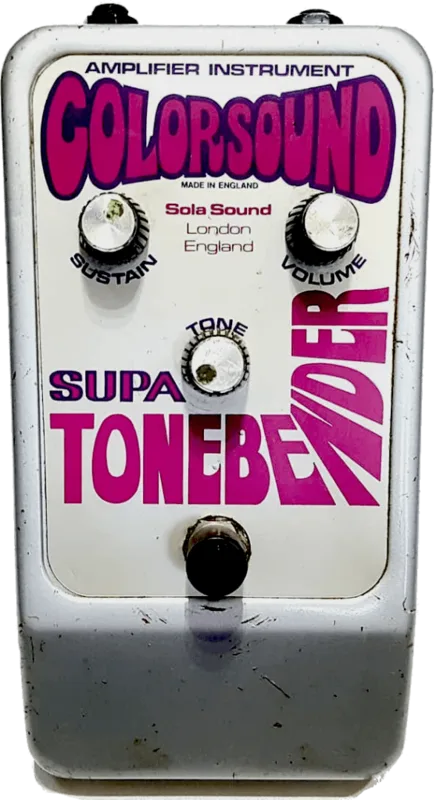
The Colorsound Supa Tonebender itself is a related but distinct animal. TONEHOME notes it uses a silicon transistor circuit8, and a technical analysis on Guitar FX Layouts argues it is essentially a modified Big Muff, with a few changes to component values and the removal of the first set of clipping diodes, rather than a Tone Bender variant9. So the family tree splits: the Marshall Supa Fuzz that Tru-Fi recreates is a Tone Bender MKII derivative with more bass, while the Colorsound Supa Tonebender is a Big Muff derivative.
The controls
Tru-Fi keeps the control set of the original: Level and Attack, just like the Marshall Supa Fuzz1.
| Control | What it does |
|---|---|
| Level | Sets the output volume, as on the original1 |
| Attack | Sets the fuzz intensity, as on the original1 |
| Internal bias | Adjusts the transistor bias to set the tone1 |
The internal bias control is the one extra knob, and it matters on a germanium fuzz. Tru-Fi uses what it calls "correct 'real' OC75 transistors, that are adjustable biased to create perfect tone"1. Germanium transistors vary widely from unit to unit, so the bias point is set internally rather than left to chance, letting the builder tune where the transistors sit and how they clip.
Transistor options and sound
The standard build uses three vintage Mullard OC75 germanium transistors, with Mullard OC81 transistors available as an option1. Tru-Fi describes the difference between the two in plain terms:
"OC75 Smooth and Fat OC81 bit more grit and Rock n Roll"1
In other words, the stock OC75 version is the smoother, rounder take, while the OC81 option trades some of that smoothness for extra edge1.
Power and practical details
The Supa Fuzz runs on a negative tip 9V DC power supply, which Tru-Fi achieves with a power inverter circuit inside the pedal1. That is worth noting for anyone with a germanium fuzz background: vintage-style germanium circuits were often positive ground, which rules out daisy chaining with standard negative tip supplies, and the inverter circuit sidesteps that problem. There is also an internal 9V battery clip1.
Other details from Tru-Fi's product page:
- True bypass switching1
- LED indicator1
- Chrome/Polished Aluminum finish available for $30 extra1
- Comes in a cigar box1
Where it came from and where it is made
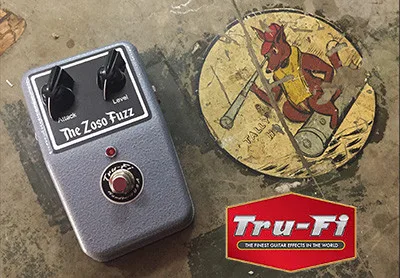
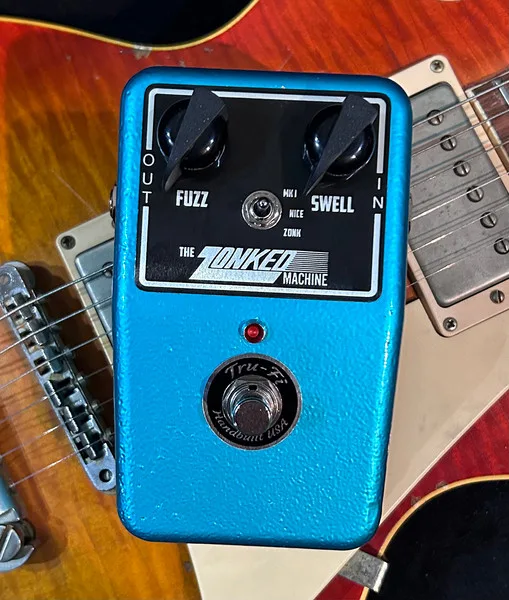
The Tru-Fi Supa Fuzz is made in the USA1. The original it recreates was made in England by Sola Sound, created in 1966 by Gary Hurst for Jim Marshall's amplifier company24. Tru-Fi's version sits alongside its other vintage recreations, including the Tru-Fi Zosa Fuzz and the Tru-Fi Zonked Machine.
For players comparing Supa Fuzz-style pedals, the same circuit family is available elsewhere: the Marshall Supa Fuzz and Marshall Supa Fuzz Model 1975 pages cover the originals, the Colorsound Supa Tonebender page covers the silicon Big Muff-derived cousin, and the Skreddy Supa Tone page covers another modern take. More broadly, see fuzz pedals.
Videos
Guy Incognito
Guy Incognito
Guy Incognito
Questions
What is the difference between a Supa Fuzz and a Tonebender?
Tru-Fi says the Supa Fuzz circuit is very similar to the Vox Tonebender, with only three components different, but those changes make it noticeably bassier than a standard Tonebender. The Marshall Supa Fuzz it recreates was itself built from Sola Sound Tone Bender circuits, with a larger input capacitor pushing the low end.
Is the Tru-Fi Supa Fuzz true bypass?
Yes. Tru-Fi states the Supa Fuzz is true bypass, so when it is off the guitar signal passes through without buffering or coloring.
What does the internal bias control do on a germanium fuzz?
Germanium transistors vary from unit to unit, so Tru-Fi biases its OC75 transistors internally to dial in the tone. The bias setting determines how the transistors clip, letting the builder set the fuzz character where they want it before the pedal leaves the shop.
Where is the Tru-Fi Supa Fuzz made?
The Tru-Fi Supa Fuzz is made in the USA. It is a hand-made recreation of the Marshall Supa Fuzz, originally created in England in 1966 by Gary Hurst for Jim Marshall's amplifier company.
Sources (9)
- Tru-Fi Supa Fuzz Guitar Pedal, tru-fi.com
- TONEHOME, TONEHOME - the World of Vintage Guitar Effect Pedals
- Marshall SupaFuzz • Fuzzboxes, Fuzzboxes.org, 2021-05-19
- TONEHOME, TONEHOME - the World of Vintage Guitar Effects Pedals
- PUTB_v2 (1), GuitarPCB.com, 2018-06
- Toetags Electronics Launches Toe Bender & Supa Fuzz, Premier Guitar, 2016-05-04
- ToneBender variants, Skreddy Pedals
- TONEHOME, TONEHOME - the World of Vintage Guitar Effects Pedals
- Guitar FX Layouts: Colorsound Supa ToneBender, Guitar FX Layouts (tagboardeffects.blogspot.com), 2016-01-03