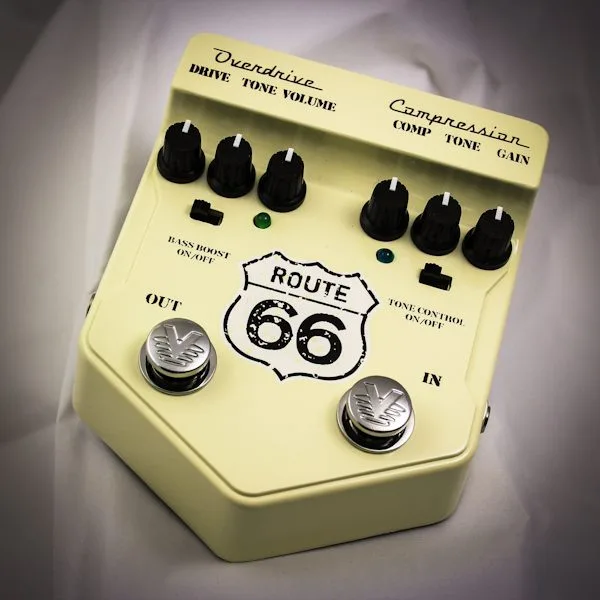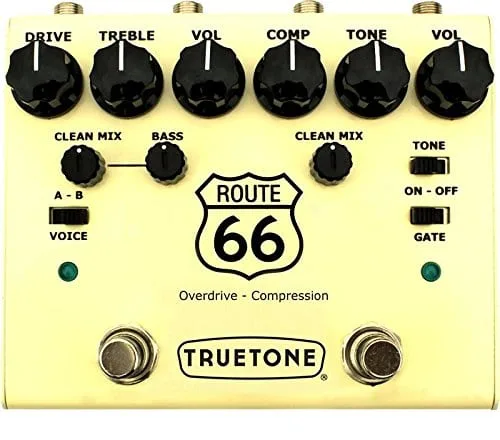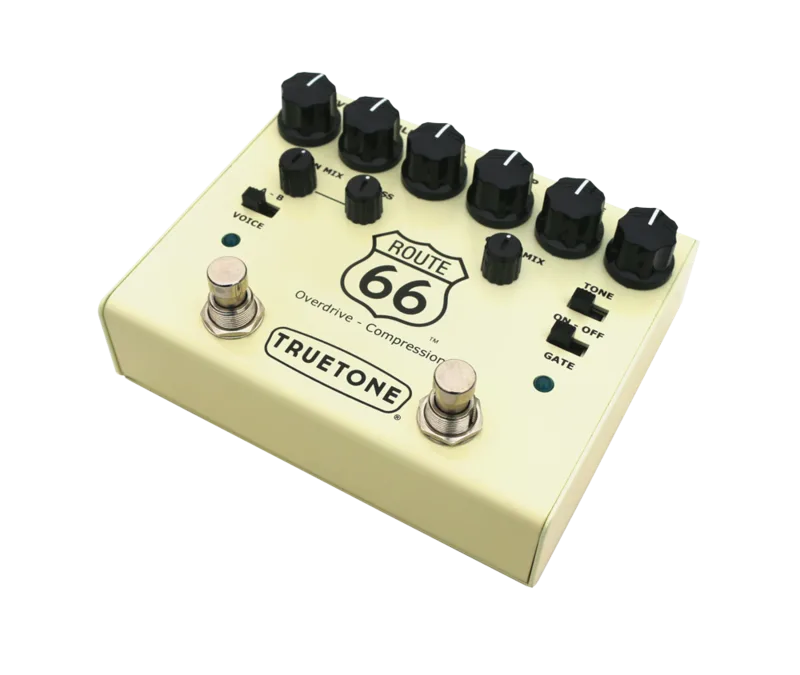



The Visual Sound V3 Route 66 American Overdrive is a dual pedal that puts separate compressor and overdrive circuits in one pedalboard-friendly box, each with its own footswitch. Unveiled on November 21, 2014, it is the latest in the company's V3 series and builds on the tones of the original Route 66, first introduced in 1999, with what Visual Sound called more gig friendly features and greater tonal versatility1. Visual Sound positioned it as a pedal that can enhance the sound of guitar or bass, and even keyboards and other electronic instruments1.
The pedal came in at a $179 street price1, and Delicious Audio's reviewer found it reasonably priced for a dual switch overdrive pedal with loads of options for tone control, particularly given the warranty2.
An overdrive and a compressor in one pedal
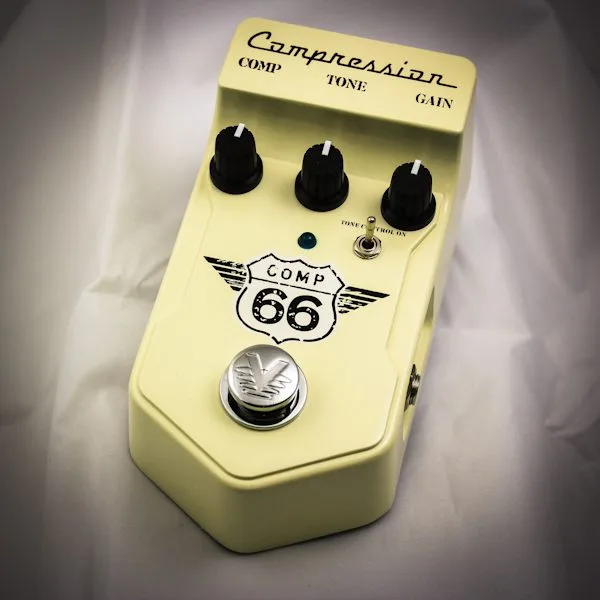
The Route 66 line goes back to 1999, when Visual Sound first paired compression with overdrive in a single pedal, something Truetone notes nobody else was doing at the time3. Players had been asking for the compressor channel as a standalone pedal since 1999, which eventually produced the Visual Sound Comp 66 and its V2 Comp 66 sibling45. The V3 Route 66 keeps the two effects together: one side serves as the overdrive, the other as a compressor, and users can stack and combine them for a variety of compressed overdriven tones2.
The V3 also changed the enclosure. The V1 and V2 Route 66s were pentagonal, like home plate, and Delicious Audio's reviewer called that highway-sign design a nuisance on a pedalboard. The V3 moved to a more traditional rectangular casing2.
Truetone, which now sells the pedal, describes the pairing this way:
"The compression ranges from smooth and connected to tight and punchy. The overdrive responds like a well-cranked amp."
The controls on each side
Both channels gained Clean Mix controls in the V3 refinement, which Truetone says lets the natural dynamics of your guitar cut through3.
| Side | Control | What it does |
|---|---|---|
| Overdrive | Clean Mix | Blends overdrive and dry signal, from all drive to all clean boost1 |
| Overdrive | Voice switch (2-position) | Varies the tone between bright and open, or more saturated14 |
| Compressor | Clean Mix knob | Mixes dry signal back into the compressed signal1 |
| Compressor | Noise gate switch | Improved noise gate, removable from the circuit via a top mounted switch1 |
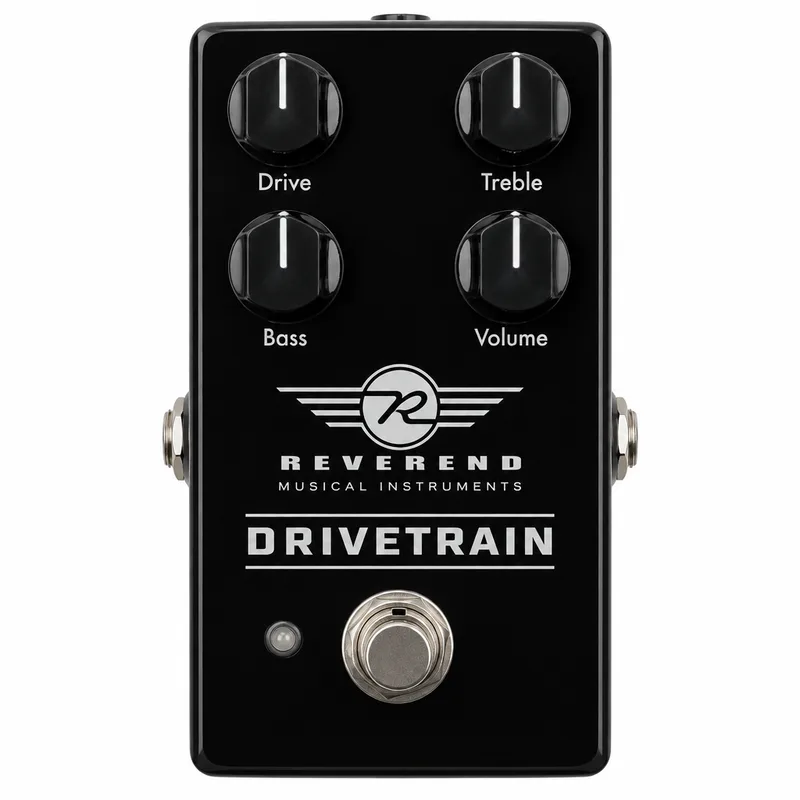
The Clean Mix on the overdrive side is the update over the Reverend Drivetrain circuit it is based on: Vintage Guitar reported the overdrive circuit follows the Drivetrain pedal, with the added Clean Mix control blending overdrive and dry signal4. The compressor's noise gate can be switched out entirely if you would rather run ungated1.
A Reverend Drivetrain circuit by Bob Weil and R.G. Keen
The overdrive side is based on the classic Reverend Drivetrain circuit developed by Bob Weil and Joe Naylor, and the pedal itself was developed by Visual Sound's Bob Weil and Chief Engineer R.G. Keen1. The Drivetrain earned a strong review from Vintage Guitar in 2001, which found it very flexible:
"Even the slightest crunch is an authentic, in-your-face sound that mirrors an early Deluxe at 8, and further increments of drive and tone bring a whole spectrum of sound, from AC/DC fat rock to slink, subtle Ry Cooder…"
That review also noted the Drivetrain shipped with an information sheet including sample settings from blues through rock, plus suggestions for bass players and overdriven amp use6, a hint of the flexibility the Route 66 line carried forward.
Warranty and the Truetone connection
All V3 series pedals carry the Visual Sound Lifetime Warranty1, and it is unusually generous: it not only covers the purchaser but applies to second and third owners as well2. Visual Sound also designed its footswitches to withstand 10 million hits, what the company calls the "forever footswitch"2.
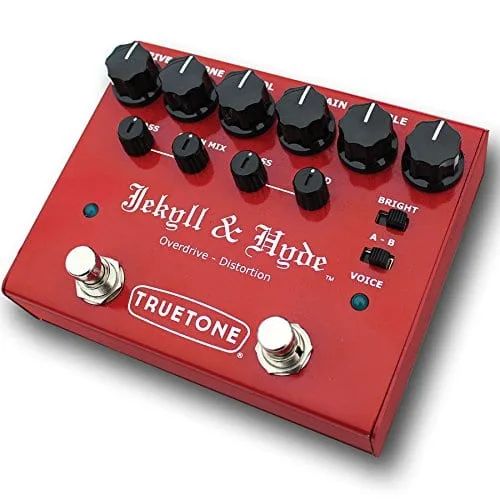
Today the Route 66 is sold under the Truetone name, which lists the V3 as a Compressor & Overdrive dual channel pedal compatible with guitar, bass, keyboards, and acoustic-electric instruments3, and keeps the V2 in its archive7. The V3's sibling in the series, the dual-channel Jekyll & Hyde overdrive and distortion, rounds out the line.
Videos
Premier Guitar
Truetone
HaarGuitars
Questions
Can you stack the overdrive and compressor on the Route 66?
Yes. The V3 Route 66 has separate compressor and overdrive circuits with their own footswitches, and users can stack and combine the two sides for a variety of compressed overdriven tones. Each side can also be used on its own.
Can you turn off the noise gate on the V3 Route 66?
Yes. The compressor side has an improved noise gate that can be removed from the circuit entirely via a top mounted switch, so you can run the compressor without any gating.
Does the Route 66 work with bass?
Yes. Visual Sound said the dual pedal can enhance the sound of guitar or bass, and even keyboards and other electronic instruments. Truetone's current product page lists it as compatible with guitar, bass, keyboards, and acoustic-electric instruments.
Is the Visual Sound lifetime warranty transferable?
Yes. The lifetime warranty on the V3 line of pedals not only covers the original purchaser, it also applies to second and third owners, which is unusual for pedal warranties.
Is Truetone the same company as Visual Sound?
Yes. Truetone sells the Route 66 today, and its archive carries the V2 Route 66 under the Truetone name. Truetone's product pages describe the company pairing compression with overdrive in 1999, the same year Visual Sound introduced the original Route 66.
Sources (7)
- Visual Sound Launches V3 Route 66 American Overdrive, Premier Guitar, 2014-11-21
- New Pedals: Visual Sound V3 Route 66 American Overdrive + Compressor, Delicious Audio, 2015-01-16
- V3 Route 66, Truetone, 2026
- Visual Sound Launches V3 Route 66 American Overdrive, Vintage Guitar magazine, 2014-11-27
- Visual Sound V2 Comp 66 Pedal Review, Premier Guitar, 2008-10-15
- Reverend Drivetrain Overdrive, Vintage Guitar magazine, 2001-07-18
- V2 Route 66, Truetone, 2026