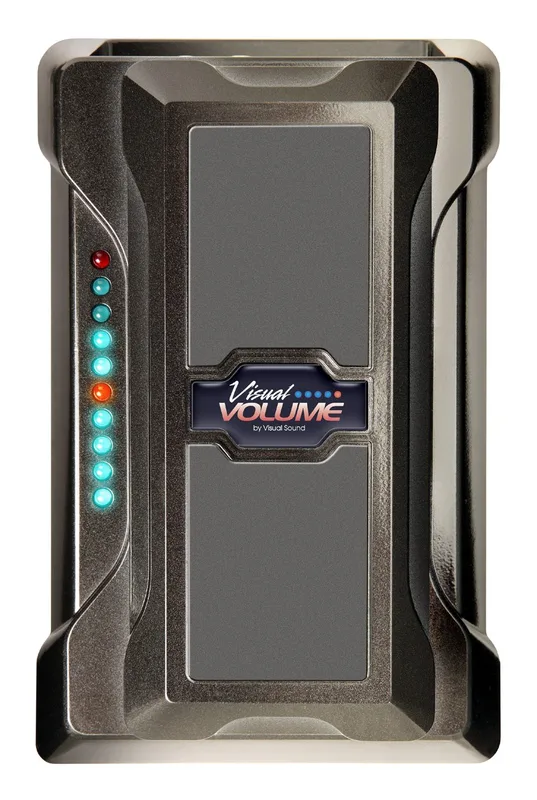


The Truetone Visual Volume is a volume pedal with a 0-10 LED readout that shows your level as you play. It was originally sold under the Visual Sound name, and Truetone now lists it in the archive section of its website, so it is a discontinued product1. What set it apart from a standard volume pedal is a choice of two operating modes: an active mode with a Pure Tone buffer and a clean boost, and a passive mode that Truetone describes as an expression pedal mode1.
The LED readout
The pedal's signature feature is a vertical row of 10 LEDs showing the volume level. Truetone describes it plainly: "The 0-10 LED readout removes the guesswork from volume swells, letting you set repeatable levels night after night with visual precision."1 Jonathan Moody, reviewing the pedal for Bass Musician Magazine in 2011, found the idea simple but effective: "Adding a vertical row of 10 LEDs seems a simple fix, but it's quite useful."2 Vintage Guitar's 2009 review agreed: "The LED scale indicator is a fantastic aid for consistently producing the same output."3
Active and passive modes
The two modes give the pedal two distinct jobs on a board: a buffered, boosted volume pedal, or a straightforward passive one12.
| Mode | What it does |
|---|---|
| Active | Pure Tone buffer plus a clean boost1 |
| Passive | Acts exactly like a standard volume pedal; Truetone lists it as an expression pedal mode1 |
In active mode, Moody noted that "the VV can actually act as a boost pedal"2. In passive mode, "it acts exactly like a standard volume pedal"2.
Inputs, outputs and stereo use
The Visual Volume carries two inputs and two outputs, plus a tuner output1. Moody's review explained the flexibility this adds: "each of these inputs has internal controls to adjust the overall output of each input, as well as whether they're active"2. Truetone states the two inputs and two outputs allow mono or stereo operation1, and Moody noted you can "use the VV to split the signal of one input into two outputs (as in, stereo) or vice versa"2.
Ways to hook it up:
- Mono: one input, one output1
- Stereo: two inputs, two outputs1
- Split: one input into two outputs2
- Merge: two inputs into one output2
- Tuner: dedicated tuner output alongside the main signal path1
Power and mechanism
The pedal runs on 9V DC with the center pin negative, drawing 26 to 30mA depending on the LED state1. Vintage Guitar's review also noted the unit "can also be powered by 9-volt DC power"3.
With a current draw of 26 to 30mA, the Visual Volume sits above what many low-current daisy-chain outputs supply, so plan your power supply accordingly1.
Truetone also highlights the pedal's mechanical drive: "The rack-and-pinion mechanism is dramatically more reliable than string-driven alternatives."1 Many volume pedals use a string or cord to connect the rocker to the potentiometer, and Truetone's claim is that a gear-driven rack and pinion avoids the wear that approach can bring.
How it compares
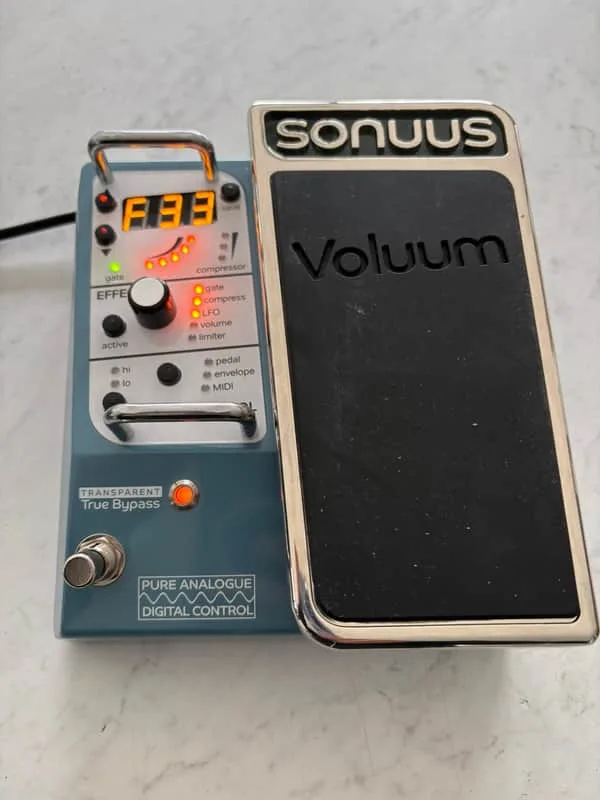
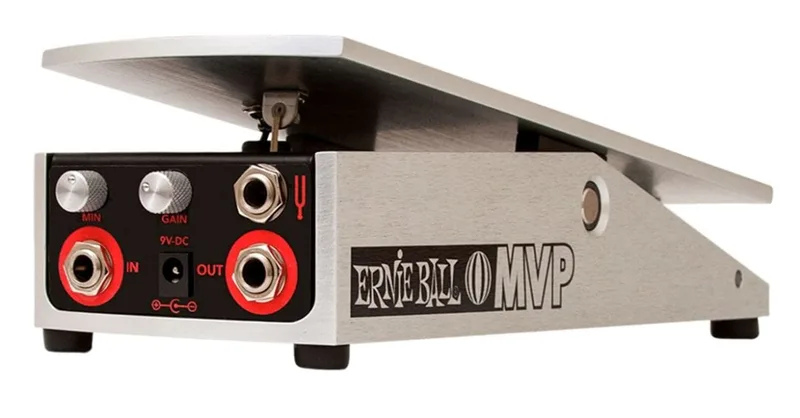
The Visual Volume's combination of an LED scale, a buffer and clean boost, a tuner output and stereo capability puts it among feature-rich volume pedals. Truetone also says its rack-and-pinion drive mechanism is "dramatically more reliable than string-driven alternatives"1. For other options with built-in features, see the Sonuus Voluum or the Ernie Ball MVP, or browse the full range of Volume Pedals.
Videos
Guitar World
Truetone
GuitarrasXclusivas
Questions
What does the LED readout on the Truetone Visual Volume show?
A vertical row of 10 LEDs shows the volume level on a 0-10 scale. Truetone says the readout removes the guesswork from volume swells and lets you set repeatable levels night after night with visual precision. Vintage Guitar's reviewer called the LED scale indicator a fantastic aid for consistently producing the same output.
Can the Truetone Visual Volume work as an expression pedal?
Yes. In passive mode the pedal acts exactly like a standard volume pedal, and Truetone lists that mode as an expression pedal mode. In active mode it instead provides a Pure Tone buffer and a clean boost.
Does the Truetone Visual Volume have a tuner output?
Yes. Alongside two inputs and two outputs, the pedal has a dedicated tuner output, so you can keep a tuner connected without running your main signal through it.
What polarity does the Truetone Visual Volume use?
It runs on 9V DC with the center pin negative, drawing 26 to 30mA depending on the LED state. That current draw means a standard low-current daisy chain may not be suitable.
Does the Truetone Visual Volume work in stereo?
Yes. It has two inputs and two outputs for mono or stereo operation. Bass Musician Magazine's reviewer noted you can also split the signal of one input into two outputs, or the reverse.
Is the Truetone Visual Volume still made?
No. Truetone lists the Visual Volume in the archive section of its website, described as a legacy of tone, so it is a discontinued product.
Sources (3)
- Visual Volume, Truetone, 2026
- Visual Volume Gear Review by Jonathan Moody, Bass Musician Magazine, 2011-12-01
- Visual Sound’s Route 808, Visual Volume, and Comp 66, Vintage Guitar magazine, 2010-04-13