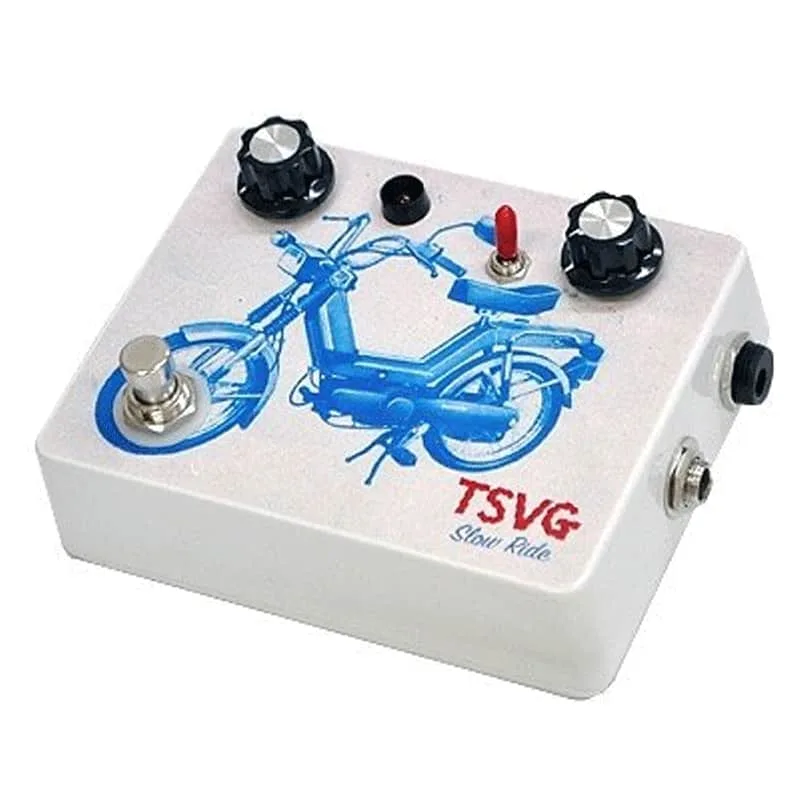


The TSVG Slow Ride Overdrive/Fuzz is a handwired germanium fuzz pedal that delivers what Premier Guitar called "a one-two punch of late-'60s fuzz, combining the smoothness of a Fuzz Face with the raunchy aggression" of a Tone Bender1. Released by Philadelphia boutique builder TSVG in May 2013, it packs an overdrive-to-fuzz range into a small box with just two knobs and a voicing switch2.
Vintage Guitar described the pedal at launch as offering "a germanium fuzz tone with a two-position 'thickening' switch the company says changes the effect's voicing from 'high-end scream' to 'full-bodied midrange growl'"3. In practice, it is a pedal aimed squarely at players chasing raw, vintage fuzz rather than the smoother sounds of many modern boutique units.
A Fuzz Face and Tone Bender hybrid, handwired
The Slow Ride's circuit draws on the two fuzz designs that defined late-'60s psychedelic guitar. Premier Guitar's reviewer wrote that "the Slow Ride harkens back to a time when the Tone Bender and Fuzz Face ruled psychedelic guitar," pairing Fuzz Face smoothness with the raunchier edge of a Mk II-era Tone Bender1.
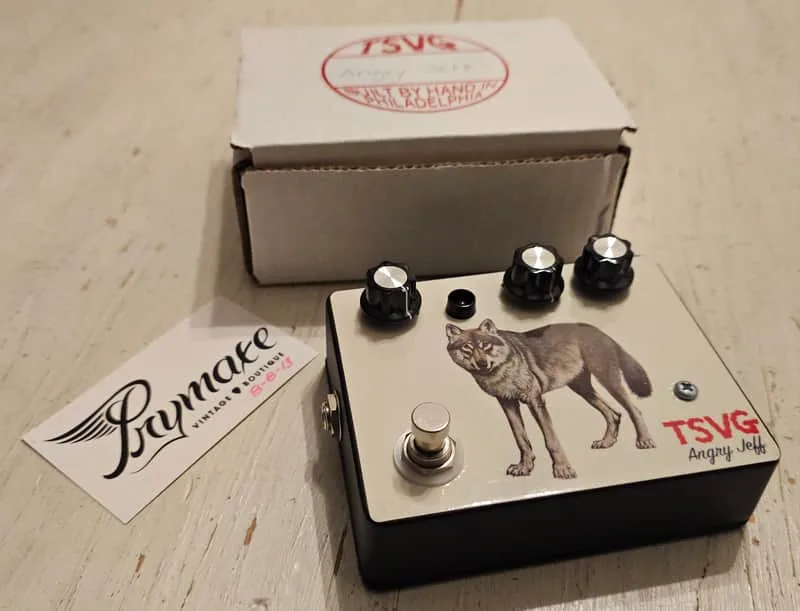
Like TSVG's earlier Angry Jeff and Keystone fuzzes, the Slow Ride is built point-to-point by hand with new-old-stock parts1. The build includes:
- Mullard "tropical fish" capacitors
- IRC resistors
- Alpha pots
- Cloth-covered wire
- Three hand-selected NOS AC128 germanium transistors1
The AC128s are PNP-style transistors, which is what gives the pedal its vintage character and dictates its unusual power requirement1.
The controls: level, Attack and the 2-way switch
Despite its unlabeled knobs, the Slow Ride is about as straightforward as a fuzz pedal gets1. The face carries two knobs and a two-position switch:
| Control | What it does |
|---|---|
| Left knob (Volume) | Sets the output level12 |
| Right knob (Attack) | Transitions between relatively smooth overdrive and raspy fuzz1 |
| 2-way switch | Changes the voicing from thick and mid-heavy to cutting and bright1 |
The Attack control is advertised as morphing the tone from fuzz to overdrive, but the reviewer cautioned not to expect the relatively smooth overdrive of a modern pedal: lowering it reins in high-end raspiness, while cranking it introduces more fuzz and snarling treble bite1. Delicious Audio described the toggle as a high-end filter, with the down position passing the full signal and the up position cutting most of the bass response for focused high-gain tones4.
Power: positive ground only
The Slow Ride only accepts a positive-ground power supply, because its AC128 transistors are PNP-style devices1. It cannot share a standard center-negative daisy chain with most modern pedals, so it needs its own isolated or dedicated supply.
What reviewers said
Premier Guitar's 2021 review was positive on both build and tone, summing up: "Sturdy, handwired build. Top-shelf components. Great '60s-style fuzz tones."1 The reviewer found the pedal surprisingly quiet even with single-coils, tested with a Fender Strat and a Les Paul with a PAF-style neck pickup, delivering rawness and snarl without uncontrolled feedback1.
On character, the review noted that "its tones have a wild, sputtering style that stands in colorful contrast to some of today's smoother boutique fuzzes"1. The reviewer also found the pedal surprisingly quiet even when playing a Fender Strat with single-coils, delivering rawness and snarl without uncontrolled feedback1.
Where it came from
The Slow Ride Overdrive/Fuzz comes from TSVG, a Philadelphia-based boutique stompbox manufacturer4. It carries a $200 street price1.
Videos
Premier Guitar
Premier Guitar
Curtis Kent
Questions
What circuits is the TSVG Slow Ride based on?
Premier Guitar describes the Slow Ride as a hybrid that combines the smoothness of a Fuzz Face with the raunchier character of a Mk II-era Tone Bender. It uses three hand-selected NOS AC128 germanium transistors in a PNP-style circuit, built point-to-point by hand.
Does the Slow Ride need a positive ground power supply?
Yes. Because it uses PNP-style AC128 germanium transistors, the Slow Ride only accepts a positive-ground power supply. That rules out sharing a standard center-negative daisy chain with most modern pedals, so plan its power separately.
Is the TSVG Slow Ride true bypass?
Yes. Both the 2013 press release and Premier Guitar's 2021 review confirm the Slow Ride uses true-bypass switching, so it passes your clean signal untouched when the effect is off.
What transistors are inside the TSVG Slow Ride?
Three hand-selected NOS AC128 germanium transistors, which are PNP-style devices. That germanium construction is part of why the pedal has its vintage, sputtering fuzz character and why it needs a positive-ground supply.
How much did the TSVG Slow Ride cost?
The suggested retail price at its 2013 release was $200, and Premier Guitar's 2021 review listed its street price at $200 as well. It was built by hand in Philadelphia by TSVG.
Sources (4)
- TSVG Slow Ride Overdrive/Fuzz Review, Premier Guitar, 2013-08-29
- TSVG Releases the Slow Ride OD/Fuzz Pedal, Premier Guitar, 2013-05-31
- TSVG Pedals Unveils Slow Ride OD/Fuzz, Vintage Guitar magazine, 2013-05-31
- New Pedals: TSVG's Slow Ride Overdrive/Fuzz, Delicious Audio, 2013-06-04