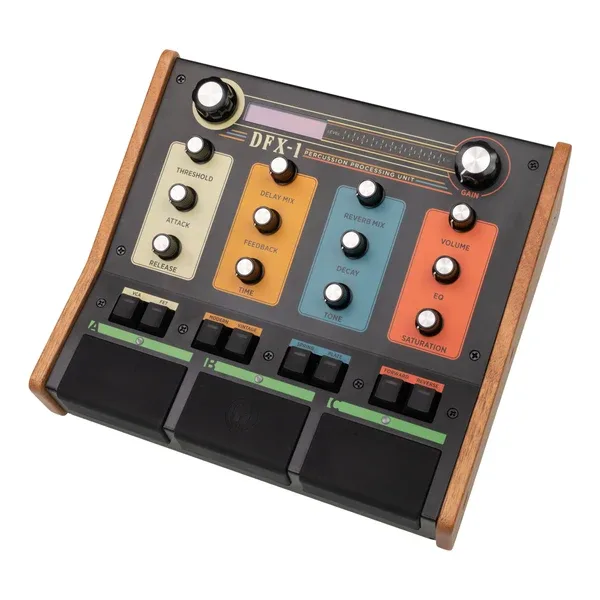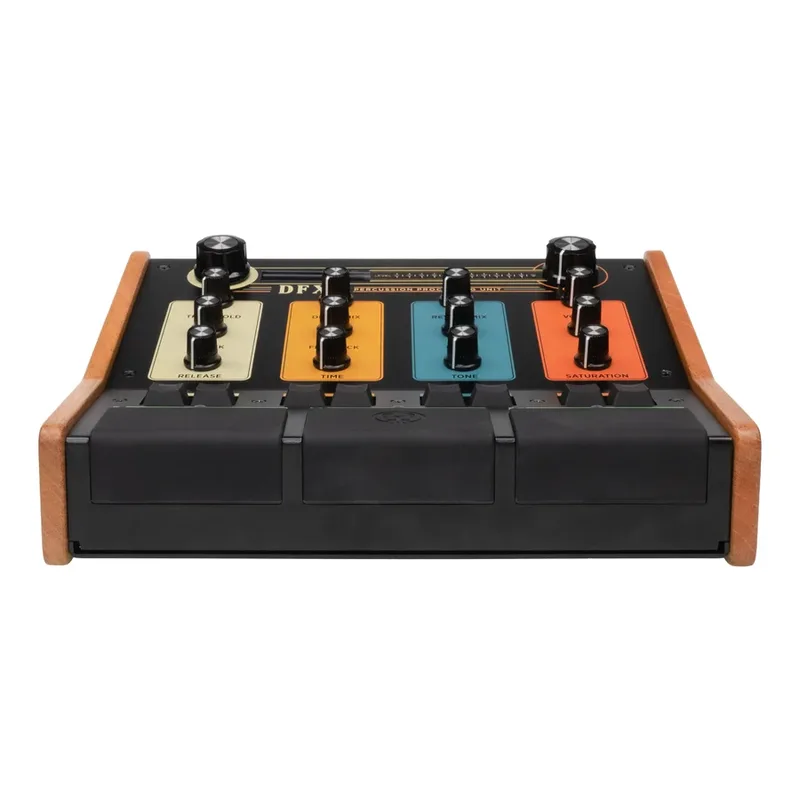


The Walrus Audio DFX-1 is a multi-effect processing unit designed for acoustic drum or percussion sources, built in collaboration with drummer Aaron Sterling1. Where most drum pedals generate rhythms or loops, the DFX-1 does something different: it processes the sound of a real drum or percussion instrument through a chain of effects, taking a microphone signal from input to finished tone in one box.
It is a digital unit, built on the Walrus MDSP module, running at a 44.1kHz sample rate and 24 bit depth2. Inside are a microphone preamp with phantom power, saturation, compression, delay, reverb, EQ, an effects loop for external outboard gear, MIDI connectivity and presets1. Aaron Sterling describes the idea in plain terms:
"It allows a microphone to go straight into a world filled with gain, compression, delay, reverb, saturation, and EQ"2
In other words, no external mic preamp, no mic-to-line level converter and no extra cables between the drum and the effects2.
The effects: saturation, compression, delay, reverb and tone
The DFX-1 runs five effect blocks in series, and the order can be flipped. In FWD (Forward) mode the chain runs Saturation, then Compression, then Delay, then Reverb, then Tone. In REV (Reverse) mode it runs Saturation, Reverb, Delay, Compression, Tone2. For a drummer, that choice matters: compression before delay behaves differently than compression after it, since in reverse order the compressor reacts to the repeats as well as the drum hit.
Each block has its own flavors:
| Block | Modes / controls | What Walrus Audio says it does |
|---|---|---|
| Saturation | Asymmetrical clipping | Tube-like clipping that enhances even/odd harmonic content1 |
| Compression | VCA / FET | VCA mode models the API 2500's signature VCA compression for added punch and to smoothly "glue" the mix together1 |
| Delay | Vintage / Modern | Vintage gives warm, analog/tape-inspired repeats with natural degradation; Modern provides a tasteful digital delay with clearer repeats23 |
| Reverb | Spring | Captures the splashy character of classic spring tanks with lively, wobbly reflections1 |
| Tone / EQ | LP Cut, Mid Cut | LP Cut sweeps 1 kHz to 20 kHz; Mid Cut offers +6dB to −18 dB with a sweepable mid frequency (300 to 1k Hz) and adjustable Q12 |
The compression and delay engines each offer two characters, a distinction Pedal of the Day also highlighted in its coverage, listing "Compression (VCA / FET)" and "Delay (Vintage / Modern)" among the unit's modes3.
An effects loop lets you insert external outboard equipment, and its position is flexible: it can be placed after the saturation control, after the delay, or after the reverb1. That means an external overdrive, filter or EQ pedal can sit at whichever point in the chain suits the material.
Power and connections
The DFX-1 runs on 9V DC with a minimum current draw of 500mA, through a standard 2.1mm x 5.5mm center negative barrel connector1.
The 500mA minimum draw means the DFX-1 needs its own adequately rated 9V supply. It is a heavier current load than most compact analog pedals, so check your power supply's per-output rating before sharing a supply.
Connections on the audio side are fully balanced. Inputs are an XLR balanced mic input with +48V phantom power and a 1/4 inch balanced input switchable between line and instrument level. Outputs are an XLR balanced output and a 1/4 inch balanced output, though these are not discrete outputs: both are split from the same source12. Rear pushbuttons handle +48V phantom (XLR only) and a Pad function that applies a global −20 dB attenuation after the preamp12.
MIDI is on 5-pin DIN, with MIDI IN and MIDI THRU carrying clock and program control1. Presets can be copied and pasted between slots through the preset menu, three pads handle live operation, and presets step via Pad B or MIDI program change2.
Walrus Audio publishes measured performance for the outputs1:
| Measurement | Balanced output | Unbalanced output |
|---|---|---|
| SNR | 99dB @ 1kHz +4dBu A-weight | 98dB @ 1kHz +4dBu A-weight |
| THD+N | 0.0025% @ 1kHz +4dBu A-weight | 0.0032% @ 1kHz +4dBu A-weight |
| Dynamic range | 102 @ 1kHz +4dBu A-weight | 101 @ 1kHz +4dBu A-weight |
Where it came from and what reviewers said
The DFX-1 is a recent release: Pedal of the Day described it in January 2026 as "the newly released Walrus Audio DFX-1 Percussion Processing Unit"3. The design collaboration with Aaron Sterling is central to the product's identity, and the maker frames it as a complete front end for a miked drum, with the mic preamp, phantom power and full effect chain in a single chassis1.
Pedal of the Day's coverage walked through the same effect descriptions Walrus Audio publishes, including the saturation's asymmetrical, tube-like clipping and the Vintage delay mode's warm, analog/tape-inspired repeats with natural degradation3.
The unit measures 262mm x 232mm x 97mm including knobs and weighs 3.8lb on its own, 5.7lb in the box1. It carries Walrus Audio's limited lifetime warranty1. A blemished version was offered at one point and is listed as sold out2.
Videos
walrusaudioeffects
walrusaudioeffects
walrusaudioeffects
Questions
Can the Walrus Audio DFX-1 be used on guitar or bass?
Yes. Alongside its XLR microphone input, the DFX-1 has a 1/4 inch balanced input that is switchable between line and instrument level, so a guitar or bass can plug straight in and run through the same saturation, compression, delay, reverb and EQ chain. It was designed first for acoustic drum and percussion sources, but nothing in the signal path limits it to drums.
Does the DFX-1 have phantom power for a microphone?
Yes. The XLR balanced input carries +48V phantom power, switched by a rear pushbutton that applies to the XLR input only. That means a condenser microphone can go straight into the DFX-1's built-in preamp without an external mic preamp or a separate phantom supply.
Does the DFX-1 store presets?
Yes. Presets can be copied and pasted into different slots through the preset menu, and there are three pads for live operation. Presets can be stepped through using Pad B or MIDI program change messages sent over the 5-pin DIN MIDI connection.
What is the latency of the Walrus Audio DFX-1?
Walrus Audio lists total latency of 2.9ms for the DFX-1. The unit processes audio digitally on the Walrus MDSP module at a 44.1kHz sample rate and 24 bit depth, with a frequency response of 20Hz to 20kHz.
Does the DFX-1 have a balanced output?
Yes, two of them: an XLR balanced output and a 1/4 inch balanced output. Walrus Audio notes these are not discrete outputs, they are split from the same source. Balanced output specs include SNR of 99dB and THD+N of 0.0025%, both measured at 1kHz, +4dBu, A-weighted.
Sources (3)
- DFX-1 Percussion Processing Unit, Walrus Audio
- DFX-1 Percussion Processing Unit, Walrus Audio
- Walrus Audio DFX-1 Percussion Processing Unit, Pedal of the Day, 2026-01-08