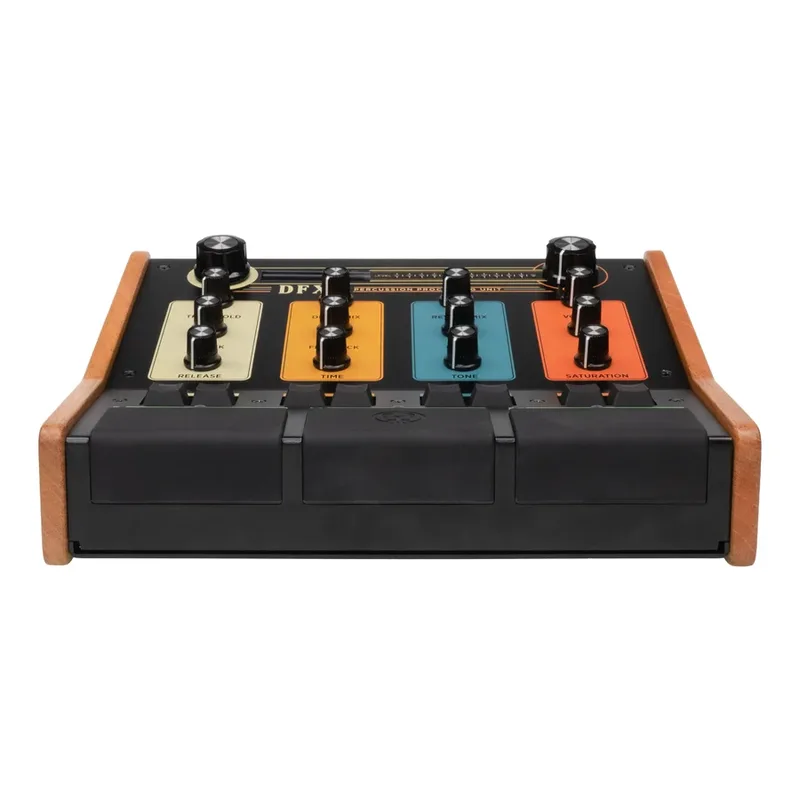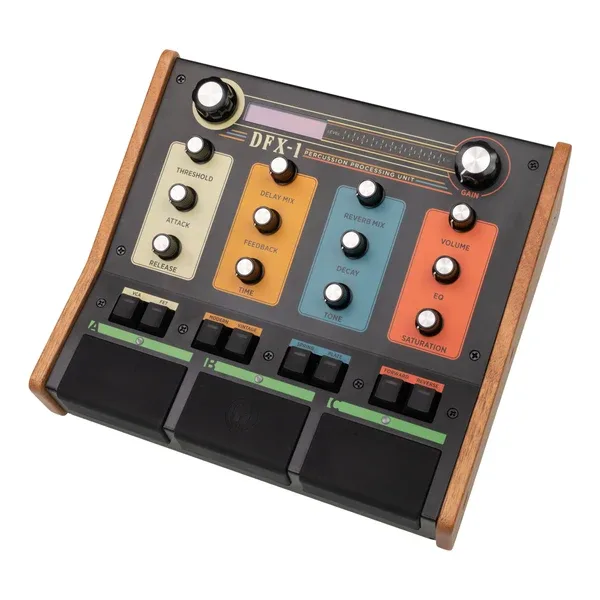


The Walrus Audio DFX-1 Percussion Processing Unit is a multi-effect processor designed for acoustic drum and percussion sources, built in collaboration with drummer Aaron Sterling. Instead of routing a drum mic through a preamp, converters and outboard gear, the DFX-1 puts a high-performance microphone preamp, compression, delay, reverb, saturation and EQ in a single pedal-style box12.
As Walrus Audio puts it, the unit "allows a microphone to go straight into a world filled with gain, compression, delay, reverb, saturation, and EQ" with no external mic pre, no mic-to-line level converter and no extra cables1. Pedal of the Day reviewed it at release in January 2026 and called it "nothing shy of a masterpiece," saying it "turns your favorite mic into an fx-laden wrecking machine, producing big, stadium-sounding drums with ease"3.
What it is: a pedal-style unit for drum and percussion mics
The DFX-1 sits in the multi-effects family, but its target is different from most: it is meant to sit in front of a drum or percussion microphone rather than in a guitar signal chain. The unit combines a mic preamp with phantom power, an effects loop for connecting external outboard equipment, MIDI connectivity and presets2. Walrus Audio describes the range of sounds as running "from subtle to in-your-face drum sounds," with studio-grade VCA and FET compression, two flavors each of delay and reverb, saturation, gating, a routable FX loop and a flexible EQ1.
The unit measures 262mm x 232mm x 97mm including knobs and weighs 3.8 lb1.
The effects: compression, delay, reverb and saturation
Each of the four effect engines offers two modeled flavors, and the signal order can be flipped between forward and reverse routing1.
| Effect | Flavors | What Walrus Audio says each does |
|---|---|---|
| Compression | VCA / FET | VCA models the API 2500's signature VCA compression for added punch and to smoothly "glue" the mix together; FET emulates the classic 1176 FET compressor with fast attack and release for punchy, gritty dynamics1 |
| Delay | Vintage / Modern | Vintage gives warm, analog/tape-inspired repeats with natural degradation; Modern provides a tasteful digital delay with clearer repeats1 |
| Reverb | Spring / Plate | Spring captures the splashy character of classic spring tanks with lively, wobbly reflections1 |
| Saturation | one mode | Asymmetrical, tube-like clipping that enhances even/odd harmonic content1 |
The effect order is switchable between two paths1:
- FWD (Forward): Saturation → Compression → Delay → Reverb → Tone
- REV (Reverse): Saturation → Reverb → Delay → Compression → Tone
The FX loop can be placed at three points in the chain: after the saturation control, after the delay, or after the reverb1.
The controls
The EQ section gives players three bands of cut plus a sweepable mid1:
- HP Cut: 2 Hz to 600 Hz high-pass filter
- Mid Cut: +6dB to −18 dB, with a sweepable Mid Frequency from 300 Hz to 1 kHz and adjustable Q
- LP Cut: 1 kHz to 20 kHz low-pass filter
Front and rear pushbuttons handle input conditioning1:
- Pad: global −20 dB attenuation after the preamp
- LINE/INST toggle: for the 1/4" input, Line applies a −20 dB pad at 24 kΩ, Inst sets a high-impedance 1 MΩ input
- +48V phantom: rear pushbutton, XLR input only
Presets can be copied and pasted into different slots through the preset menu, with three pads for live operation; presets step via Pad B or MIDI program change1.
Power and connections
The DFX-1 runs on a 9V DC supply delivering at least 500mA, through a 2.1 mm x 5.5 mm center-negative barrel connector1.
The 500mA minimum draw means the DFX-1 needs its own adequate power supply, not a shared daisy chain or a low-current pedal supply.
Connections and impedances, as listed by the maker1:
| Connection | Detail |
|---|---|
| XLR input (mic) | Balanced, +48V phantom, 6.8k Ohm input impedance |
| 1/4" input | Balanced, line/instrument switchable, 24k Ohm line / 1M Ohm instrument |
| XLR output | Balanced, 220 Ohm output impedance |
| 1/4" output | Balanced, 220 Ohm output impedance |
| FX loop send / return | 220 Ohm send, 1M Ohm return |
| MIDI | 5-pin DIN IN and THRU, clock and program control |
The two outputs are not discrete: they are split from the same source1. Walrus Audio also publishes measured performance for the balanced path: SNR of 99dB at 1kHz +4dBu A-weighted, THD+N of 0.0025% at 1kHz +4dBu A-weighted, and dynamic range of 102 at 1kHz +4dBu A-weighted1.
Is it analog or digital?
Can you use it on guitar?
Yes. The 1/4" balanced input has a LINE/INST toggle, and in Inst mode the input impedance is 1M Ohm, which suits instruments like guitar with passive pickups1. The XLR path with phantom power remains available for mics at the same time as a separate input option.
History: designed with Aaron Sterling
The DFX-1 was designed in collaboration with Aaron Sterling, a drummer, and Walrus Audio describes it as a unit built "to add musical character" to acoustic drum and percussion sources12. It was released in January 2026, with Pedal of the Day covering it as a newly released product on January 8, 20263.
"enjoy this one, it's nothing shy of a masterpiece!!"
The reviewer's overall take was that the unit turns a microphone into an effects-laden machine producing big, stadium-sounding drums with ease3. The product carries Walrus Audio's limited lifetime warranty, with support available at help@walrusaudio.com12.
Videos
walrusaudioeffects
walrusaudioeffects
walrusaudioeffects
Questions
Can you plug a microphone straight into the Walrus DFX-1?
Yes. The DFX-1 has a balanced XLR mic input with its own high-performance preamp and +48V phantom power, so a microphone goes straight into gain, compression, delay, reverb, saturation and EQ with no external mic pre, no mic-to-line level converter and no extra cables.
Does the Walrus DFX-1 have phantom power?
Yes. A rear pushbutton switches on +48V phantom power, and it applies to the XLR mic input only. That covers condenser mics, which need phantom power to work, while dynamic mics can be used with it switched off.
Does the Walrus DFX-1 work with MIDI clock?
Yes. The unit has 5-pin DIN MIDI IN and MIDI THRU connections for clock and program control. MIDI IN and clock enable are available for parameter control, and presets can be stepped through with MIDI program change messages.
Can you use the Walrus DFX-1 on guitar?
Yes. Alongside the XLR mic input there is a 1/4 inch balanced input with a LINE/INST toggle, so line-level gear and instruments like guitar can go straight in. In Inst mode the input impedance is 1M Ohm, which suits passive guitar pickups.
Is the Walrus DFX-1 analog or digital?
It is digital. The DFX-1 is built on the Walrus MDSP module, the same digital processing platform Walrus Audio uses in its other multi-effects units, running at a 44.1kHz sample rate with 24-bit conversion.
Sources (3)
- DFX-1 Percussion Processing Unit, Walrus Audio
- DFX-1 Percussion Processing Unit, Walrus Audio
- Walrus Audio DFX-1 Percussion Processing Unit, Pedal of the Day, 2026-01-08