

The Walrus Audio Emissary Parallel Boost is a boost pedal that puts two independent boost circuits in one box, running in parallel so they can be used together1. Made by Walrus Audio, it was released on 18 June 20182 and is now discontinued and no longer available1. Walrus Audio pitched it as a tool "to help make leads stand out, slides sing, finger picking come to life"1.
The idea is simple: instead of one boost voice, you get two, and because the circuits run in parallel you can dial in both at once. One is a clean, high-headroom JFET boost with a slight emphasis on higher frequencies; the other is a mid boost that targets a specific frequency, either 1kHz or 800Hz, chosen with a toggle switch1.
Two JFET boosts running in parallel
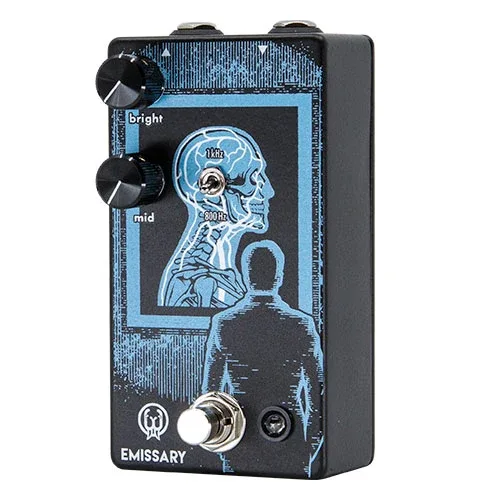
The Emissary's core is its parallel layout: two independent boost circuits that "work together" rather than being switched between1. Gearnews described one of the two as "based in a clean, high-headroom JFET boost circuit"5, which is the bright path. JFET stands for junction gate field-effect transistor, a transistor type often used in boost and overdrive circuits because it behaves in some ways like a tube.
The two circuits are voiced differently:
- Bright boost: a clean, high-headroom JFET boost with a slight emphasis on higher frequencies, which Walrus Audio says livens up your tone1.
- Mid boost: a circuit with a targeted boost at either 1kHz or 800Hz, selected by the toggle switch1.
For a player, the practical difference is what each boost does to an amp. A clean full-range-ish boost with treble emphasis is the classic tool for pushing a tube amp harder, while a mid-focused boost at 1kHz or 800Hz helps a solo cut through a band mix or an already driven lead channel. Having both in parallel means you can blend a touch of top-end sparkle with a mid push in one stomp.
The controls
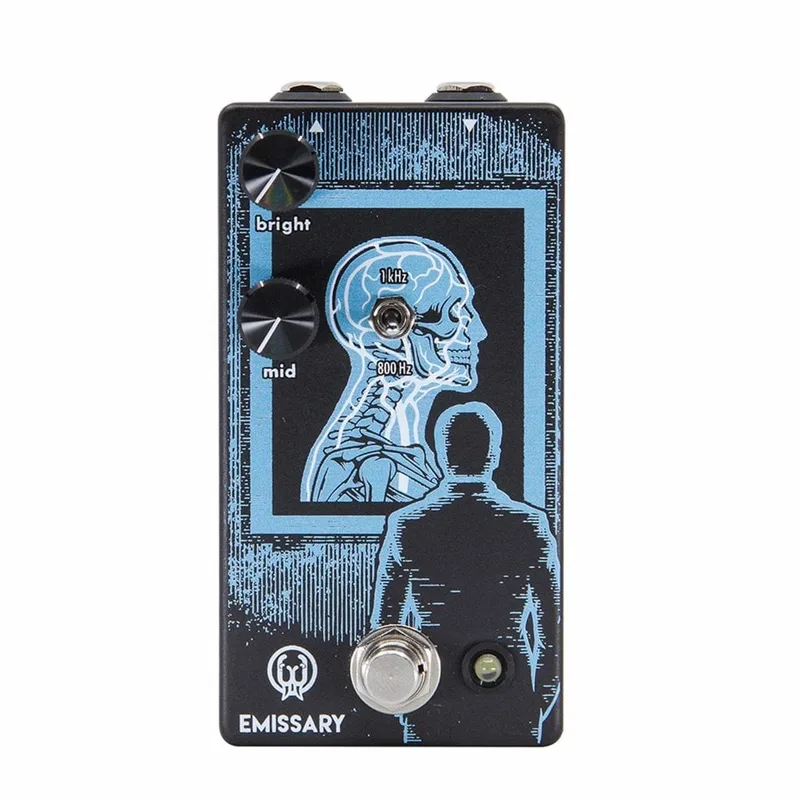
The control set is minimal: two knobs, one toggle, and one footswitch16.
| Control | What it does |
|---|---|
| Top knob (Bright) | Volume for the "bright" boost circuit, the clean high-headroom JFET path voiced to emphasize high frequencies16 |
| Bottom knob (Mid) | Volume for the "mid" boost circuit, the midrange-voiced path16 |
| Toggle switch | Selects the mid boost's target frequency, 1kHz or 800Hz1 |
| Bypass switch | Soft-relay switch with a momentary function16 |
Premier Guitar's reviewer described the layout the same way: "A bright knob dials in the former, a mid knob governs the latter"6.
The momentary switch
The bypass switch is a soft-relay, non-latching type with a bonus momentary function6. When the pedal is in the off position, press and hold the switch to temporarily activate the effect; releasing the switch turns the effect off1. A quick click gives you normal stomp-on and stomp-off behavior6.
This is a useful trick for swells and accents: hold the switch for as long as you want the boost, let go and it is gone. You do not have to commit to tapping twice16.
Power and enclosure
The Emissary runs on 9VDC with a minimum of 100mA1. Premier Guitar's review noted that Walrus Audio recommends an isolated power supply rather than a daisy-chained solution6.
The 100mA minimum draw and the maker's recommendation of an isolated supply mean this pedal is best powered from its own isolated output, not shared on a daisy chain16.
The pedal comes in a "Silk Satin Black" finish with light blue and white ink, in a die-cast enclosure measuring 4.77" x 2.6" x 1.39"1. The artwork, by illustrator Adam Forster, is an x-ray of a patient's skull showing the Emissary and other vital veins running through the head14.
Where it came from
Walrus Audio announced the Emissary Parallel Boost in June 2018, with a retail price of $169 at walrusaudio.com and authorized dealers4. MusicRadar reported the same $169 preorder price and a release date of 18 June 20182. Premier Guitar's later review listed its street price as $1696.
The name comes from anatomy. As gearnews explained it, emissary veins are veins that pass through the skull and connect the venous sinuses inside with the veins outside5, which is also what the skull x-ray artwork refers to1.
What reviewers said
Premier Guitar reviewed the Emissary using a Gibson 1958 Les Paul reissue, a Novo Serus J with P-90s, a tweed Deluxe-style combo, and a Friedman Small Box head with a 2x12 cab6. The reviewer's overall verdict:
"A surprisingly versatile yet simple boost pedal, great for both nudging your tube amp into overdrive and helping solos cut through an already sizzling lead channel"
That verdict lines up with what the parallel design promises on paper: one clean boost for pushing an amp, one mid boost for cutting through, both available at once61.
Videos
Premier Guitar
Premier Guitar
Premier Guitar
Questions
Is the Walrus Audio Emissary discontinued?
Yes. Walrus Audio's product page states that the Emissary Parallel Boost is discontinued and no longer available. It was released on 18 June 2018 at a preorder and retail price of $169, so finding one now means looking at the used market.
How does the momentary switch on the Emissary work?
The bypass switch has a momentary function. When the pedal is off, press and hold the switch to temporarily turn the effect on, and release it to turn the effect off again. A quick click works as a normal stomp-on and stomp-off switch, so you can use it either way.
Why is it called the Emissary?
The name comes from anatomy. Emissary veins pass through the skull and connect the venous sinuses inside the head with the veins outside, and the pedal's artwork by illustrator Adam Forster shows an x-ray of a skull with the Emissary and other veins running through it.
How much did the Walrus Emissary cost?
It was offered at a retail price of $169 when announced in June 2018, and MusicRadar reported the same $169 preorder price. Premier Guitar's later review also listed its street price as $169.
Sources (6)
- Emissary Parallel Boost, Walrus Audio
- Walrus Audio introduces Emissary Parallel Boost pedal, MusicRadar, 2018-06-12
- Emissary Parallel Boost by Walrus Audio, RockBoard PedalPedia, 2026
- Walrus Audio Introduces the Emissary Parallel Boost, Premier Guitar, 2018-06-11
- Walrus Audio Emissary Parallel Boost: 2 boost circuits in one pedal, gearnews.com, 2018-06-13
- Walrus Audio Emissary Review, Premier Guitar, 2018-08-24