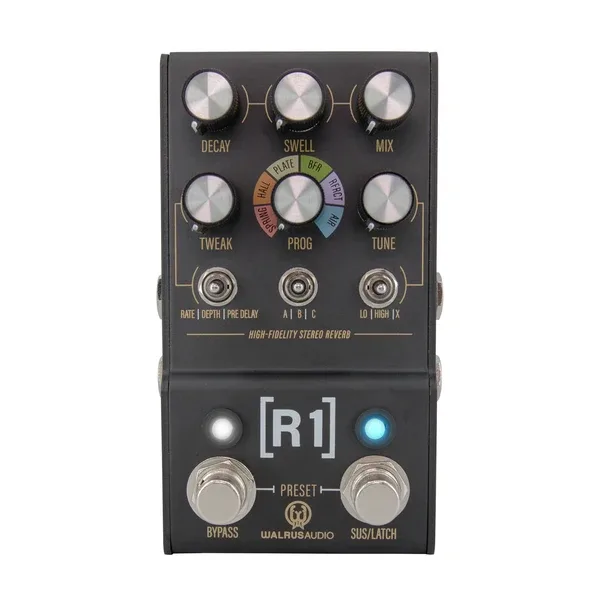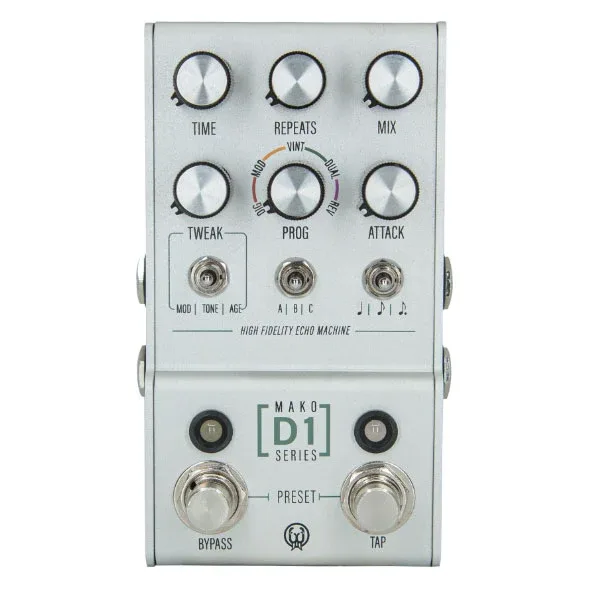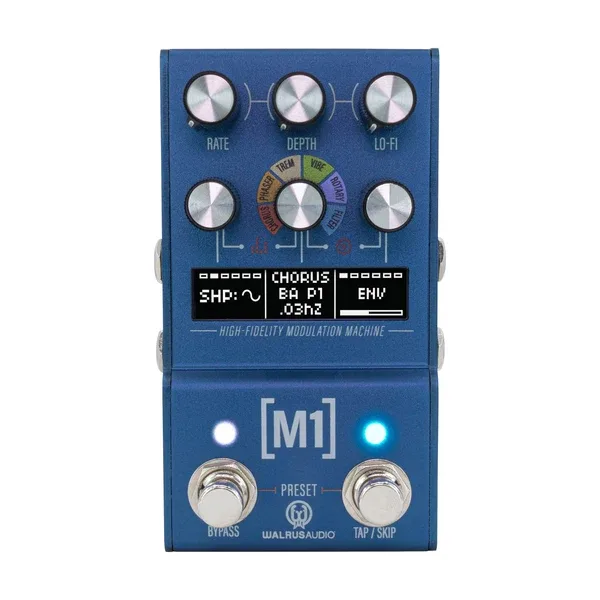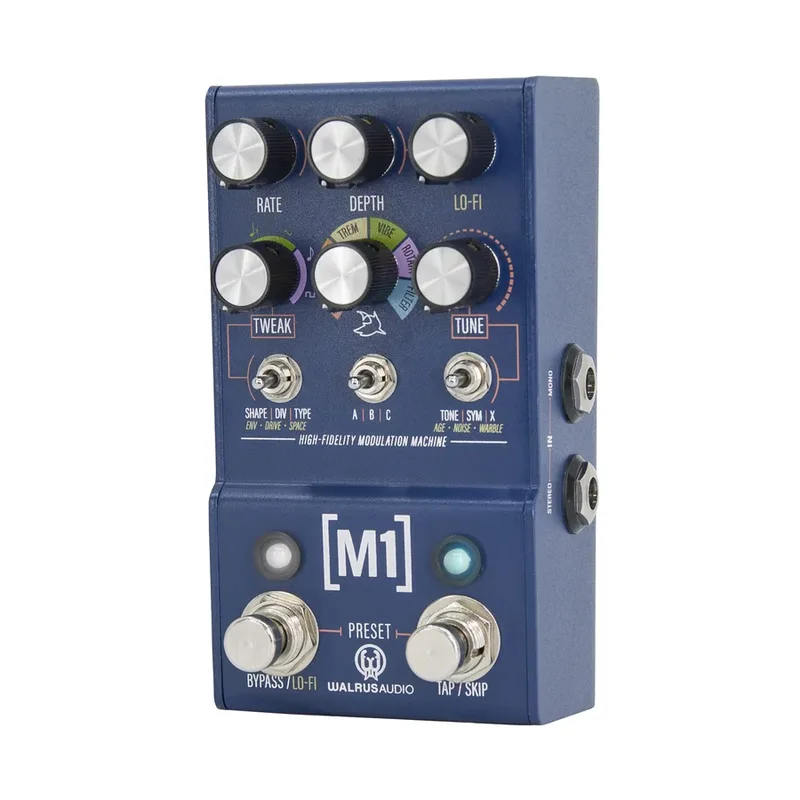


The Walrus Audio Mako M1 High-Fidelity Modulation Machine is a digital modulation pedal that packs six studio-quality programs into one compact enclosure: chorus, phaser, tremolo, vibrato, rotary and filter, each with three different types for 18 modulation effects in total12. Released in 2022, it completed Walrus Audio's Mako series compact workstation lineup, following the R1, D1 and ACS13. Even though the pedal is digital, it emulates analog-style modulation effects, with sounds guitar.com reported as inspired by "analogue modulation circuits of old"42.
For a player, the appeal is breadth: one box covers most modulation duties, from subtle chorus to rotary speaker swirl, with a lo-fi mode that adds vintage character on top of any program31.
What the M1 does: six programs, three types each
The central control knob is a rotary selector choosing between chorus, tremolo, phaser, vibrato, rotary speaker and filter effects4. Each program then offers three types, which is where the M1's range lives18.
| Program | Type 1 | Type 2 | Type 3 |
|---|---|---|---|
| Chorus | Traditional Chorus | Tri-chorus, three chorus units in parallel1 | Sweeping, vintage-style flanger1 |
| Phaser | 2-stage, single notch | 4-stage, two notches9 | Uni-Vibe tuning and LFO shape9 |
| Tremolo | Optical and bias style | Harmonic tremolo9 | Sequenced pattern tremolo9 |
| Vibrato | Traditional | Vinyl (33/45/78 rpm speeds)9 | Tape wow and flutter9 |
| Rotary | Full Leslie-style watery sound | Horn only9 | Drum only1 |
| Filter | Envelope Follower type, with adjustable resonance, envelope speed and release9 |
MusicRadar's reviewer found the chorus offers "more familiar 'Traditional' type, then airier Series and warm, watery Tri-Chorus," while the phaser covers 2- and 4-stage phasing along with a Univibe type8. The same reviewer noted that a filter program instead of a flanger was "an odd choice to us"8. There is no dedicated flanger program on the original M1; the MKII addresses this by putting flanger sounds in the chorus algorithm1011.
The controls and lo-fi mode
The M1 follows the same dual-footswitch, six-knob, three-switch format as its Mako siblings3. Its stepped enclosure has two footswitches, three toggle switches and six control knobs4.
- Program selector: rotary switch for the six programs34
- Rate and Depth: single-function controls for the modulation speed and intensity4
- Lo-Fi knob: sets the amount of lo-fi effect added4
- Tweak and Tune: multi-function knobs offering extensive deep-editing of each program's behavior4
- Tone: controls the overall tone of the signal passing through the M11
- Left footswitch: bypasses the pedal or toggles lo-fi mode4
- Right footswitch: tap tempo, also usable for a Skip performance effect3
The lo-fi mode is the M1's signature extra. Walrus describes it as "a dedicated lo-fi knob allowing you to mix various lo-fi parameters to every program"1. The six parameters that form the lo-fi effect are warble, age, drive, space (ambient reverb), noise and envelope8. You enter the mode by holding down the Bypass/lo-fi switch and keeping it held while tweaking the parameters8. MusicRadar's verdict called the M1 "an especially rewarding pedal for fans of lo-fi and ambient modulation"8.
Power and connections
Power requirements are 9VDC at 300mA minimum, from an adaptor that is not supplied13. That draw rules out a battery and makes a robust power supply a practical necessity.
The M1 needs 9VDC at 300mA minimum1. A pedal this hungry for current belongs on a proper power supply, not a shared or weak source.
Connections are standard 1/4-inch mono and stereo inputs and outputs, MIDI IN, MIDI THRU and USB8. MIDI allows control over most of the M1's parameters3. The onboard presets are arranged in three banks and scrolled through by pressing both footswitches simultaneously, with the right LED lighting red, green or blue to indicate the active preset3. Bypass is selectable between True Bypass, DSP+True Bypass with trails, and DSP Bypass3. The enclosure measures 4.9" x 2.52" x 2.64" with knobs, in a dark blue finish with red, orange, cream, gold, green, purple and blue ink1.
The MKII version
In September 2024 Walrus Audio announced the Mako MKII, an updated version of the Mako M1 with a new screen-based control interface1213. The MKII is a stereo, all-in-one modulation pedal with the same six studio-grade programs, and adds a 2-inch OLED screen measuring 128x32 pixels, total BPM control with a tempo readout on the menu screen for the Chorus, Phaser, Tremolo and Vibrato programs, and a left encoder knob for features like effect type, BPM and wave shape9. USB firmware updates can be done via www.walrusaudio.io9. It lists at $399.9914. Guitar Pedal X's first-hand impressions noted the MKII runs 18 algorithms in total, three for each effect type, with a tap tempo switch for real-time synchronization of the modulation rate15. Full details are on the Walrus Audio Mako Series MKII M1 page.
What reviewers said
Guitar World's Trevor Curwen concluded in 2022 that the M1 delivers "perhaps not all but most of the modulation effects you'd need, complete with optional lo-fi character, in a classy pedal that won't hog valuable 'board real estate"3. MusicRadar praised the "great selection of effects with three types of each," the "huge scope for manipulation with an array of parameters," and found that "the Rotary sounds in particular are so good they win a lot of favour with us," while noting the price represents "an extra investment for players"8. Of the MKII, Guitar World's Jonathan Horsley gave four stars overall, calling it "a superb choice for players serious about modulation" but not cheap and daunting for casual users12, and guitar.com's Josh Gardner rated it 8, finding top-class sounds and deep tweakability but reduced intuitiveness versus the original12.
Videos
Sweetwater
walrusaudioeffects
walrusaudioeffects
News
Questions
Does the Walrus M1 have a flanger?
Not as its own program. The original M1's six programs are chorus, phaser, tremolo, vibrato, rotary and filter. On the updated M1 MKII, the chorus algorithm also handles flanger, with a sweeping, vintage-style flanger as its third chorus type, so flanger sounds are available there rather than as a separate program.
How many presets does the Mako M1 hold?
The original M1 saves up to nine onboard presets, arranged in three banks, with a full 128 accessible via MIDI. The M1 MKII increases the onboard count to 128 presets. On the original, presets are scrolled through by pressing both footswitches simultaneously, with an LED showing which bank is active.
Does the Walrus Mako M1 have tap tempo?
Yes. The right footswitch is a tap-tempo switch for real-time synchronization of the modulation rate, and it can also be used for a Skip performance effect. MIDI gives further control over most of the pedal's parameters, including tempo.
Can the M1 run in stereo?
Yes. It offers Mono In / Mono Out, Mono In / Stereo Out, and Stereo In / Stereo Out configurations, with standard 1/4-inch mono and stereo inputs and outputs. In stereo, one of the deep-editing controls sets the phase of the right output in relation to the left on the tremolo program.
What is the difference between the M1 and the M1 MKII?
The MKII, announced in September 2024, adds a 2-inch OLED screen with clickable encoder knobs, a flanger in the chorus algorithm, updated rotary and filter algorithms, total BPM control with a tempo readout, an internal wet/dry mix, and 128 onboard presets instead of nine. Both run on 9VDC at 300mA minimum.
What is the difference between the Walrus Mako M1 and the M1 MKII?
The MKII is an updated version of the 2022 Mako with the same six modulation programs but a new screen-based control interface, a flanger added to the chorus algorithm, refreshed rotary and filter algorithms, BPM control with on-screen tempo readout, and 128 onboard presets. The original M1 has nine onboard presets and knob-and-switch control.
Sources (15)
- MAKO Series: M1 High-Fidelity Modulation Machine, Walrus Audio
- Walrus Audio MAKO M1 High-Fidelity Modulation Machine: With 18 modulation effects!, gearnews.com, 2022-01-20
- Walrus Audio Mako M1 High-Fidelity Modulation Machine review, Guitar World, 2022-07-28
- Walrus Audio launches its latest Mako pedal, the M1 High-Fidelity Modulation Machine, Guitar.com, 2022-01-20
- Guitar Pedal X, Guitar Pedal X, 2022-01-21
- Is the new Walrus Audio MAKO M1 the only modulation pedal you'll ever need?, MusicRadar, 2022-01-20
- Walrus Audio MAKO Series: M1 High-Fidelity Modulation Machine, Pedal of the Day, 2022-03-12
- Walrus Audio Mako Series M1 High-Fidelity Modulation Machine pedal review, MusicRadar, 2022-06-09
- 385 Overdrive, Walrus Audio
- Walrus Mako M1 MKII review, guitar.com, 2025-09-22
- “Dialling in these inspiring studio grade tones has never been easier and has never sounded better”: Walrus Audio adds OLED display, more controls, features and sounds on its new and improved flagship Mako MkII series pedals, MusicRadar, 2024-09-25
- Walrus Audio Mako M1 MKII High-Fidelity Modulation Machine review, Guitar World, 2025-01-10
- Walrus Audio Mako M1 MkII, Delicious Audio, 2026-10-06
- Mako Series MKII, Walrus Audio
- Guitar Pedal X, Guitar Pedal X, 2024-11-19
 Yvette Young