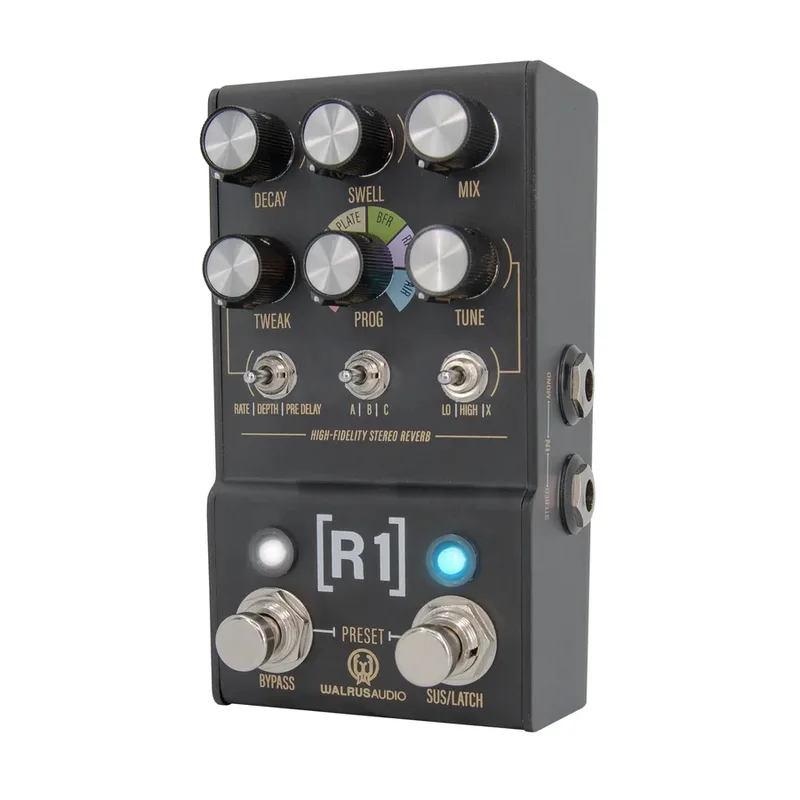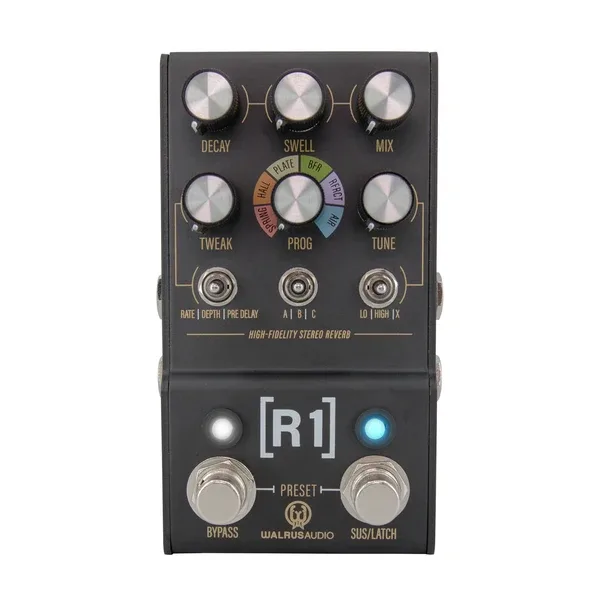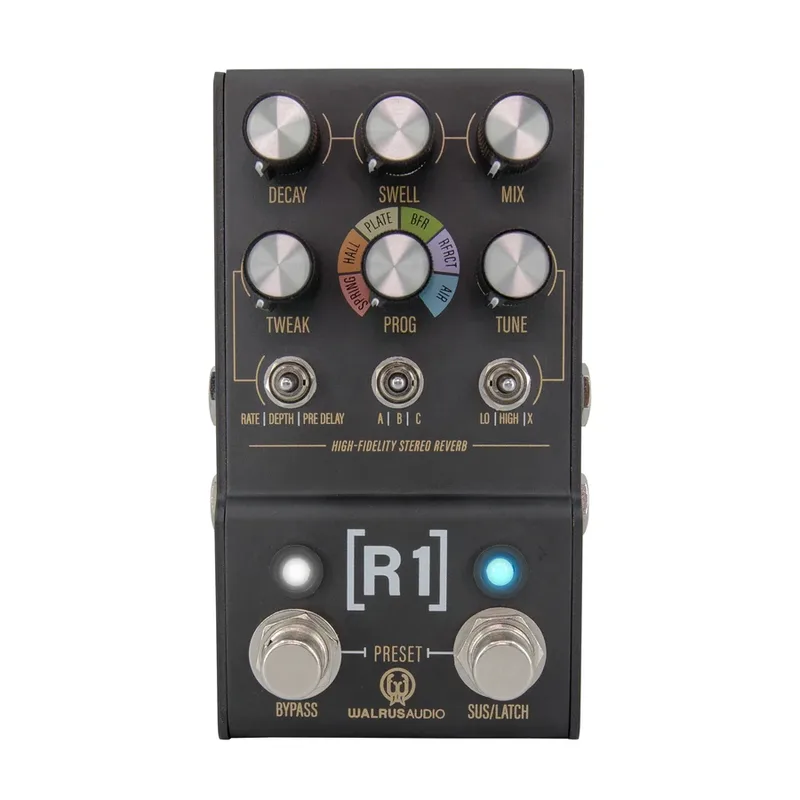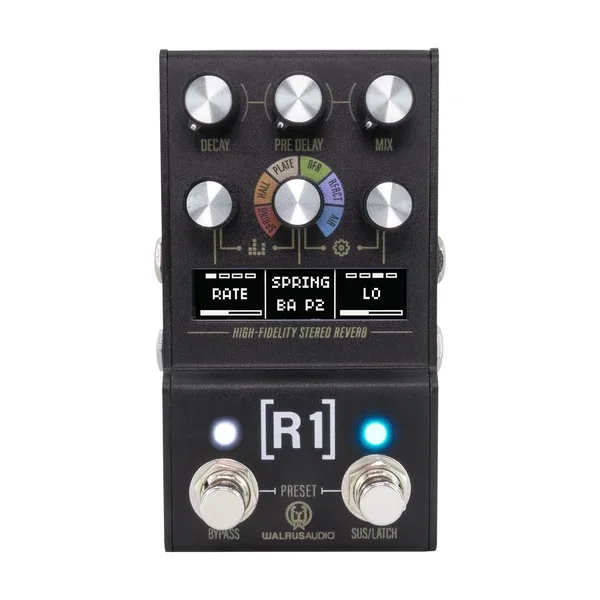


The Walrus Audio Mako Series MKII R1 High-Fidelity Reverb is a stereo reverb pedal and the second version of the R1, part of Walrus Audio's Mako Series. Walrus Audio describes it as "an extremely powerful and versatile multi-function reverb that can go from intimate, small-room type subtlety to massive, otherworldly soundscapes"12. It carries six reverb programs, an OLED screen for editing, up to 128 onboard presets, MIDI, and three selectable bypass modes. The original R1, released in 2021, is now discontinued and no longer available34.
The MKII R1 lists at $399.995. Walrus Audio has also sold units at a discount: blemished units at $339.99, and units with a minor screen issue, where part of the OLED image is skewed or pixels are missing, also at $339.9967.
The six programs
The core of the pedal is six reverb programs, which Walrus Audio says were rebuilt from the ground up for the MKII5. MusicRadar's Jonathan Horsley wrote at launch that "the R1 covers all the main [reverb pedal] food groups with Spring, Hall, Plate, BFR, Refract, and Air"8. Guitar.com's Josh Gardner grouped them as "the vanilla trio of spring, hall and plate, and then three of the more esoteric ambient reverbs"10.
| Program | What Walrus Audio says it does |
|---|---|
| Spring | Emulates an excited spring reverb commonly found in tube amps, with "loads of transducing drip"57 |
| Hall | The acoustics of large live sound spaces, from concert halls to arenas; longer decays give a massive wash of ambience75 |
| Plate | Emulates a smooth analog plate reverb with even diffusion5 |
| BFR | A hall-esque reverb with rich, lush decay, "a vast cavern filled with choirs of angels"57 |
| Refract | Granular textures, "lovely, charming, and glitch-like," over a controllable amount of diffusion57 |
| Air | A larger diffused reverb with shimmer and distinct clarity in its decay5 |
The Refract program works differently from the others. It pulls grains from a buffer: Rate sets how often new grains trigger, Depth controls the modulation applied to the grains, Time sets the grains' delay time, Size sets the grain size, and Diffuse takes the grains from dry and stuttery to washed out in a reverb mix6. On the Air program, a shimmer control leans into the high-octave sound ambient players use5.
The controls
The MKII replaces the original's knob-and-switch panel with a screen-based interface. A 2-inch OLED display, measuring 128x32 pixels, shows what you are editing5. Two encoder knobs do most of the work:
- Left encoder: customizes each program with features like modulation rate and ducking5.
- Right encoder: adjusts parameters like reverb EQ and room size5.
A Ducking/Swelling control works in both directions: higher settings make the swelling effect more prominent, while lower settings enhance the ducking effect, where the reverb backs off while you play5. MusicRadar also noted a new Size control on the MKII R1, "offering you greater control over your guitar's ambience"8.
For comparison, the original R1 used dials for Decay, Swell, Mix, Tweak and Tune, with a six-way rotary Prog dial for program selection and a Tune switch selecting Lo, High or X9. Its Tweak knob's Depth setting controlled the depth of the LFO applied to the reverb signal11.
Presets, MIDI and bypass
The R1 MKII can save up to 128 onboard presets, held in a preset bank you reach by tapping down on the footswitch. Presets 10 through 128 can be accessed by manual selection or MIDI65. That is a step up from the original R1, which held nine presets onboard with 128 accessible via MIDI34.
Three bypass modes are selectable: True Bypass, Hybrid Bypass and Buffered Bypass5. MusicRadar's review of the original described the same three options there as true bypass, DSP+True Bypass with trails, and DSP Bypass, and listed MIDI control among its reasons to buy9. The original also carried MIDI In/Out DIN connections4.
Power
Power requirements are 9V DC at 300mA minimum, center negative, and no power supply is included64.
Walrus Audio recommends an isolated power supply for all of its pedals and does not recommend daisy chain supplies53. With a 300mA draw, the R1 MKII needs a dedicated output on a powered pedalboard rather than a shared chain.
Where it came from
The original Mako Series R1 High-Fidelity Stereo Reverb launched in January 2021, announced as the expansion of Walrus Audio's Mako Series12. Guitar World called it "feature-rammed" at launch12, and Guitar.com's Cillian Breathnach wrote that "the core of its sound is six reverb programs: Spring, Hall, Plate, BFR, RFRCT, and Air"13. The MKII series arrived in September 2024, with MusicRadar reporting that in the case of the R1, "all six core reverbs have been wholly redesigned from top to bottom"8. The original R1 is discontinued3.
What reviewers said
Blemished and discounted units
Walrus Audio sells some pedals at a discount in separate listings. A blemished unit has cosmetic damage only, such as scratches or dents in the finish611. A separate listing covers units with a minor screen issue, where a portion of the OLED is not properly set, causing a slightly skewed image or missing pixels, sold at $339.997. Blemished MKII R1 units have also been listed at $339.995, and blemished original R1 units are sold out11.
Videos
walrusaudioeffects
Rabea Massaad
EytschPi42
Questions
Is the Walrus Audio R1 MKII stereo?
Yes. The R1 line is a high-fidelity stereo reverb, with stereo input and output on standard Left/Mono and Right jacks, plus MIDI in and out. It will also run with a single mono connection if you only feed one input.
How many presets does the R1 MKII store?
The R1 MKII can save up to 128 onboard presets, held in a preset bank you reach by tapping down on the footswitch. Presets 10 through 128 can also be selected manually or over MIDI. The original R1 held nine presets onboard with 128 accessible via MIDI.
Can I power the R1 MKII from a daisy chain?
Walrus Audio recommends an isolated power supply for all of its pedals and does not recommend daisy chain supplies. The R1 MKII needs 9V DC at 300mA minimum, center negative, and no power supply is included, so plan on a dedicated isolated output.
What is a blemished Walrus Audio R1?
A blemished unit is a pedal sold at a discount because of cosmetic damage only, such as scratches or dents in the finish. Walrus Audio states the blemish does not affect function. Blemished MKII R1 units have been listed at $339.99.
Where is the Walrus Audio R1 made?
The R1 is made in the USA. Guitar World's review of the original R1 lists its origin as USA, and Guitar Pedal X's roundup of stereo reverb workstations also describes it as made in the USA.
What changed from the original R1 to the MKII?
All six reverb programs were rebuilt and revamped, which Walrus Audio describes as a vast tonal improvement. The MKII adds a 2-inch OLED screen, a new Size control for ambience, and up to 128 onboard presets instead of the original's nine. The original R1 is now discontinued.
Sources (13)
- Lüm Texture Engine, Walrus Audio
- Monumental Harmonic Stereo Tremolo, Walrus Audio
- MAKO Series: R1 High-Fidelity Stereo Reverb, Walrus Audio
- Guitar Pedal X, Guitar Pedal X, 2021-08-16
- Mako Series MKII: R1 High-Fidelity Reverb, Walrus Audio
- Mako Series MKII: R1 High-Fidelity Reverb, Walrus Audio
- Mako Series MKII: R1 High-Fidelity Reverb, Walrus Audio
- “Dialling in these inspiring studio grade tones has never been easier and has never sounded better”: Walrus Audio adds OLED display, more controls, features and sounds on its new and improved flagship Mako MkII series pedals, MusicRadar, 2024-09-25
- Walrus Audio Mako Series R1 High-Fidelity Stereo Reverb review, MusicRadar, 2021-09-24
- Walrus Audio Mako Mk II R1 review, Guitar.com, 2025-10-22
- MAKO Series: R1 High-Fidelity Stereo Reverb, www.walrusaudio.com
- Walrus Audio's feature-rammed Mako Series expands with the dreamy R1 High-Fidelity Stereo Reverb, Guitar World, 2021-01-20
- Walrus Audio announces the Mako R1, a high-fidelity stereo reverb, Guitar.com, 2021-01-20