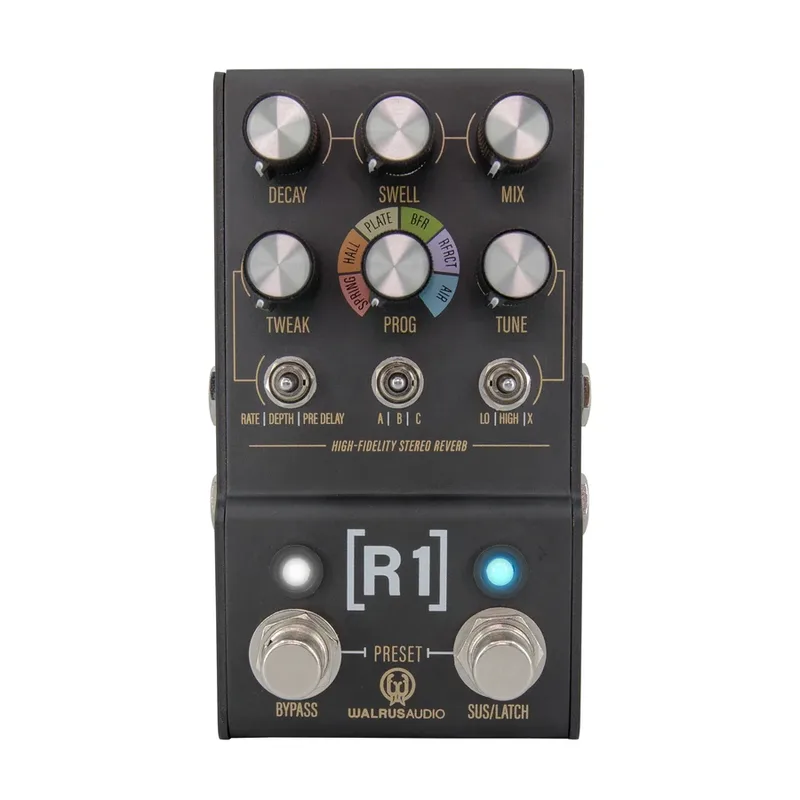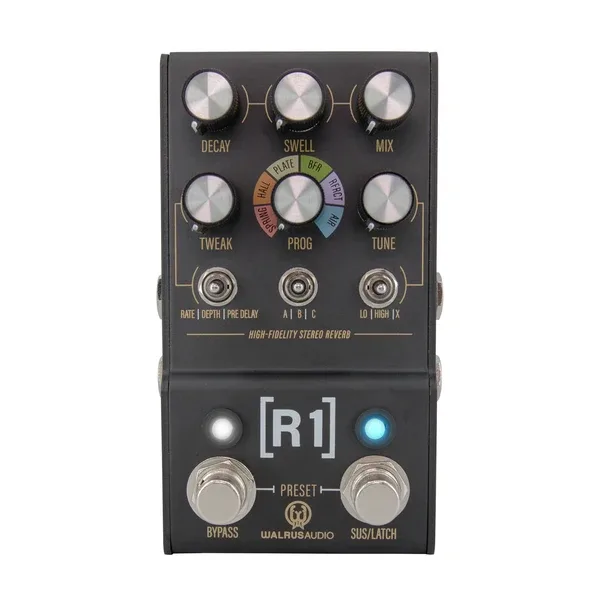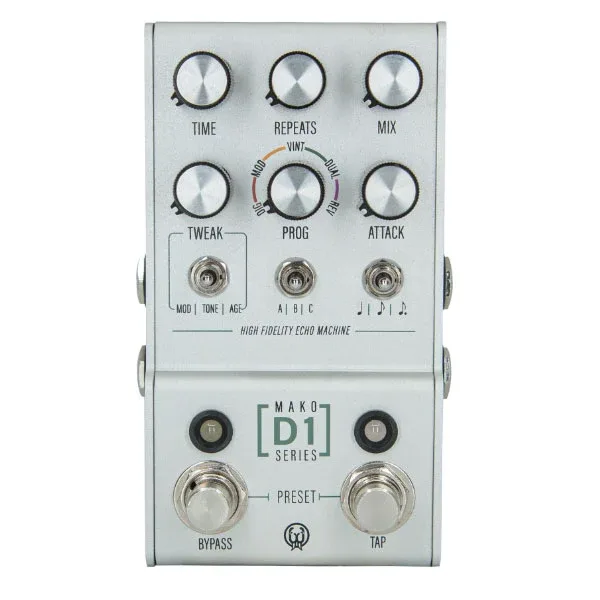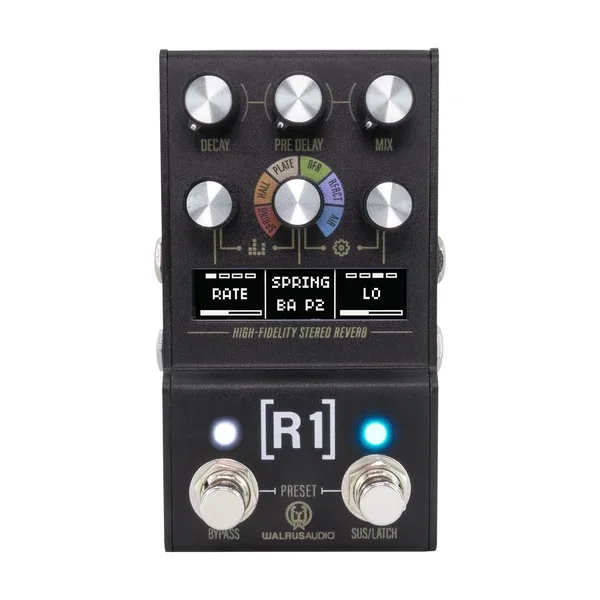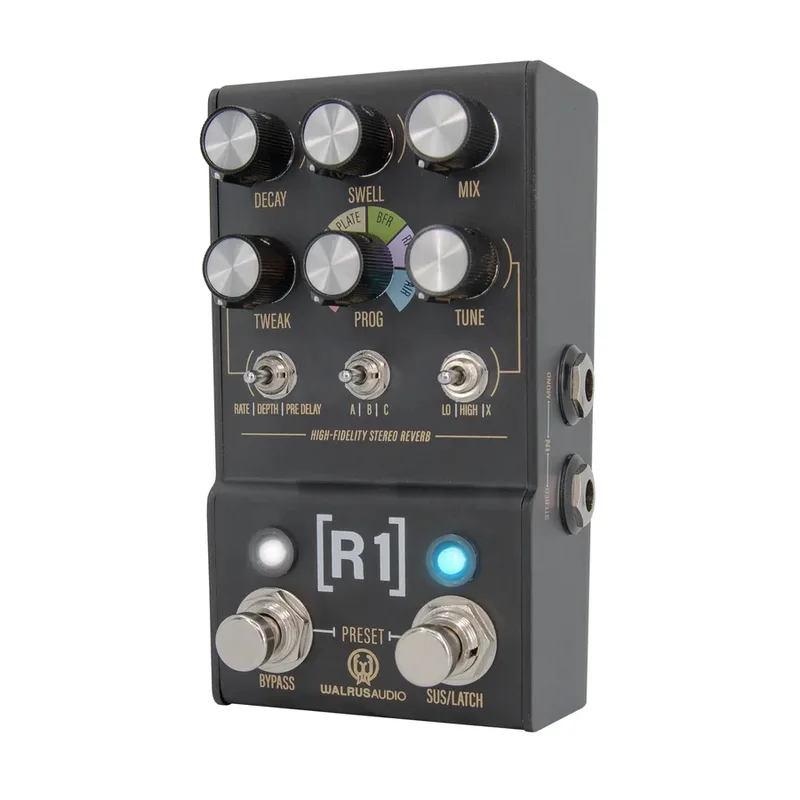


The Walrus Audio Mako Series R1 is a digital multi-mode stereo reverb pedal, the second pedal in Walrus Audio's premium Mako line after the D1 delay12. It carries six reverb programs, Spring, Hall, Plate, BFR, Refract and Air, in a six-knob enclosure with stereo inputs and outputs, MIDI control and preset storage3. It was announced in January 2021, expected to ship that February, and carried a list price of $34945.
The original R1 is now discontinued and no longer available from Walrus Audio, and its blemished units are sold out3. It was succeeded by the Mako MKII R1, announced in late 2024 at $3996.
A six-mode stereo reverb
The core of the R1 is its six reverb programs, which Walrus Audio calls "six customized, studio-quality programs"3. Three of them, Spring, Hall and Plate, model familiar physical spaces and hardware. The other three are more unusual:
- BFR: short for Big F***ing Reverb234. Walrus describes the effect as "a vast cavern filled with choirs of angels"1.
- Refract (RFRCT): an experimental program, one of the modes reviewers pointed to when calling the pedal unusually strong for ambient and stereo work234.
- Air: the sixth program, listed alongside the others on the six-way selector3.
Guitar.com's reviewer Richard Purvis found the pedal "wondrous for stereo space exploration, but not as strong on the humdrum stuff", rating it 8 overall1. MusicRadar's review team listed its "wide range of reverbs" among the reasons to buy it8.
The R1 runs in mono or stereo, with twin inputs and outputs on the sides of the enclosure1. Its connections also include USB and MIDI in and out7, with five-pin MIDI in and through giving access to 128 preset slots1. A microUSB port handles firmware updates1.
The controls and footswitches
Like the other pedals in the Mako Series, the R1 uses a six-knob enclosure8. The full control set, as listed in Guitar World's review, is:
| Control | What it does |
|---|---|
| Program selector | Six-way rotary dial choosing Spring, Hall, Plate, BFR, Refract or Air83 |
| Decay | Sets decay time, "ranging from nothing to practically forever"1 |
| Swell | Shapes how the reverb builds |
| Mix | Balances dry and wet signal |
| Tweak | Modifies the parameter chosen by the Tweak switch |
| Tune | Modifies the parameter chosen by the Tune switch |
| Tweak switch | Selects Rate, Depth or Pre Delay for the Tweak knob8 |
| Tune switch | Selects Lo, High or X for the Tune knob7 |
| Bank switch | Selects preset bank A, B or C7 |
The twin-footswitch layout pairs a Bypass switch with a Sus/Latch footswitch7. The sustain side "takes a snapshot of the current reverb sound and sustains it" until you tap it again or release it, and MusicRadar describes it as offering "an infinitely sustaining reverb"18. That makes it a pad-like freeze function for ambient playing rather than a simple hold.
Presets work much as they do on the Mako D1: nine on-board presets, with both footswitches or the bank switch moving between them, and full MIDI control opening up 128 slots13.
Power and connections
The R1 needs a 9V DC supply rated at 300mA minimum, and the supply is not included38. Walrus Audio recommends an isolated power supply for all its pedals and does not recommend daisy-chain supplies3. At 300mA it will not run on a battery, and it needs its own isolated outlet on a power brick.
Physically, the pedal measures 126 x 75 x 63mm in Guitar.com's listing, and is made in the USA17. Its enclosure is a plain metallic shade, different for each Mako pedal, a departure from the elaborate graphic designs Walrus Audio is known for7. Guitar.com's reviewer described it as echoing the D1's "crisp and classy form but now clad in black"1.
The Mako Series and the MKII
The R1 was the second pedal in the Mako Series, following the D1 High-Fidelity Stereo Delay, and MusicRadar noted at launch that it was "part of Walrus Audio's premium Mako line and will surely do for reverb what the D1 did for delay"2. The series shares the six-knob format, twin footswitches and MIDI integration across its pedals87.
In September 2024 Walrus Audio announced MKII versions of the Mako pedals, including the R19. The MKII R1 keeps the same six programs, Spring, Hall, Plate, BFR, Refract and Air, built from the ground up, and adds a menu screen for navigating secondary controls and a new Ducking/Swelling feature109. Its biggest change is preset storage: up to 128 on-board presets, held in a bank you reach by tapping down on the bottom left and bottom middle knobs simultaneously, with presets 0 to 9 divided into Banks A, B and C and presets 10 to 128 accessible by manual selection or MIDI11. Guitar.com's Josh Gardner noted the jump from "just nine on the original"10. Guitar Pedal X listed the MKII R1 at $399 when it arrived6.
If you are shopping for an R1 today, the original is discontinued3. The current version is the MKII, and Walrus Audio has also sold blemished and minor-screen-issue units of it directly.
Videos
walrusaudioeffects
walrusaudioeffects
walrusaudioeffects
News
Questions
Is the Walrus Audio R1 discontinued?
Yes. Walrus Audio lists the original Mako Series R1 High-Fidelity Stereo Reverb as discontinued and no longer available, and its blemished units are sold out. It was replaced in the Mako line by the MKII version of the R1, announced in late 2024.
Does the Mako R1 have reverb trails?
Yes. The R1 offers three bypass modes: true bypass, DSP+ true bypass with trails, and DSP bypass with trails. You can switch between them, so you can choose whether the reverb tail rings out or cuts off when you disengage the pedal.
How many presets does the Walrus R1 have?
The original R1 holds up to nine on-board presets, with up to 128 slots accessible via MIDI. The MKII version expands this to up to 128 on-board presets, stored in banks you reach by tapping down on two knobs at once.
What is the BFR mode on the Walrus R1?
BFR is one of the R1's six reverb programs. The name is short for Big F***ing Reverb, and Walrus describes the effect as a vast cavern filled with choirs of angels, a large, lush ambient reverb rather than a simulation of a physical space.
Does the Mako R1 come with a power supply?
No. The R1 runs on a 9V DC supply rated at 300mA minimum, which is not included. Walrus Audio recommends an isolated power supply and does not recommend daisy-chain supplies for its pedals, so plan on a dedicated outlet on your power brick.
Sources (11)
- Review: Walrus Audio Mako Series R1, Guitar.com, 2021-03-15
- 13 must-have stompboxes for 2021, MusicRadar, 2021-01-29
- MAKO Series: R1 High-Fidelity Stereo Reverb, Walrus Audio
- Walrus Audio announces the Mako R1, a high-fidelity stereo reverb, Guitar.com, 2021-01-20
- Guitar Pedal X, Guitar Pedal X, 2021-08-16
- Guitar Pedal X, Guitar Pedal X, 2024-09-27
- Walrus Audio Mako Series R1 High-Fidelity Stereo Reverb review, Guitar World, 2021-05-07
- Walrus Audio Mako Series R1 High-Fidelity Stereo Reverb review, MusicRadar, 2021-09-24
- Mako Series MKII: R1 High-Fidelity Reverb, Walrus Audio
- Walrus Audio Mako Mk II R1 review, Guitar.com, 2025-10-22
- Mako Series MKII: R1 High-Fidelity Reverb, Walrus Audio