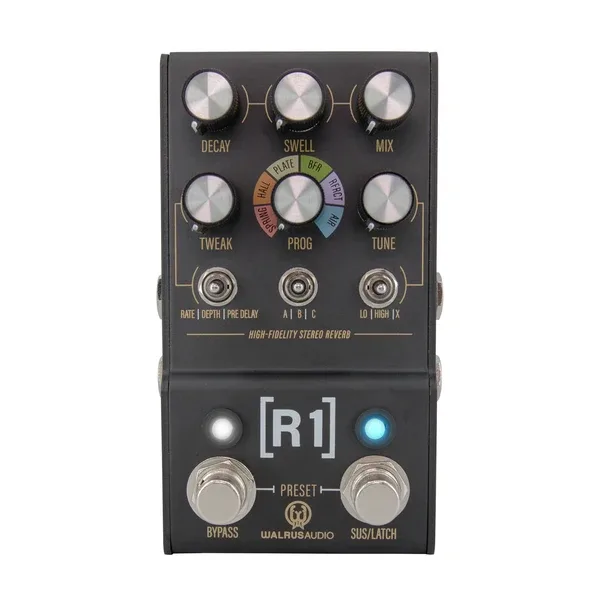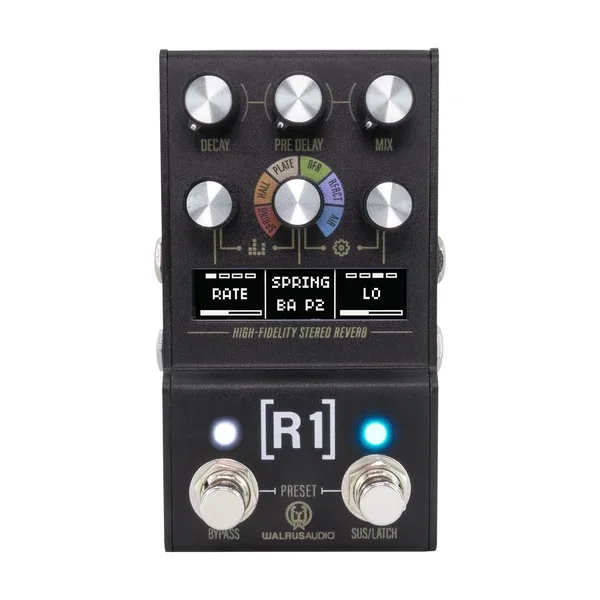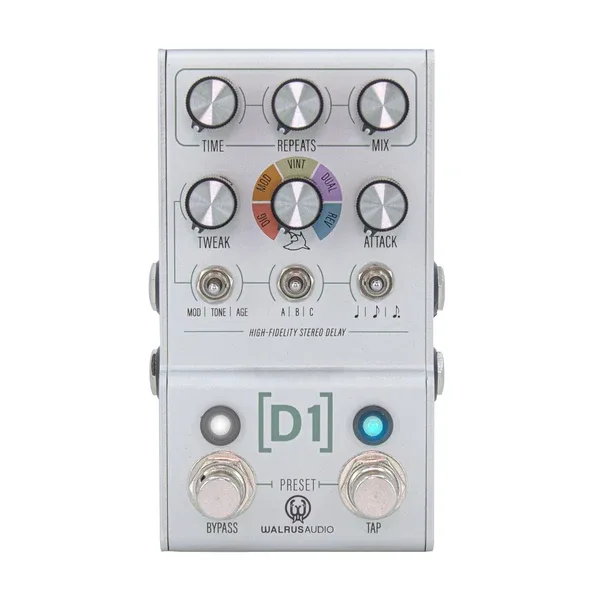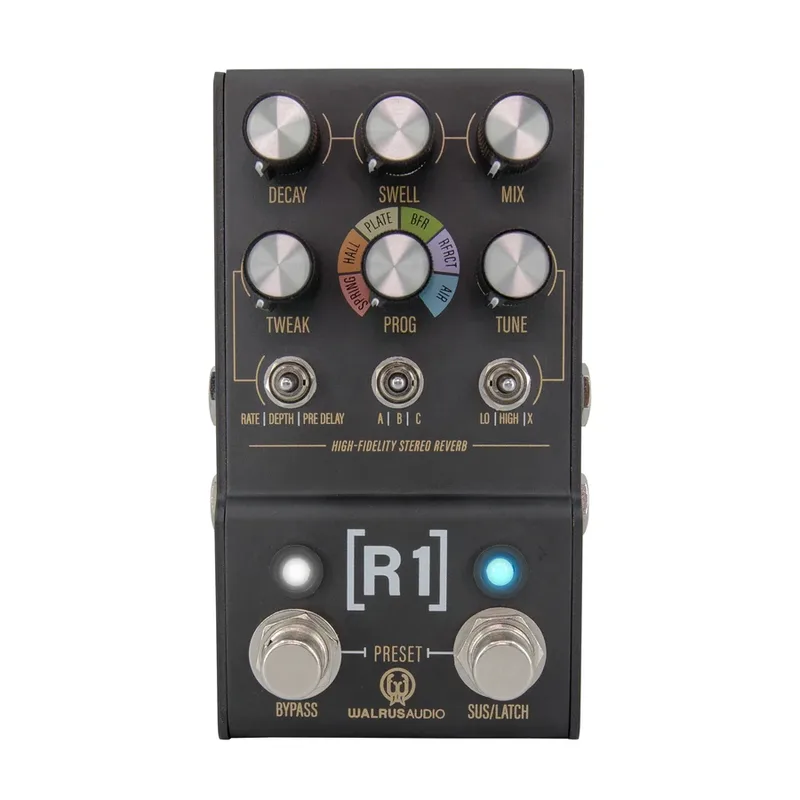


The Walrus Audio R1 is a stereo, multi-algorithm reverb pedal from Walrus Audio's premium Mako Series, released in early 2021 as the second pedal in the line after the D1 delay12. It runs six studio-quality reverb programs on an Analog Devices Sharc processor, with stereo inputs and outputs, MIDI control, presets, and a sustain/latch footswitch for holding reverb washes while you keep playing345.
Walrus Audio describes it as "an extremely powerful and versatile multi-function reverb"3. The original R1 is now discontinued and no longer available, replaced in late 2024 by the R1 MKII6.
The six reverb programs
The R1's six programs each have their own character, and the X knob changes function depending on which program is active313.
| Program | What it does | X knob |
|---|---|---|
| Spring | Emulates an excited spring reverb commonly found in tube amps, with "loads of transducing drip" | Adds a warm grit to the reverb decay |
| Hall | The acoustics of large live sound spaces, from concert halls to arenas | Controls the room's size, from smaller to larger as you turn it up |
| Plate | A smooth analog plate reverb with even diffusion, inspired by famous plates like the EMT 140 | Varies by program |
| BFR | A hall-esque reverb with rich, lush decay, described by Walrus as "a vast cavern filled with choirs of angels" | Varies by program |
| RFRCT (Refract) | Glitch-like textures hovering over a largely diffused reverb | Rate controls how often the glitch effects occur; Depth controls their overall volume |
| Air | A larger diffused reverb with a subtle shimmer and a more "crisp" clarity to its decay | Varies by program |
Walrus says the Air program also complements keys and synths, not just guitar312. MusicRadar's launch coverage summed up the range as running from "small intimate room sounds to massive washes of experimental euphoria"14.
Controls and the sustain/latch footswitch
The R1 uses a six-knob enclosure shared with its Mako Series siblings12. The main controls are:
- Decay: Sets the length of the reverb tail7
- Swell: Controls a volume swell effect that can be applied to any program39
- Mix: Blends dry and wet signal7
- Tweak: Gives quick access to secondary parameters, controlling Rate, Depth and Pre-Delay139
- Tune/X: Shapes the low and high frequencies of the reverb signal via a three-way toggle switch, with the X knob taking a different parameter in each program4139
- Program selector: Chooses among the six reverb programs7
The second footswitch, labeled SUS/LATCH, is the pedal's signature control. Press and hold it to momentarily sustain the current reverb and keep playing over it through the same reverb algorithm, with no dry signal; click it to latch the present reverb decay while you play over it310. Guitar.com's reviewer described it as taking "a snapshot of the current reverb sound" that sustains until you tap it again or release1, and Guitar.com's launch coverage called it a way to create "an infinite ambient wash"15. Gearnews noted that the sustain/latch footswitch controls different parameters depending on which reverb you are using4.
The R1 saves up to nine on-board presets, with up to 128 accessible via MIDI37. Presets A/B/C sit on the enclosure for quick switching7.
Power and connections
The R1 runs on 9V DC, center negative, with a 300mA minimum draw, and the power supply is not included39. Walrus Audio recommends an isolated power supply for all of its pedals3.
At 300mA minimum, the R1 draws more current than a standard 100mA daisy-chain output can supply. Plan on a dedicated or isolated 9V output.
Connections are stereo: standard inputs and outputs on Left/Mono and Right jacks, plus MIDI In/Out DIN connections129. The pedal can operate in either stereo or mono, so it works on a mono board as well as in a full stereo rig154.
Bypass is selectable among three modes: true bypass, DSP+True Bypass (which keeps trails), and DSP Bypass1219. The enclosure is anodized matte black with red, orange, cream, gold, green, purple and blue ink, sized 4.9" x 2.52" x 2.64" with knobs3. Guitar World noted the Mako pedals use a plain metallic shade, different for each pedal, unlike Walrus's usual elaborate graphic designs16.
History and versions: R1 and R1 MKII
The R1 launched at NAMM in January 2021 as the second installment in the Mako Series, following the D1 delay14. It carried a list price of $34995, and Gearnews' launch report called it "a very nice reverb pedal, feature packed and well thought out," while cautioning that it was premium priced4.
In September 2024, Walrus Audio announced the Mako Series MKII range, and Guitar World reported that the R1's sounds had been "completely rebuilt from the ground up"17. The R1 MKII is a multi-mode stereo reverb with six distinct programs, a menu screen for simple navigation of secondary controls, a Feedback EQ control, and up to 128 on-board presets held in a preset bank reached by tapping down on the footswitches181911. Its second footswitch handles momentary sustain and latch effects, and both footswitches together switch presets19. It offers True Bypass, Hybrid Bypass and Buffered Bypass modes18.
The original R1 is now discontinued and no longer available, and Walrus's blemished units are sold out310.
What reviewers said
MusicRadar's review verdict: "Walrus Audio makes the most of a compact stompbox with an intuitive array of controls that present exceptional sounding reverbs that range from the everyday to the sublime"12.
"The R1 has much going for it including form factor and that really cool Swell parameter which is possibly the main innovation."
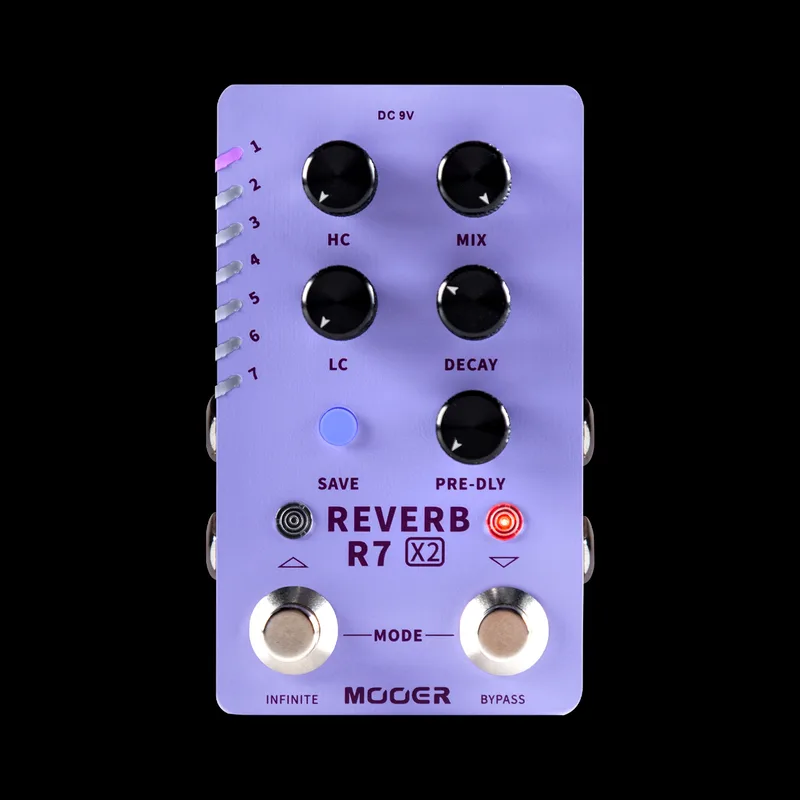
Guitar Pedal X's reviewer had been excited at launch but reported being "still impressed, I'm not quite as excited any more" after the Neunaber Illumine and Mooer R7 X2 appeared9. Guitar.com's review of the Mk II found its basic reverb sounds (spring, hall and plate) much improved over the original20.
Videos
Premier Guitar
walrusaudioeffects
walrusaudioeffects
Questions
Is the Walrus Audio R1 true bypass?
The R1 offers three selectable bypass modes: true bypass, DSP+True Bypass (which keeps reverb trails), and DSP Bypass. You can choose full true bypass or a mode that lets the reverb decay continue when you switch the pedal off.
How many presets does the Walrus R1 hold?
The original R1 saves up to nine on-board presets, with up to 128 presets accessible via MIDI. The R1 MKII expands this to up to 128 on-board presets, held in a preset bank you reach by tapping down on the footswitches.
Has the Walrus Audio R1 been discontinued?
Yes. Walrus Audio lists the original Mako Series R1 High-Fidelity Stereo Reverb as discontinued and no longer available, and its blemished units are sold out. It was replaced in late 2024 by the Mako Series MKII R1.
What reverb algorithms does the Walrus R1 have?
Six programs: Spring, Hall, Plate, BFR, RFRCT (Refract) and Air. Spring emulates an excited spring reverb with drip, Hall covers concert-hall spaces, Plate emulates a smooth analog plate, BFR is a vast hall-like reverb, RFRCT adds glitch-like textures, and Air is a diffused reverb with subtle shimmer.
Does the Walrus R1 have reverb trails?
Yes, as an option. The DSP+True Bypass mode keeps the reverb decay ringing when you bypass the pedal, so your sound tails off naturally instead of cutting off abruptly.
Can the Walrus R1 run in mono?
Yes. The pedal has stereo inputs and outputs (Left/Mono and Right) and can operate in either stereo or mono, so it works on a mono board or in a full stereo rig.
Sources (20)
- Review: Walrus Audio Mako Series R1, Guitar.com, 2021-03-15
- Walrus Audio Releases the R1 Reverb, Premier Guitar, 2021-01-20
- MAKO Series: R1 High-Fidelity Stereo Reverb, www.walrusaudio.com
- NAMM 2021: Walrus Audio R1 Reverb, gearnews.com, 2021-01-20
- Walrus Audio reveals its latest Mako Series pedal: the R1 High-Fidelity Stereo Reverb, and it sounds spectacular, MusicRadar, 2021-01-21
- Discover the Latest Walrus Audio Mako Series MKII, Premier Guitar, 2024-09-25
- Guitar Pedal X, Guitar Pedal X, 2022-01-21
- Walrus Audio Mako Series M1 High-Fidelity Modulation Machine pedal review, MusicRadar, 2022-06-09
- Guitar Pedal X, Guitar Pedal X, 2021-08-16
- MAKO Series: R1 High-Fidelity Stereo Reverb, Walrus Audio
- Mako Series MKII: R1 High-Fidelity Reverb, Walrus Audio
- Walrus Audio Mako Series R1 High-Fidelity Stereo Reverb review, MusicRadar, 2021-09-24
- Walrus Audio R1 High-Fidelity Stereo Reverb, Pedal of the Day, 2021-05-08
- 13 must-have stompboxes for 2021, MusicRadar, 2021-01-29
- Walrus Audio announces the Mako R1, a high-fidelity stereo reverb, Guitar.com, 2021-01-20
- Walrus Audio Mako Series R1 High-Fidelity Stereo Reverb review, Guitar World, 2021-05-07
- Walrus Audio overhauls Mako pedal line with new MkII series, Guitar World, 2024-09-25
- Mako Series MKII: R1 High-Fidelity Reverb, Walrus Audio
- Walrus Audio R1 MkII Multi-Mode Stereo Reverb, Delicious Audio, 2025-01-14
- Walrus Audio Mako Mk II R1 review, Guitar.com, 2025-10-22