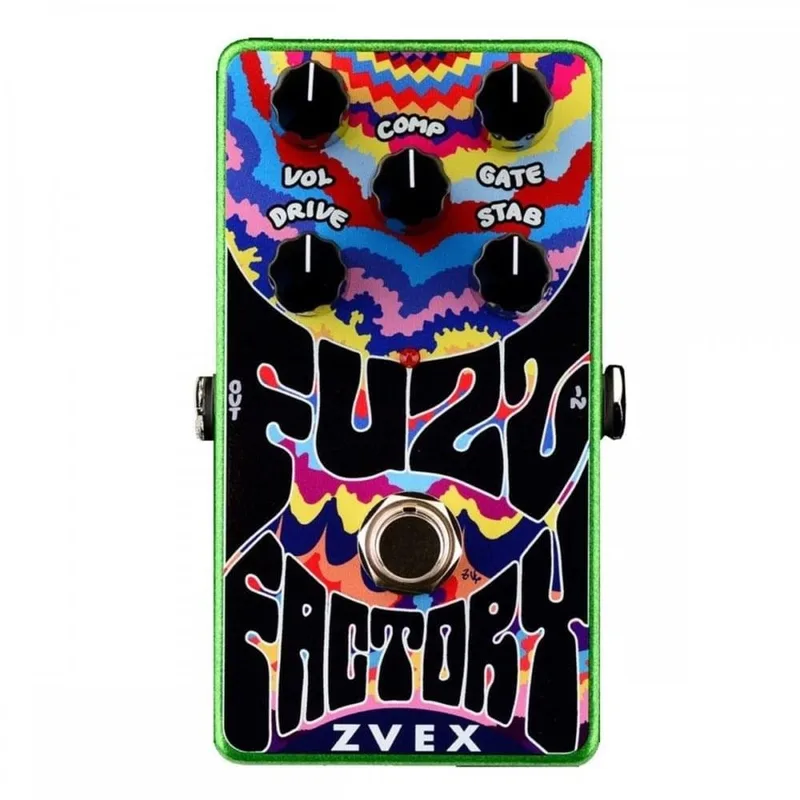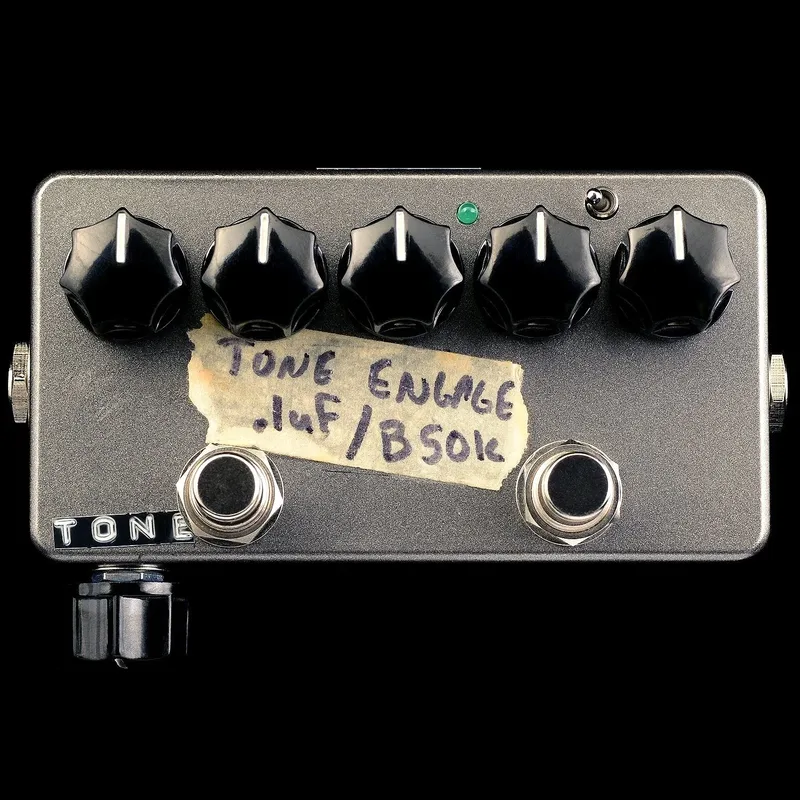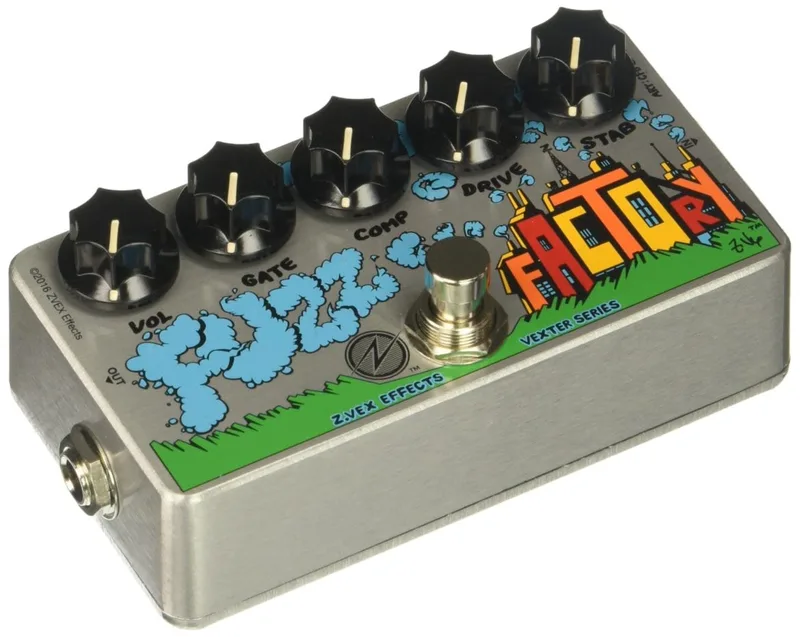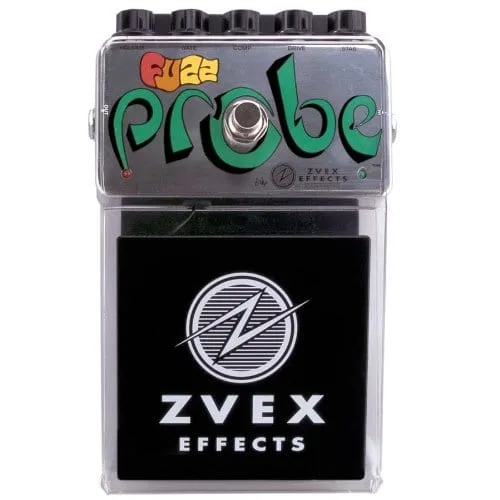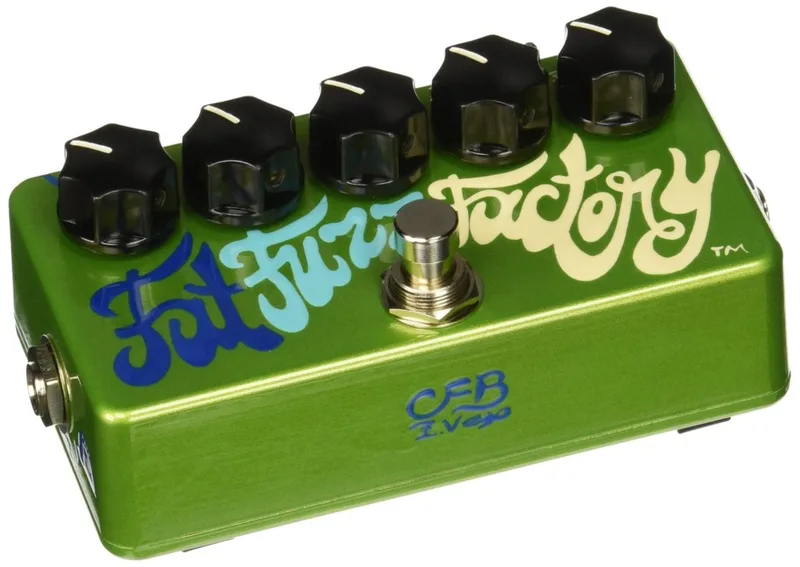


The ZVex Fat Fuzz Factory is a version of the ZVex Fuzz Factory, the germanium fuzz pedal ZVex first released in 19951. What sets the Fat apart is a three-position mini toggle switch: position 1 gives you a standard Fuzz Factory, while positions 2 and 3 introduce "low" and "lower" frequencies to manipulate, oscillate, and mutate as you like2. Premier Guitar's reviewer described it as a switch that "greatly expands the low end and shifts the range of its famous oscillating feedback to much lower registers"3.
The circuit uses new-old-stock (NOS) 1960s germanium transistors3, and ZVex says the pedal "sounds fantastic on both guitar and bass"4. Note that ZVex's own listings for the current hand-painted and Vexter editions show both as sold out25.
A Fuzz Factory with a three-way low-end switch
The Fat Fuzz Factory builds on the same core components and tone-generating capabilities of the standard Fuzz Factory3. The sub switch is the only addition, and it changes the character of the pedal at each position. Pedal of the Day's reviewer called it a toggle "controlling 3 different sub levels for beefier low end," producing "some low, low synth-y tones and sub-sonic booms"6.
| Switch position | What it does |
|---|---|
| 1 | Standard Fuzz Factory; the pedal's brightest and sharpest tones3 |
| 2 | Adds considerable lows; darker sounding, with a meaner, less razor-like edge3 |
| 3 | Bottom-heavy, the pedal's most corpulent tones; described as suiting single notes or bass3 |
ZVex describes position 3 as "the lowest setting and an excellent way to create seismic disturbances if you're feeling mischievous," and suggests it for a bass synth type of sound5.
For players interested in the circuit itself, the DIY community has traced how the fat mode works: the switch shorts a 1M resistor, putting a 0.1µF and 10µF capacitor in parallel, with the resistor there to prevent noise when flicking the switch8. Builders on the Tagboard Effects blog have verified the layout, one reporting a working build with a 2n3904 for Q1 and germanium transistors for Q2 and Q38.
The controls
The Fat Fuzz Factory carries the Fuzz Factory's five highly interactive knobs: Volume, Gate, Comp, Drive and Stab3. They are famously interdependent, and small changes on one knob change what the others do.
| Control | What it does |
|---|---|
| Volume | Adjusts the pedal's overall output6 |
| Gate | Gating control; adds buzzes, hiss and squelch-type tones you can get from some fuzzes6 |
| Comp | Compression; adds attack to the signal and works with Stab to create a multitude of noises and fuzz6 |
| Drive | Increases the amount of distortion, but has no effect when Comp is all the way up6 |
| Stab | Stability; can change the pitch of the oscillating squeal or the tone of the fuzz, depending on where the other controls are set3 |
Pedal of the Day's reviewer found Stab "keeps everything on an even keel... kinda," noting that past about noon it is fully fuzzy, and turning it while playing an open string produces a chaotic sweep6. The manual includes sample settings for high-gain compressed fuzz, Velcro-ripping tones, and cleaner Octavia-type effects3.
Power: 9V, 4 mA
The pedal runs on either a 9V battery or a Boss-style 9V power adapter3. Current draw is just 4 mA, which Premier Guitar's reviewer called "astonishingly small," and listed among the pedal's pros as a minimal battery draw3. That draw is low enough that battery operation is a realistic option, and the pedal will not strain a typical pedalboard power supply.
Hand-painted and Vexter editions
The Fat Fuzz Factory comes in two flavors: a hand-painted version completely assembled in the U.S., and a more affordable Vexter edition partially built in Taiwan with a silk-screened motif3. ZVex says the parts inside Vexters are identical to the hand painted pedals5.
- Hand-painted: one-of-a-kind artwork, in the current run by Lisa McGrath (LJM), with a lifetime warranty on all hand painted pedals2. The color of the lettering varies and is not limited to the pictured examples7.
- Vexter: the current edition features UV printed graphics commemorating ZVEX's 25th Anniversary5.
- FFFTK01 prototype: a one-of-a-kind Fat Fuzz Factory built while ZVEX was experimenting with tone controls on the Fuzz Factory circuit, sold with workbench notes9.
ZVex's own listings show the hand-painted edition at $479.00 (sold out)2 and at $399.00 on the standard hand-painted page7; when Premier Guitar reviewed it in 2023, street prices were $329 for the hand-painted version and $199 for the Vexter3.
What reviewers said
Premier Guitar's 2023 review was positive on the whole, listing as pros that the pedal is "enormously versatile," can be run in standard Fuzz Factory mode, has minimal battery draw and massive volume capability, and can produce warm Moog-like emulations with both guitar and bass3. Pedal of the Day's Mike B was more colorful in 2015:
"this thing will push you and your amp to the extreme of all fuzzdom, and a bit beyond, I'm pretty sure"6
Mike B, Pedal of the Day6
MusicRadar's review of the Fuzz Factory line credited Z.Vex with a quality build10. The common thread across reviews is that the Fat Fuzz Factory is less a fuzz with a bass boost than an instrument in itself: the same oscillation, gating and self-modulation the Fuzz Factory is known for, with the added ability to push all of it into sub-harmonic territory.
Videos
Chicago Music Exchange
Prymaxe
Best Guitar Effects
Questions
Does the Fat Fuzz Factory work on bass?
ZVex says the Fat Fuzz Factory sounds fantastic on both guitar and bass, and Premier Guitar's reviewer found it could produce warm Moog-like emulations with both guitar and bass. The switch's position 3, the most bottom-heavy setting, was described as best for single notes or bassists.
Is the Fat Fuzz Factory true bypass?
Yes. Premier Guitar's review notes that the pedal uses true bypass switching, so with the effect off your signal passes through without active buffering.
What is the difference between the Fat Fuzz Factory and the regular Fuzz Factory?
The Fat Fuzz Factory has the same five controls and core tone-generating capabilities as the standard Fuzz Factory, plus a three-position mini toggle switch. Position 1 is a standard Fuzz Factory; positions 2 and 3 add low and lower sub frequencies that darken and thicken the fuzz and shift its oscillation into lower registers.
Does the Fat Fuzz Factory use germanium transistors?
Yes. Premier Guitar's review describes the circuit as using new-old-stock (NOS) 1960s germanium transistors, the same class of parts associated with the original Fuzz Factory.
Where is the Fat Fuzz Factory made?
The hand-painted version is completely assembled in the U.S., according to Premier Guitar. The more affordable Vexter edition is partially built in Taiwan and carries a silk-screened or UV printed finish instead of hand painting.
Sources (10)
- Flare Fuzz Machine / ZVEX Fuzz Factory, Aion FX, 2021-03-19
- Fat Fuzz Factory, ZVEX Effects
- Z.Vex Fat Fuzz Factory Pedal Review, Premier Guitar, 2013-06-18
- Daniel Buettner Fat Fuzz Factory, ZVEX Effects (www.zvex.com)
- Fat Fuzz Factory Vexter, ZVEX Effects
- Z.Vex Effects Fat Fuzz Factory, Pedal of the Day (pedal-of-the-day.com), 2015-04-25
- Fat Fuzz Factory, ZVEX Effects
- Guitar FX Layouts: Madbean Zombii / ZVex Fat Fuzz Factory, Guitar FX Layouts (tagboardeffects.blogspot.com), 2017-12-11
- Fat Fuzz Factory, ZVEX Effects
- Z.Vex Fuzz Factory review, MusicRadar, 2014-11-05