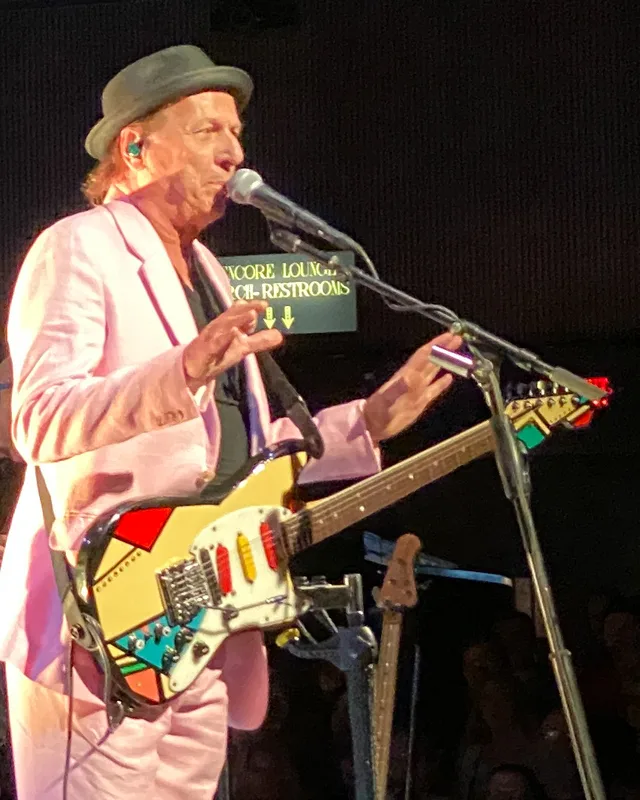

Adrian Belew is a guitarist whose long career spans work with Frank Zappa, David Bowie, Talking Heads, Tom Tom Club, Nine Inch Nails and Paul Simon, as well as King Crimson12. His newest project is the super-group BEAT, with Steve Vai, Danny Carey and Tony Levin1.
What ties the whole career together is a single idea: using effects to make a guitar sound like something else. Premier Guitar puts it plainly, that from his career launching stints with Zappa and Bowie, through the Talking Heads and Tom Tom Club, to his career defining years in King Crimson, "Adrian Belew has always been on the cutting edge of using effects for cultivating intriguing and out-of-this-world guitar tones"3.
The sound he is known for
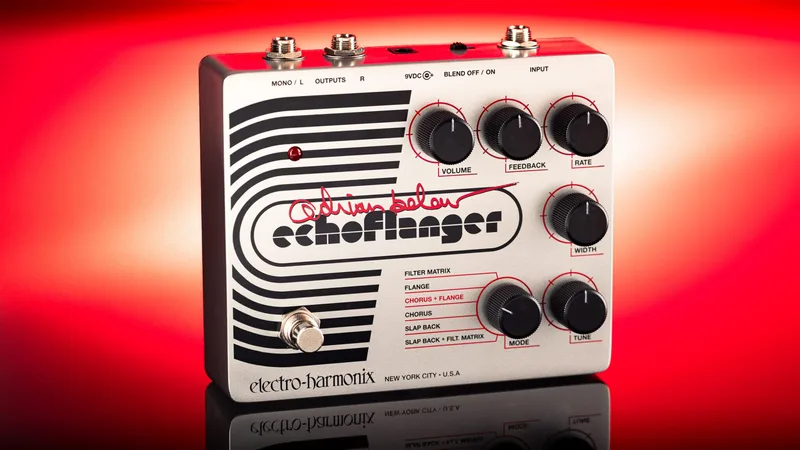
Belew's reputation rests on guitar tones that stop sounding like guitar: a steel drum on Tom Tom Club's Genius of Love, an elephant on King Crimson's Elephant Talk, a rhinoceros on his own The Lone Rhinoceros84. All three of those signature sounds came out of one pedal, the rare late-1970s Electro-Harmonix Echo Flanger, a bucket-brigade device that Delicious Audio describes as his "ultimate secret weapon"94.
The other half of the equation is his hands. DigiTech's artist page on him describes a style built on:
- tapping
- pick scrapes
- bending the neck
- slide guitar techniques that are not the typical approach1
His attitude to the boxes themselves matters just as much. Reflecting on his long relationship with Electro-Harmonix, he says:
"The thing I always loved about their pedals was that you could make them do things they weren't actually meant to do."
He puts the same point more bluntly in a later Guitar World interview: "Electro-Harmonix is the one company you could make do things they're not supposed to do"11. That willingness to misuse a pedal, combined with an unconventional technique, is how a guitar ends up trumpeting like an elephant.
Effects with Zappa, Bowie, Talking Heads and Tom Tom Club
Belew's first big break was rehearsing with Frank Zappa in L.A. in 19772. It was around that time, at a casual party in L.A. in 1977, that he first heard a Roland JC-120 Jazz Chorus amplifier, and he told Roland he "was madly in love with it within the first two notes" he played through it2. Zappa liked his playing enough to advance him the money to buy his first JC-120, and he still has it in his studio and still records with it2. That amp, with its built-in chorus, has been a constant under everything else on his board.
In the late 1970s he was also a regular at the Electro-Harmonix store on 48th Street in New York, where he demoed pedals live with about eight boxes on a stand, using a MicroSynthesizer-based rig and early sampling boxes10. As he recalls of those visits:
"I'd go there and, of course, Mike Matthews would just talk my arm off about all the new pedals they were designing, and show me some of them."
The Echo Flanger entered his rig in 1980, and MusicRadar notes that it "performed as advertised"5. Its most famous result is the steel drum guitar on Tom Tom Club's Genius of Love. Guitar World reports that with the original Echo Flanger the guitarist was able to achieve a steel drum sound with his guitar, and that the single went on to become, per Belew, the most sampled song of all time11. Guitar Pedal X counts the steel drum effect, the elephant of Elephant Talk and the rhino of The Lone Rhinoceros as signature sounds he evolved using the pedal8.
Pedals in the King Crimson years and beyond
Belew fronted King Crimson for 36 years1, and the Echo Flanger's blend of chorus and flanging is all over those records. Guitar World calls his go-to Chorus and Flange combination, the pedal's hybrid mode, something that is "all over his King Crimson records"11.
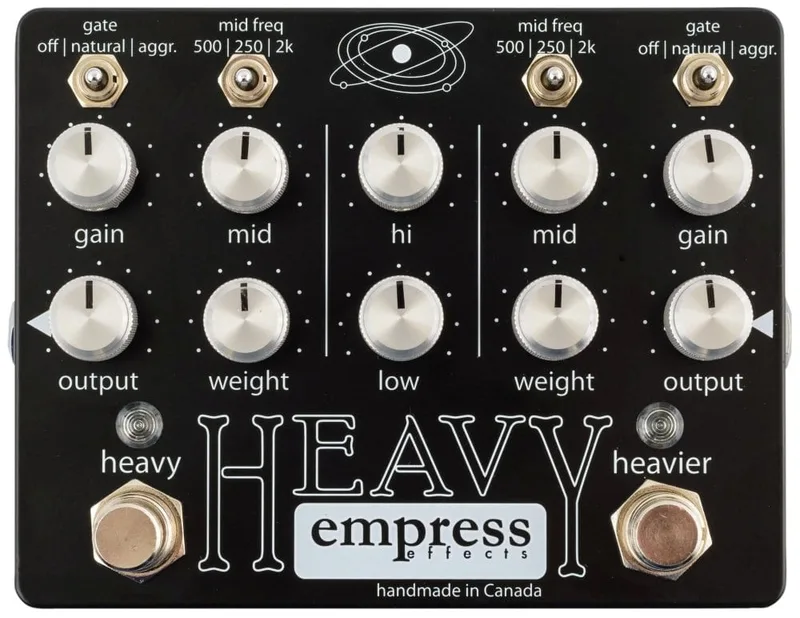
His dirt sounds have their own history. His solo track Big Electric Cat is cited by Gearnews as the best example of a Foxx Tone, the sound of the Ibanez Foox Tone Machine fuzz box12. Today Empress Effects names him among the artists who use both the Empress Fuzz, an all-analog fuzz, and the Empress Heavy, the company's high-gain distortion and fuzz pedal67. DigiTech says he still uses the DigiTech Harmony Man, a pitch-shifting effect, to create his unique sounds1, and that its new HammerOn pedal is not yet on his board, though the company expects it will not be long before it is1.
He has also shaped other makers' designs from the inside. Gig-FX's Pan-Ec echo and reverb pedal was designed with input from top players such as Belew, aiming to digitally emulate classic tape-loop echo units like the Wem Copycat and Echoplex while panning the echo smoothly left to right13.
Signature pedal: the DigiTech iStomp Impossible Pedal
In 2013 DigiTech announced its first iStomp Signature Artist e-pedal, joining forces with Belew to debut The Impossible Pedal14. The iStomp itself was a new concept in stompboxes: an infinitely reconfigurable pedal that can be turned into any pedal available in DigiTech's Stomp Shop online pedal store1415. MusicRadar's reviewer called it "a blank canvas to be painted on over and over again," and noted that it comes with removable stickers, some blank and some representing the downloadable pedals, that fit where the iStomp logo sits15. Out of the box it ships preloaded with the Redline Overdrive stomp so a player can start immediately16.
The Impossible Pedal was Belew's own download for that platform, made for his "impossible" sounds, and DigiTech notes that at one point he had his own signature iStomp Impossible Pedal1. Even its iStomp icon played along: Premier Guitar reported that the icon is an impossible optical illusion "that has to be seen to be disbelieved"14.
The Echoflanger comes back
In 2026 Belew teamed up with Electro-Harmonix to bring back the Echo Flanger as a limited Adrian Belew signature Echoflanger, a pedal MusicRadar describes as a long out-of-production cult modulation pedal that Belew used to spectacular effect511. The reissue was created in collaboration with him17, and its controls were expanded at his request11. Delicious Audio reports two heavily requested hybrid settings inspired by his own physical in-between switch tweaks on the original: Chorus + Flange and Slap Back + Filter Matrix, layering shimmering thickness with comb-filtered resonance9. His verdict on the pedal he has now endorsed for over four decades:
"Absolutely go out and get one, see what you make of it. You're gonna love it because you can do a lot of things with it."
Questions
How did Adrian Belew get the steel drum sound on Genius of Love?
He got it from the original Electro-Harmonix Echo Flanger, a bucket-brigade multi-modulator he has kept in his rig since 1980. With it he was able to achieve a steel drum sound on guitar, and it went on to make Tom Tom Club's Genius of Love, which Belew calls the most sampled song of all time. The pedal has now returned as a limited Adrian Belew signature Echoflanger.
What fuzz did Adrian Belew use on Big Electric Cat?
His solo track Big Electric Cat is cited as the best example of a Foxx Tone, the sound of the Ibanez Foxx Tone Machine fuzz. The track is regularly pointed to as the reference recording for that particular fuzz voice.
Does Adrian Belew use a Roland guitar synth?
He has a long relationship with the Roland JC-120 Jazz Chorus amplifier, which he first heard at a party in L.A. in 1977 and bought with money Frank Zappa advanced him. He still records with that amp today.
What was the Adrian Belew Impossible Pedal?
The Impossible Pedal was a DigiTech e-pedal for the iStomp platform, an infinitely reconfigurable stompbox that can be turned into any pedal in the DigiTech Stomp Shop online store. Belew was DigiTech's first iStomp Signature Artist collaborator, and the pedal was built for his so-called impossible sounds.
What fuzz pedal does Adrian Belew use now?
Empress Effects names Adrian Belew among the artists who use the Empress Fuzz, an all-analog fuzz pedal. He is also named as a user of the Empress Heavy, the company's higher-gain distortion and fuzz pedal.
How does Adrian Belew make guitar sound like animals?
Two things combine. His playing style includes tapping, pick scrapes, bending the neck, and unconventional slide guitar techniques, and he runs it all through effects pushed past their intended use. The elephant on King Crimson's Elephant Talk and the rhino on The Lone Rhinoceros both came out of the Electro-Harmonix Echo Flanger he has used since 1980.
Sources (17)
- Artist Spotlight: Adrian Belew, DigiTech, 2025-03-24
- Heard on Classic Records by the Cult, the Smiths, Frank Zappa, David Bowie, Metallica, Talking Heads, King Crimson and More, the Boss and Roland Chorus Sounds Are a Mainstay of Rock, GuitarPlayer, 2023-02-07
- Electro-Harmonix Unveils The Adrian Belew Echoflanger, Premier Guitar, 2026-09-16
- Adrian Belew Echoflanger, Electro-Harmonix (ehx.com)
- EHX and Adrian Belew resurrect the cult classic Echoflanger, MusicRadar, 2026-09-16
- Fuzz - Empress Effects Inc., Empress Effects Inc.
- Heavy - Empress Effects Inc., Empress Effects Inc.
- Guitar Pedal X, Guitar Pedal X, 2026-09-21
- New Pedal: Electro-Harmonix Adrian Belew Echoflanger, Delicious Audio, 2026-09-15
- EHX Hall of Science: the futuristic guitar store that disappeared, Guitar World, 2025-11-11
- Electro-Harmonix launches Adrian Belew Echoflanger pedal, Guitar World, 2026-09-16
- Ibanez 'Foxx' Tone Machine, gearnews.com, 2019-01-26
- Gig-FX Launches the Pan-Ec Echo-Reverb Pedal, Premier Guitar, 2012-01-15
- DigiTech Announces The Impossible Pedal, Premier Guitar, 2013-01-24
- DigiTech iStomp review, MusicRadar, 2012-04-09
- Pedal Review: DigiTech IStomp, Delicious Audio, 2012-03-07
- Adrian Belew Echoflanger by Electro-Harmonix, RockBoard (rockboard.de PedalPedia), 2026