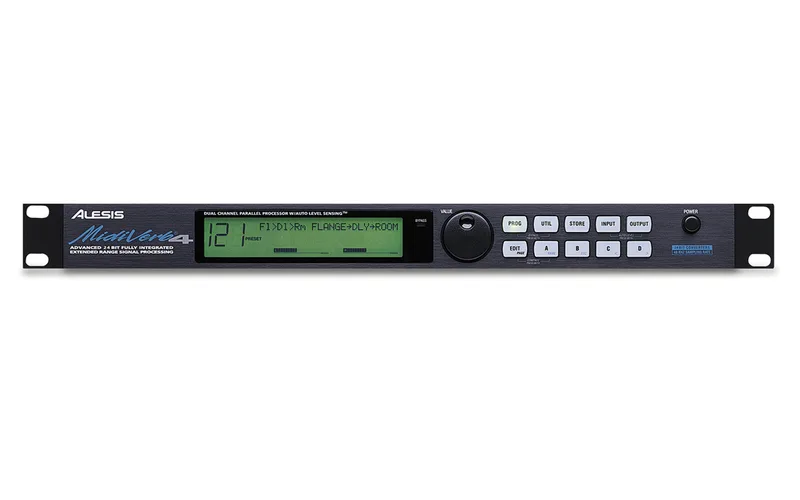


The Alesis MidiVerb 4 is a half-rack digital multi-effects processor that puts reverb, delay, chorus, flanging, rotary and pitch effects in one programmable unit. Alesis released it in 1995 as the fourth incarnation of the MidiVerb hardware, and it became a common sight in project studios and on pedalboards of keyboard and guitar players who wanted rack effects without rack prices1. Alesis now lists it as discontinued2.
Inside, it is a digital design: 18 bit Sigma-Delta A/D and D/A converters running at a 48 kHz sampling frequency, with 24 bit internal processing, giving a 20Hz to 20kHz bandwidth and 90dB dynamic range23. A 3 MIPs processor with 64K x 16 bits of memory drives the effects, and up to three effects can run at once3.
Algorithms, programs and effect configurations
The MidiVerb 4's 32 effects algorithms cover reverb, chorus, delay, flanging, rotary and pitch shifting, and they add up to 256 programs: 128 factory presets plus 128 user-adjustable presets2. Programs are numbered 00 to 127 in each bank, and each carries an eight character name. The 128 User Programs can be renamed; the factory presets cannot3.
Although the unit has both a Preset and a User bank, you can only store edited Programs in the User bank. Preset 00 is set up as a Bypass Program that passes the dry, unprocessed signal only3.
The preset chart groups programs into categories including Utility, Chorus, Flange, Delay, Rooms, Halls, Plates, Other Verbs, Pitch, Guitar, Perc, Keybd, Dual, Misc and Configs4. A few named programs give a flavor of what is in there:
| Program | Name | What it does |
|---|---|---|
| Preset 44 | MidiCDly | A delay which syncs to MIDI clock4 |
| User 00 | Defeat | Mutes all output from the unit4 |
| User 50 | AmbDelay | 440 ms delay with subtle room reverb4 |
| User 111 to 127 | BlankPrg | Blank programs for user storage4 |
Effects can be arranged in four configuration types: Single, Double, Dual Mono and Multi Chain3. The Double configurations pair two effects, such as Real Room with Delay, Real Room with Chorus, or Real Room with Flange. Dual Mono runs two independent mono effects side by side, with combinations like Delay:Delay, Chorus:Delay and Pitch:Pitch. Multi Chain strings effects in series, from simple chains like Delay into Real Room up to three stage chains such as Chorus into Delay into Room3.
The delay side of the unit includes Mono Delay, Stereo Delay, Ping Pong Delay, MultiTap Delay and BPM Mono Delay algorithms3, with 1,300 ms of total delay time2. The manual's own description of the Real Room reverb algorithm:
"It compares favorably to high end studio reverbs for its rich sound"
Alesis reference manual2
Alesis says Real Room works well on drums, keyboards and guitars3. What any of this sounds like in your room is, as always, something to judge with your own ears.
Controls, inputs, outputs and MIDI
The front panel is built around a VALUE knob for parameter changes, a PROG button that selects programs and toggles between the Preset and User banks, and four A/B/C/D buttons that select parameters for editing and double as NAME, ESC and navigation functions3. INPUT and OUTPUT buttons set levels, and pressing both at once activates Auto Input level setting; a UTIL button opens utility functions including Dry Defeat and the footswitch setting3. An 18 segment LED with a clip light warns of overload2, and a BYPASS LED shows when Bypass mode is active3.
Around the back are the two 1/4" unbalanced inputs, two 1/4" unbalanced outputs (Left/Ch.1 and Right/Ch.2), MIDI In and MIDI Out/Thru connectors, a Bypass/Advance footswitch jack, and the socket for the external AC power adapter3. The adapter is supplied for the voltage of the country the unit ships to, either 110 or 220V at 50 or 60 Hz3.
The unit supports four hookup options: mono, mono in with stereo out, dual mono, and full stereo3. MIDI receives program changes, Sysex storage and realtime modulation of parameters, and two simultaneous MIDI controls can be routed23. A momentary footswitch on the rear jack can extend the Auto Input listening time or select the Bypass Program or Bypass mode3.
The fourth MidiVerb
The MidiVerb 4 is the fourth incarnation of the MidiVerb hardware, released in 19951. Where the earlier MidiVerbs were preset machines, the MidiVerb 4 is fully programmable, with the 32 algorithms and 256 programs described above21. Vintage Synth Explorer's write up sums up how it landed with players:
"Overall, the Alesis MidiVerb 4 is a very straightforward bit of hardware that is also very user-friendly"1
Vintage Synth Explorer1
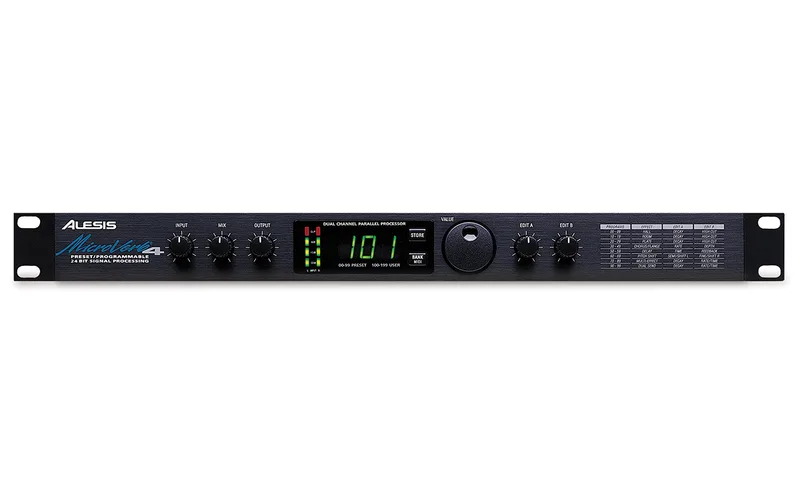
The same write up notes it stood out for its price and usability and was popular with new users, and that it is capable of up to three simultaneous multi-effects1. For players comparing rack and pedal approaches today, the same effect types live on in pedal form: see reverb pedals, delay pedals, chorus pedals, flanger pedals and octave and pitch pedals. Alesis also made a related rack unit, the Alesis MicroVerb 4.
Specifications
| Specification | Value |
|---|---|
| Sampling frequency | 48 kHz3 |
| Processor | 3 MIPs, 64K x 16 bits memory3 |
| A/D | 18 bit Sigma-Delta, 128 times oversampling3 |
| D/A | 18 bit Sigma-Delta, 8 times oversampling3 |
| Internal resolution | 24 bit accumulator3 |
| Frequency response | ±1dB from 20Hz to 20 kHz3 |
| Distortion | <0.009% at 1 kHz, nominal level (-12 dBfs); <0.005% at peak level3 |
| Crosstalk | <90dB below full scale3 |
| Delay memory | 1299 milliseconds3 |
| Simultaneous MIDI controls | 22 |
| Programmable wet/dry/mix | Yes2 |
| Compare / Bypass | Yes / Yes2 |
The Mix parameter runs from 000 to 1003. Alesis notes that specifications were subject to change without notice4.
Videos
Zed Marty
dcooper830
Steve Cliff Miller
Questions
How many presets does the Alesis MidiVerb 4 have?
It has 256 programs in total: 128 factory presets plus 128 user-adjustable presets, built from 32 effects algorithms. Programs are numbered 00 to 127 in each bank. The 128 User Programs can be renamed with eight character names; the factory presets cannot.
Does the MidiVerb 4 sync delay to MIDI clock?
Yes. Preset program 44, called MidiCDly, is a delay that syncs to MIDI clock. The unit also has BPM Mono Delay among its delay algorithms, and its MIDI In receives program changes, Sysex storage and realtime parameter modulation.
Is the MidiVerb 4 stereo?
Yes. It has two 1/4 inch unbalanced inputs and two 1/4 inch unbalanced outputs, and supports mono, mono in/stereo out, dual mono and stereo hookup options. Crosstalk is rated at less than 90dB below full scale.
Where can I find the MidiVerb 4 manual?
Alesis hosts the reference manual as a PDF at alesis.com, linked from the product page. A program chart PDF listing every preset and user program is also available from Alesis.
Is the Alesis MidiVerb 4 discontinued?
Yes. Alesis lists the MidiVerb 4 as discontinued on its product page. It was released in 1995 as the fourth incarnation of the MidiVerb hardware, so units today are found on the secondhand market.
Can the MidiVerb 4 be used with a guitar directly?
Yes. The preset program list includes a dedicated Guitar category, and the manual describes its Real Room reverb as sounding good on drums, keyboards and guitars. It is a line level rack unit, so it sits in an effects loop or after a preamp rather than taking a guitar straight in at full level.
Sources (4)
- Alesis MIDIVerb 4, Vintage Synth Explorer, 2026
- Alesis MIDIVerb 4, Alesis, 2026
- Alesis MidiVerb 4 Reference Manual, Alesis, 2025
- Subject:, Alesis Corporation, 1994-06