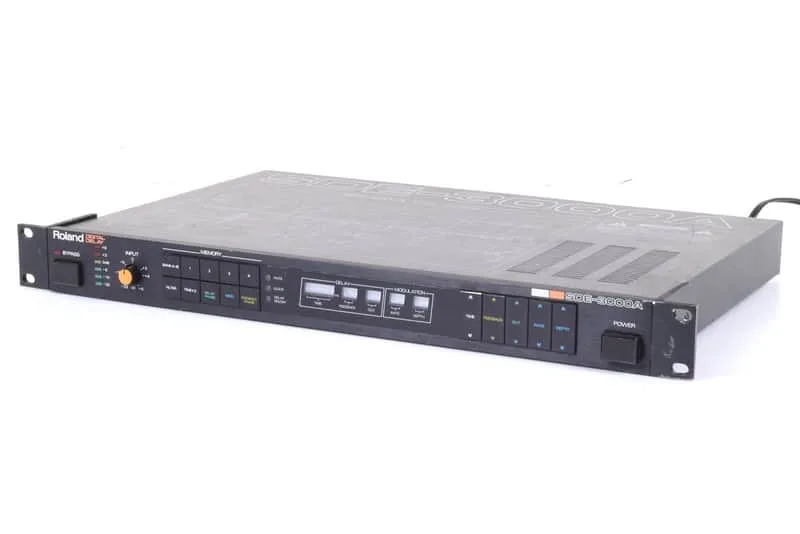


The Roland SDE-3000 is a rackmount digital delay introduced in 1983 by Roland, the parent company of Boss. Boss describes it as revered for its "beautifully rich sound and distinctive modulation," and it became a fixture in the stage racks and studios of the 1980s12. Guitar World calls it "the larger and more expensive SDE-3000 rack-unit professional digital delay" of its era, and notes it was famously used by studios, session guitarists, and one Edward Van Halen throughout the '80s34.
For a player today, the SDE-3000 matters for two reasons. First, its sound: a digital delay whose character comes as much from the non-linear behaviors of the supporting analog circuitry as from the digital engine itself. Second, its afterlife: Boss has reborn it in pedal form as the BOSS SDE-3000D and Boss SDE-3000EVH pedals, so the original rack unit's tone is available in floor form516.
A rackmount digital delay with analog character
The SDE-3000 is digital at its core, built around a proprietary 63H101 CMOS gate array IC and 12-bit analog-to-digital converters, delivering a maximum frequency range of 10Hz to 17kHz7. But Boss attributes its sought-after tone to the analog circuitry supporting that digital engine, describing "non-linear behaviors of the supporting analog circuitry, including magnetic saturation in the anti-alias filter, evolving modulation produced by the components of the time, and an altered triangle LFO shape"9.
In practice, that means the repeats are not clean digital copies. The anti-alias filter saturates, the modulation drifts and evolves, and the LFO shape departs from a perfect triangle, all of which color the delayed signal in ways players found musical91.
Delay time was generous for 1983 but came with trade-offs:
| Setting | Max delay time | Bandwidth |
|---|---|---|
| Standard | 1500ms | Full fidelity |
| 1.5x Delay Time knob (rear) | 2250ms | Full frequency |
| 1.5x Delay Time knob (rear) | 4500ms | 8kHz peak |
| 2x button (front panel) | 3000ms | 8kHz, sampling rate halved |
The 2x button doubled the base delay time to 3000ms by halving the sampling rate, which reduced the high frequency response to 8kHz7.
The front panel carried an impressive display for delay time, feedback, output level, and modulation rate and depth8. Eight memories stored settings, and footswitch jacks enabled remote operation of memory selection, hold, tap tempo, and delay on/off82. Two functions stood out for players of the time: a Hold function that engages infinite repeats, which Guitar World describes as usable for primitive looper applications, and the "wonderfully named" Playmate function, a very early tap tempo feature where the first tap reset delay time to zero, the second started the clock, and the third stopped it7.
Modulation and the outputs
The SDE-3000's modulation is a defining part of its character. Boss says the "intentional" modulation effect came courtesy of an LFO capable of generating anything from subtle modulation to genuine pitch shifting8. Users could program chorus, flanging, and vibrato effects with the modulation section's rate and depth controls, using triangle wave modulation only7.
A Filter button engages lo- and high-cut filter EQ settings that generate warmer, darker echo-style repeats7, a quick route to tape-echo-like tones without touching the rest of the panel.
On the back, the unit offered outputs for delay-only and mixed signals8. That routing flexibility mattered: the delay-only output let a player send wet signal to a separate amp while keeping the dry signal clean, and it enabled the spacious wet/dry/wet setups the unit became known for. Guitar World describes one such "reverb" setup requiring three separate amps and cabinets, with the dry signal going to the center amp and the 3000's mixed outputs going to the respective left and right amps7.
The unit was mono, so if you wanted to operate in stereo, you needed two8.
Eddie Van Halen and the two-unit setup
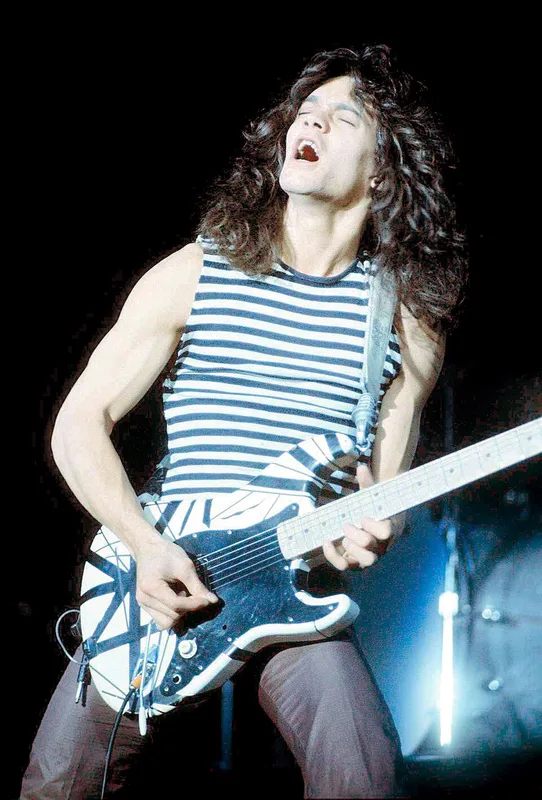
The SDE-3000's most famous user ran two of them. Boss states plainly: "The original SDE-3000 was a mono delay, and Eddie used two units with unique settings on each to achieve his sound"5. Delicious Audio likewise notes Van Halen famously used it10.
That pairing is the basis of the wet/dry/wet approach associated with his rig: dry signal to a center amp, delayed signal spread to left and right amps. When Boss built the SDE-3000EVH pedal with EVH Gear, it shipped with a set of EVH presets designed by Edward Van Halen himself, letting players replicate Eddie's wet/dry/wet setup from his three-cabinet rig115.
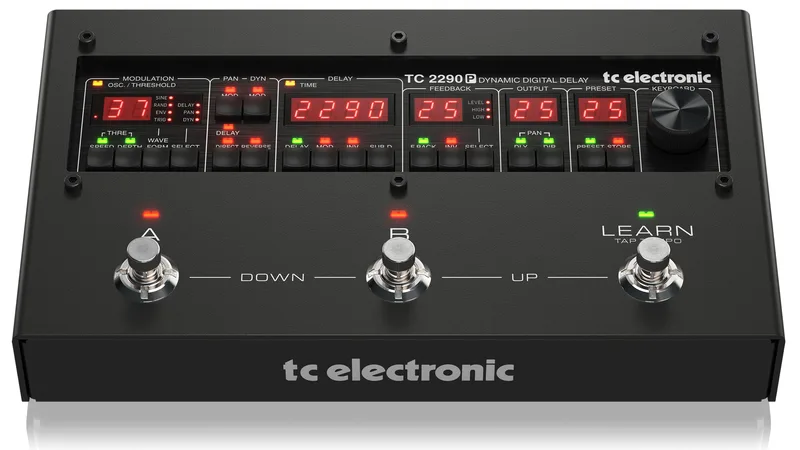
Beyond Van Halen, Boss says that once a who's who of big-name guitarists had recorded with it, they couldn't resist having one, or several, in their stage racks8. Guitar.com's history of echo units places it alongside the TC 2290 and the AMS DMX 1 as an early example seen in period guitar racks12.
History and the Boss pedal versions
The SDE-3000 arrived in 19831. Product development of the unit was Yoshi Ikegami's first big assignment with Roland8. Guitar World reports that it carried a hefty price tag of $1,099 at launch7.
The run was short. Guitar World reports the model was discontinued in 1985, when Roland released the "new and improved" SDE-25007.
Forty years later, the circuit came back as pedals. To mark the unit's 40th anniversary, Boss relaunched it as the SDE-3000D and SDE-3000EVH, the latter made in collaboration with EVH Gear13. Announced in May 2023, the SDE-3000D is a dual delay pedal reproducing two SDE-3000s in one floor unit, with two inputs and two outputs for dual mono, wet/dry, or stereo setups, and MIDI142. While the SDE-3000 was mono, the SDE-3000D provides two discrete delays with series or parallel operation15. It carries 100 memories, up from the original's eight, plus carryover when switching sounds2. Guitar Pedal X listed the SDE-3000D at $499 and the EVH edition at $599162.
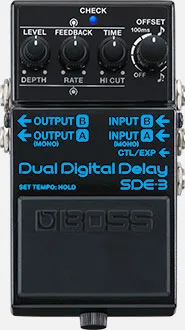
In 2024 Boss followed with the compact SDE-3, which MusicRadar described as the acclaimed 1983 SDE-3000 rack unit reborn in pedal form6.
What reviewers said
Premier Guitar's reviewer, assessing the SDE-3000's legacy in the context of the SDE-3 pedal, wrote that "the SDE-3000's simplicity and reliable predictability made it conducive to fast workflow in the studio"17. That ease of use, alongside its tone, is a recurring theme in how the unit is remembered: a professional rack delay whose panel made sense at a glance, in an era when many rack units demanded deep menu diving.
FAQ
What is the maximum delay time on the Roland SDE-3000?
The SDE-3000 offered 1500ms of delay at full fidelity. A rear 1.5x Delay Time knob stretched that to 2250ms at full frequency or 4500ms with an 8kHz peak, and a front panel 2x button doubled the base time to 3000ms by halving the sampling rate, which reduced the high frequency response to 8kHz7.
Did Eddie Van Halen use the Roland SDE-3000?
Yes. Guitar World notes the SDE-3000 was famously used by studios, session guitarists, and one Edward Van Halen throughout the '80s3. Boss confirms the original was a mono delay and that Eddie used two units with unique settings on each to achieve his sound5.
Is the Roland SDE-3000 analog or digital?
It is a digital delay, but its character comes from the analog circuitry around the digital engine. Boss describes the coveted SDE tone as the result of a finely tuned digital engine plus non-linear behaviors of the supporting analog circuitry, including magnetic saturation in the anti-alias filter and an altered triangle LFO shape9.
What is the difference between the Roland SDE-3000 and the Boss SDE-3000D?
The Roland SDE-3000 is the original 1983 mono rack unit with eight memories12. The Boss SDE-3000D is a 2023 floor-based pedal that reproduces two SDE-3000s at once, with two inputs and two outputs for dual mono, wet/dry, or stereo setups, and 100 memories instead of the original's eight214.
How did Eddie Van Halen set up his SDE-3000s?
Eddie ran two SDE-3000 units with different settings on each, since the original was mono5. The wet/dry/wet setup associated with his rig uses three amps and cabinets: the dry signal goes to the center amp, and the delay's mixed outputs feed the left and right amps7.
Videos
WeArePixelforge
That Pedal Show
News
Questions
What is the maximum delay time on the Roland SDE-3000?
The SDE-3000 offered 1500ms of delay at full fidelity. A rear 1.5x Delay Time knob stretched that to 2250ms at full frequency or 4500ms with an 8kHz peak, and a front panel 2x button doubled the base time to 3000ms by halving the sampling rate, which reduced the high frequency response to 8kHz.
Did Eddie Van Halen use the Roland SDE-3000?
Yes. Guitar World notes the SDE-3000 was famously used by studios, session guitarists, and one Edward Van Halen throughout the '80s. Boss confirms the original was a mono delay and that Eddie used two units with unique settings on each to achieve his sound.
Is the Roland SDE-3000 analog or digital?
It is a digital delay, but its character comes from the analog circuitry around the digital engine. Boss describes the coveted SDE tone as the result of a finely tuned digital engine plus non-linear behaviors of the supporting analog circuitry, including magnetic saturation in the anti-alias filter and an altered triangle LFO shape.
What is the difference between the Roland SDE-3000 and the Boss SDE-3000D?
The Roland SDE-3000 is the original 1983 mono rack unit with eight memories. The Boss SDE-3000D is a 2023 floor-based pedal that reproduces two SDE-3000s at once, with two inputs and two outputs for dual mono, wet/dry, or stereo setups, and 100 memories instead of the original's eight.
How did Eddie Van Halen set up his SDE-3000s?
Eddie ran two SDE-3000 units with different settings on each, since the original was mono. The wet/dry/wet setup associated with his rig uses three amps and cabinets: the dry signal goes to the center amp, and the delay's mixed outputs feed the left and right amps.
Sources (17)
- BOSS - SDE-3 | Dual Digital Delay, BOSS (boss.info)
- BOSS - SDE-3000D | Dual Digital Delay, Boss (boss.info)
- Boss SDE-3 Dual Digital Delay pedal review, Guitar World, 2024-11-04
- The Boss digital delay pedal that changed the world, Guitar World, 2026-06-01
- BOSS - SDE-3000EVH | Dual Digital Delay, BOSS (boss.info)
- Boss has now made its acclaimed dual delay pedal compact with the SDE-3, MusicRadar, 2024-09-05
- Why Roland's SDE-3000 was a game-changer for digital delay, Guitar World, 2023-09-01
- BOSS - The Roland SDE-3000, BOSS (boss.info)
- BOSS - SDE-3 | Dual Digital Delay, BOSS (boss.info)
- BOSS SDE-3 Digital Delay, Delicious Audio, 2025-06-04
- Eddie's 80s Classic Returns! BOSS reissues the SDE-3000, gearnews.com, 2023-05-18
- All About… Echo, Guitar.com, 2015-09-22
- “Unlock an array of colorful textures with two simultaneous delays”: Boss unveils the SDE-3 Dual Delay, GuitarPlayer, 2024-09-05
- Boss reinvents the SDE-3000 Digital Delay rack unit as two feature-packed pedals, Guitar World, 2023-05-18
- BOSS Unveils SDE-3000D & SDE-3000EVH Digital Delays, Premier Guitar, 2023-05-18
- Guitar Pedal X, Guitar Pedal X, 2023-10-30
- Boss SDE-3 Dual Digital Delay Review, Premier Guitar, 2024-12-31
 Eddie Van Halen
 Steve Lukather
 Steve Vai