

The Boss DD-3 Digital Delay is a compact delay pedal from Boss, introduced in 1986 and in continuous production ever since, making it one of the longest-running pedals in the company's lineup1. It delivers 12.5 to 800ms of delay, dual outputs, and a Hold function that loops a delayed part infinitely23. Premier Guitar's columnist notes that "a digital pedal introduced in 1986 remains a standard tool for working musicians today"1.
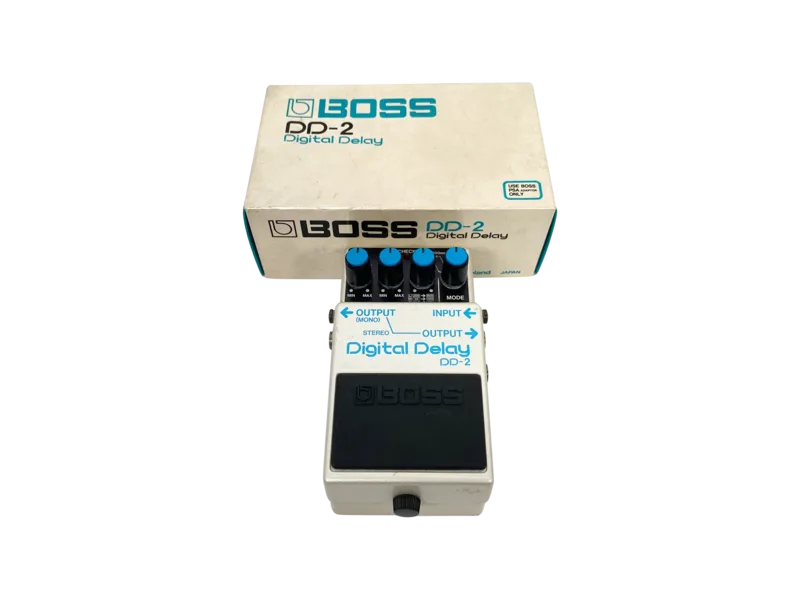
The DD-3 began life as a renamed DD-2: when the cost of the 63H101 delay chip dropped significantly, Boss changed the pedal's name to DD-3 and reduced the list price4. Other than minor cosmetic differences, the DD-3 is identical to the original DD-2, according to Boss's own history of its delay pedals5.
What it does: up to 800ms of digital delay
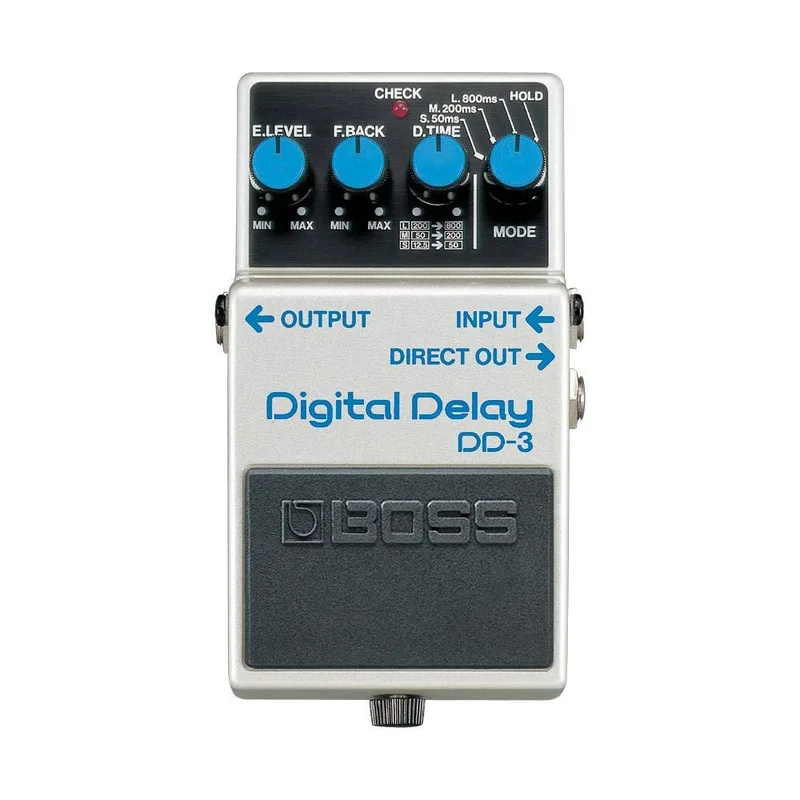
The DD-3 offers delay times from 12.5ms up to 800ms, depending on which of its three modes you are in101112. The Mode switch sets a maximum delay time of 50ms on the short setting, 200ms on medium, and up to 800ms on long, plus a HOLD mode for recording a sample12. That 800ms ceiling far outstripped what regular analog designs could manage when the circuit debuted in the DD-2, whose delay range of 12.5ms to 800ms gave guitarists far greater sonic flexibility than analog technology allowed253.
GuitarPlayer's reviewers described the result as "clear sounding, quiet, and delivering up to 800ms of delay," calling the DD-3 "an immediate hit"2. Ed O'Brien of Radiohead, interviewed by Boss, describes the DD-3 as "slightly cleaner than an analog delay, but still has lots of character," and calls it "the sound of the '80s"13.
The controls are simple:
| Control | What it does |
|---|---|
| E. Level | Effect Level, a mix control blending the analog and delayed signals before the output12 |
| F. Back | Feedback, setting the number of repeats12 |
| D. Time | Delay time, up to 800ms on the long setting12 |
| Mode | Selects 50ms, 200ms, 800ms, or HOLD12 |
The Hold function records up to 800ms of audio and effectively loops it, so a delayed part repeats infinitely; the sample cannot be saved and played back later1214. On the DD-3T the same function returns renamed Short Loop14.
Inside the pedal: a digital chip in an analog path
The DD-3 is a digital delay, but only just. MusicRadar's history of the pedal notes that "apart from the digital delay chip in the pedal, the signal path is all-analogue"12. The first version was the initial re-badging of the DD-2, a 12-bit digital delay with a largely analog signal path12. Keeley Electronics explains the general architecture: signal passes first through an analog-to-digital converter, through whatever digital process the device supports, and back out via a digital-to-analog converter8.
That hybrid design is part of why the pedal has stayed popular. Alessandro "Asso" Stefana told Boss, "I also really love the DD-3 Digital Delay. I've used that pedal for many years. It's a classic!"15
The versions
The DD-3's long production run means the circuit inside changed several times:
| Version | What changed |
|---|---|
| Version 1 | Re-badged DD-2 with the long 63H101 chip; had a notoriously wobbly Mode control and an overly complicated PCB124 |
| Version 2 | Harder-to-assemble and fly-wire parts incorporated into a new PCB, identifiable by a much smaller delay chip on the underside of the board; later refined with a power jack attached directly to the PCB. Production moved from Japan to Taiwan during this period12 |
| Version 3 (current) | Delay chip changed again, PCB redesigned to a modern double-sided board with SMD components12 |
Sometime during the very late '80s the 63H101 chip was replaced by a smaller square IC with improved bandwidth and audio specs, and further chip upgrades appeared in later iterations up through 20144. Coda Effects notes that early "long chip version" DD-3s are technically identical to the DD-2, while later units moved to a small microcontroller with more automatic assembly, and today's units use SMD components and a double-sided PCB1663.
Bypass and the buffered question
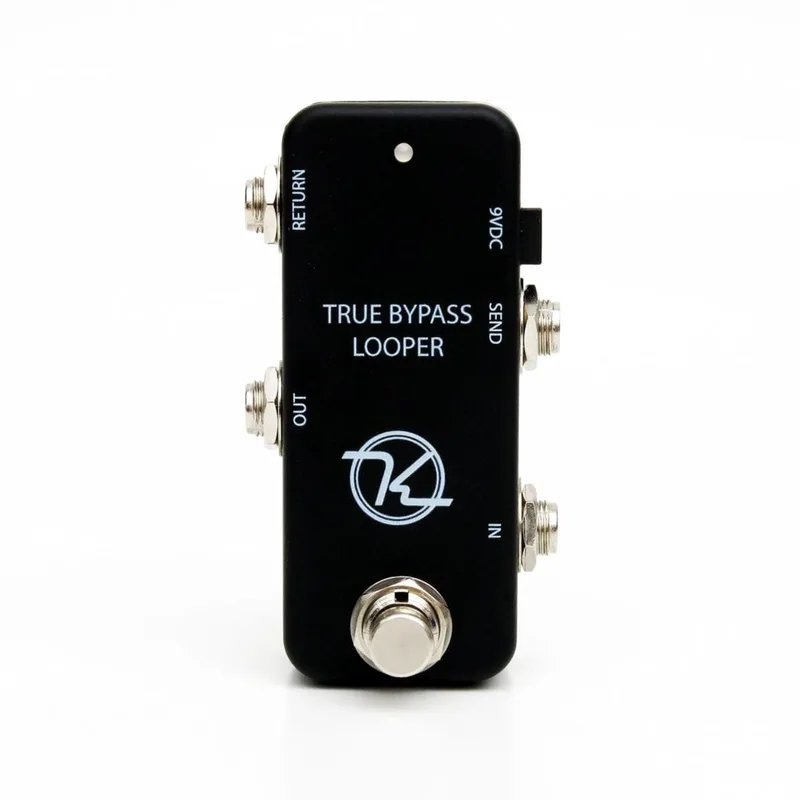
The DD-3 is not true bypass, and Keeley Electronics states plainly that it "isn't a candidate for a true bypass modification"8. Keeley's casual observation is that the pedal "produces a slightly brittle sound when in the chain with the effect turned off," and the best demonstration is to hook the DD-3 up to a Keeley True Bypass Looper and compare it against a guitar run direct to the amp8.
Can the Boss DD-3 be modded?
Yes, if you have the right version. Keeley Electronics offers a preset mod for the DD-3, but only for units with serial numbers 690000 to NC09999 or ZC10000 to SO911998. When Boss switched to all surface mount technology, the design changed and prevented easy modification of later units8.
JHS Pedals offers a similar service, describing it as: "We take your stock DD-5 or DD-3 and give you a second 'Mode' option with the tap of an onboard footswitch"17.
Who plays it
The DD-3's user list spans genres and generations:
- Prince used the DD-3 from the early 1990s to the late 2003; one of his stage-used units was auctioned in 2016 for $1,9206
- Tom Morello uses two Boss DD-3s, and ran Boss digital delays into the front of a driven amp on Rage Against the Machine tracks like "The Ghost of Tom Joad" so the amp affects the delay repeats118
- Dave Navarro's tech Dan Cleary says one secret to Dave's signature DD-3 sound is the delay time, always set to the beginning part of Pink Floyd's "Run Like Hell" to check it is correct; for "Three Days" and "Then She Did" he uses two Super Choruses and two digital delays with DD-3 times set differently19
- Wolf Van Halen always uses the DD-3 together with the EarthQuaker Devices Afterneath for the solo in "Distance"20
- Ed O'Brien of Radiohead calls it one of his go-to stompboxes13
- Mattias Johansson names it a gateway pedal alongside the HM-221
- Mike Gavrailoff keeps one on his board set to slapback for lap steel parts and country-rockabilly echo22
Joe Bonamassa's rig rundown notes the DD-3 is "readily available and costs $154 brand new" as of 202523.
DD-3 vs DD-3T
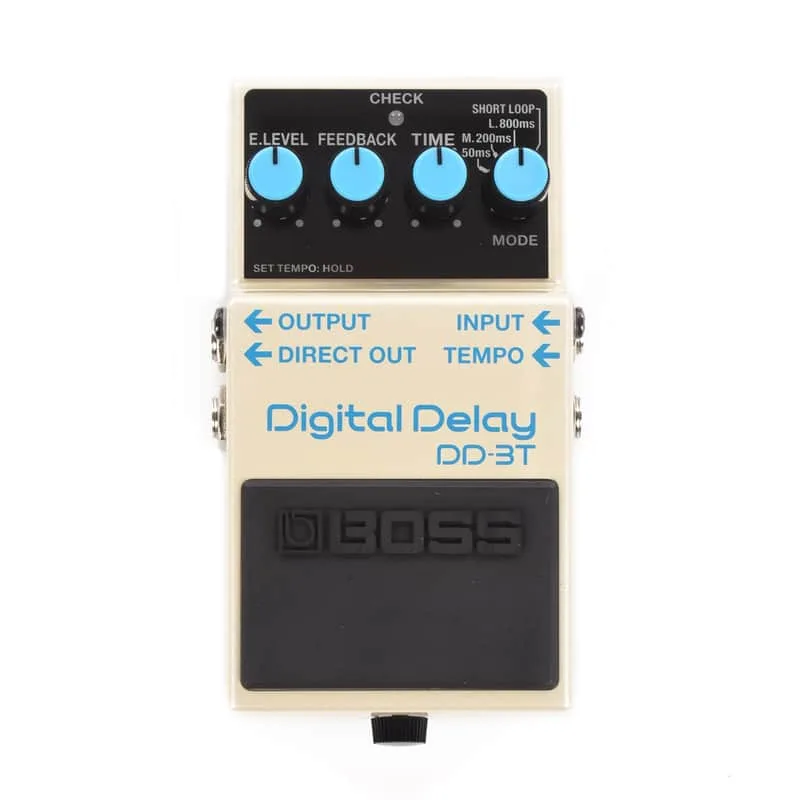
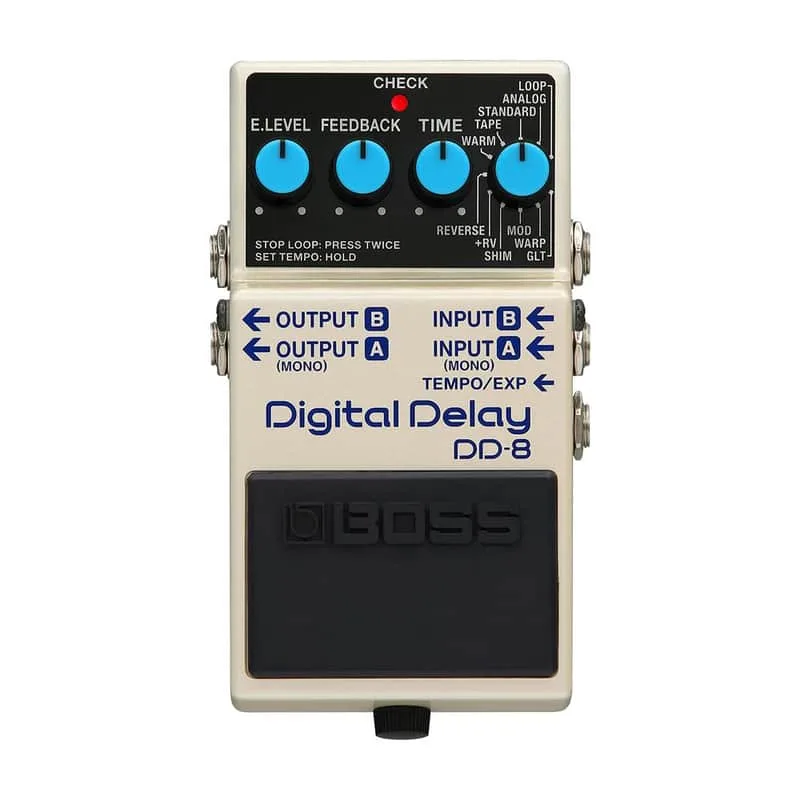
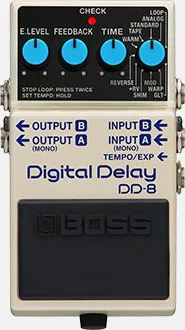
In 2019 Boss released the DD-3T alongside the DD-8, replacing the DD-3 and DD-7 respectively and adding useful features such as tap tempo2425. The DD-3T keeps the same 12.5 to 800ms delay range and the 50/200/800ms mode settings plus a Short Loop function, and adds a dedicated direct output2614. Guitar World's reviewer found the DD-3T's control set familiar: a rotary switch for selecting maximum delay times of 50ms, 200ms and 800ms plus a Short Loop function26.
Videos
Sweetwater
BOSSchannel
Worship Artistry
News
Questions
Is the Boss DD-3 true bypass?
No. The DD-3 uses a buffered bypass rather than true bypass, and Keeley Electronics notes it is not a candidate for a true bypass modification. Keeley's casual observation is that the pedal produces a slightly brittle sound in the chain with the effect turned off, and suggests comparing it against a guitar run direct to the amp through a true bypass looper to hear the difference.
What is the difference between the Boss DD-2 and DD-3?
The DD-3 began as a renamed DD-2. When the cost of the 63H101 delay chip dropped significantly, Boss changed the pedal's name to DD-3 and reduced the list price. Other than minor cosmetic differences, the DD-3 is identical to the original DD-2, and early DD-3 units contain the same 63H101 long chip as the DD-2.
How do I tell which version of the DD-3 I have?
Early units have the same long 63H101 IC as the DD-2. Sometime in the very late '80s that chip was replaced by a smaller square IC with improved bandwidth and audio specs, and further chip upgrades appeared up through 2014. Keeley lists serial numbers 690000 to NC09999 or ZC10000 to SO91199 as candidates for its modification, since later all-surface-mount units cannot easily be modified.
What does the Hold mode on the DD-3 do?
Hold records up to 800ms of audio and effectively loops it, so a delayed part repeats infinitely while you hold the switch. It does not save the sample for later playback. On the DD-3T the same function returns renamed Short Loop.
What is the difference between the DD-3 and the DD-3T?
The DD-3T, released in 2019 alongside the DD-8, replaces the DD-3 and adds useful features such as tap tempo. It keeps the same 12.5 to 800ms delay range, the 50/200/800ms mode settings, and the Hold function, renamed Short Loop, plus a dedicated direct output.
Can the Boss DD-3 be modded?
Yes, depending on the version. Keeley Electronics offers a preset mod that adds a second Mode option on an onboard footswitch, but only for units with serial numbers 690000 to NC09999 or ZC10000 to SO91199. When Boss switched to all surface mount technology, the design changed and prevented easy modification. JHS Pedals also offers a preset mod for the DD-3 and DD-5.
Sources (26)
- Why the Boss Digital Delay Is Still a Pedalboard Staple, Premier Guitar, 2026-07-04
- The Best Guitar Effects Pedals of All Time, GuitarPlayer (www.guitarplayer.com), 2021-06-25
- The PX-1 Plugout FX: Timeless BOSS Pedals Reborn, BOSS (articles.boss.info), 2025-06-06
- The Boss digital delay pedal that changed the world, Guitar World, 2026-06-01
- Echoes in Time: The History of BOSS Delay Pedals, BOSS (articles.boss.info), 2024-01-10
- Boss DD-3 Digital Delay, Guitarcloud (guitarcloud.org), 2026
- The Ultimate Guitar Pedal Buyer’s Guide, Performer Mag, 2024-03-03
- Delayed Gratification, Keeley Electronics Guitar Effects Pedals, 2013-07-31
- BOSS DD-3T Digital Delay, Delicious Audio, 2020-04-24
- Boss DD-3 Digital Delay, Pedal of the Day, 2015-02-03
- Boss revamps its delay pedal line-up with new DD-8 and DD-3T, www.gearnews.com, 2019-09-26
- The FX files: Boss DD-3, MusicRadar, 2019-02-12
- Reverberations: Ed O’Brien of Radiohead, BOSS (articles.boss.info), 2024-04-23
- Boss announces evolution of their digital delay with DD-8 and DD-3T stompboxes, MusicRadar, 2019-09-26
- Reverberations: Alessandro "Asso" Stefana, BOSS (articles.boss.info), 2025-06-06
- Coda Effects, Coda Effects, 2015-03
- BOSS DD-3/DD-5 PRESET MOD, JHS Pedals
- Behind the Board: James Sharpe with Sam Smith, Gary Numan, and The Stranglers, BOSS (articles.boss.info), 2026-09-25
- Behind the Board: Dan Cleary with Dave Navarro of Jane’s Addiction, BOSS (articles.boss.info), 2024-07-11
- Mammoth WVH Wolf Van Halen Guitar Rig Rundown, Premier Guitar, 2022-06-01
- Behind the Board: Mattias Johansson With The Cure, Dinosaur Jr., and The Black Crowes, BOSS (articles.boss.info), 2025-12-18
- Pedalboard Feature: Mike Gavrailoff, Strymon, 2015-12-15
- Joe Bonamassa buys his pedals from Sweetwater, Guitar World, 2025-06-30
- Boss has just revealed a new version of its legendary DD-3 delay pedal, Guitar.com, 2019-09-26
- Boss DD-3T Digital Delay, pedal-of-the-day.com, 2020-01-04
- Boss DD-3T and DD-200 Digital Delay review, Guitar World, 2020-05-28
 Matt Schofield
 Dave Navarro