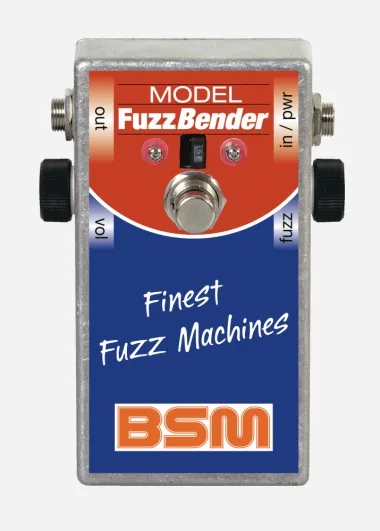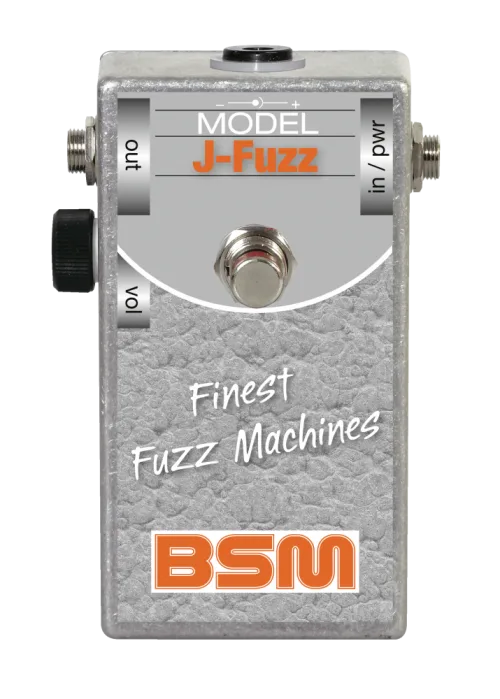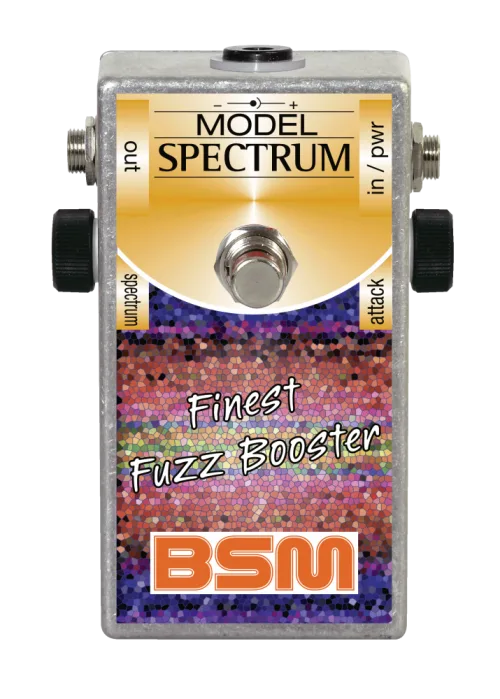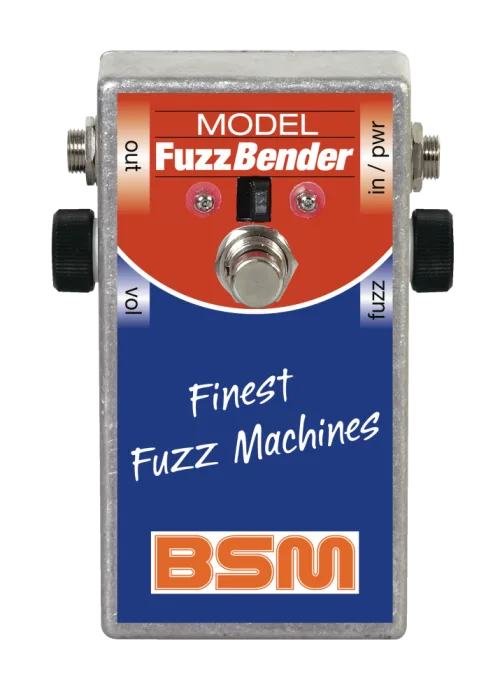

The BSM FuzzBender Fuzz Machine is a fuzz pedal for electric guitar from BSM - Finest Treble Booster. Its defining feature is a small lever switch that lets the player choose between two classic fuzz circuits: a Fuzz Face mode and a Vox/Sola Sound Tone Bender (Mk1.5) mode. BSM points out that the Fuzz Face was actually just a modification of the Vox/Sola Sound (Mk1.5), so the two modes share a family line1. It sits among other fuzz designs in the maker's range, alongside units like the BSM J-Fuzz Fuzz Machine and the BSM Spectrum, and belongs to the broader family of fuzz pedals.
The controls
The FuzzBender keeps its control layout simple: besides the usual volume control, it comes with an additional Fuzz control pot. BSM's Bernd C. Meiser describes the Fuzz control as enabling sounds in the range of hardly notable up to extremely distorted2.
| Control | What it does |
|---|---|
| Volume | The usual output level control. One customer reports it acts like a kind of tone control in Fuzz Face position, with bass increasing as it is turned up1 |
| Fuzz | Sets the amount of fuzz, from hardly notable up to extremely distorted2 |
| Lever switch | Selects the circuit: left position for Fuzz Face, right position for Vox/Sola Sound Tone Bender (Mk1.5)1 |
The two modes
The lever switch is the heart of the pedal. In the left position you get the sound of a Fuzz Face, including the warm and fat bass frequencies2. In the right position you activate the Vox/Sola Sound Tone Bender (Mk1.5), which BSM describes as having a thinner, almost hard sounding bass and aggressive highs, the character behind many British recordings of the mid-Sixties1.
"In the left position you will get the sound of a Fuzz Face, including the warm and fat bass frequencies."
For a Hendrix-style sound, BSM suggests setting the Fuzz control to its almost maximum position and turning the volume pot slightly down on a single coil guitar, in Fuzz Face mode. The maker says this produces a sound that really reminds of Jimi Hendrix2.
Power
The FuzzBender is powered by a 9V battery with a current consumption of approximately 600 µA1. BSM adds a note that matters for anyone servicing the pedal:
"Note: The positive pole of the battery is ground."
On output, BSM gives an average output level of -3dBm, and says the maximum output voltage is 1V when the strings are struck really hard1.
Where it goes in the signal chain
BSM is explicit about placement: the FuzzBender achieves its tone best when connected in the signal path directly after the guitar, through the interaction between player, pickup and fuzz unit1. In practice that means first in the chain, before any other pedals.
Questions and support
BSM says its tech-head and mastermind, Mr. Bernd C. Meiser, would be happy to talk to anyone with questions. Questions can be sent by email to info@treblebooster.net or through the contact form on the treblebooster.net site1.
Videos
Haiko Heinz
Questions
What is the difference between the Fuzz Face and Tone Bender modes on the BSM FuzzBender?
A small lever switch selects between the two circuits. In the left position you get the sound of a Fuzz Face, including the warm and fat bass frequencies. In the right position you activate the Vox/Sola Sound Tone Bender (Mk1.5), which BSM describes as having a thinner, almost hard sounding bass and aggressive highs, the character behind many British recordings of the mid-Sixties.
Where should the BSM FuzzBender go in the signal chain?
BSM says the FuzzBender achieves its tone best when connected in the signal path directly after the guitar, because of the interaction between player, pickup and fuzz unit. Placing it first, before other pedals, is what the maker recommends for the best tone.
Does the BSM FuzzBender run on a battery?
Yes. The FuzzBender is powered by a 9V battery with a current consumption of approximately 600 µA, according to BSM. Note that the positive pole of the battery is ground, which matters if you service or replace the battery yourself.
Is the positive pole of the battery ground on the FuzzBender?
Yes. BSM notes that the positive pole of the battery is ground on the FuzzBender. That is typical of vintage style positive-ground fuzz circuits and is worth knowing before wiring power or replacing the battery.
How do I get a Hendrix-style sound from the FuzzBender?
BSM suggests setting the Fuzz control to its almost maximum position and turning the volume pot slightly down on a single coil guitar. In Fuzz Face mode, the maker says this produces a sound that really reminds of Jimi Hendrix, with the warm and fat bass frequencies of that circuit.
Who do I contact with questions about the BSM FuzzBender?
BSM says its tech-head and mastermind, Bernd C. Meiser, is happy to answer questions. You can reach him by email at info@treblebooster.net or through the contact form on the treblebooster.net website.
Sources (2)
- FuzzBender Fuzz Machine, treblebooster.net (BSM - Finest Treble Booster), 2025
- FuzzBender Fuzz Machine, BSM - Finest Treble Booster (treblebooster.net), 2025