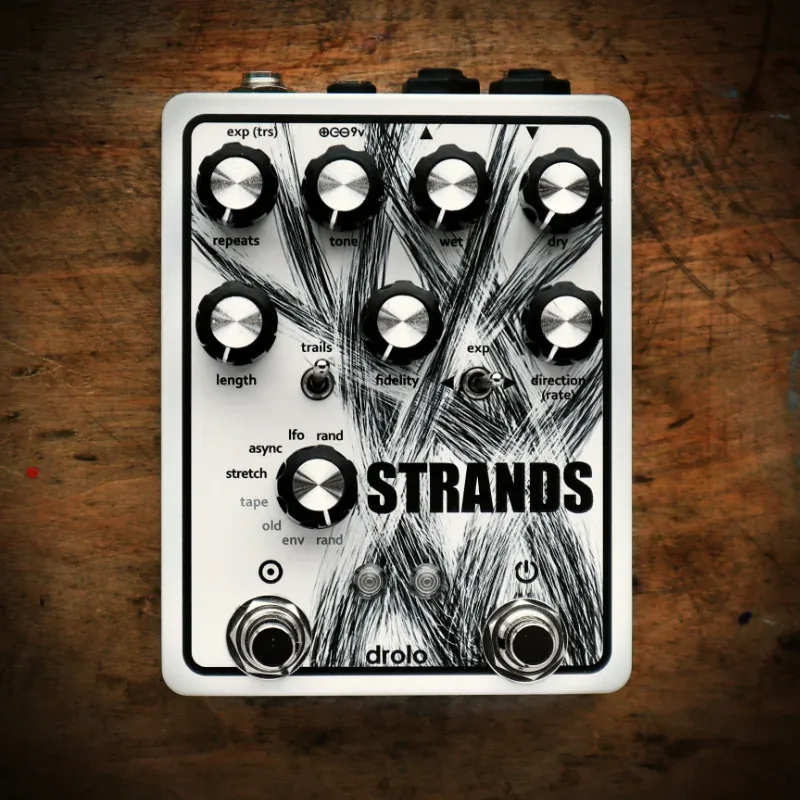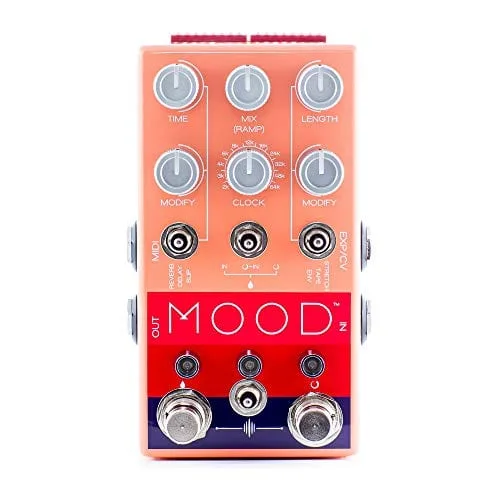


The Chase Bliss Audio MOOD is a two-channel granular micro-looper and ambience pedal, first shown on June 20, 2019 and built in collaboration with Drolo FX and Old Blood Noise Endeavors12. One half is an always-listening micro-looper that continuously records even when the pedal is bypassed, so engaging it captures whatever just happened; the other half is a suite of real-time spatial effects, with reverb, delay and Slip modes34. What sets it apart from a conventional looper or delay is that the two channels are aware of each other: audio passes freely back and forth between them, evolving and transforming over time32.
The original MOOD is no longer available for purchase; it was superseded by the MOOD MKII, which carries the same two-channel idea with stereo, overdubbing and far deeper MIDI added35. Chase Bliss describes MOOD as "a different kind of multi-effect"3.
The two channels and how they work together
The Loop channel, designed by David Rolo of Drolo FX, is an always-listening micro-looper: it records continuously, even in bypass, and Chase Bliss likens engaging it to "fishing for music"314. It has three modes of its own: Env, Tape and Stretch, with Stretch time-stretching the loop4. Holding down the Loop bypass switch records a passage on the fly that is added into the loop on release4.
The Wet channel, designed by Old Blood Noise Endeavors, holds the spatial effects31:
| Wet channel mode | What it does |
|---|---|
| Reverb | A cluster of smearable delay taps leading to a blanket of atmosphere; descends into frequency-shifting at a turn of a knob34 |
| Delay | A looping delay mode that interacts specifically with the Clock knob4 |
| Slip | A buffer with an adjustable playback head, from half speed to double speed, backwards or forwards, producing skipping "doppelgängers" via auto-sampling34 |
The channels can be routed in three different ways, and the maker presents the whole pedal as a "study in interaction"2710.
The controls: Time, Modify, Clock and routing
The control set runs to Time, Mix (Ramp), Length, Modify, Clock, Routing, the Reverb/Delay/Slip switch, the Envelope/Tape/Stretch switch, and a preset switch that saves two favorite settings for instant recall114. Time and Modify change jobs depending on the mode4:
| Mode | Time knob | Modify knob |
|---|---|---|
| Slip | Sets the buffer's length | Controls playback speed and direction |
| Delay | Sets the delay time | Controls loop feedback |
| Reverb | Adjusts all of the delay taps | Goes from clean repeats to washed-out reverb |
The heart of the pedal is the Clock knob, which controls the sample rate of both channels at once and shifts everything in harmonized steps517. It is a global control for the recording and playback of each channel, and each sample rate setting is half the value of the clock, with options running from 64k = .5s down to 2k = 16s4.
Chase Bliss notes that aliasing and noise become more present at 8k and lower on the Clock knob, and that the two channels' levels are slightly offset by design. The overall wet volume can be raised by turning the trimmer closest to the footswitches clockwise12.
Two footswitches engage the Spatial and Looper channels independently119, and there are 16 external DIP switches on the MKII for deeper configuration9.
Power, connections and MIDI
Both versions run on 9V DC with a center-negative plug: the original draws about 200 mA and the MKII about 270 mA35. Those are draws that rule out a battery and call for an isolated output on a powered board rather than a shared daisy chain.
MIDI is where the versions diverge most. The original responds to program change and control change messages, with 2 presets on board, 6 via a "faves" switch and 122 via MIDI, but it does not support MIDI clock712. The MKII adds clock sync, note control, control over every parameter including hidden ones, and the ability to play the pedal with a keyboard5. Both carry an expression/CV jack35.
History: from MOOD to MKII and Bad Mood
MOOD was unveiled on June 20, 2019 through a video by the videographer Knobs, as a continuation of the collaborative designs Chase Bliss began releasing in 201812. The company later called it a surprise success whose greatest strength is that it is fun, with instant gratification13. Guitar Pedal X reports it remains Chase Bliss's most popular pedal to date14.
The MOOD MKII followed in March 2023 at $399, available directly from Chase Bliss8. It keeps the same controls plus stereo and overdubbing, with loops twice as long as the original's, a hold function on both channels, and a looper that can overdub, sync, freeze or be used like a live effect913. The new firmware was also released as an update for existing original MOOD pedals15. Special editions have appeared across both versions, including Black, Bauhaus Brew Labs, Last 100, Birthday Cake, Light Bright and Desert Friends artworks11.
Chase Bliss has also announced the BAD MOOD, which carries over CV control from the MOOD line16. The MOOD MKII itself was offered as a preorder, with Chase Bliss stating it was in the late stages of beta testing with hardware on the way, and aiming to start shipping by the end of April13. Alongside the new hardware, MKII expands on the original: loops can be twice as long as the original MOOD's, both channels now have a powerful hold function, and the looper can overdub, sync, freeze, and be used like a live effect13.
What reviewers said
The launch video by Knobs, made for the original MOOD's announcement, walks through the two channels, the clock concept and the routing options in demo form1.
Videos
David Hilowitz Music
Reverb
News
Questions
Is the Chase Bliss MOOD MKII stereo?
Yes. The MKII has stereo input and output, which the maker lists among its main additions along with overdubbing, freezing, syncing, fading and filtering. The original MOOD is mono only, with mono input and output, so stereo operation is one of the clearest reasons to choose the MKII over the first version.
Does the original MOOD support MIDI clock?
No. Chase Bliss states plainly that the original MOOD does not support MIDI clock. It does respond to MIDI program change and control change messages, and it has an expression/CV jack. The MKII goes much further, adding clock sync, note control, the ability to play the pedal with a keyboard, and control over every parameter including hidden ones.
Can the original MOOD get the MKII firmware update?
Yes. When the MKII arrived, Chase Bliss released its new firmware as an update available to existing original MOOD pedals, so owners can bring their pedal up to the MKII feature set without buying new hardware. Guitar Pedal X noted the limited Light Bright edition was another option for owners who preferred not to upgrade.
Is the MOOD true bypass or buffered?
The MOOD uses buffered bypass with analog dry-through, and the bypass can run in momentary or latching mode. The MKII is also listed as buffered bypass. Players who want true bypass will not find it here, but the analog dry path means the untouched signal stays in the analog domain.
What is the difference between the MOOD and the MOOD MKII?
The MKII keeps the same core controls and two-channel workflow but adds stereo input and output, overdubbing, freezing, syncing, fading, filtering and balancing, plus much deeper MIDI including clock sync and keyboard play. Loops can be twice as long as the original's, both channels gain a hold function, and a Classic Mode restores the original sound quality for players who prefer it.
What is Classic Mode on the MOOD MKII?
Chase Bliss polished the MKII's sound quality compared with the original, and Classic Mode is there for players who prefer the old character. As the maker puts it, there is a Classic Mode for those who prefer the dents and dings. Delicious Audio describes it as a mode that restores all the functions of the MkI.
Sources (16)
- Chase Bliss Audio MOOD MkII, Delicious Audio, 2025-11-24
- Chase Bliss Audio is in a playful M O O D with new granular micro-looper/delay pedal, MusicRadar, 2019-06-20
- MOOD - Chase Bliss, Chase Bliss
- Chase Bliss Audio MOOD Granular Micro Looper Delay, Pedal of the Day (www.pedal-of-the-day.com), 2019-06-25
- MOOD MKII, Chase Bliss
- Chase Bliss launches MOOD looper/delay pedal. With a 20-minute, must-see video., gearnews.com, 2019-06-20
- Chase Bliss Launches MOOD Micro-Looper/Delay Pedal, Premier Guitar, 2019-06-20
- The Chase Bliss Mood MKII is here with an array of new features, gearnews.com, 2023-03-15
- Chase Bliss Mood MkII review: A knob-twiddler’s delight, Guitar.com, 2023-05-19
- 5 great multi-function guitar effects pedals you need to try, MusicRadar, 2022-01-05
- Guitar Pedal X, Guitar Pedal X, 2025-11-25
- Support | Get Expert Support Now - Chase Bliss, Chase Bliss
- Setting the MOOD, Chase Bliss
- Guitar Pedal X, Guitar Pedal X, 2026-04-08
- Guitar Pedal X, Guitar Pedal X, 2024-03-21
- Chase Bliss Bad Mood, Delicious Audio, 2026-10-21