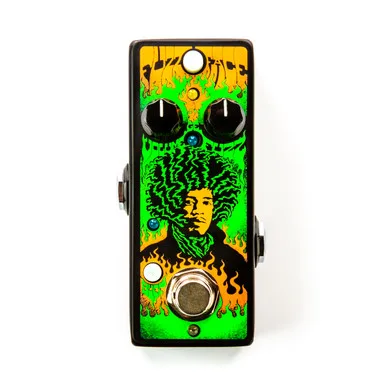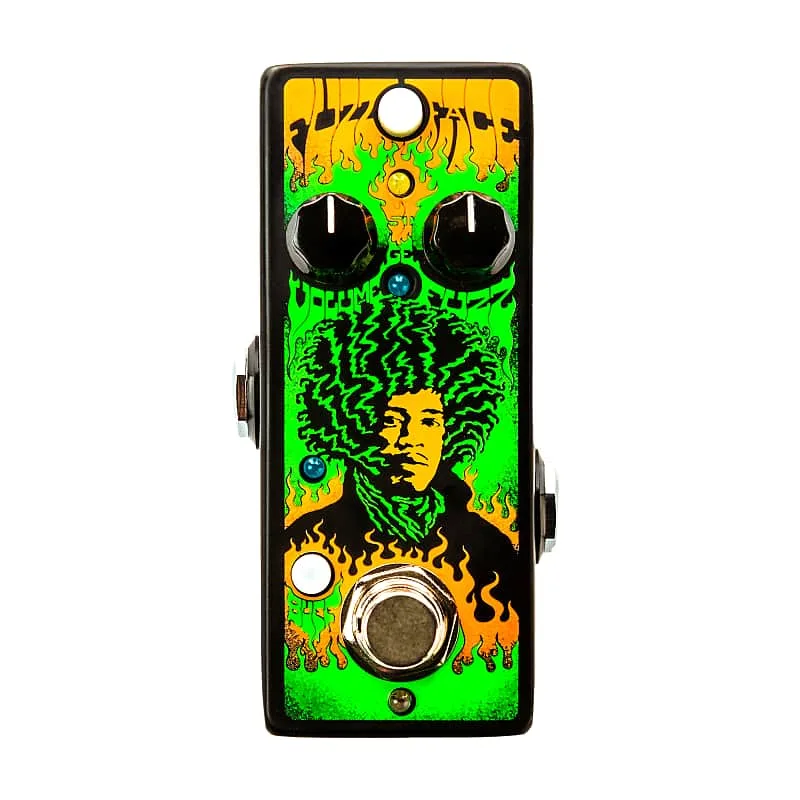
The Dunlop JHMS1 is a fuzz pedal from Dunlop's Jimi Hendrix Shrine Series, described in the company's manual as a Fuzz Face Distortion packed into an MXR mini housing. What sets it apart from other Fuzz Face pedals is that it carries two fuzz voices in one box: a silicon-based crunch and a germanium-based fuzz, selected by a switch rather than by buying two pedals1.
Dunlop describes the design goal in terms of Hendrix's own history: the pedal, in the company's words, "captures both the aggressive silicon-based crunch that Jimi Hendrix used in the latter part of his career and the warm, smooth saturation of germanium-based fuzz that he used in the early years"1. The finish is part of the Shrine Series concept too, a custom treatment that remixes rock artist John Van Hamserveld's famous 1968 Shrine Auditorium concert poster art1.
Controls and voices
The control set is small, which suits a mini-format fuzz. Everything on the surface is listed in the manual1:
| Control | What it does |
|---|---|
| BUFF switch | Toggles between high and low input impedance; blue LED indicates high impedance |
| VOLUME knob | Sets overall volume of the effect |
| SI/GE switch | Selects silicon fuzz (OUT position, white LED) or germanium fuzz (IN position, blue LED) |
| FUZZ knob | Controls intensity of the fuzz effect |
| FOOTSWITCH | Toggles effect on and bypass; blue LED indicates on |
The two voices are the heart of the pedal. For aggressive silicon-based crunch, the SI/GE switch goes to its OUT position, indicated by the white LED; for smooth germanium fuzz, it goes to the IN position, indicated by the blue LED1. In practice this gives you the two eras of the Fuzz Face circuit side by side: the brighter, harder-edged silicon sound and the warmer, smoother germanium sound, without swapping pedals.
The buffer and how it changes the pedal
The BUFF switch is the control that will matter most to players thinking about pedal order. It toggles the pedal's input impedance between high and low, and the difference is large: 800 kΩ with the buffer on, 10 kΩ with it off1. Low input impedance is part of how vintage fuzz circuits interact with guitar volume controls, but it also makes the pedal more sensitive to whatever sits in front of it.
Dunlop ships the pedal with the buffer engaged for a reason. The manual notes that "this pedal's buffer is set to ON by default, indicated by the associated LED," and that the default exists to prevent oscillation when using a wah pedal and to preserve high end tone1. If you run a wah into the JHMS1, leaving the buffer on is the safe setting; if you want the vintage low-impedance interaction with your guitar's controls, you can switch it off and accept the tradeoff.
The buffer also changes the measured behavior of the circuit. With the buffer on, Dunlop lists a max gain of 55 dB, a max output level of -4 dBV, and an output impedance of 16 kΩ at max volume or 160 kΩ at mid volume. With the buffer off, the silicon voice still reaches 55 dB of gain with output impedance below 16 kΩ at max volume and 66 kΩ at mid volume, while the germanium voice tops out at 45 dB of gain with output impedance of 2 kΩ at max volume and 115 kΩ at mid volume1.
Power and connections
Setting the pedal up is a two-cable job: run a cable from your guitar to the JHMS1's INPUT jack, then another from the OUTPUT jack to your amplifier1.
The JHMS1 cannot run on a battery. It requires the Dunlop ECB003 9-volt adapter or an MXR Brick Series power supply, each sold separately, at 9 volts DC with a 6.8 mA current draw1.
The 6.8 mA draw is modest by pedalboard standards, so a single power brick output will run it comfortably. Plan for a power supply before the pedal arrives, since nothing for powering it comes in the box1.
Where it sits in the Fuzz Face family
Questions
Can the Dunlop JHMS1 run on a battery?
No. Dunlop's manual states plainly that this pedal cannot be powered by a battery. It runs on 9 volts DC through the Dunlop ECB003 adapter or an MXR Brick Series power supply, both sold separately, and draws 6.8 mA.
Is the JHMS1 true bypass?
Yes. Dunlop lists the bypass as True Hardwire in every configuration, whether the buffer is on or off and whether you are running the silicon or germanium fuzz voice. With the effect bypassed, your signal passes through without the pedal's buffer in the path.
Does the JHMS1 work after a wah pedal?
Yes, but Dunlop advises leaving the buffer on. The manual says the buffer is set to ON by default to prevent oscillation when using a wah pedal and to preserve high end tone. Switching the buffer off drops the input impedance to 10 kΩ, which is where interaction with other pedals becomes more likely.
What does the BUFF switch do on the JHMS1?
It toggles between high and low input impedance, with a blue LED showing the high-impedance setting. With the buffer on, the input impedance is 800 kΩ; with it off, 10 kΩ. Lower input impedance changes how the fuzz reacts to your guitar's volume and tone controls and to pedals placed before it.
Sources (1)
- JHMS1.pdf, Jim Dunlop, 2023