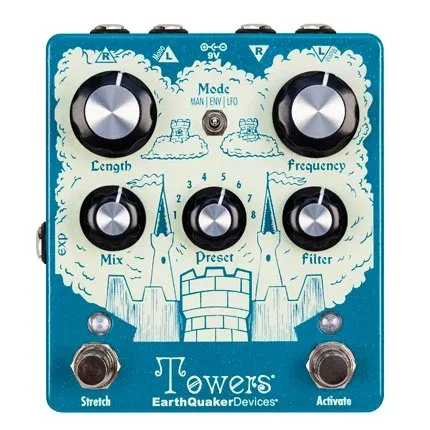


The EarthQuaker Devices Towers is a Stereo Reverberant Filter, a reverb pedal that combines ambience with a sweeping, resonant low-pass filter reminiscent of the filters found in vintage synthesizers. Released on March 5, 2026, it is a digital pedal built in Akron, Ohio, and priced at $2991234.
Inside, the input signal is fed into an array of infinitely repeating micro-echoes, creating generative impulses that feed a cathedral-style reverb. A resonant low-pass filter is interwoven with the delay and reverb pathways at multiple points, which EarthQuaker says generates warm and ringy tones that impart layers of dark atmosphere into the reverberated echoes1. The maker is clear that the colorful, resonant movement in the reflections is created internally and is not the kind of effect you could recreate with external hardware2.
Reverb through a resonant stereo filter
The premise, as MusicRadar's Trevor Curwen describes it, is to feed your guitar signal through what EarthQuaker describes as a resonant filter working on a reverb4. The Filter control determines how intensely the resonant low-pass filter intertwines with the reverb pathways3. Because the filter intersects both the delay and reverb paths at multiple points, the movement you hear sits inside the reflections rather than on top of them1.
The pedal works across the stereo field, with the left channel opposite the right, so the two channels move against each other rather than simply spreading a mono reverb wide1. Gearnews notes the Towers offers two stereo inputs and outputs on the head7.
Manual, Envelope and LFO modes
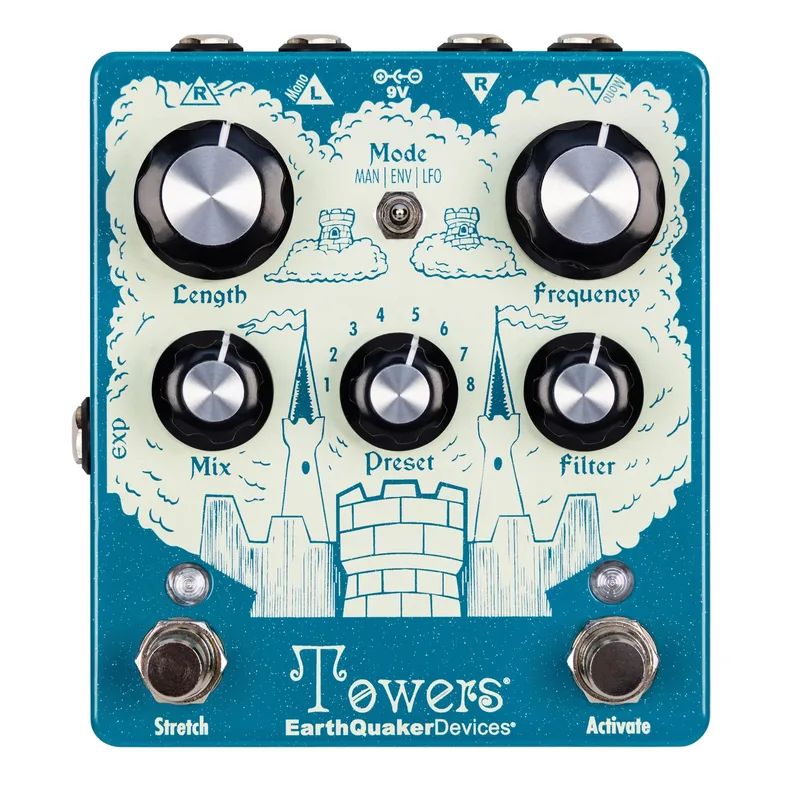
The filter frequency offers three distinct modes of navigation, selected by a 3-position toggle switch that changes the mode of operation13.
| Mode | What it does |
|---|---|
| Manual | You are in charge: twist the Frequency knob and the left channel moves opposite the right, creating stereo movement that is physical rather than just wide5 |
| Envelope | Your picking dynamics become filter movement: play harder and the frequencies shift. The Frequency knob becomes a sensitivity control3 |
| LFO | A slow oscillator sweeps across the stereo field, and the Frequency knob becomes a rate control5 |
Eight user assignable presets capture and recall settings with the turn of a knob and a press13. An expression pedal jack is also on board6.
The Stretch footswitch
The Activate footswitch turns the effect on and off1. The second footswitch, Stretch, is the headline feature. Hold it and the whole digital system slows down: the reverb length is doubled, the spectrum of frequencies shifts, and a pitch-bending effect runs throughout the morphing process23.
EarthQuaker describes the mechanism in more detail: Stretch doubles the length of the reverb effect by slowing the processor speed, which generates a lo-fi effect that pulls apart the delay lines while smearing the filter and lowering the frequency responses1. MusicRadar's Jonathan Horsley summarized it as a footswitch that slows everything down, doubling the length of the reverb and playing around with the spectrum of filter frequencies, with a pitch-bending effect8.
Bypass, presets and power
The Towers can operate in two bypass states, Tails or Full Bypass, and comes factory set in Tails Mode, which lets the reverb tail continue after you switch the effect off. A green Activate LED indicates Tails Mode and a red LED indicates Full Bypass1. The switching itself is mechanical true bypass23.
Power comes from a standard 9-volt DC power supply with a 2.1 mm negative center barrel1, drawing 85mA5.
The 85mA draw and the requirement for a standard 9-volt DC power supply with a 2.1 mm negative center barrel mean the Towers runs from a typical pedalboard power supply rather than a battery.
Is it a stereo Afterneath?
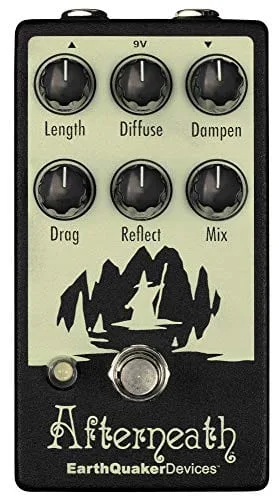
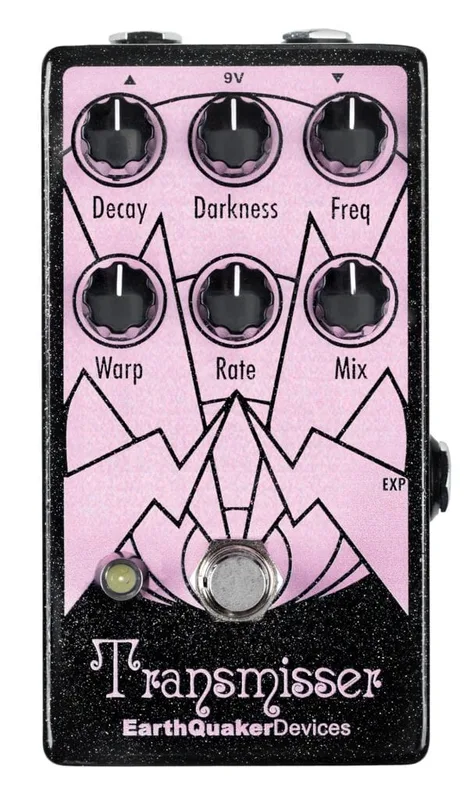
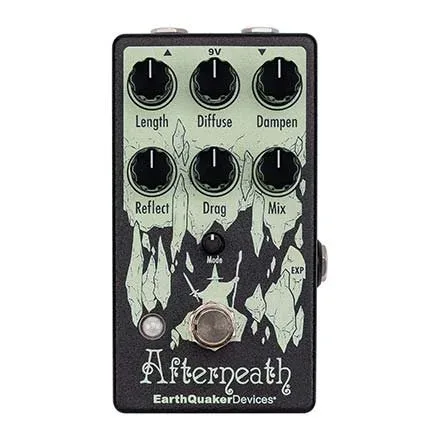
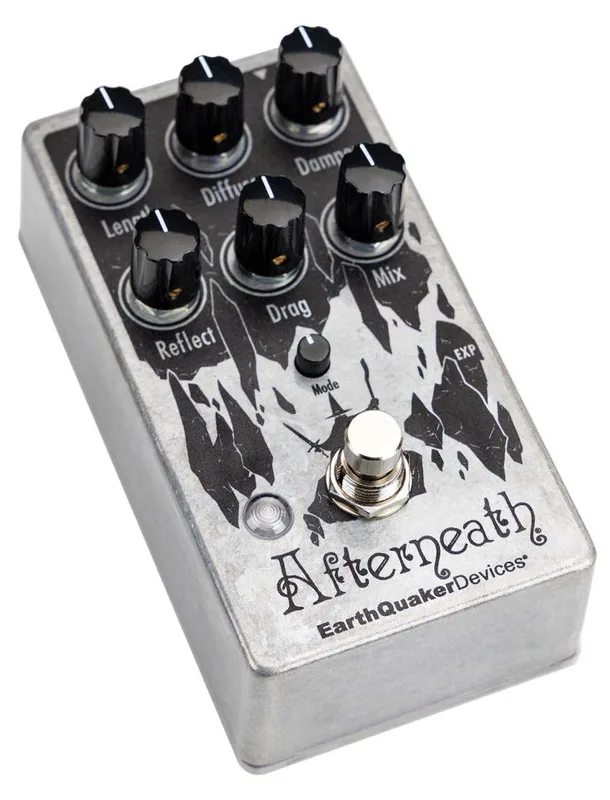
No. When the Towers launched, some players wondered how it related to the Afterneath or the Transmisser. Delicious Audio reported designer Jamie Stillman being very clear that this is not an evolution of anything the company has done before, calling it a linear progression5. The maker's own description points to a different architecture: the input signal is fed into an array of infinitely repeating micro-echoes feeding a cathedral style reverb, interwoven with a resonant low-pass filter intersecting the delay and reverb pathways at multiple points1.
What reviewers said
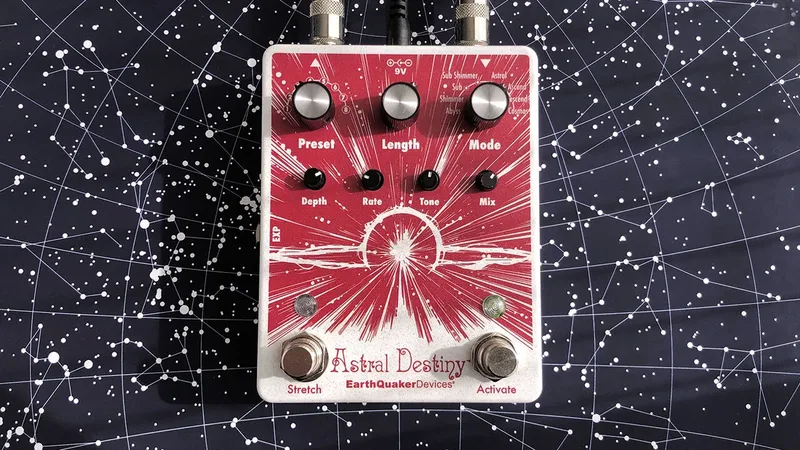
James Volpe Rotondi reviewed the pedal for Premier Guitar in April 2026, in sections titled Soundscape Generator, A Real Stretch and The Verdict9. Guitar World's Matt Lincoln found the build quality "as robust as it gets," built to the same sturdy standard as the Astral Destiny and designed to take a beating6.
"All-round a rather handy take on reverb - balancing filtering and modulation."
Karlsson praised the dynamics available from the Expression and Stretch functions, though he was not sure the Towers would challenge his existing reverbs, and it was not his favorite form-factor overall10.
Videos
Premier Guitar
EarthQuakerDevices
EarthQuakerDevices
News
Questions
Is the EarthQuaker Towers a stereo Afterneath?
No. EarthQuaker Devices has stated that the Towers uses its own reverb algorithm with resonant filter modes, stereo signal flow and user presets, and is distinct from the Afterneath, Transmisser and Astral Destiny. Designer Jamie Stillman has described it as a new design rather than an evolution of anything the company has done before.
Can the Towers run in mono?
Yes. The pedal has both mono and stereo inputs and outputs, so it works on a standard mono pedalboard and opens up into stereo when you use both outputs. An expression pedal jack is also on board.
How many presets does the Towers store?
Eight. The presets are user assignable, so you can capture and recall your own settings with the turn of a knob and a press, rather than working from fixed factory patches.
Does the Towers have trails bypass?
It can. The Towers operates in two bypass states, Tails or Full Bypass, and comes factory set in Tails Mode, which lets the reverb continue after you switch the effect off. A green Activate LED indicates Tails Mode and a red LED indicates Full Bypass.
Who did the artwork on the Towers?
The enclosure artwork is by Dave Neeson, as credited by EarthQuaker Devices on the product page.
Sources (10)
- Towers Stereo Reverberant Filter, EarthQuaker Devices
- EarthQuaker Devices Release the Towers Stereo Reverberant Filter, Premier Guitar, 2026-03-05
- EarthQuaker Devices Towers Stereo Reverberant Filter, Pedal of the Day, 2026-03-24
- EarthQuaker Devices Towers review, MusicRadar, 2026-08-20
- EarthQuaker Devices Towers Reverberant Filter, Delicious Audio, 2026-04-09
- EarthQuaker Devices Towers review, Guitar World, 2026-03-27
- EQD Towers Stereo Reverberant Filter: Ambient FX, gearnews.com, 2026-03-05
- EarthQuaker Devices' Towers is a reverb pedal like no other, MusicRadar, 2026-03-11
- EarthQuaker Devices Towers Review, Premier Guitar, 2026-04-22
- Guitar Pedal X, Guitar Pedal X, 2026-03-06