

The Electro-Harmonix Q-Tron is an envelope filter pedal: a filter whose peak frequency moves in response to how hard you play. The volume of your input signal, called the envelope, controls the cutoff or center frequency of a swept filter, so a hard-picked note opens the filter up and a soft one lets it close down, producing everything from a subtle auto-wah to an ultra-funky squelch1. Electro-Harmonix describes it as "The phattest, funkiest envelope filter ever made!"2, and it arrived in 1996 as the first all-new Electro-Harmonix product in 15 years3. Sources differ on the exact year: Musitronics' history gives 19964, while another account places it in 1998.
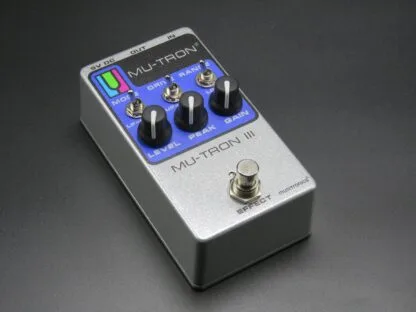
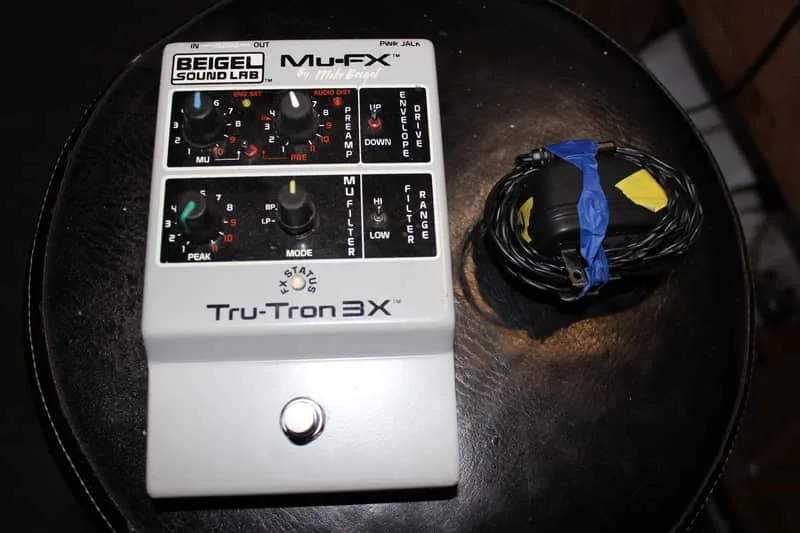
The circuit is a direct descendant of the Mu-Tron III, the Musitronics envelope filter unveiled in 19725. The Q-Tron uses the same opto-electronic design as the Mu-Tron III, with an increased frequency response and an improved signal-to-noise ratio3. It was developed with assistance from Mike Beigel, the Musitronics co-founder and electronics engineer behind the original6.
How it works and what it does to your sound
An envelope filter, sometimes called an auto-wah8, reads the envelope of your playing and uses it to sweep a voltage-controlled filter whose peak response frequency varies with the input signal9. Where a wah pedal moves under your foot, the Q-Tron moves under your fingers: dig in and the filter sweeps wide, back off and it settles. The pedal offers selectable low pass, band pass and high pass filters, so you can shape whether the sweep emphasizes lows, a narrow band, or highs2.
The controls
The original Q-Tron front panel covers the filter's shape and how it reacts to your hands.
| Control | What it does |
|---|---|
| Gain knob and boost switch | Sets how hard the envelope is driven by your input2 |
| Peak (Q) control | Adjusts the filter's resonance, from subtle to dramatic2 |
| Mode | Selectable low pass, band pass and high pass filters2 |
| Sweep direction switch | Up or down filter sweeps2 |
| Drive switch (up/down) | Selects sweep direction: up (wah) or down (ow)3 |
| Hi/lo frequency response modes | Matches the filter's range to your instrument2 |
The sweep direction choice matters more than it sounds: an up sweep behaves like a wah opening on each note, while a down sweep produces the reverse, "ow"-style articulation3. The pedal also carries two outputs, one normal and one effected, so you can split dry and filtered signals to separate destinations3.
Power: 24V AC adapter
The original Q-Tron will not run on batteries. It includes a 24 volt AC adapter, and that power requirement rules out the 9V battery operation most pedalboards assume3.
This is the biggest practical difference from the rest of the family. The Micro Q-Tron runs on an included 9V battery with an optional 9.6VDC-200mA adapter10, and the Nano Q-Tron also comes with a 9V battery and takes an optional 9V supply1. Anyone building a board around the original Q-Tron needs to plan for its 24V AC supply rather than a standard 9V daisy chain.
History and versions
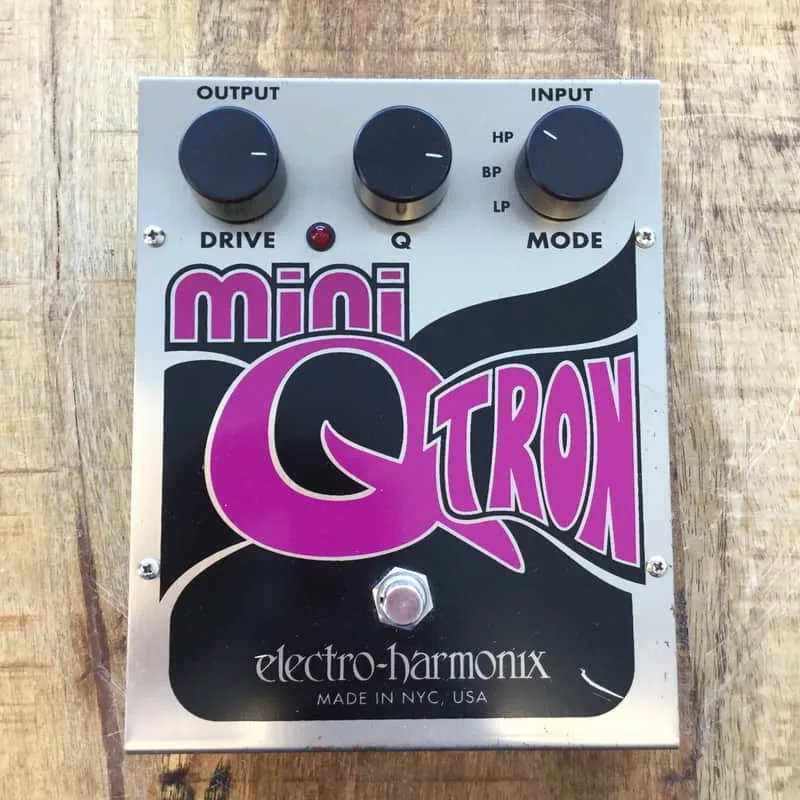
The Q-Tron spawned a whole line. The original was later adapted as the Mini Q-Tron, Micro Q-Tron and Q-Tron+, the latter two of which are still in production11.
| Version | Year | What changed |
|---|---|---|
| Q-Tron | 1996 (or 1998) | The original, opto-electronic Mu-Tron III-based design43 |
| Mini Q-Tron | 2000 | A smaller version similar to the original Mu-Tron; now discontinued412 |
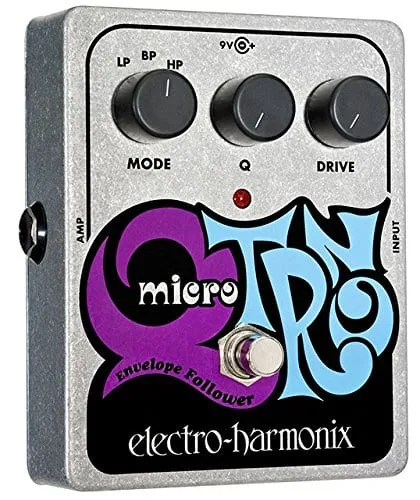
| Micro Q-Tron | 2006 | Compact version with filter mode, Q and drive only; 9V battery1013 |
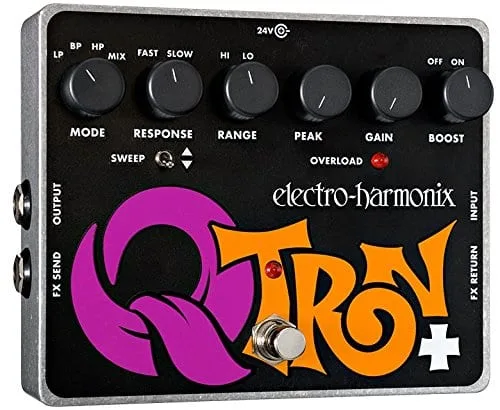
| Q-Tron+ | 2008 | Same design plus effects loop and Attack Response switch14 |
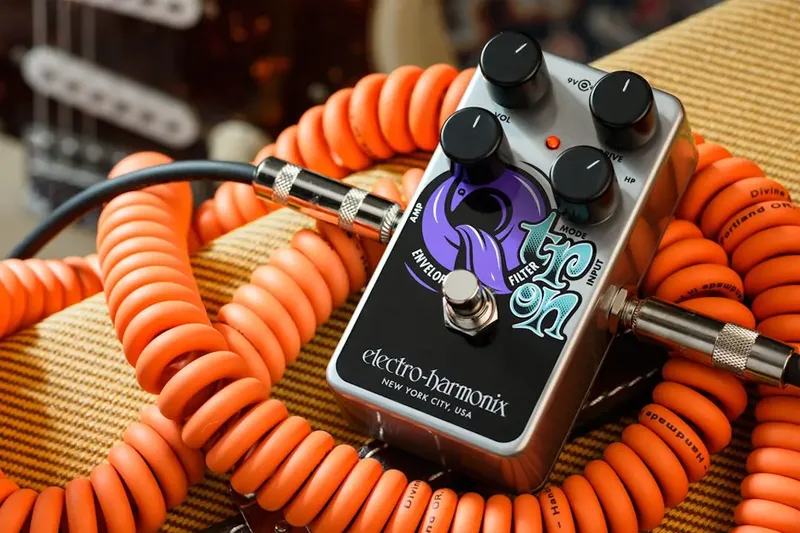
| Nano Q-Tron | 2021 | A more compact Micro Q-Tron with an added volume control1516 |
The Q-Tron Plus is the closest sibling: the same design as the original with an extremely useful effects loop and an Attack Response Switch14. That switch selects between a slow, smooth, vowel-like attack and the fast, snaked response of the original Q-Tron17. The Micro Q-Tron trims the panel down to filter mode, Q and drive13, while the Nano Q-Tron shrinks it further and finally adds a volume control1618.
What reviewers said
Guitar World's history of the Mu-Tron III, by Nick Wells, addressed the Q-Tron directly as the affordable route into this sound:
"This is a fine filter for those on a budget, and well worth considering if you can't justify the hefty price of the Mu-Tron III."
Premier Guitar has called the Q-Tron a legendary Electro-Harmonix envelope filter used by guitar and bass players since its inception20. Reviews of the later versions point back to the same core: Pedal of the Day found the Q-Tron+ a "powerful machine" with its sweep toggle and FX loop21, and Guitar World's Trevor Curwen found the Nano version offered "Plenty of control over the sound"22, noting that its Drive knob really starts to have an effect in normal dynamic playing beyond 12 o'clock, where you can dial in wider, more prominent filter sweeps22.
Who uses it
Two documented players stand out. Mark Karan uses a Q-Tron with RatDog7, and the Analog Man mix knob mod was developed specifically for him7. Flea's rig, documented in Premier Guitar's rig rundown, includes an Electro-Harmonix Q-Tron used for the Red Hot Chili Peppers' "Sir Psycho Sexy"23.
Mods: adding a mix knob
Analog Man offers a MIX knob mod for the Q-Tron that sets the blend of dry versus effected sound, functional only in MIX mode7. Availability depends on the version: the mix knob can be added to the classic Q-Tron or the XO version of the Q-Tron and Q-Tron+, but not the classic Q-Tron Plus7.
Videos
John Mayer Gear
Vitaly Ganya
Pedal of the Day
Questions
Can the Electro-Harmonix Q-Tron run on batteries?
No. The original Q-Tron will not run on batteries and ships with a 24 volt AC adapter. That sets it apart from the later Micro Q-Tron and Nano Q-Tron, which both run on a 9V battery. If you want a battery-powered Q-Tron, the smaller versions are the ones to look at.
What is the difference between the Q-Tron, Q-Tron+ and Micro Q-Tron?
The Q-Tron Plus uses the same design as the original Q-Tron but adds an effects loop and an Attack Response switch that shifts between a slow, vowel-like attack and the original's fast response. The Micro Q-Tron is a smaller version with just filter mode, Q and drive controls, and it runs on a 9V battery instead of the 24V adapter.
Is the original Q-Tron discontinued?
Yes. Electro-Harmonix lists the original Q-Tron as discontinued in 2017. The Q-Tron Plus and Micro Q-Tron have remained in production, and the Nano Q-Tron, released in 2021, carries the design on in a compact enclosure with a volume control.
Who designed the Q-Tron?
Electro-Harmonix developed the Q-Tron pedals in the mid-1990s with assistance from Mike Beigel, the Musitronics co-founder and electronics engineer behind the original Mu-Tron III envelope filter of 1972. The circuit uses the same opto-electronic design as the Mu-Tron III.
Can you add a mix knob to a Q-Tron?
Yes, as a mod. Analog Man offers a MIX knob mod that sets the blend of dry and effected sound, working only in MIX mode. The mod came about for guitarist Mark Karan, who uses a Q-Tron with the band RatDog. It is available on the classic Q-Tron and the XO versions, but not on the classic Q-Tron Plus.
Is the Q-Tron true bypass?
Yes. Electro-Harmonix lists true bypass for the original Q-Tron, and the same applies across the family: the Q-Tron Plus, Micro Q-Tron and Nano Q-Tron are all true bypass as well.
Sources (23)
- Electro-Harmonix Introduces the Nano Q-Tron Envelope Controlled Filter, Electro-Harmonix
- Q-Tron | DISCONTINUED 2017 | Envelope Filter - Electro-Harmonix, Electro-Harmonix, 2017
- electro-harmonix Q-TRON, Analog Man Vintage guitar effects, 2015
- Mike Beigel, Musitronics Mu-Tron (mu-tron.com)
- Favored by Frank Zappa and Jerry Garcia, the Musitronics Mu-Tron III Combined Wild Sonics and Creative Usability, GuitarPlayer (www.guitarplayer.com), 2023-03-03
- Electro-Harmonix Unveils the Nano Q-Tron Envelope Filter, GuitarPlayer (www.guitarplayer.com), 2021-12-03
- aNaLoG.MaN Guitar Effects Electro-Harmonix pedals, analogman.com, 2024
- VFE_SPS_MiniMu.pdf, madbeanpedals.com, 2024-04-25
- Guitar FX Layouts: Mutron III, Guitar FX Layouts (tagboardeffects.blogspot.com), 2014-06-19
- Micro Q-Tron, Electro-Harmonix
- Lumitron Resonant Filter / Mu-tron® III, Aion FX, 2023-09-08
- Electro-Harmonix Mini Q-Tron Envelope Filter, Pedal of the Day, 2015-07-29
- The Best Wah Wah Pedals for Iconic Guitar Tones: Cry Baby and Beyond, gearnews.com, 2025-08-18
- Q-Tron Plus, Electro-Harmonix
- Nano Q-Tron, Electro-Harmonix
- Electro-Harmonix shrinks the Micro Q-Tron down to the Nano Q-Tron, Guitar.com, 2021-12-02
- Q-Tron Plus by Electro-Harmonix, RockBoard PedalPedia, 2026
- New EHX Nano Q-Tron Envelope Filter: Now smaller, funkier and improved, gearnews.com, 2021-12-02
- The Mu-Tron III: “Without it, there ain't no Bootsy”, Guitar World, 2023-03-17
- Electro-Harmonix Enigma Q-Balls Review: Bass Filter, Premier Guitar, 2009-12-10
- Electro-Harmonix Q-Tron+ Envelope Filter, Pedal of the Day (www.pedal-of-the-day.com), 2017-03-13
- Electro-Harmonix Nano Q-Tron review, Guitar World, 2023-10-18
- Rig Rundown, Premier Guitar, 2012-06-03