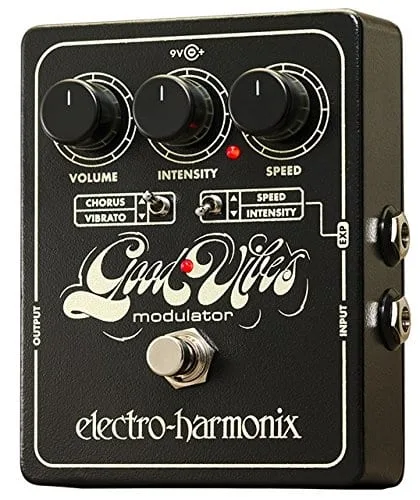


The Electro-Harmonix Good Vibes is a compact analog chorus/vibrato pedal that recreates the classic 1960s Uni-Vibe sound in a modern, pedalboard-friendly box. Like the original Uni-Vibe, it uses photocells to create its chorus and vibrato, which Electro-Harmonix says produces "a warm, undulating, liquid groove for a sound and response that's true to the classic design"1.
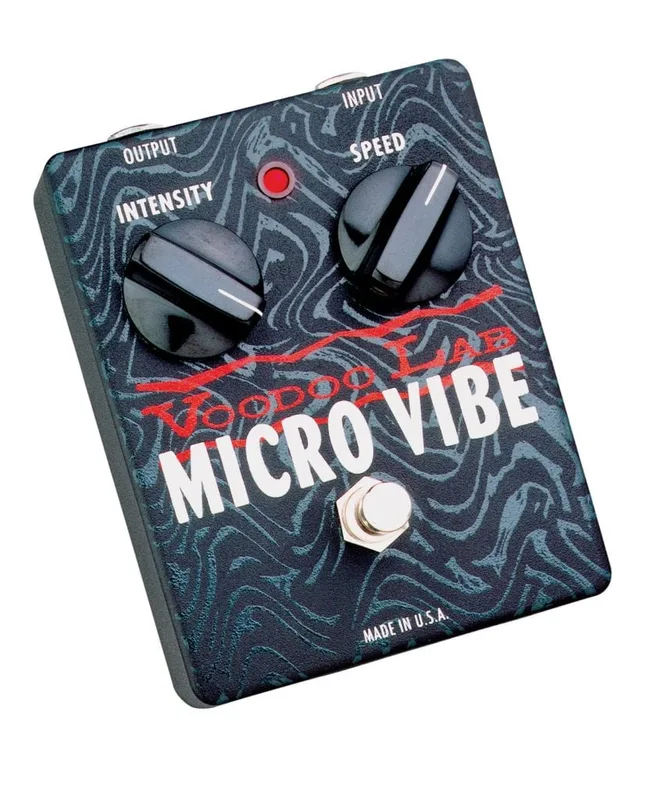
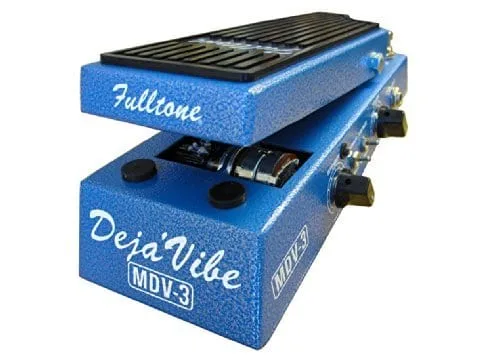
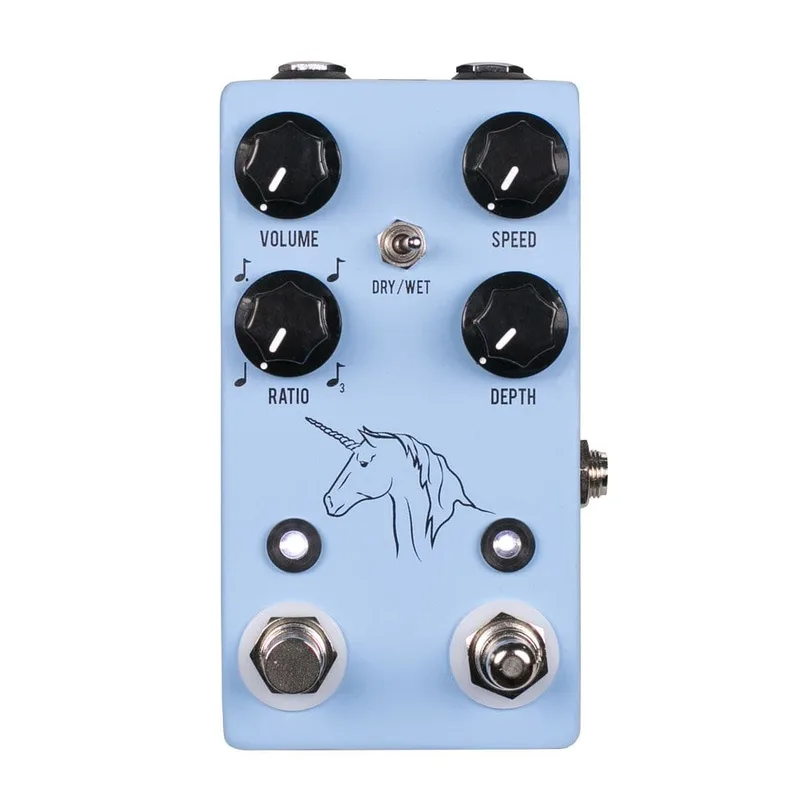
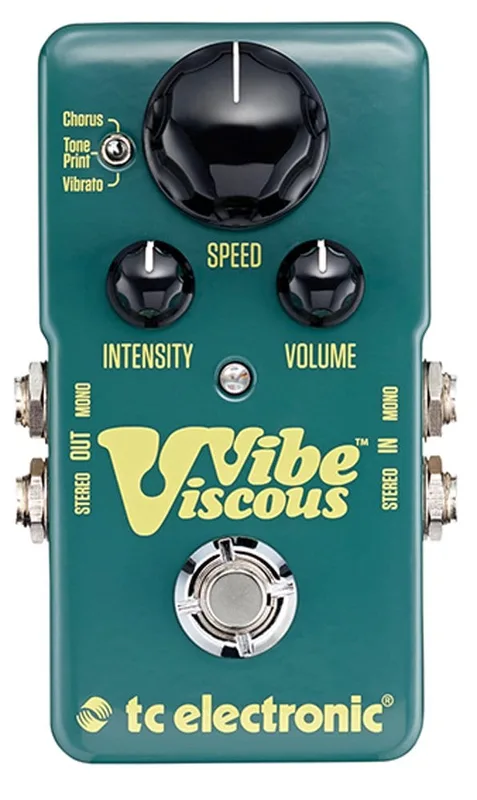
Released in 2015, the Good Vibes holds a particular place in the EHX range. As Premier Guitar's reviewer put it, "the Good Vibes is the company's first accessibly-priced, photocell-driven Uni-Vibe-style modulation pedal"21. It sits among a crowded field of Uni-Vibe-inspired pedals, from the Voodoo Lab Micro Vibe and Fulltone MDV3 to the JHS Pedals Unicorn V2 and TC Electronic Viscous Vibe, but it does so at a lower price than most photocell designs.
A photocell Uni-Vibe in a compact pedal
The Good Vibes is built around the same idea as the 1960s Univox Uni-Vibe: a photocell-based phase-shift topology, a four-stage optical vibrato circuit in which light-dependent cells shape the modulated signal15. That original circuit design is what gives Uni-Vibe-style pedals their characteristic swirl, and modern versions of it, the Good Vibes included, come in compact, pedalboard-friendly enclosures rather than the large original housing6.
A Chorus/Vibrato switch selects between the two modes. Electro-Harmonix describes the difference plainly: "When set to Vibrato, the Good Vibes delivers pure pitch-modulation. When set to Chorus, the Good Vibes delivers a lush, vibe-like chorus"1. The vibrato mode is the pure pitch-bend sound players associate with the Uni-Vibe's vibrato setting, while the chorus mode blends the modulated signal with the dry signal for the thicker, phased chorus texture of the Uni-Vibe's chorus setting.
The pedal also carries boosted power rails, which the maker says give extended headroom and definition1, and it sits in a rugged, compact die-cast chassis1. When the effect is engaged, the LED lights, and the footswitch toggles between effect and bypass mode1.
At launch, Delicious Audio's Brandon Stoner offered a measured verdict on the pedal as a whole7:
"If you're looking for a fresh take on a classic effect, this pedal might fit the bill"
The controls
The Good Vibes keeps its control set small, with three knobs, two switches and an expression jack1.
| Control | What it does |
|---|---|
| Volume knob | Controls the output volume1 |
| Speed knob | Controls the speed of modulation1 |
| Intensity knob | Sets the depth of modulation sweep1 |
| Chorus/Vibrato switch | Selects chorus mode or vibrato mode1 |
| Exp Speed-Intensity switch | Assigns the expression source to speed or depth1 |
| Footswitch | Toggles between effect and bypass mode; LED lights when engaged1 |
The expression jack is the most flexible part of the pedal. This 1/4" jack accepts a TRS expression pedal connector or a Tip-Sleeve 0-5V control voltage input1. The Exp Speed-Intensity switch then decides what that source controls: "When this switch is set to SPEED, the connected expression source controls the speed of modulation. When this switch is set to INTENSITY, the connected expression source controls the modulation depth"1.
That makes the pedal workable two ways. A player who wants to swell the speed with their foot for a Leslie-style ramp can set the switch to SPEED, while a player who wants to keep the rate fixed and pull the depth in and out for a subtler pulse can set it to INTENSITY. Premier Guitar's reviewer noted that "the switch for assigning it to speed or intensity is right there with the volume, intensity, speed, and chorus/vibrato controls"2.
Power and connections
The Good Vibes runs from the included 9.6VDC-200mA power adapter1, and Guitar Interactive Magazine reported at launch that it is "powered by a standard center negative 9V power supply, which is included"4. MusicRadar's launch coverage also noted it can run on a nine-volt battery3. Current draw is 45mA1.
Audio connections are simple: one 1/4" input jack, one 1/4" output jack, and the 1/4" expression jack on the control side1.
The battery option comes from the pedal's 2015 launch coverage3. If you run it from a pedalboard power supply, it wants a standard center negative 9V output4, the same polarity as most modern pedals, so it daisy-chains with them without a polarity adapter.
Where it came from and what it costs
The Good Vibes is a selectable chorus or vibrato pedal that Electro-Harmonix says delivers "classic 1960's tone and vibe"1. The current EHX product page lists it at $165.10 USD1, Premier Guitar gives a street price of $137.402, and the UK RRP at launch was £1153.
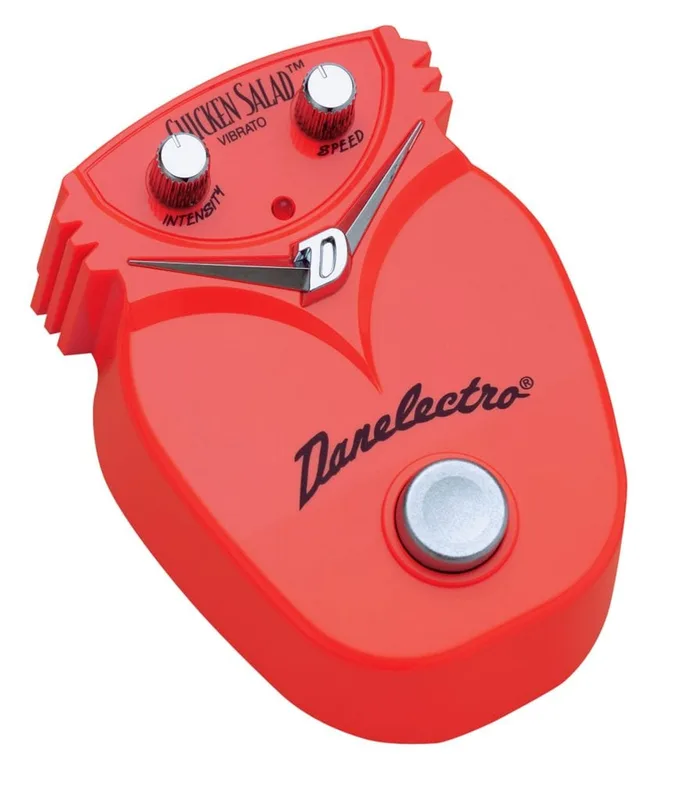
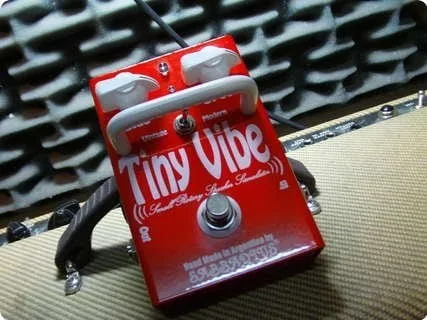
The pedal arrived into a market already full of Uni-Vibe interpretations, including compact options like the Danelectro DJ-15 Chicken Salad Vibrato Mini and the Sabbadius Tiny Vibe, and larger photocell designs like the Fulltone Custom Shop Mini DejaVibe Mk II and the DryBell Vibe Machine V-2. Within EHX's own range, it was later joined by the Eddy, a bucket-brigade chorus/vibrato pedal announced in December 2020 at a $99 street price, which takes a different circuit approach to similar territory.
For a player weighing the Good Vibes against other vibrato pedals, the essentials are these: it is a true bypass, photocell-based analog chorus/vibrato with an expression input that can be assigned to either speed or depth, in a compact die-cast chassis, at a price below most other photocell vibe designs12.
Videos
EHX
David Curtis
Reverb
Questions
Does the Good Vibes take a 9V battery?
Yes. When the pedal launched in 2015, MusicRadar reported it was powered by a nine-volt battery or the included power supply. Electro-Harmonix ships it with a 9.6VDC-200mA adapter, and it also runs from a standard center negative 9V supply.
Is the Electro-Harmonix Good Vibes true bypass?
Yes. Electro-Harmonix lists the Good Vibes as true bypass, so with the effect disengaged the signal passes through without the circuit coloring it. The footswitch toggles between effect and bypass mode, and an LED lights when the effect is on.
Can an expression pedal control the Good Vibes speed?
Yes. The expression jack accepts a TRS expression pedal or a Tip-Sleeve 0-5V control voltage input. An Exp Speed-Intensity switch decides what the expression source controls: set it to SPEED for modulation speed, or to INTENSITY for modulation depth.
Is the Good Vibes analog or digital?
Electro-Harmonix describes it as an Analog Modulator, listed as analog with digital control. Like the original Uni-Vibe, it uses photocells to create its chorus and vibrato, and it carries boosted power rails for extended headroom and definition.
Sources (7)
- Good Vibes, Electro-Harmonix
- Quick Hit: Electro-Harmonix Good Vibes Review, Premier Guitar, 2015-07-05
- Electro-Harmonix launches Good Vibes modulation pedal, MusicRadar, 2015-02-25
- EHX Introduces Good Vibes Vintage-Style Chorus/Vibrato Pedal, Guitar Interactive Magazine, 2015-02-25
- Deluge Optical Vibe / EQD The Depths, Aion FX, 2026-07-03
- The Swirl Start of the Univibe vintage guitar pedal, tru-fi.com
- New Pedals: EHX Good Vibes, Delicious Audio, 2015-07-31