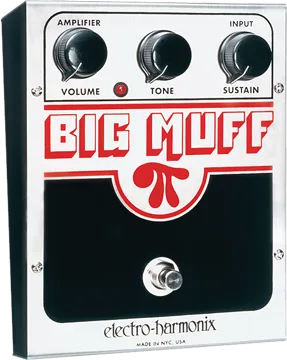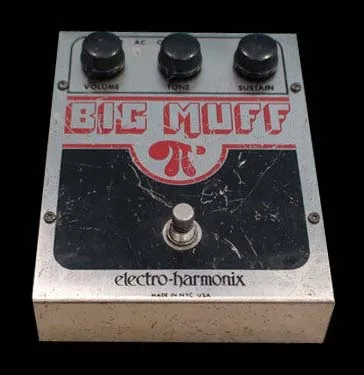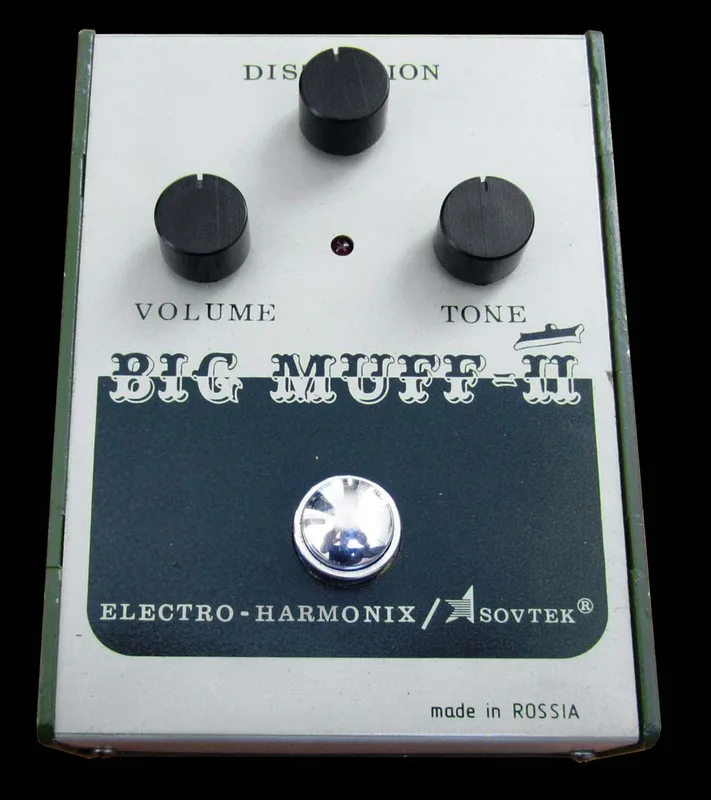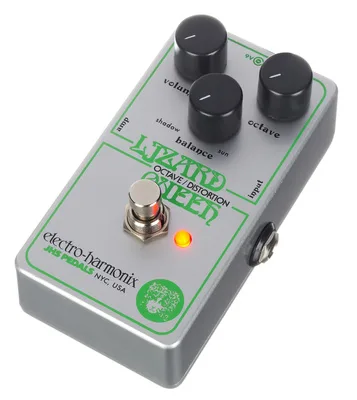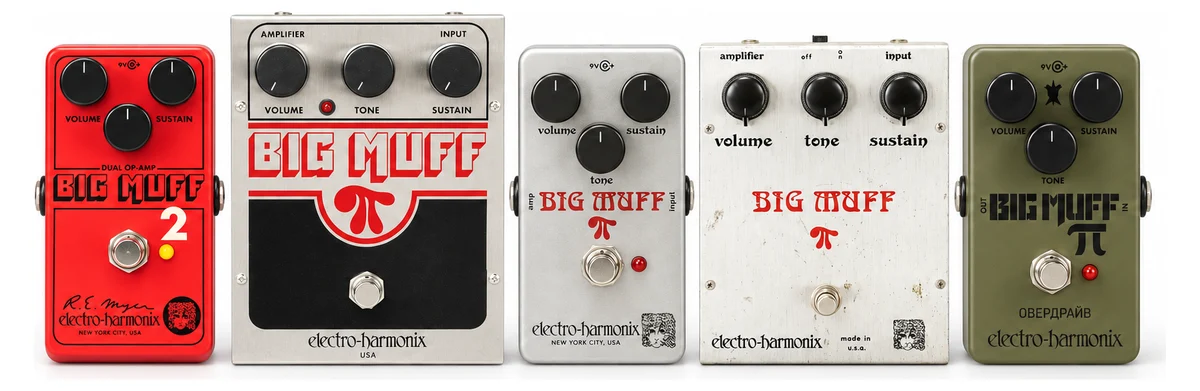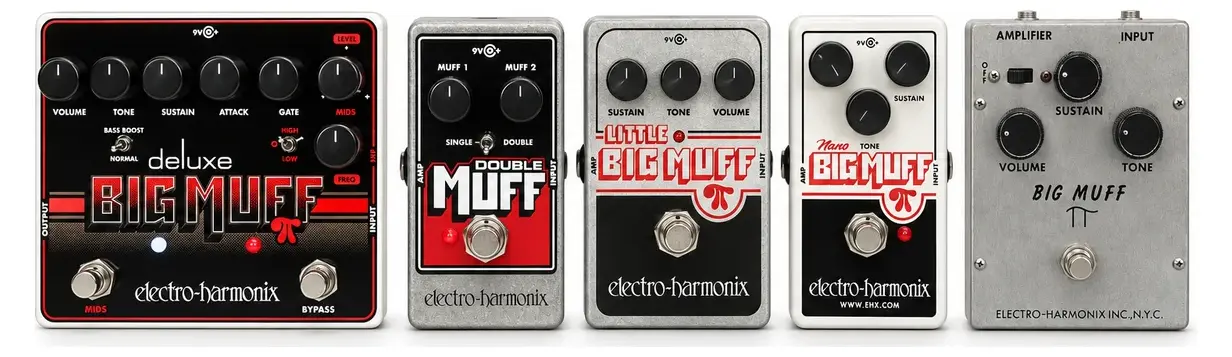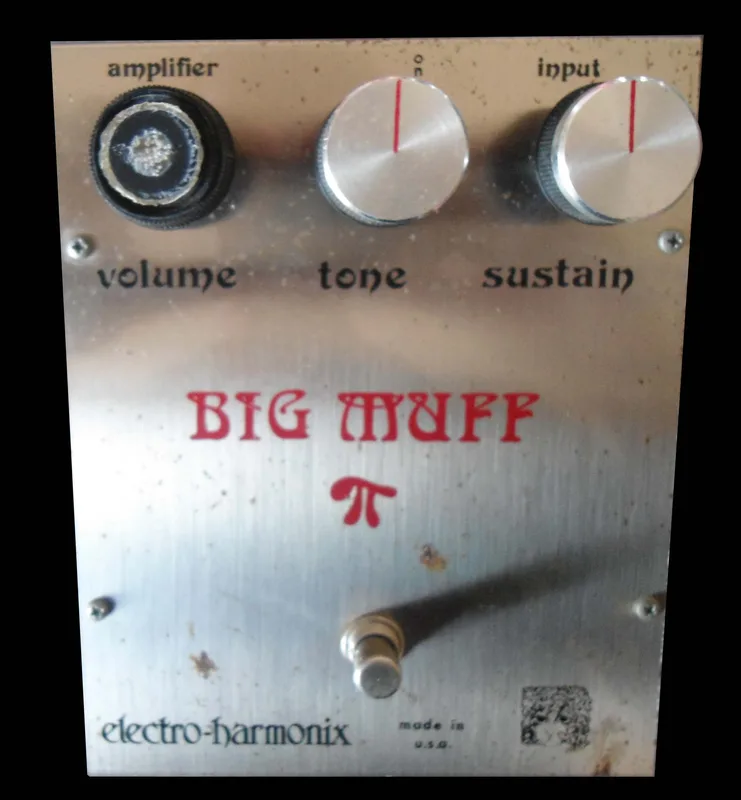


The Ram's Head Big Muff Pi is a fuzz / distortion / sustainer pedal made by Electro-Harmonix, sold today as a nano-sized reissue of the 1973 Violet Ram's Head Big Muff1. The original Ram's Head was the second version of the Big Muff Pi, produced from 1973 to around 1977, and it became one of the most sought-after vintage fuzzes, associated above all with David Gilmour of Pink Floyd and J Mascis of Dinosaur Jr234.
Electro-Harmonix describes the current pedal as a faithful reproduction of the highly coveted 1973 Violet Ram's Head Big Muff Pi, "heard on countless classic recordings and famous guitar solos"1. It is an analog, true bypass pedal in a compact die-cast chassis, with the vintage look and graphics carried over15.
What the Ram's Head Big Muff is
The name comes from the artwork. Around 1973 Electro-Harmonix put an elfin face graphic with ivy-like hair in the lower right corner of the Version 2 Big Muff's front panel, and that face led to the nickname "Ram's Head"3. The V2 was essentially the V1 circuit in a larger enclosure, with component values that changed from one production run to the next, so the sound varied between pedals3. It was the number one selling pedal for Electro-Harmonix in the 1970s until the Small Stone phaser knocked it to number two3.
The V2 shipped with three knobs in a line across the top, a Carling SPDT footswitch, no LED, no battery door and no true bypass, and ran on a 9V battery drawing approximately 3 mA37. Its list price was originally $39.95, rising to $49.95 around 19743.
Circuit variants: the '47, the '73, the Violet and the White Can
There were approximately 20 circuit variants across the V2's production run3. Kit Rae's history identifies several by nickname:
| Variant | Period | What distinguishes it |
|---|---|---|
| "47" | around 1973 | Nicknamed for the .47µF, .047µF and 470pF caps and 470k resistors used3 |
| "Violet" | 1973 | Probably the most common V2 circuit; smoother, more articulate, less mid-scoop, less gain3 |
| "White Can" | circa 1974 | Large white axial poly film caps, NPN FS36999 transistors, 680pF filter caps3 |
| Later white box cap variants | circa 1975-76 | Followed the White Can in frequency3 |
The Violet name refers to the graphics rather than one fixed circuit. During the early to mid '70s Electro-Harmonix changed the square Ram's Head logo to a round shape and switched to a one-color layout, printed in blue, black, red and violet inks, and collectors call the violet-inked 1973-74 pedals the "Violet Editions," with multiple circuit versions among them and no single exact "Violet" sound89. The paint color does not necessarily determine the circuit inside10. Stomp Under Foot's history of the 1973 pedals traces them as V1 through V16, with V2 known as the "Blue" version, V3 as the popular "Violet," V4 as the "Black," and V12, nicknamed "The 47," as the Gilmour-associated circuit10.
Originals now command collector prices. Coda Effects noted in 2015 that violet-era Ram's Heads sold around 1000 dollars on eBay2, and in 2019 Guitar.com reported the average Reverb.com listing for a '73 Ram's Head hovering around $600 to $70011.
Controls and circuit
The reissue carries the standard three controls found on all classic Big Muffs12:
| Control | What it does |
|---|---|
| Volume | Sets the output level1 |
| Sustain | Adjusts the amount of sustain and distortion1 |
| Tone | Provides a range of sounds from high treble to deep bass1 |
A footswitch and status LED toggle between effect and bypass modes; the effect is active when the LED is lit1.
Under the hood, the Big Muff is a four-transistor circuit built in five stages: an input/gain stage, two clipping stages, a tone stage and an output stage13. The input stage is a transistor amplifier that boosts and buffers the signal and holds the gain control1415. Each clipping stage uses two diodes placed back-to-back in the feedback loop, creating soft clipping15, and Coda Effects notes that most of the saturation comes from the diodes, making the Big Muff technically a distortion whose two cascaded stages produce its heavily compressed, fuzz-like sound2. The tone stack splits the signal into a high-pass and a low-pass filter and blends them back together with the tone potentiometer1316, which is what scoops the mids, the characteristic Big Muff trait and, as Coda Effects puts it, "the enemy of guitarist playing in a band"1614. The output stage then boosts the signal back up after the tone filters cut it down1415.
The reissue uses four BC547 transistors on a through-hole printed circuit board1217, with through-hole transistors, capacitors and diodes, a mix of ceramic and poly capacitors as on the vintage unit, and small surface-mount resistors12. Kit Rae credits Gino Maisano as the reissue engineer, working from the Violet version of the original Bob Myer circuit12.
The 2019 Ram's Head Big Muff π reissue
Electro-Harmonix released the reissue in October 2019 as part of its nano range of Big Muff reissues, which also includes the Triangle Muff, the Op-Amp Big Muff and the Green Russian12618. It came in a compact enclosure rather than the original's large casing11, with true bypass, an indicator LED and support for a 9V power supply added as conveniences the original never had11. It launched with a U.S. street price of $99.005.
Kit Rae, who compared it against an original Violet, judged the reissue "95% the same, or nearly dead on"12.
J Mascis Ram's Head Big Muff π
In August 2022 Electro-Harmonix released a J Mascis signature Ram's Head Big Muff Pi, a limited edition in a white and violet finish with special-edition artist graphics1219. It is based on the 1973 V2 Violet Ram's Head, the version J Mascis has used as his sonic center for decades19. Electro-Harmonix says the fuzz is "sonically more articulate than other Big Muffs with excellent string separation and dynamics, which make it one of the most versatile Big Muffs"19.
"That's my sound. The Muff is always on. All distorted sounds begin with the Muff. That's what I grew up playing, so it's kind of amazing to have my own signature one."
The signature edition shares the standard reissue's nano chassis, dimensions, 2mA current draw and true bypass19, and was priced at $131.5019. Kit Rae's examination found its circuit identical to the violet circuit in the standard reissue, not a replica of J Mascis's own favorite Ram's Head12, and Guitar.com calls it "only a cosmetic change over the regular reissue"15. That matters because Mascis's actual pedal, a mid-1970s Ram's Head he has used since 1987, sounds different from other Ram's Heads, which Tim of Tym Guitars attributed to unusual component values rather than a wiring mistake21.
Double Anniversary Gold Ram's Head Big Muff π
In January 2024 Electro-Harmonix marked 55 years of the Big Muff Pi and 50 years of the Ram's Head circuit with a limited-edition Double Anniversary Big Muff Pi122223. It used the same folded metal chassis as the V9 NYC reissue in a gold finish with gold silkscreen, gold-plated footswitch and screws, a violet LED and gold-painted knobs12, and shipped in a wood box with gold printing, a violet velvet bag, a certificate of authenticity, a holographic sticker and a laser-etched serial number1222.
Its circuit is nearly identical to the 2019 reissue but built on a full-size blue PCB with through-hole carbon film resistors instead of surface-mount parts12. Limited to 555 pedals (600 were actually made), the $250 edition sold out immediately and is now a rare collectible1224.
Power and connections
The reissue runs on the included 9V battery or an optional 9.6VDC-200mA power adapter, which is not included, and draws 2mA1. Kit Rae lists the power supply as 9.6 Volts DC, or other AC adapters capable of delivering at least 30mA12. Connections are a standard input jack and a standard amp output jack16. The Double Anniversary edition draws 12mA and presents 117kΩ input impedance and 25kΩ output impedance at its quarter-inch jacks22.
The original 1970s V2 is a different story: it ran on a 9V battery only, with no AC adapter jack, and some V2 Big Muffs are positive ground (PNP), so they cannot be daisy-chained with standard negative-tip pedals3.
Price
The current Ram's Head Big Muff Pi lists at $114.301, and the J Mascis edition at $131.5019. At launch in 2019 the reissue carried a $99.00 U.S. street price5, and Premier Guitar listed it at $99 street17. Guitar World's reviewer called it "very reasonably priced"18. The Double Anniversary edition was $250.00 and is sold out2422.
What reviewers said
Guitar World's Trevor Curwen found the reissue "nails the classic Ram's Head tone" and that "it sounds every bit as good as it did back in 1973," citing its compact size as a reason to buy18. He described the Sustain knob as starting at medium-gain overdrive and transitioning into saturated fuzzy sustain that blooms into harmonic feedback, with the tone knob rolled back for smooth liquid sustain or forward for a crispier, more cutting top end18. MusicRadar's review team found it "gets the Ram's Head tone bang-on"6, and quoted Premier Guitar's finding that at noon on the gain control it yields "some of the smoothest high/mid-gain fuzz you'll hear from the Muff family"6. Premier Guitar's own review praised its "sweet, smooth, mid-forward, and super-rich Big Muff tones"17.
On the J Mascis edition, Guitar World found "more note separation and attack than on our standard Big Muff Pi reissue" and concluded that "Dinosaur Jr. fans are going to love this. For everyone else, it's a fuzz pedal that is more usable than some of the more wooly examples"25. Guitar.com's Richard Purvis was more reserved, calling it "Undeniably a fantastic Muff… but just be aware you're paying extra for the paint job and nothing more"26.
Players
David Gilmour's 1974 Ram's Head was mounted on his Cornish pedal board and used on Pink Floyd tours from the late 1970s onward, including the 1977 In the Flesh tour273. Kit Rae credits it with the Comfortably Numb solos and the fuzz tones across Animals, The Wall and The Final Cut12. Gilmour often blended the Big Muff with an overdrive to smooth and EQ the tone, using a Boss GE-7 to fine tune it27, and Coda Effects notes he ran it with a boost for nearly infinite sustain on solos2. Guitar World calls the Ram's Head "the model most associated with David Gilmour"18.
Other documented users include Ernie Isley of the Isley Brothers, who used a Ram's Head throughout much of the 1970s312, and J Mascis, who uses the Ram's Head as the basis for all of his drive sounds, sometimes solo and often stacked with other gain providers25.
Videos
Premier Guitar
EHX
gilmourish
Sources (27)
- Ram's Head Big Muff Pi, Electro-Harmonix
- Coda Effects, Coda Effects, 2015-05
- The Big Muff History of All Versions Part 1, Kit Rae (www.kitrae.net), 2023-02
- Electro Harmonix reissues Ram’s Head Big Muff Pi '73, gearnews.com, 2019-10-16
- Electro-Harmonix Announces the Re-Release of Their 1973 V2 Ram’s Head Big Muff Pi, Bass Gear Magazine, 2019-10-15
- Electro-Harmonix Ram's Head Big Muff Pi review, MusicRadar, 2020-03-02
- Big Muff Versions_Quick Identifier, Kit Rae (kitrae.net), 2026
- Blue Violet Caprid Small Foot, Wren and Cuff
- Violet World, Wren and Cuff
- 1973 Ram's Head, Stomp Under Foot, 2026-07-18
- EHX Reissue the sought-after Ram’s Head Big Muff Pi, Guitar.com, 2019-10-15
- The Big Muff History of All Versions Part 1, Kit Rae (kitrae.net), 2024-04
- BIG MUFF TRANSISTORS AND OTHER COMPONENTS, Kit Rae (kitrae.net), 2012-07
- Coda Effects, Coda Effects, 2026
- A guide to the best Big Muff-style pedals, from classic reissues to boutique oddities, Guitar.com, 2025-07-30
- Coda Effects, Coda Effects, 2026
- Electro-Harmonix Ram’s Head Big Muff Review, Premier Guitar, 2020-02-03
- Electro-Harmonix Ram's Head Big Muff Pi review, Guitar World, 2020-05-25
- J Mascis Ram's Head Big Muff Pi, Electro-Harmonix
- Electro-Harmonix J Mascis Ram's Head Big Muff Pi Fuzz Distortion Sustainer, Pedal of the Day, 2024-07-07
- J Mascis Big Muffs, Kit Rae (The Big Muff Page, kitrae.net), 2011-08-02
- Double Anniversary Big Muff Pi, Electro-Harmonix
- NAMM 2024: “For all of the original mojo and magic craved by the true believers”: EHX's Double Anniversary Big Muff Pi delivers its first 'big box' Ramshead circuit since the 1970s, Guitar World, 2024-01-24
- Double Anniversary Big Muff Pi, Electro-Harmonix
- Electro-Harmonix J Mascis Ram's Head Big Muff review, Guitar World, 2022-12-02
- Electro-Harmonix J Mascis Ram’s Head Big Muff Pi review, Guitar.com, 2022-10-19
- The Big Muffs of David Gilmour of Pink Floyd, kitrae.net, 2024-07
 David Gilmour
 J Mascis