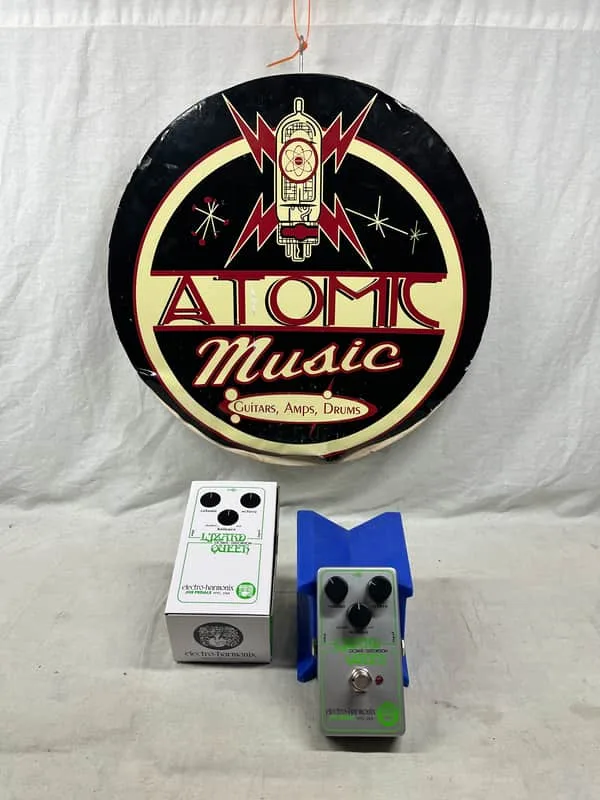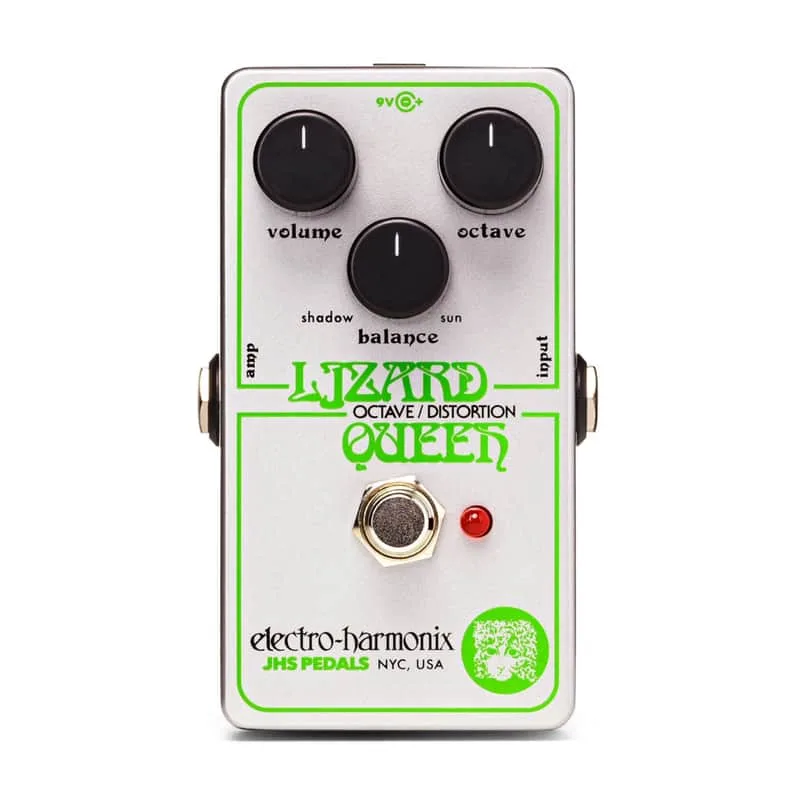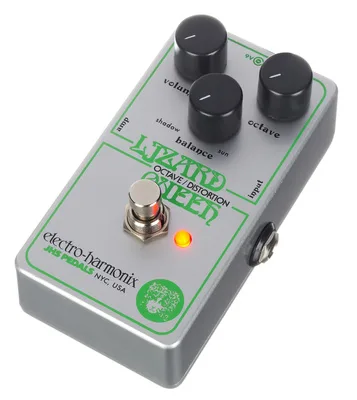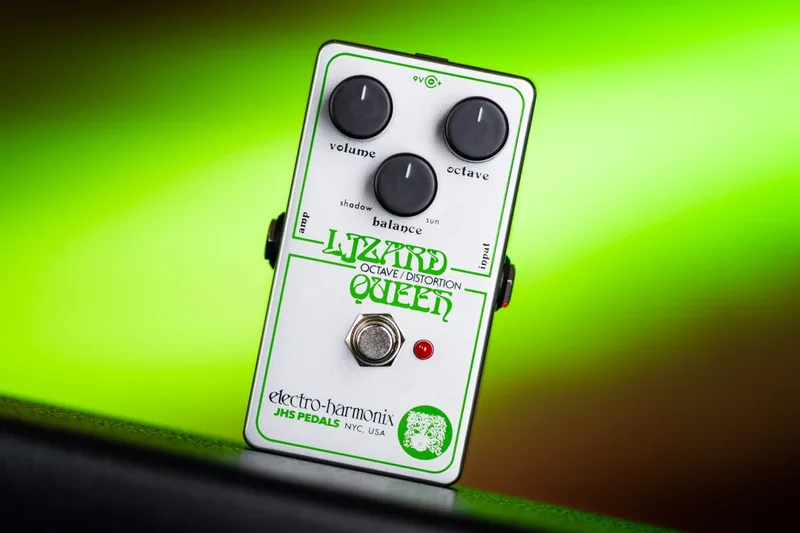


The Lizard Queen is an analog octave-up fuzz pedal, a collaboration between Electro-Harmonix and JHS Pedals, released in 20231. It is a fixed gain fuzz, meaning there is no gain or fuzz knob: the drive character is set by the circuit itself, and the player shapes it with a Balance control that sweeps between two voices called Shadow and Sun2. The pedal is housed in EHX's Nano-sized chassis and carries vintage EHX-inspired graphics by Daniel Danger2.
Electro-Harmonix discontinued the Lizard Queen in 20251.
An octave-up fuzz with a Shadow-to-Sun balance
The Lizard Queen is a silicon-transistor-based octave-up fuzz7. The fuzz side is fixed gain, and the octave-up signal sits on top of it at a level the player sets with the Octave knob, from zero to what the maker's description calls "full octave chaos"2. The manual describes the result as "a gnarly sounding fuzz with a decent octave up"9.
The distinctive control is Balance. Electro-Harmonix describes the two ends of its sweep in plain terms: "SHADOW is a classic dark, yet smooth, sustaining fuzz. SUN is a brighter, raspy biting fuzz"1. The effect of the balance point is especially apparent with the octave turned up2. Premier Guitar's reviewer described the control as a filter, with shadow (counter-clockwise) rolling off highs for a darker tone and sun (clockwise) adding treble7.
GuitarPlayer's Art Thompson found the two positions behave quite differently:
"The distortion sounds thickest and heaviest with the balance control turned counter-clockwise to the Shadow position. It's more biting and gated sounding" at the Sun position.10
He also found an unusual trick at the extremes: turning the octave knob all the way up with the balance set to Shadow produced gated, modulating swells that sound like a backward effect10. With the guitar volume up and the balance toward Sun, he heard tones that become smooth and vocally in a "woman tone" sort of way, descending into spittiness with a halo of octave chime when turned down10.
The controls: Volume, Octave and Balance
Three knobs and a bypass footswitch make up the whole interface108. The footswitch engages or bypasses the effect, and a status LED lights when the effect is on and is off in bypass1.
| Control | What it does |
|---|---|
| Volume | Sets the overall output volume level2 |
| Octave | Adjusts the level of the octave-up signal, from zero to full octave chaos2 |
| Balance | Sets the tone balance between the smoother Shadow setting and the raspy, biting Sun setting2 |
The Balance knob resists a simple label. Thompson characterized it as having a dual personality: "not a tone control, but it affects the tone; and not a gain control, but it affects the gain"10.
Power and battery
The Lizard Queen requires 5mA at 9VDC on a center-negative plug, and the power jack should not be fed more than 12VDC1. A 9V battery is included, with a 9V adapter optional1. Premier Guitar's reviewer noted it runs on a 9V DC barrel-type supply or, in a suitable salute to the past, a battery7, and it accepts a standard EHX Volt power supply11. One caveat from a review unit: guitar.com's Richard Purvis found that although the Lizard Queen ships with a battery installed, his sample would only run on mains power3.
History: Josh Scott's JHS Show circuit and the big box version
The circuit comes from Josh Scott of JHS Pedals, and was first featured on the JHS Show in 2022, in the "Making a Vintage Electro-Harmonix Pedal!" episode where Scott dreamed up, DIY-ed and geeked out over the pedal912. Gearnews reported it was originally designed in secret as a loving tribute to the historic sound and design of Electro-Harmonix effects of the 1970s and 1980s13. Premier Guitar described the concept as imagining "the vintage EHX Octave Fuzz that never was," with familiar graphics and controls and period-correct components11.
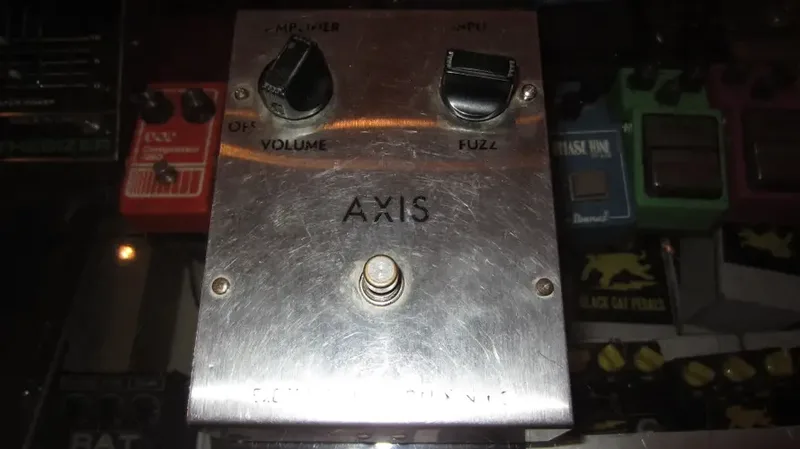
The pedal exists in two versions. The first was a large-form JHS prototype that was never commercialized as a standard product, styled like a vintage EHX stompbox14. It reached players as a limited-edition big box run with period-correct sheet-metal housings, silk-screened graphics, N.O.S. transistors and old-school circuit-board construction, complete with hand-drawn traces rendered by Daniel Danger himself10. That limited edition has sold out, so the nano series pedal from EHX is the version players found in shops8.
The nano Lizard Queen carries the same graphics and the same volume, octave and balance controls, but adds modern conveniences the JHS version lacked, including a jack for external power and an on/off LED10. Griffin Effects notes the Big Box and Nano versions have slight circuit differences15, while guitar.com reported buyers were assured the nano is sonically identical, with the larger unit's NOS components replaced by modern equivalents with matched values3.
The design is credited to Josh Scott with graphic designer Daniel Danger, as a homage to Electro-Harmonix in what the two consider the company's design heyday of the 1970s111.
What circuits is the Lizard Queen based on?
Under the homage, the electronics are documented DIY territory. The manual states the Lizard Queen "is well documented as a mashup of two popular DIY circuits. Namely, the Bazz Fuss and Tim Escobedo's Push Me Pull You"9. Delicious Audio describes it more broadly as a unique transistor-based octave fuzz distortion circuit designed by Josh Scott, with a tone inspired by EHX's fuzz pedigree and a unique analog octave-up circuit14.
What reviewers said
Reviewers were positive. GuitarPlayer's Art Thompson called it "the most flexible octave-fuzz available" and "the bomb," giving it an Editors' Pick Award, and judged that "for the admission price of $99 you're essentially getting a boutique pedal for a pittance"10. MusicRadar likewise listed the Lizard Queen at $99 among must-have guitar effects pedals for 20236.
Premier Guitar's reviewer compared it against other octave fuzz pedals, including the Way Huge Purple Platypus, and concluded that the Queen reigned with its balance of fuzz and articulation7.
guitar.com's Richard Purvis found that with the balance control at minimum it produces "a thick and gurgly high-gain distortion," more present than the classic buzzy mid-scoop of a Muff3.
On the JHS Pedals YouTube channel, Josh Scott demonstrated the pedal for specific cover tones, including John Mayer's Crossroads cover, where he noted the gated fuzz used on the recording is very similar, and Jack White style tones16.
Videos
JHS Pedals
EHX
Nate Navarro
Questions
Is the Lizard Queen discontinued?
Yes. Electro-Harmonix lists the Lizard Queen as discontinued in 2025. It was released in 2023 as a collaboration with JHS Pedals, and the earlier limited-edition JHS big box version had already sold out before that. Secondhand units are the main way to find one now.
What circuits is the Lizard Queen based on?
The circuit is documented as a mashup of two popular DIY circuits: the Bazz Fuss and Tim Escobedo's Push Me Pull You. Josh Scott designed it as a tribute to the sound and design of Electro-Harmonix effects of the 1970s, imagining a vintage EHX octave fuzz that never existed.
Does the Lizard Queen come with a battery?
Yes, a 9V battery is included, with a 9V adapter optional. It draws 5mA at 9VDC on a center-negative plug, and the power jack should not be fed more than 12VDC. One reviewer's unit would only run on mains power despite the installed battery.
What is the difference between the JHS big box and the EHX nano Lizard Queen?
The big box was a limited-edition, JHS-built 1970s-style pedal with period-correct sheet-metal housing, silk-screened graphics and N.O.S. transistors, and it has sold out. The nano version from EHX carries the same graphics and controls in a Nano-sized chassis, with NOS parts replaced by modern equivalents of matched values, plus a power jack and an on/off LED.
Who designed the Lizard Queen artwork?
The pedal was originally designed by Josh Scott of JHS Pedals with graphic designer Daniel Danger, as a homage to Electro-Harmonix in what the two consider the company's design heyday of the 1970s. Danger also hand-drew the circuit-board traces on the big box version.
Sources (16)
- Lizard Queen, Electro-Harmonix, 2025
- Lizard Queen by Electro-Harmonix, RockBoard PedalPedia, 2026
- Electro-Harmonix Lizard Queen review: imaginary classic to real octave fuzz, guitar.com, 2023-07-10
- Electro-Harmonix / JHS Pedals Lizard Queen Octave Fuzz Distortion, Pedal of the Day, 2024-07-06
- Lot Lizard Octave Fuzz, PedalPCB.com
- The must-have new guitar effects pedals of 2023, MusicRadar, 2023-05-04
- EHX/JHS Lizard Queen Review, Premier Guitar, 2023-08-29
- Electro-Harmonix Lizard Queen review, Guitar World, 2023-07-28
- Freeloader.pdf, madbeanpedals.com, 2024-04-25
- EHX Lizard Queen Octave/Distortion Review, GuitarPlayer, 2023-06-19
- Electro-Harmonix Releases the Lizard Queen, Premier Guitar, 2023-04-12
- NAMM 2023: Josh Scott's DIY EHX Lizard Queen is out for real, Guitar.com, 2023-04-12
- JHS EHX Lizard Queen: The octave fuzz distortion inspired by the '70s, www.gearnews.com, 2023-04-11
- Electro-Harmonix Lizard Queen Octave Fuzz, Delicious Audio, 2025-07-22
- The Zarn PCB, Griffin Effects
- How To Get Any Blues Tone (EHX Holy Grail, Dunlop Band of Gypsies Fuzz Face, JHS Unicorn), JHS Pedals (YouTube), 2024-09-19