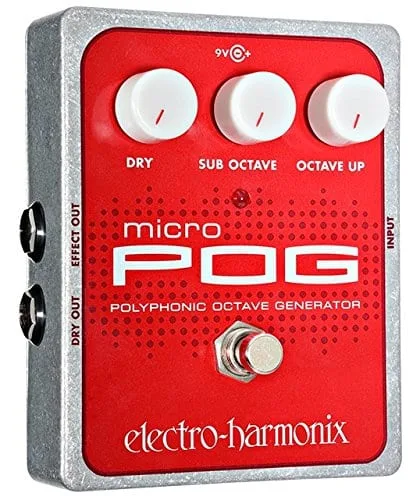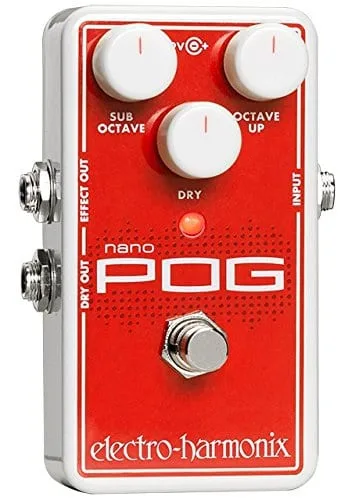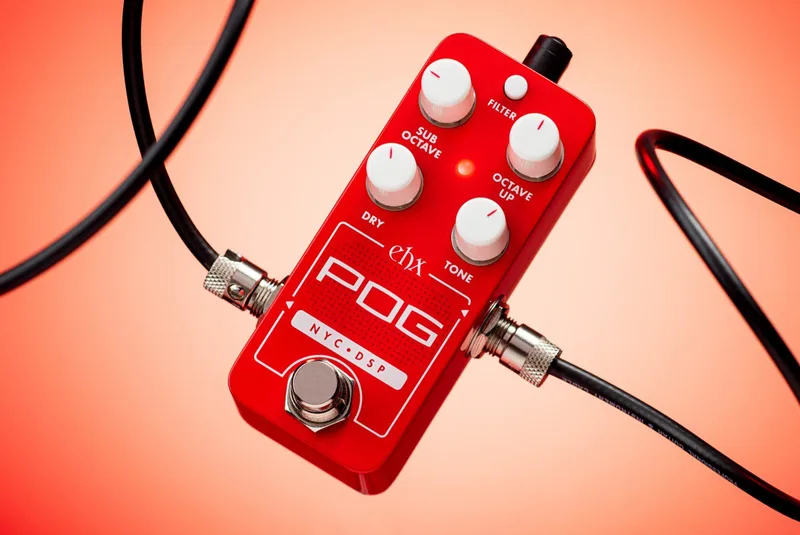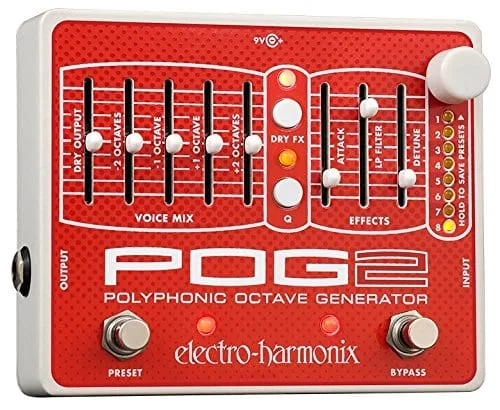



The Electro-Harmonix POG, short for Polyphonic Octave Generator, is a pedal that adds one octave up, two octaves up, and one octave down from your original guitar signal and blends all of them together1. What made it remarkable when it arrived was that it did this polyphonically: it tracks full chords, not just single notes, and Electro-Harmonix describes the tracking as glitch-free and fully polyphonic1. The company positions it as a tool that can make a guitar sound like a 12-string or even an 18-string, generate the sound of a drawbar organ, or make a guitar sound like a bass guitar1.
The original POG is discontinued, and has been since 20091, but it started a whole family of pedals that are still current, from the compact Micro POG and Nano POG to the Pico POG, the POG2 and the POG3.
What the POG does: polyphonic octaves up and down
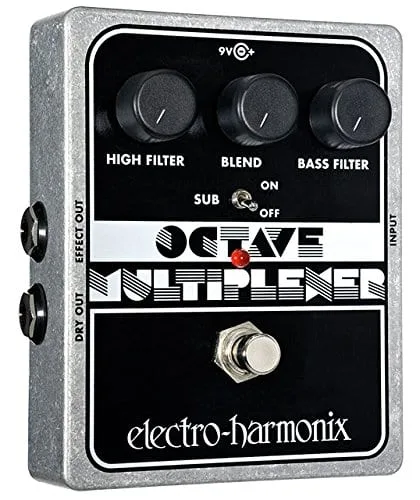
An octave pedal in the POG's sense is not a fuzz-style octave-up like the vintage Octave Multiplexer; it is a pitch shifter that generates new notes at fixed intervals and mixes them with your untouched dry signal. The POG gives you three generated voices, one octave up, two octaves up and one octave down, each blendable against the original1. Because the tracking is polyphonic, chords, arpeggios and single notes all work, which is what separates the POG from the monophonic octave pedals that came before it. MusicRadar's reviewers trace pitch-shifting pedals' evolution as "eventually culminating in polyphonic shifting, courtesy of Electro-Harmonix"6.
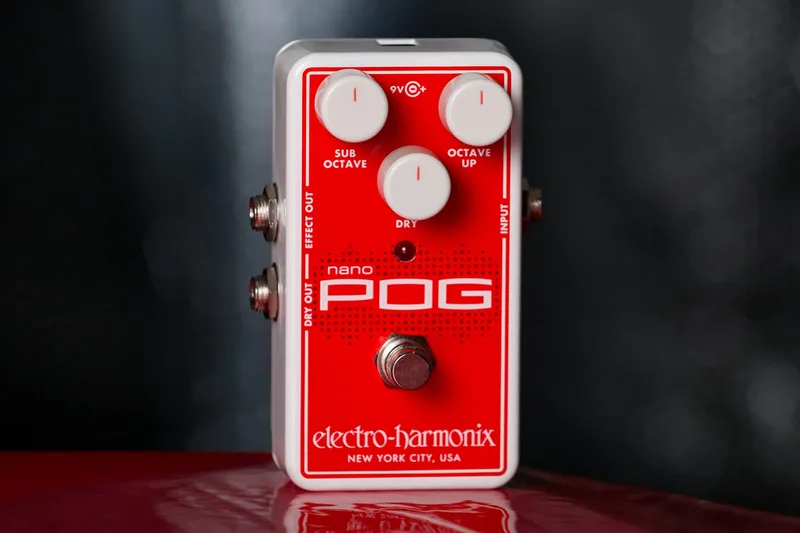
The practical results are the sounds Electro-Harmonix itself points to: a 12-string or 18-string impression, drawbar-organ-like textures, or a bass-guitar register under your normal playing1. The later family extends the same idea: the Nano POG mixes the dry signal with one octave above and one octave below7, and the POG3 adds a fifth-above voice to the octave stack8.
The sliders and modes
The original POG put its controls on what MusicRadar's review team called "an octet of fiddly sliders"5: eight slide faders for balancing the dry signal and the octave voices. Vintage Guitar's 2005 review also documented a low-pass filter switch with two modes, one of which affects only the octave generator and leaves the dry signal untouched4.
Later versions reshaped this control set:
| Version | Controls |
|---|---|
| Original POG | Eight sliders, low-pass filter switch45 |
| Micro POG | Three knobs: dry, octave below, octave above5 |
| POG2 | Sliders for -2, -1, +1 and +2 octaves plus dry, with Attack, LP Filter and Detune sliders9 |
| Pico POG | Sub Octave, Octave Up and Dry knobs plus a Tone knob and a Filter button10 |
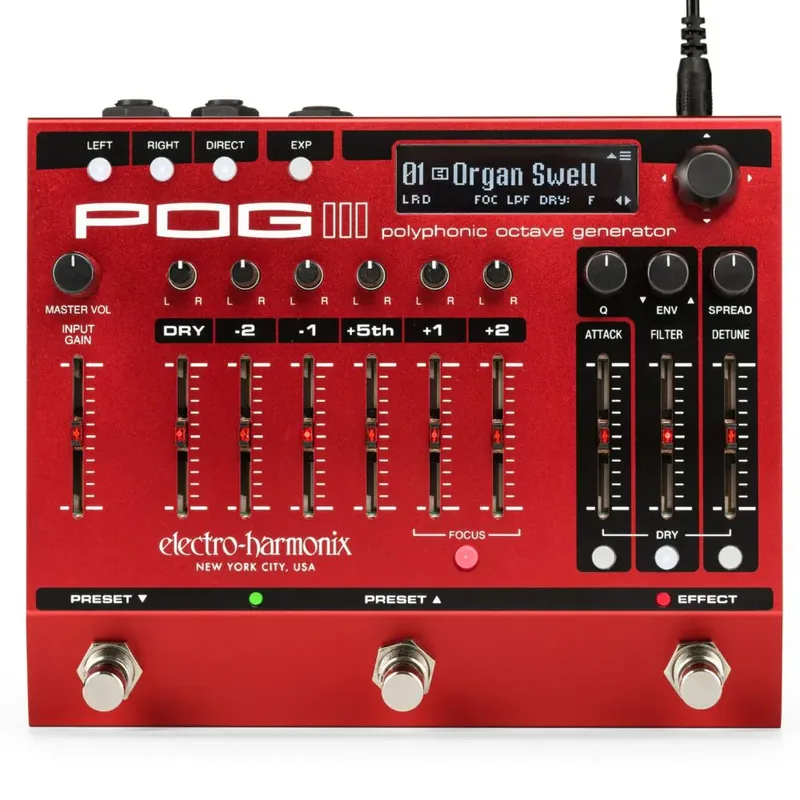
| POG3 | Ten sliders (Master Volume, Input Gain, Dry, -2, -1, +5th, +1, +2 and more), each with its own LED2 |
The POG2's Attack slider controls the fade-in speed of the generated voices, a feature Pedal of the Day's reviewer called "awesome"9, and its LP Filter slider works with a Q control9. The Pico POG's Filter button selects between three filter modes: Tone, Low Pass Filter and High Pass Filter11. On the POG3, each of the ten sliders has an LED that glows a brighter red the further it is engaged2.
Power and build: an 18-volt supply in a steel chassis
The original POG was a large pedal. Vintage Guitar measured its brushed steel chassis at 77/8" x 63/4" x 11/2" in 20054, and it shipped with an 18-volt DC power supply4 at a list price of $6904. MusicRadar later described it as "a giant metal cuboid"12.
The smaller versions moved away from both the size and the voltage. The Micro POG, released in 2007, came in a die-cast chassis with a 9.6VDC-200mA power adapter included13, and the Nano POG (2015) and Pico POG follow the same 9.6VDC-200mA pattern, with the Nano also able to run on a 9V battery714. The POG3 runs on 9V at 500mA28. One difference worth noting for pedalboard planning: the original POG is true bypass via a mechanical relay1, while the Micro, Nano, Pico and Soul POG all use buffered bypass13714.
History and versions: from POG to POG2, POG3 and the Micro, Nano and Pico
MusicRadar dates the POG line's launch to 20052, while a Guitar.com review published in November 2024 describes the original POG as launched "a full 20 years" earlier, which would be around 20043. What is not in dispute is the family tree:
- Original POG (2005 by MusicRadar's dating1254): the eight-slider steel-chassis original, discontinued 20091254.
- Micro POG (200713): the same tracking and polyphony in a simplified three-knob design13.
- POG2 (200915): added programmability15 plus Attack, LP Filter and Detune controls9.
- Nano POG (20157): the streamlined design in a smaller box, with an optional 9V battery7.
- Pico POG (202311): the smallest POG yet, with a Tone knob and Filter button the Micro and Nano lack1416.
- POG3 (20243): six voices including a fifth above, ten illuminated sliders, and features that take it toward multi-effects territory217.
MusicRadar's POG3 review sums up the line's path: "we've seen many iterations arrive since then, from the scaled-down Nano POG to the more involved POG 2, right through to" the POG328. Guitar Pedal X's review of the POG III describes it as a pedal that "expands polyphonic octave generation into Multi-FX territory"17. There is also the Soul POG, a 2016 multi-effect that combines overdrive with Nano POG-style octave generation1819.
What reviewers said
Guitar World's Classic Gear retrospective on the POG is direct about its significance20:
"With the POG, polyphonic pitch-shifting finally arrived for the average player, and its great tones and superior tracking have cemented its place in pedal history"20
Reviewers have also weighed in on the original POG itself: with it, polyphonic pitch-shifting finally arrived for the average player, and its great tones and superior tracking have cemented its place in pedal history20.
Reviews of the descendants have been positive too. Premier Guitar's Nano POG review found it "hits the sweet spot on range vs ease of use, fidelity vs funkiness, and price vs performance," calling it "compelling enough to excite experienced sound-sculptors, yet simple enough for beginners"21. MusicRadar's Nano POG verdict was "Compact. Excellent performer." with no reasons to avoid it12. For the Pico POG, MusicRadar's reviewer noted it offers more features than the Micro and Nano versions thanks to its Filter button and Tone knob14, and Guitar World observed that there is not a lot of price difference between the Pico, Micro and Nano versions16. The POG3 earned a four-out-of-five usability rating from MusicRadar, easy enough to get started but with plenty of depth2, while Guitar.com's review found it a powerful but niche and expensive evolution of the POG22.
Who uses it
Electro-Harmonix itself, in the POG3 announcement, named Joe Satriani and Jack White as players the original POG became a favorite of22. On Trey's Guitar Rig, an independent page documents Trey Anastasio's use of the POG29.
Videos
ProGuitarShopDemos
John Nathan Cordy
John Nathan Cordy
Questions
Is the original Electro-Harmonix POG true bypass?
Yes. Electro-Harmonix lists the original POG as true bypass using a mechanical relay. That sets it apart from most of the later family: the Micro POG, Nano POG, Pico POG and Soul POG all use buffered bypass instead.
Is the POG analog or digital?
The POG is digital. MusicRadar's reviewers note that the Micro POG, like the original POG and the HOG, is a digital pedal, and the later POG2, POG3, Nano and Pico versions carry digital circuits too. The digital design is what allows the glitch-free polyphonic tracking the line is known for.
What is the difference between the POG and the Micro POG?
The Micro POG, released in 2007, delivers the same tracking and polyphony in a simplified design. It drops the original's eight sliders for three knobs that balance the dry signal, the octave below and the octave above, moves to a compact die-cast chassis, and runs on a 9.6V adapter instead of the original's 18V supply.
Why was the original POG discontinued?
Electro-Harmonix lists the original POG as discontinued in 2009. That same year the company introduced the POG2, which kept the octave voices but added programmability, so the larger second-generation pedal took over the original's place in the range.
Sources (22)
- POG | DISCONTINUED 2009 | Polyphonic Octave Generator - Electro-Harmonix, Electro-Harmonix
- “A frankly ludicrous pedal that stakes itself as the ultimate octave funhouse”: Electro-Harmonix POG 3 review, MusicRadar, 2025-02-25
- Electro-Harmonix POG3 review, Guitar.com, 2024-11-25
- Electro-Harmonix Pog and English Muff’n pedals, Vintage Guitar magazine, 2007-09-05
- Electro-Harmonix Micro POG review, MusicRadar, 2008-01-28
- Electro-Harmonix Pitch Fork review, MusicRadar, 2015-04-11
- Nano POG, Electro-Harmonix (www.ehx.com)
- EHX POG3, Electro-Harmonix
- Electro-Harmonix POG2 Polyphonic Octave Generator, Pedal of the Day, 2015-09-25
- EHX Pico POG Polyphonic Octave Generator with 3 Filter Modes, gearnews.com, 2023-07-25
- Electro-Harmonix heralds a new era of mini pedals with its most versatile compact POG yet, Guitar World, 2023-07-25
- Electro-Harmonix Nano POG review, MusicRadar, 2015-12-04
- Micro POG, Electro-Harmonix
- Electro-Harmonix Pico Pog review, MusicRadar, 2024-01-02
- Electro-Harmonix announces POG2, MusicRadar, 2009-06-10
- Electro-Harmonix Pico POG review, Guitar World, 2024-02-13
- Guitar Pedal X, Guitar Pedal X, 2024-08-07
- Soul POG, Electro-Harmonix
- NAMM 2016: Electro-Harmonix unveils Soul POG multi-effects pedal, MusicRadar, 2016-01-14
- Classic gear: Electro-Harmonix POG, Guitar World, 2020-03-09
- Electro-Harmonix Nano POG Review, Premier Guitar, 2015-08-17
- Discover Electro-Harmonix Pog3 Polyphonic Octave Generator, Premier Guitar, 2024-08-05