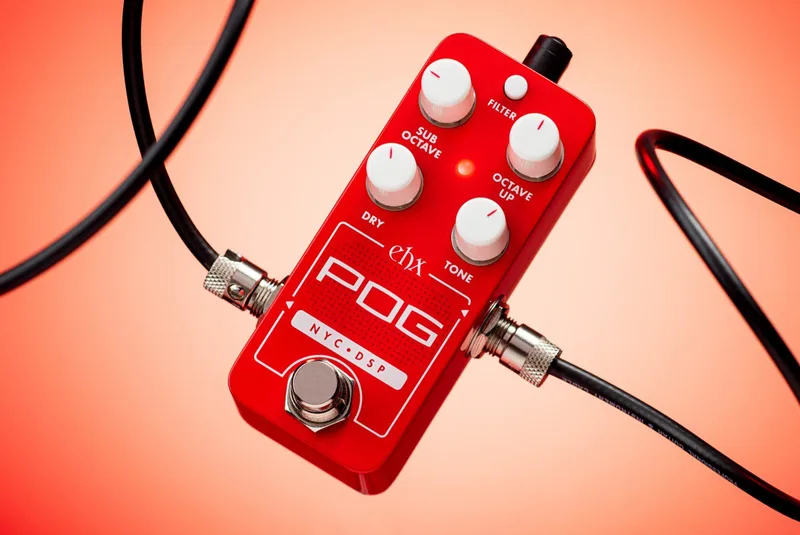


The Electro-Harmonix Pico POG is a digital polyphonic octave generator pedal from Electro-Harmonix, released in 2023 as the smallest member of the POG family. It tracks every note and chord you play and generates three voices at once: your dry signal, a sub octave one octave below, and an octave up, each blendable with its own knob. Electro-Harmonix describes it as its "smallest and most powerful compact Polyphonic Octave Generator yet"1.
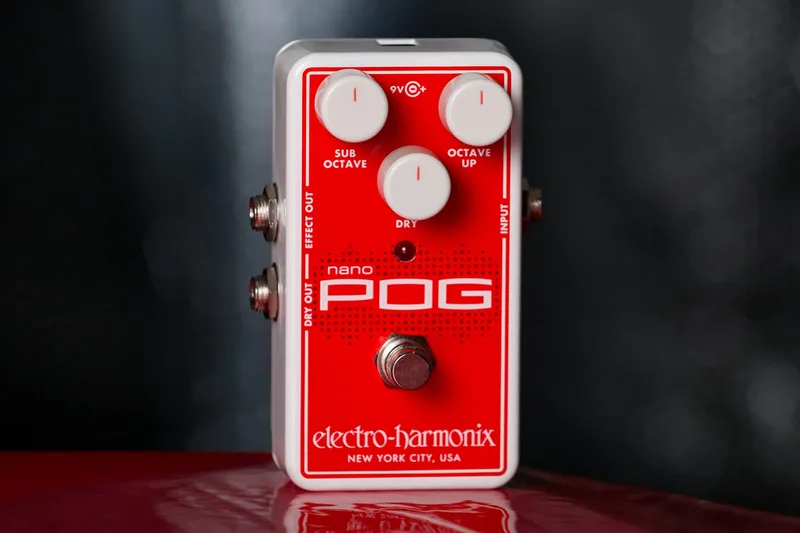
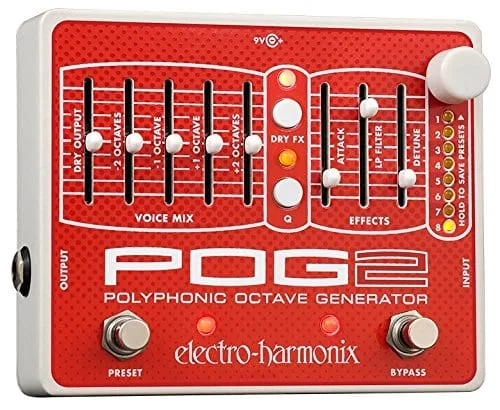
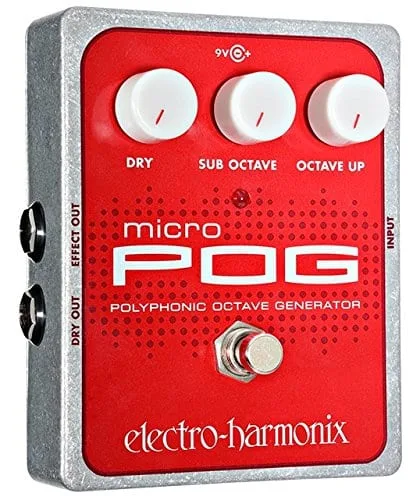
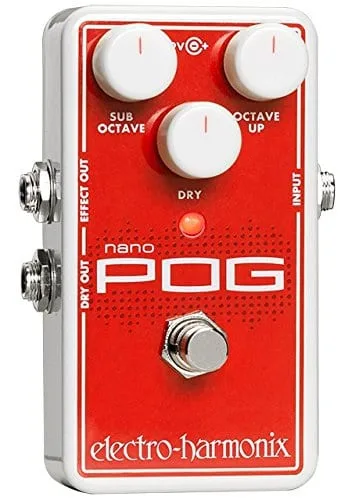
Where the original POG and POG2 put eight or more sliders on the table, the Pico POG distills the format to three knobs and a filter button. MusicRadar's reviewer notes that after downsizing the bulky original and POG2 into the Micro POG and Nano POG versions, the Pico POG is the smallest yet, and that its tracking shares the same DSP processing power as its predecessors2. Delicious Audio describes it as taking "the streamlined simplicity of the Micro and Nano POGs" and fitting it into an ultra-compact chassis, with an added tone control3.
What it does to your sound
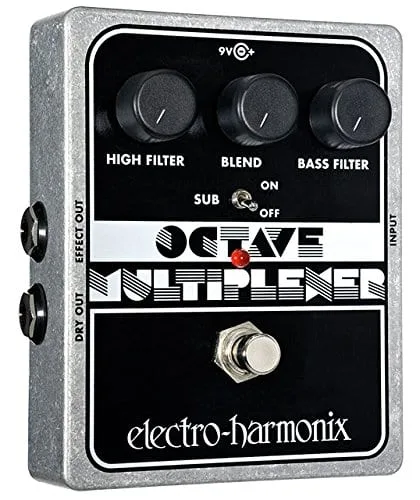
The Pico POG generates a sub octave and an octave up alongside your dry signal. Electro-Harmonix says the sub octave can add "rumble or thunder" while the octave up brings "ethereal air," and that the three voices blend into tones from subtle thickening to full organ-like stacks1. Because the octave algorithm is polyphonic, it tracks chords as well as single notes, which is what separates the POG line from monophonic octave boxes like the vintage Octave Multiplexer.
MusicRadar reported at launch that the pedal "takes the powerful and lightning-fast polyphonic octave algorithm from the EHX's acclaimed POG line" and packs it into the pico format5. Premier Guitar confirmed the pedal was available now as of July 20234.
The controls and filter modes
The control surface is deliberately minimal: three knobs, one button, one footswitch.
| Control | What it does |
|---|---|
| SUB OCTAVE knob | Sets the volume of the lower octave1 |
| OCTAVE UP knob | Sets the volume of the octave-up voice1 |
| TONE knob | Controls the frequency response of the signal, and its function depends on the FILTER button's mode1 |
| FILTER button | Switches between three filter modes, shown by LED color: green, red, or orange1 |
| Footswitch | Engages or bypasses the effect; the LED lights green, orange, or red to match the selected filter type when engaged, and is off in bypass1 |
The FILTER button is the feature that separates the Pico POG from the Micro and Nano POGs, which have no tone shaping. Each mode changes what the TONE knob actually does16:
- Tone Mode (green LED): the knob acts as a tilt-EQ with a flat frequency response in the center. Turning it one way gives more treble and less bass, the other way more bass and less treble, and the EQ applies to all three voices1.
- Low Pass Filter Mode (red LED): the knob controls the frequency of a resonant low pass filter that cuts highs in the sub and octave-up voices1.
- High Pass Filter Mode (orange LED): the knob controls the frequency of a high pass filter that cuts lows in the sub and octave-up voices1.
Guitar World's reviewer described the same system from a player's angle: in regular tone mode the control "functions as you'd expect with a flat response in the middle, and a cut to the bass while boosting the high-end as you turn it clockwise." The low-pass filter "cuts the high-end for the effected signals," and the high-pass mode "cuts the low-end of the same signals"6. Note that in the two filter modes the shaping applies to the effected voices, not the dry signal, which makes it possible to thin the generated octaves without dulling your core tone.
Power, size and connections
The Pico POG runs on external power only. There is no space for a battery2, and the pedal draws 100mA at 9.0VDC through its 9V power jack, with a 9.6VDC-200mA adapter included in the box1. At 3.65 x 2.0 x 2.0 inches it is genuinely tiny, roughly the footprint of a standard mini pedal1. Audio is mono, with a single input jack and a single output jack12.
The Pico POG uses buffered bypass, not true bypass1. The larger POG2 is listed by Electro-Harmonix as true bypass2, so players comparing the two should expect a difference in bypass behavior. A buffer is not a drawback on a long cable run, but it is a difference worth knowing before you buy.
Where it sits in the POG line
The POG family now spans a wide range. The original POG and POG2 established the format; the Micro and Nano POGs stripped it down; the Pico POG is the smallest POG yet, after the original, POG2, Micro and Nano versions2. It adds the filter modes the Micro and Nano lack, with a Tone knob that works as a tilt-EQ by default and switches to filter modes that cut the highs or the lows in the two effected signals13. For players who want POG tracking in the smallest possible box, the Pico POG is where the line currently ends up.
At launch in 2023 the pedal was listed at $188.00 at Thomann7; Electro-Harmonix's current list price is $240.001, and Guitar World's 2026 review lists it at $240 / £1996.
What reviewers said
Published reviews have been positive about the pedal's core job: tracking.
"World-class tracking and tones"
MusicRadar review, 20262
MusicRadar's reviewer found the tracking "lives up to the high bar set by its predecessors," sharing the same DSP processing power for both tracking and tones2. That is the essential verdict for a polyphonic octave pedal: if the octaves follow your chords cleanly, the rest is tone shaping, and the three filter modes give the Pico POG more tonal range than the simpler Micro and Nano versions it descends from13.
Guitar World's review focused its description on the filter system, calling the Filter switch a multi-function control "which changes the functionality of the Tone control" and walking through the three modes in detail6. Delicious Audio framed the pedal as the natural endpoint of the POG line's shrinking act: the simplicity of the Micro and Nano, in a smaller chassis, with a tone control neither of them had3.
Videos
EHX
Pedal Empire
Brent Brown Music
Questions
Can the Pico POG run on a battery?
No. The enclosure is small enough that there is no space for a battery, so the pedal runs on the included power adapter through its 9V power jack. Plan on a pedalboard power supply or the supplied adapter rather than a battery.
Is the Pico POG stereo?
No. The Pico POG is a mono pedal with one audio input jack and one audio output jack. If you need a stereo POG, look at the larger POG3, which adds a stereo Spread feature.
How much current does the Pico POG draw?
Electro-Harmonix lists the current draw as 100mA at 9.0VDC. That is modest for a digital pedal, but it is more than a typical analog stompbox, so give it its own isolated output or a supply rated for digital pedals.
Is the Pico POG true bypass?
No. The Pico POG uses buffered bypass, unlike the larger POG2, which Electro-Harmonix lists as true bypass. A buffer in bypass can actually help long cable runs, but players who insist on true bypass should note the difference.
How big is the Pico POG?
The enclosure measures 3.65 x 2.0 x 2.0 inches, making it the smallest pedal in the POG line. It is small enough to tuck into a crowded pedalboard where a full-size POG would not fit.
Sources (7)
- Pico POG, Electro-Harmonix (ehx.com)
- Electro-Harmonix Pico Pog review, MusicRadar, 2024-01-02
- Electro-Harmonix Pico POG, Delicious Audio, 2023-08-22
- Electro-Harmonix Introduces the New Pico POG Octave Pedal, Premier Guitar, 2023-07-25
- Electro Harmonix unveils the 9 mini Pico effects pedals for its NYC DSP Series, MusicRadar, 2023-09-21
- Electro-Harmonix Pico POG review, Guitar World, 2024-02-13
- EHX Pico POG Polyphonic Octave Generator with 3 Filter Modes, gearnews.com, 2023-07-25