

The Electro-Harmonix Riddle is an envelope filter pedal for guitar: a filter effect that sweeps automatically in response to how hard you pick, in the territory of an auto-wah. Electro-Harmonix describes it as "a powerful and precise envelope filter fine-tuned for guitar frequency response," covering the complete 80 Hz to 5 kHz range1. It was released in 2009 and discontinued in 2021, so it is now found on the secondhand market1.
What set the Riddle apart from a basic auto-wah was its control set and its built-in distortion. The filter type is switchable between low pass, band pass and high pass, the sweep has START and STOP endpoints you set yourself, and a separate footswitch engages an analog distortion circuit designed for guitar1.
The Riddle was discontinued in 20211. A closely related pedal, the Riddle: Q Balls, appears in independent listings with the same control set and power requirements; one of those listings records its circuit type as digital, while the maker's own specification for the Riddle is analog21.
What the Riddle does to your sound
An envelope filter listens to the level of your picking and opens and closes a filter in response: pick harder and the sweep goes further, pick softly and it stays put. The Riddle gives you unusually direct control over that sweep. Instead of a single sensitivity knob and a fixed filter shape, you choose the filter mode, set the frequency the sweep starts from and the frequency it sweeps to, and shape how fast it travels between them1.
Electro-Harmonix says the pedal "will deliver tight and smooth control over the complete 80 Hz to 5 kHz range, with a consistent and even sweetness," a range the 2009 launch press release described as tailored for guitar13. The maker's own pitch for the sound: "Sculpt your envelope to reveal a truly expressive tone, with a defined and unique signature"1.
The switchable analog distortion is the other half of the character. A dedicated footswitch with a status LED engages the distortion circuitry independently of the effect itself, so you can run the filter clean or push it1. Independent listings of the Riddle: Q Balls describe the pairing as a fully analog circuit with switch-selectable analog distortion, used to shape funky filter sweeps2.
Controls
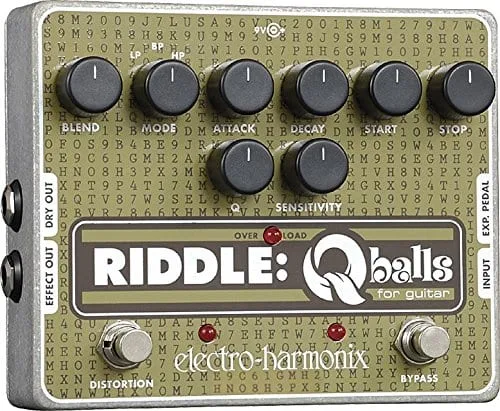
The control panel is where the Riddle earns its keep. Each knob does one clear job1:
| Control | What it does |
|---|---|
| MODE | Selects between the 3 filter modes: low pass, band pass, high pass1 |
| START | Sets the frequency the filter sweeps from1 |
| STOP | Sets the frequency the filter sweeps to1 |
| ATTACK | Controls how quickly the filter sweeps from the START frequency to the STOP frequency1 |
| Q | Controls the resonance of the Q, that is, how peaked and vocal the filter sounds1 |
| BLEND | Controls the output mix of the dry and effected signal1 |
Two footswitches with status LEDs complete the panel: one engages and disengages the effect, the other engages the analog distortion circuitry1. Independent listings of the Riddle: Q Balls also name Decay and Sensitivity controls alongside Start, Stop, Attack, Q and Blend2.
Expression pedal control
An optional expression pedal can be plugged into the Riddle for manual control of the filter, turning it from an automatic sweep into something you play like a wah1. The 2009 press release listed expression pedal control among the pedal's features at launch, and independent listings of the Riddle: Q Balls describe the same input as allowing manual control of the filter sweep32.
Power and connections
The Riddle is a mono pedal with one input and two outputs, an arrangement that opens up routing options1:
- Input jack: a 1/4" mono jack for your instrument1
- Effect out jack: a mono jack for your amplifier, carrying the effected signal1
- Direct out jack: a direct out signal from the input, so your clean signal is available on its own1
Those separate dry and effect outputs were highlighted both in the launch press release and in later independent listings, which describe them as adding versatility32. Running the effect out and the direct out to two amp channels, or blending them at the mixer, is the kind of setup the two jacks invite.
Power comes from a 9.6V DC center negative supply, with a current draw of 150mA; a 9.6VDC 200mA power adapter was included with the pedal when new21. That draw is on the high side for a single analog pedal, worth knowing if you are planning a shared supply.
The Riddle has no battery option in its listed specifications; power comes from the included 9.6VDC adapter1.
Where the Riddle came from
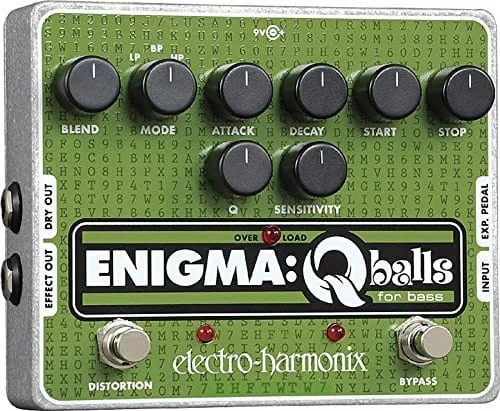
Electro-Harmonix released the Riddle in 2009 as an envelope filter voiced for guitar1. The launch press release presented it alongside a sibling, the Enigma, described as fine-tuned for bass frequency response, with the two sharing the same feature list: expression pedal control, switch selectable analog distortion, START and STOP sweep control, the three filter modes, Q control, separate dry and effect outputs, and the included 9.6VDC 200mA power supply3. The Enigma lives on in listings as the Enigma: Q Balls, and the Riddle: Q Balls name appears in independent listings for the guitar version2.
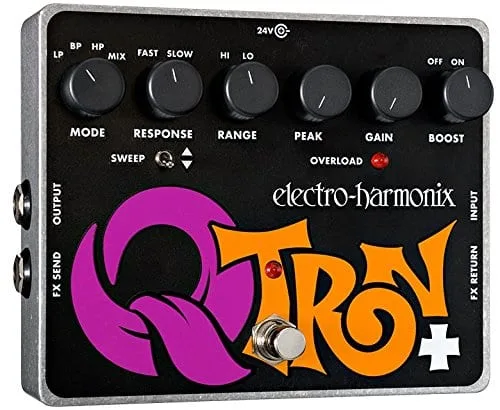
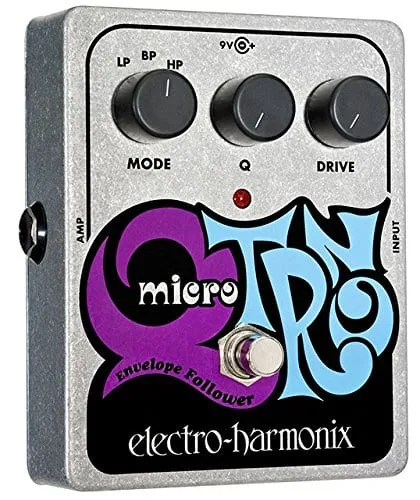
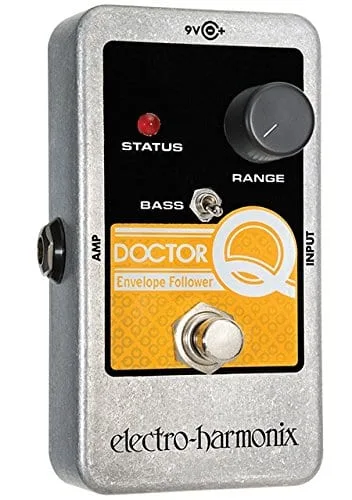
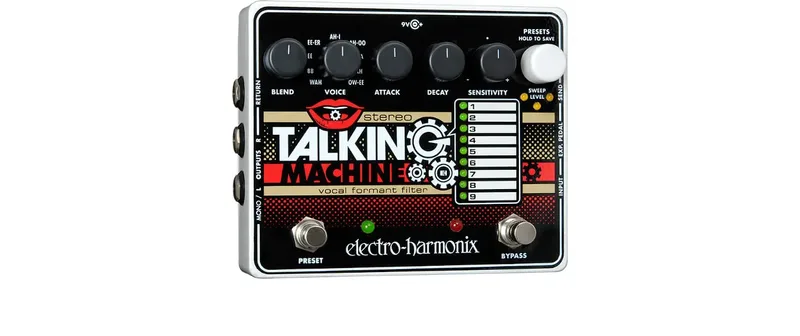
The Riddle sat in a long line of EHX envelope filters. Players comparing circuits today will find the family spread across the Q-Tron, Q-Tron Plus, Micro Q-Tron, Nano Q-Tron and Doctor Q, along with the quite different Talking Machine. What distinguished the Riddle within that range was the combination of the three selectable filter modes, the START and STOP sweep definition, and the built-in switchable distortion1.
The pedal was discontinued in 2021, per the maker's product page1.
Analog or digital?
Electro-Harmonix specifies the Riddle's circuit as analog, and the press release describes its distortion as switch selectable analog distortion designed for guitar1. RockBoard's PedalPedia entry for the Riddle: Q Balls, by contrast, records the circuit type as digital in its technical data, while elsewhere in the same entry describing a fully analog circuit with switch-selectable analog distortion2. The two sources disagree, and the maker's own specification is analog.
What the Riddle: Q Balls listings say
Independent coverage of the Riddle: Q Balls, the name under which the pedal appears in RockBoard's PedalPedia, describes it as "a powerful envelope filter pedal tailored specifically for guitar, offering tight and smooth control across an 80 Hz to 5 kHz frequency range for expressive auto-wah and 'Q' filter sounds"2. The same listing notes the optional expression pedal input and the separate dry and effect outputs as versatility features, and records the same power figures as the maker: 9.6V DC center negative, 150mA2. RockBoard also hosts demo videos of the pedal by Stu Weinberg and Jack Conte2.
Videos
EHX
gearmanndude
EHX
Questions
Is the Electro-Harmonix Riddle true bypass?
Yes. Electro-Harmonix lists the Riddle with true bypass switching, so with the effect disengaged the instrument signal passes through without the circuit coloring it1. A bypass footswitch with a status LED engages and disengages the effect, and a second footswitch turns the analog distortion circuit on and off independently1.
Can you use an expression pedal with the Riddle?
Yes. The Riddle has an expression pedal input, and an optional expression pedal gives you manual control of the filter, so you can sweep it by foot instead of relying on the envelope follower responding to your picking1. The feature was listed at launch in 2009 and in later independent listings1.
What is the frequency range of the EHX Riddle filter?
Electro-Harmonix says the Riddle delivers tight and smooth control over the complete 80 Hz to 5 kHz range, a response tailored for guitar13. The START and STOP knobs set where the sweep begins and ends within that range, and the ATTACK knob controls how quickly it moves between them1.
Is the Electro-Harmonix Riddle discontinued?
Yes. Electro-Harmonix released the Riddle in 2009 and discontinued it in 2021, according to the maker's product page1. It is now a secondhand-market pedal.
Is the Electro-Harmonix Riddle Q Balls analog or digital?
The maker describes the Riddle as an analog circuit with switch-selectable analog distortion2. RockBoard's PedalPedia entry for the Riddle: Q Balls, by contrast, records the circuit type as digital2.
What power supply does the Riddle Q Balls need?
The Riddle runs on a 9.6V DC center negative supply with a 150mA current draw, and a 9.6VDC 200mA power adapter was included with the pedal when new21. That draw is high for a compact pedal, so plan for it on a shared supply.
Sources (3)
- Riddle | DISCONTINUED 2021 | Envelope Filter for Guitar - Electro-Harmonix, Electro-Harmonix, 2021
- Riddle: Qballs by Electro-Harmonix, RockBoard PedalPedia, 2026
- Electro-Harmonix Introduces the Riddle & Enigma, Premier Guitar, 2009-07-08