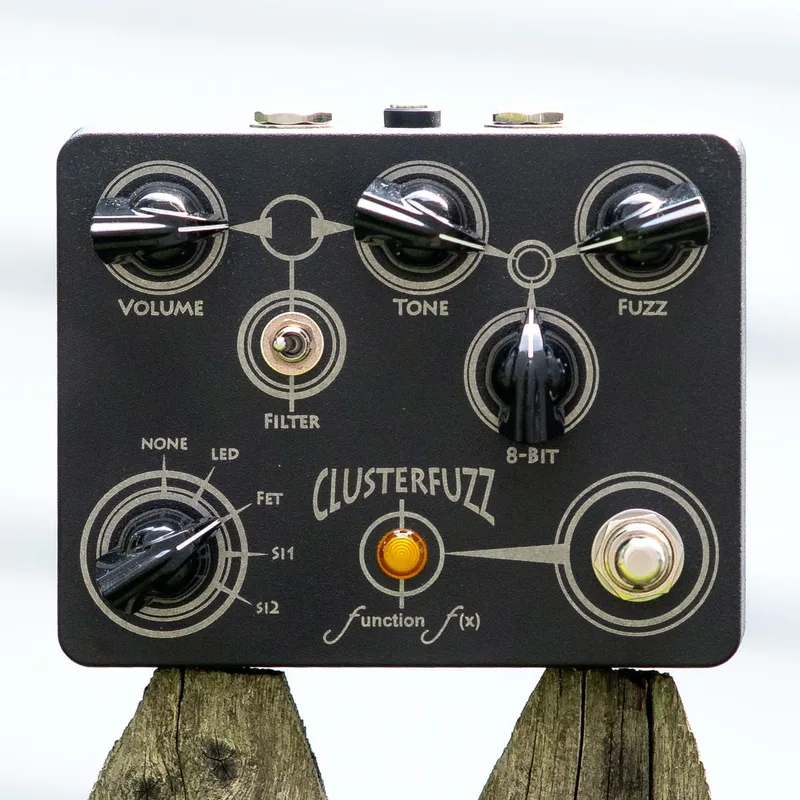


The Function f(x) Clusterfuzz Jr. is a compact fuzz pedal and the smaller brother to the full-size Clusterfuzz. Function f(x) describes it as the same circuit under the hood, with a few fewer features so it fits a standard 125B-sized enclosure, scaled down to a smaller footprint based on feedback from the company's customers1. It carries the Clusterfuzz family's signature trick: an 8-Bit/24-bit switch that toggles between tight fuzz and square-wave velcro sounds1.
[!NOTE] The Clusterfuzz Jr. is a fuzz pedal from Function f(x), priced at $189.00 USD, built into a standard 125B-sized enclosure.
The controls: Volume, Tone, Fuzz and the 8-Bit/24-bit switch
The Jr. keeps the control set simple: Volume, Tone and Fuzz knobs, plus the 8-Bit/24-bit switch1. The manual explains what each does3:
| Control | What it does |
|---|---|
| Volume | Adjusts the output level of the effect; counter-clockwise cuts the volume level |
| Fuzz | Controls the gain of the pedal, specifically the gain of the first transistor; clockwise increases the fuzz level |
| Tone | Shapes the frequency balance of the fuzz |
| 8-Bit/24-bit switch | Toggles between tight fuzz (24-bit) and square-wave velcro sounds (8-Bit) |
The 8-Bit side of the switch is where the pedal gets distinctive. In 8-Bit mode, the manual says you can get square-wave "Velcro" fuzz tones that range from "exploding amp" to synth-like tones reminiscent of older 8-bit video game systems3. In 24-bit mode the pedal behaves as a tighter, more conventional fuzz.
Three clipping options
A second switch, marked LED / SI, selects between three clipping diode options: LED (up), no diodes (center), and silicon diodes (down)3. The maker describes these as three clipping options for different saturation levels1.
- LED clipping: the up position on the switch3
- No diode clipping: the center position, letting the transistors themselves saturate3
- Silicon diodes: the down position3
Because the options sit on one switch, a player can move between them quickly and hear how each diode arrangement changes the fuzz character and headroom.
How it differs from the Clusterfuzz and the Clusterfuzz Micro
The Jr. sits in the middle of the Clusterfuzz family, alongside the original Clusterfuzz and the smaller Clusterfuzz Micro1. The Jr. is a fuzz pedal built into a standard 125B-sized enclosure, measuring 4.78″ x 2.61″ x 1.6″ (12.14 x 6.63 x 4.05 cm) and weighing 10 oz (283 g)1. Its input impedance of ~300K means it works with buffers in the chain ahead of it1.
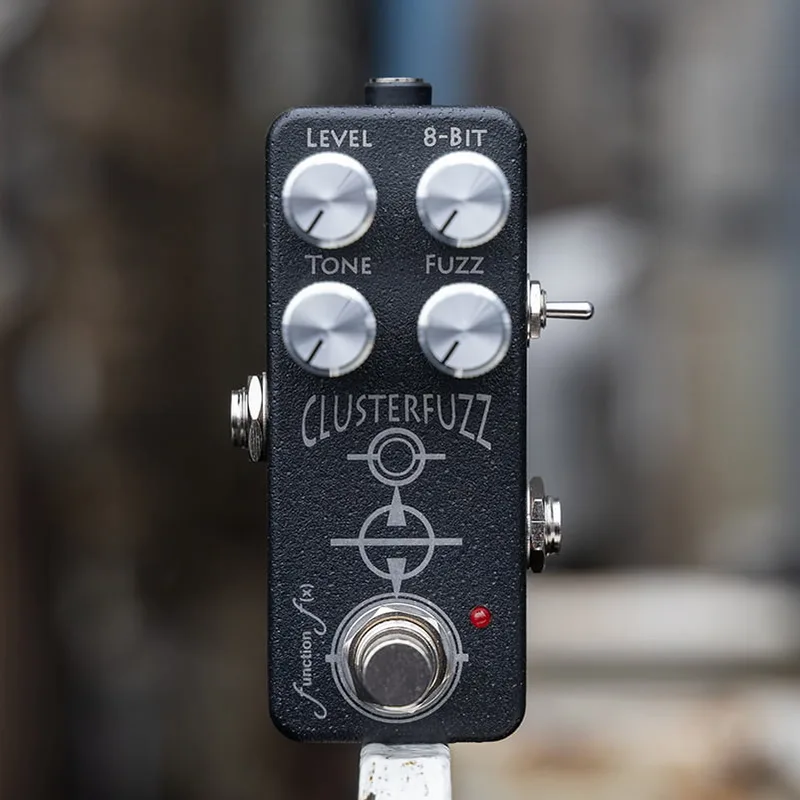
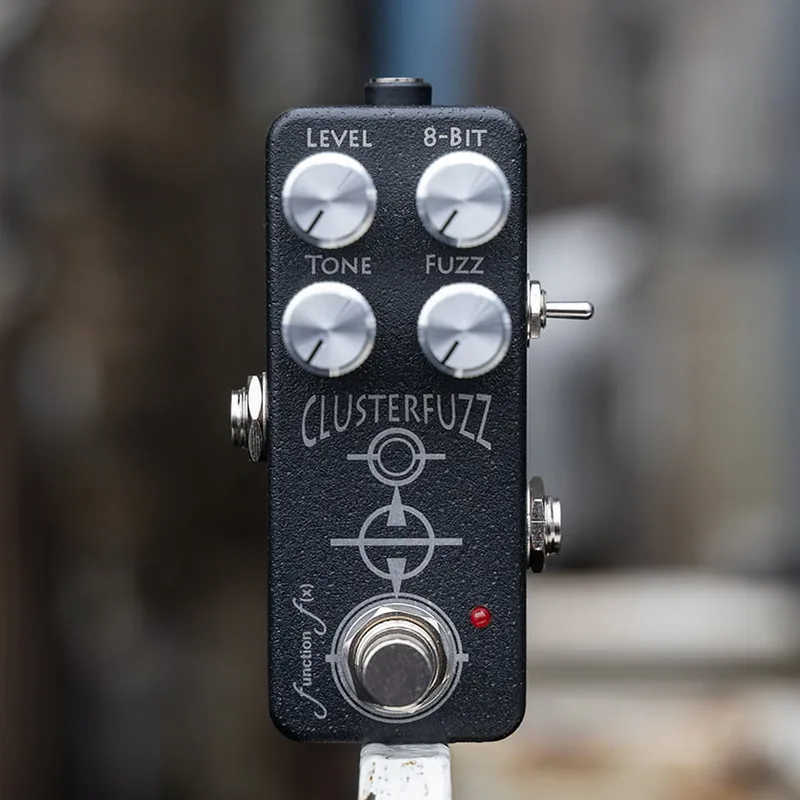
For players who want something smaller still, Function f(x) points to the Clusterfuzz Micro4. The Micro carries Volume, Tone, Fuzz and 8-Bit knobs, meaning its 8-Bit function is a variable control rather than the Jr.'s two-position switch5.
Where it came from
The Clusterfuzz Jr. is Function f(x)'s compact take on the Clusterfuzz circuit, fitted into a standard 125B-sized enclosure1. It draws 20mA when active and 10mA when bypassed21.
Videos
Mike Hermans
Goes to 11 Pedal Show
Questions
Is the Function f(x) Clusterfuzz Jr. true bypass?
Yes. Function f(x) describes it as having a soft-touch, relay-based true bypass switching system, so the signal passes through a relay rather than a mechanical switch when the pedal is off.
How much current does the Clusterfuzz Jr. draw?
The maker lists a 20mA current draw, dropping to 10mA when bypassed. It runs on 9V DC, the industry standard supply, so it works with most common pedal power bricks.
What is the difference between the Clusterfuzz Jr. and the Clusterfuzz Micro?
The Jr. is the compact version of the original Clusterfuzz, keeping the same circuit in a standard 125B-sized enclosure. The Micro is a smaller option still, and it adds a dedicated 8-Bit knob rather than the Jr.'s 8-Bit/24-bit switch.
Is the Clusterfuzz Jr. the same circuit as the original Clusterfuzz?
Yes. Function f(x) states it is the same circuit under the hood, with a few fewer features so it fits a standard 125B-sized enclosure. It was scaled down to a smaller footprint based on feedback from customers.
Sources (5)
- Clusterfuzz Jr., Function f(x), 2026-09-25
- Function f(x) Clusterfuzz, Pedal of the Day, 2016-04-20
- Clusterfuzz-JR-Product-Manual-Rev0.pdf, Function f(x), 2020
- Clusterfuzz Jr., Function f(x), 2017-06-13
- Clusterfuzz Micro, Function f(x), 2025-12-14