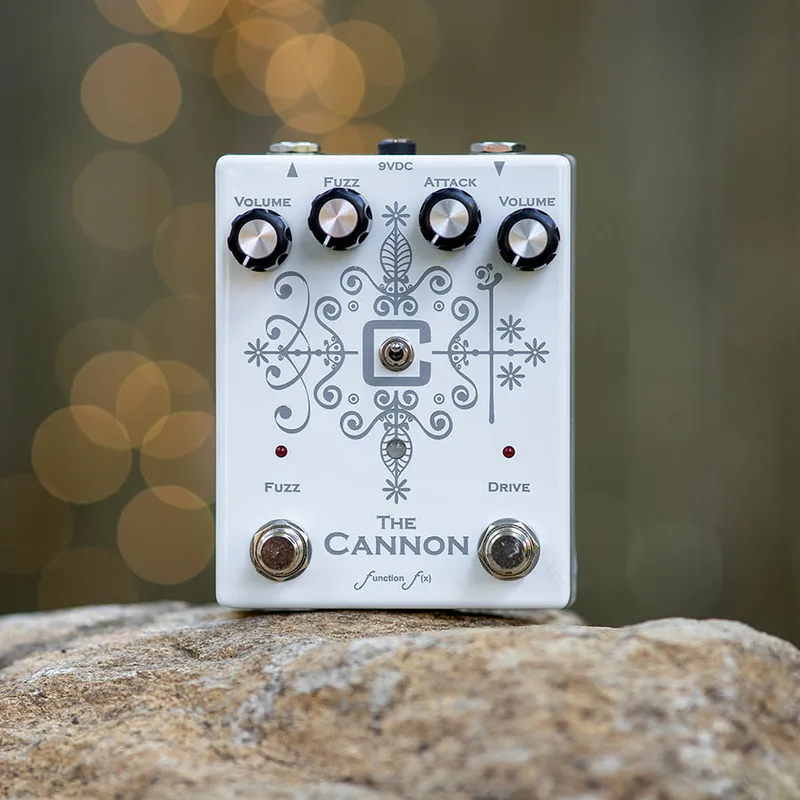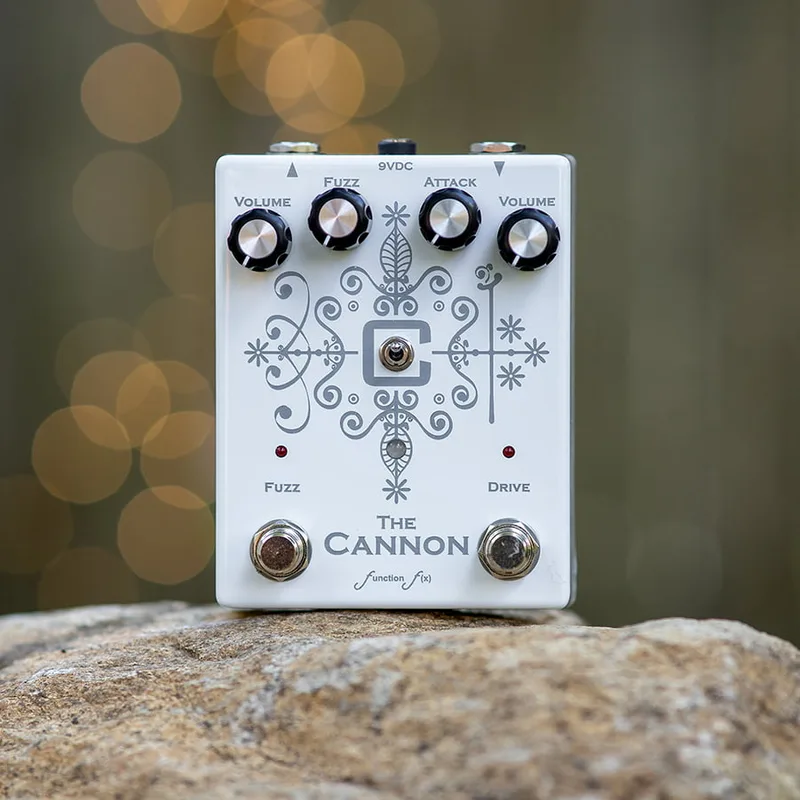

The Function f(x) Cannon is a dual fuzz pedal: two fully independent classic fuzz circuits in one box, built as what the maker calls "a 2-in-1 mashup of a pair of classic fuzz circuits: the Tycobrahe Octavia and the AstroTone Fuzz / Sam Ash Fuzzbox"1. One side gives you the octave up character of the Octavia, the other the fuzz of the AstroTone, and the two can be run separately or stacked together for what Function f(x) describes as "a really gnarly fuzz with delightful octave up overtones"1.
The pedal was conceived by, created for, and named after Chicago-area bluesman Toronzo Cannon, and Function f(x) says it created the pedal in partnership with him12. The company also points to it as its more vintage-like octave fuzz option among its signature pedals3.
Two classic fuzz circuits in one pedal
The Cannon's two sides come from two vintage designs. The Octavia side is based on the Tycobrahe Octavia, the circuit known for its octave up overtones, and it carries an octave defeat switch, called the Octave Lift Switch in the manual, which removes the octave up effect entirely if you want straight fuzz instead16. The AstroTone side is based on the AstroTone Fuzz, also known as the Sam Ash Fuzzbox16.
Because the circuits are fully independent, each has its own controls and its own place in the signal path, and the pedal gives you three ways to combine them: one at a time, the other at a time, or both stacked16. Stacking both is where the pedal earns its name, with the manual describing Cannon Mode as "high-gain stacking fun"6.
The controls
Each side has its own Volume and Fuzz controls1. The manual breaks down what each knob and switch does:
| Control | Side | What it does |
|---|---|---|
| Volume | Octavia | Adjusts the output level of the effect; turning it counter-clockwise cuts the volume level6 |
| Fuzz | Octavia | The gain control for the Octavia side6 |
| Octave Lift Switch | Octavia | Removes the octave up effect6 |
| Volume | AstroTone | Output level for the AstroTone side1 |
| Fuzz | AstroTone | Fuzz amount for the AstroTone side1 |
| Attack | AstroTone | Controls the gain of the AstroTone side6 |
The Octave Lift Switch is the one control that changes the character of a circuit rather than its level or gain. With the octave up engaged, the Octavia side produces the harmonic overtone the original circuit is known for; with it lifted, that overtone is gone and the side works as a fuzz on its own16.
Three switching modes
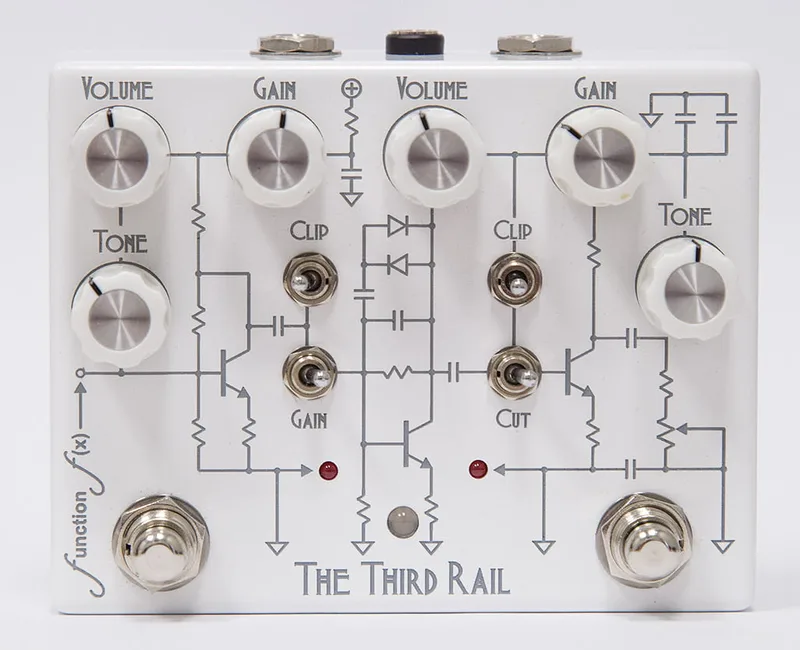
The Cannon uses the same bypass switching setup as Function f(x)'s Third Rail overdrive, which allows for On/On, Flip Flop, and Momentary bypassing modes1. The manual names the three modes and gives each an LED color: Indy Mode (Blue), Flip-Flop Mode (Green), and Cannon Mode (Red)6.
| Mode | LED color | How it works |
|---|---|---|
| Indy Mode | Blue | The left footswitch bypasses the Octavia side and the right footswitch bypasses the AstroTone side; each side can be used independently or stacked6 |
| Flip-Flop Mode | Green | The right footswitch toggles between the Octavia and AstroTone sides, and the left footswitch is a master bypass; only one channel is active at a time6 |
| Cannon Mode | Red | Both channels are always on for high-gain stacking; the left footswitch is a master bypass and the right footswitch is a momentary bypass of both channels6 |
Indy Mode is the most flexible for live use, since you can bring each fuzz in and out on its own footswitch. Flip-Flop Mode suits switching between two preset fuzz sounds quickly, at the cost of not being able to run both at once. Cannon Mode commits to the stacked sound and adds a momentary cut, so you can drop both fuzzes out only while you hold the right switch6.
To change modes, hold down both footswitches for a few seconds until the LEDs blink, then scroll through the three modes with the left footswitch and select the one you want with the right footswitch6.
One thing to know about the LEDs: the Bypass Mode LED indicator is always lit, even if the pedal is fully bypassed6. It shows which switching mode is active, not whether the effect is engaged.
The mode LED stays lit even when the pedal is fully bypassed. If you are used to an LED going dark to signal bypass, this pedal works differently: the LED indicates the active switching mode at all times6.
Power
The Cannon runs on a 9V DC center negative power supply with a 2.1mm barrel plug, which the manual spells out explicitly6. Function f(x) describes the pedal's 9V DC operation as industry standard4, and RockBoard's PedalPedia lists the current draw as 35mA5. That draw is modest, so the pedal fits comfortably on a typical isolated power supply alongside other 9V pedals.
Origins: Octavia, AstroTone and Toronzo Cannon
The pedal's name and concept come from Toronzo Cannon, a Chicago-area bluesman. Function f(x) states that the pedal "was conceived by, created for, and named after Chicago-area bluesman Toronzo Cannon"1, and the company's artist page for him adds that it created the pedal in partnership with him2.
The circuits themselves reach back further. The Tycobrahe Octavia is the octave fuzz design the Octavia side follows, and the AstroTone Fuzz, also sold as the Sam Ash Fuzzbox, is the basis of the other side16. RockBoard's PedalPedia independently lists the same two circuits as the Cannon's foundations and classifies the pedal's effect types as fuzz, overdrive and booster5.
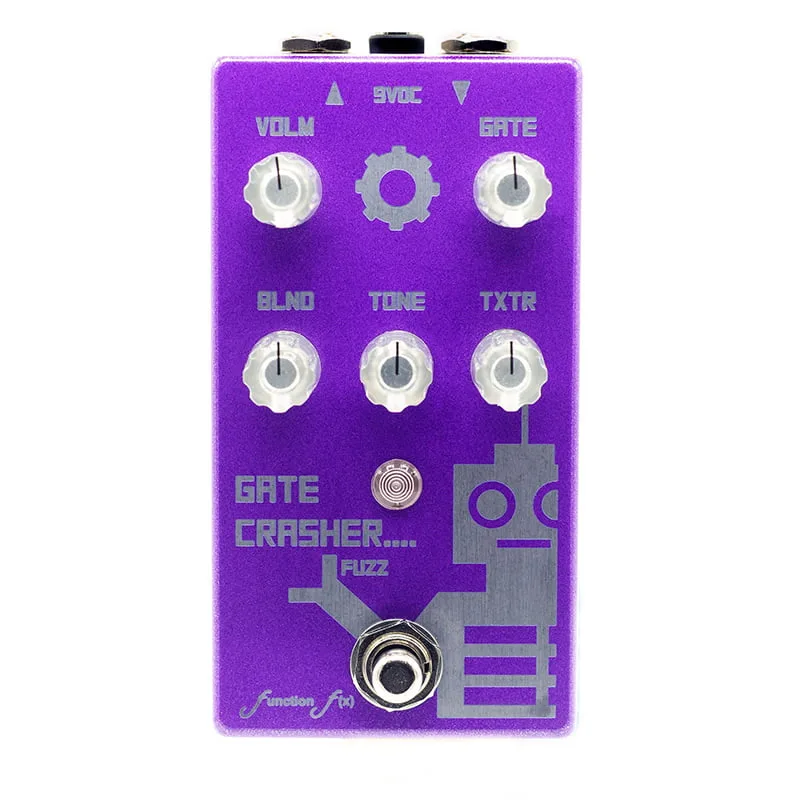
Function f(x) also positions the Cannon within its own lineup: on the page for its Gate Crasher pedal, the company points players who want "a more vintage-like octave fuzz" to the Cannon as its signature pedal for that job3.
Warranty and repairs
Function f(x) warrants its pedals against defective parts and workmanship for 1 year from the date of purchase6. Repairs are available after the warranty period as well, possibly with a fee for parts and labor, and the manual notes that a full PCB replacement may take 4 to 6 weeks if critical parts are out of stock and need to be ordered, with no upfront costs6.
Videos
Mike Hermans
Questions
What power supply does the Function f(x) Cannon need?
The Cannon runs on a 9V DC center negative power supply with a 2.1mm barrel plug, the same standard arrangement as most modern pedals. The manual is specific about the center negative polarity, so a center positive supply should not be used. Function f(x) describes the 9V DC operation as industry standard.
Can you run both sides of the Cannon at once?
Yes. The two circuits can be run separately or stacked together, and in Cannon Mode both channels are always on for what the manual calls high gain stacking fun. In Indy Mode each side has its own bypass footswitch, so you can engage either one, both, or neither.
How do you change the switching mode on the Cannon?
Hold down both footswitches for a few seconds until the LEDs blink, then scroll through the three modes with the left footswitch and select the one you want with the right footswitch. The modes are Indy (blue), Flip Flop (green) and Cannon (red).
Does the Cannon's mode LED stay lit when it is bypassed?
Yes. According to the manual, the bypass mode LED indicator is always lit, even if the pedal is fully bypassed. The LED shows which switching mode is active rather than whether the effect is engaged.
What is the warranty on the Function f(x) Cannon?
Function f(x) warrants its pedals against defective parts and workmanship for 1 year from the date of purchase. Repairs are also available after the warranty period, possibly with a fee for parts and labor, and a full PCB replacement can take 4 to 6 weeks if critical parts are out of stock.
Sources (6)
- The Cannon Dual Fuzz, Function f(x), 2026-09-12
- Toronzo Cannon, Function f(x), 2020-05-30
- Gate Crasher Octave Fuzz, function-fx.com, 2018-09-10
- The Cannon Dual Fuzz by Function f(x), Function f(x), 2017-06-13
- The Cannon by Function F(X), RockBoard PedalPedia, 2026
- Cannon-Product-Manual-V2-1.pdf, Function f(x), 2020