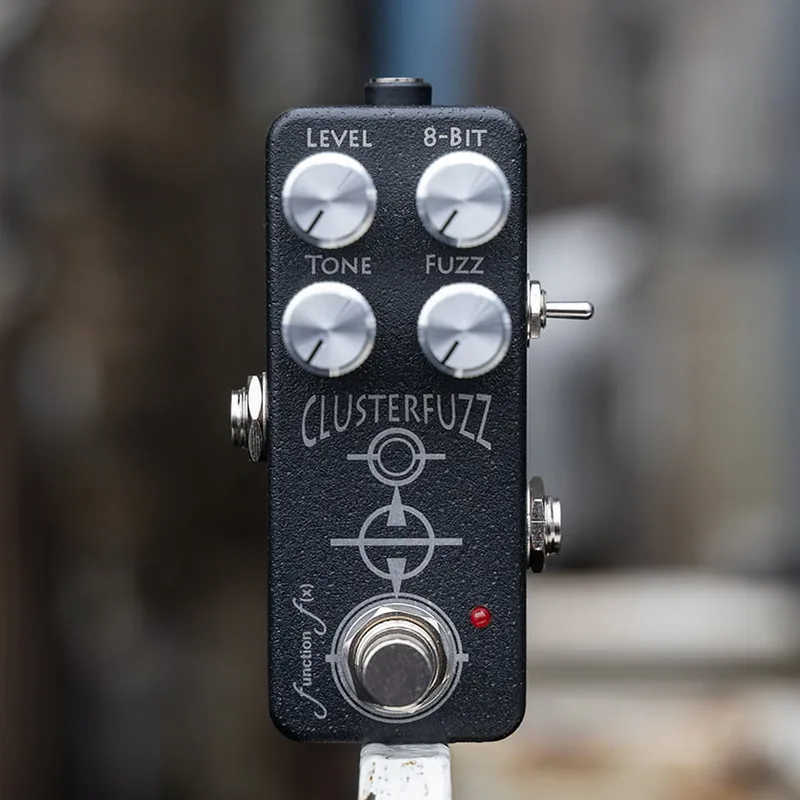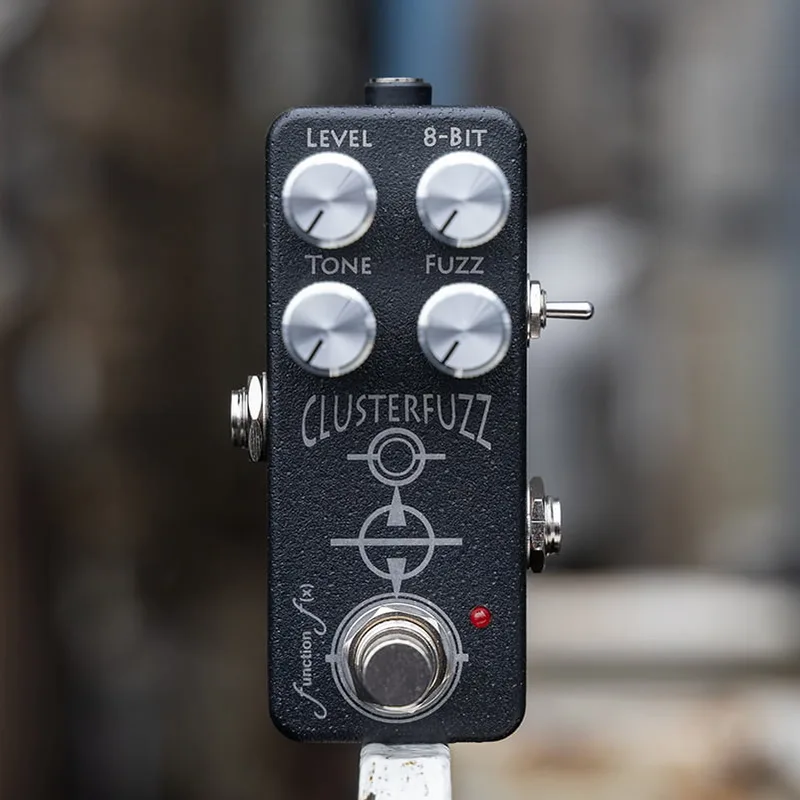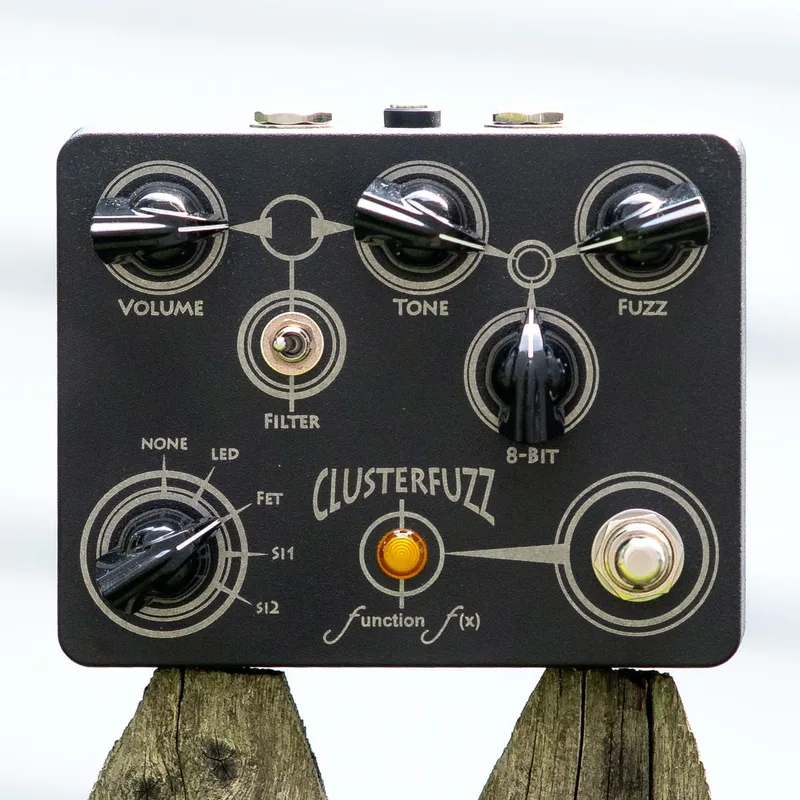


The Function f(x) Clusterfuzz is a fuzz pedal built by Function f(x) LLC, launched in January 2015 as the company's first product1. Function f(x) describes it as a new design using modern components for consistent performance and a long operational life, and states plainly that it is not patterned after any existing classic or modern boutique fuzz pedal21. In the maker's own words from the manual, "It can go from a medium gain overdrive to a broken-sounding square wave fuzz machine."3
What sets it apart from most fuzz boxes is the combination of five selectable clipping modes and a dedicated 8-Bit knob that dials in gated, square-wave fuzz sounds2. Premier Guitar's review placed its character "in the vein of the Jordan Bosstone, Mosrite Fuzzrite, and post-germanium Fuzz Faces," while crediting its aggression to its MPSA13 and 2N5089 transistors, two ultra-high-gain components4.
The controls
The front panel carries three knobs, Volume, Tone, and Fuzz, plus the 8-Bit knob and a five-position clipping selector2. The manual explains what each does:
| Control | What it does |
|---|---|
| Fuzz | Controls the gain of the pedal, technically the gain of the first transistor; clockwise increases the fuzz level3 |
| Tone | Shapes the frequency response of the effect76 |
| Volume | Sets the output level768 |
| 8-Bit | Dials in gated fuzz sounds2 |
| Mode (rotary) | Selects among the five clipping options52 |
The 8-Bit control is the unusual one, and the manual explains how it works: "The 8-bit control basically lets the signal from the first transistor in circuit to drive the second transistor harder." Past a certain level the second transistor distorts massively, producing a square-wave output3. Pedal of the Day's reviewer called it "an 8-bit knob lets you dial in some incredible gated fuzz sounds, adding a new and unexpected element to any 'normal' fuzz you might be used to."5
The manual also suggests starting points for different sounds:
- Overdrive-ish: keep 8-Bit low; the FET clipping setting gives a good balance of dynamics, smoothness, and clarity3
- Compressed metal fuzz: crank the Fuzz, move 8-Bit to taste, try Si1 or Si2; for maximum compression and sustain choose Si23
- Broken fuzz: keep the 8-Bit up; it is more audible in lower compression settings such as LED clipping3
The footswitch is a soft-touch relay, as noted in Premier Guitar's review4, and the maker lists the bypass as soft touch (true) bypass2.
Five clipping modes
The Mode knob selects among five clipping configurations, which the manual describes setting by setting52:
| Mode | Clipping elements | Character |
|---|---|---|
| None | No clipping diodes | Most output, dynamics, and low end3 |
| LED | LED clipping diodes | Still loud and dynamic; a bit more saturated; a bit less boomy3 |
| FET | MosFET + silicon diodes | Similar to the LED clippers but a bit smoother3 |
| Si 1 | Typical silicon diodes | Less volume and notably more compression than earlier settings3 |
| Si 2 | Schottky silicon diodes | A bit more scooped sounding (less bass); highly compressed with a lot of sustain but less overall output volume3 |
The progression runs from wide open to heavily compressed, so a player can move from a loud, dynamic fuzz to a tight, sustaining one without touching another control. Pedal of the Day listed the same five options in its 2016 review5.
Power, buffers, and warranty
The Clusterfuzz runs on 9V DC, and the manual is specific about the supply: "Make sure that you use a 9VDC center negative 2.1mm barrel power supply to power the Clusterfuzz."3 Current draw is 20mA engaged and 10mA bypassed2. Premier Guitar's review also notes the pedal runs on battery power or via a standard power supply, which is not included4.
The input impedance is approximately 300K and the maker states it works with buffers2, so the Clusterfuzz can sit anywhere in a pedalchain, including after buffered bypass pedals, without the loading issues that affect some vintage-style fuzz circuits.
Function f(x) warrants its pedals against defective parts and workmanship for 1 year from the date of purchase, not covering damage from user error. After that period, repairs may incur a fee for parts and/or labor, with no costs paid upfront, and a full PCB replacement may take as long as 4 to 6 weeks if critical parts need to be ordered3.
Where it came from
Function f(x) LLC announced the Clusterfuzz on January 19, 2015, as its first product, describing it as a gain pedal with five clipping levels, an input low-pass filter, and in-house relay-based bypass1. The enclosure features laser-etched artwork2. The design uses modern components chosen for consistent performance and long operational life1.
What reviewers said
Premier Guitar reviewed the pedal in August 2021 at a street price of $1994. The reviewer's summary of strengths was short and direct:
"Super-loud. Super-aggressive. Great tonal range."
Pedal of the Day reviewed it in April 2016, highlighting the 8-Bit knob's gated fuzz sounds as an unexpected element compared with a normal fuzz5. Guitar.com's reviewer, writing about the Function f(x) line in 2026, noted the Clusterfuzz "has a number of different clipping options and filters in a compact package."9
The Jr. and Micro versions
Function f(x) offers the same basic tones in two smaller footprints: the Clusterfuzz Jr. and the even-smaller Clusterfuzz Micro2. Both use the same circuit under the hood, with fewer features to fit smaller enclosures, and the same types and values of components as the full-size pedal610.
| Clusterfuzz | Clusterfuzz Jr. | Clusterfuzz Micro | |
|---|---|---|---|
| Clipping options | Five: none, LED, FET, Si 1, Si 22 | Three: LED, none, silicon7 | Three: none, MosFET, silicon257 |
| 8-Bit control | Knob2 | 8-Bit/24-bit switch6 | Not listed10 |
| Enclosure | 4.7″ x 3.7″ x 1.18″2 | Standard 125B6 | Standard 1590A10 |
The Jr. was scaled down to a smaller footprint based on feedback from customers7, and its manual describes it as a more compact version of the original full-sized Clusterfuzz, capable of going from a medium gain overdrive to a broken-sounding square wave fuzz machine3. Its LED/SI switch selects between LED clipping (up), no diodes (center), and silicon diodes (down)8.
DIY layouts
Builders in the comments verified several parts substitutions: 680pF for C1, 1N5817 for D4 and 1N4001 for D3, and a current limiting resistor of 4k7 for the LED (2k2 or 1k for a brighter one)11. For the LED clipping diodes, red LEDs with a forward voltage of 1.8 to 2v work, orange, yellow, or green are similar, and blue or white should be avoided; two or three 1N4148/1N914 pairs in series give a similar sound11. One builder reported that the 1k resistor after the tone pot is missing from the layout schematic11.
Videos
ProGuitarShopDemos
Premier Guitar
gearmanndude
Questions
Does the Clusterfuzz work with buffered pedals?
Yes. Function f(x) lists the input impedance at approximately 300K and states that it works with buffers, so the pedal behaves consistently in front of or behind buffered effects. Many vintage-style fuzz circuits load down buffers and change character, but the Clusterfuzz is designed not to.
Can the Clusterfuzz run on a battery?
Yes. Premier Guitar's review notes that the pedal runs on battery power or via a standard power supply, which is not included. For a power supply, the manual specifies a 9V DC center negative 2.1mm barrel plug, and the pedal draws 20mA engaged and 10mA bypassed.
What is the difference between the Clusterfuzz, Jr. and Micro?
All three use the same circuit and the same component types and values. The full-size Clusterfuzz has five clipping modes and an 8-Bit knob. The Jr. fits a 125B enclosure with three clipping options (LED, silicon, none) and an 8-Bit/24-bit switch. The Micro fits a 1590A enclosure with three clipping options (MosFET, silicon, none).
What transistors does the Clusterfuzz use?
Premier Guitar's review identifies MPSA13 and 2N5089 transistors, describing both as ultra-high-gain components. The Fuzz knob controls the gain of the first transistor in the circuit, and the 8-Bit control lets that transistor's output drive the second transistor harder.
Is there a DIY layout for the Clusterfuzz?
Yes. The Guitar FX Layouts blog published a stripboard (vero) layout in January 2017, linking back to the original freestompboxes.org thread and schematic. Builders in the comments verified parts substitutions including 680pF for C1 and 1N5817 and 1N4001 diodes for D4 and D3.
Sources (11)
- Function f(x) Releases the Clusterfuzz, Premier Guitar, 2015-01-19
- Clusterfuzz, Function f(x), 2026-07-17
- Clusterfuzz-Product-Manual-v2.pdf, Function f(x), 2021
- Function f(x) Clusterfuzz Review, Premier Guitar, 2015-05-08
- Function f(x) Clusterfuzz, Pedal of the Day, 2016-04-20
- Clusterfuzz Jr., Function f(x), 2026-09-25
- Clusterfuzz Jr., Function f(x), 2017-06-13
- Clusterfuzz-JR-Product-Manual-Rev0.pdf, Function f(x), 2020
- Teaching Machines FuzzBillion review: the most ambitious, unique dirt pedal?, Guitar.com, 2026-05-18
- Clusterfuzz Micro, Function f(x), 2025-12-14
- Guitar FX Layouts: Function F(x) Clusterfuzz, Guitar FX Layouts (tagboardeffects.blogspot.com), 2017-01-29