

The Hungry Robot El Castillo is an arpeggiating reverb pedal, unveiled in April 2018. It uses a combination of three circuit blocks, reverb, pitch-shift and delay, to create what its maker calls a highly experimental, ambient reverb1. Delicious Audio's Paolo De Gregorio, writing with designer Brandon Stoner, described it as combining delay, reverb and pitch-shifting into one fairly compact unit1.
The key to the design is where those blocks sit. The pitch-shift block is located in the feedback loop of the reverb, and adding a pitch-shift to the feedback signal creates a "stair step" effect, so each repeat climbs or falls in pitch. The delay block is also inside the feedback loop: a simple, single-repeat delay that can range from 0 to 800 ms, causing the signal to pass through the pitch-shift block on a delay1.
Controls
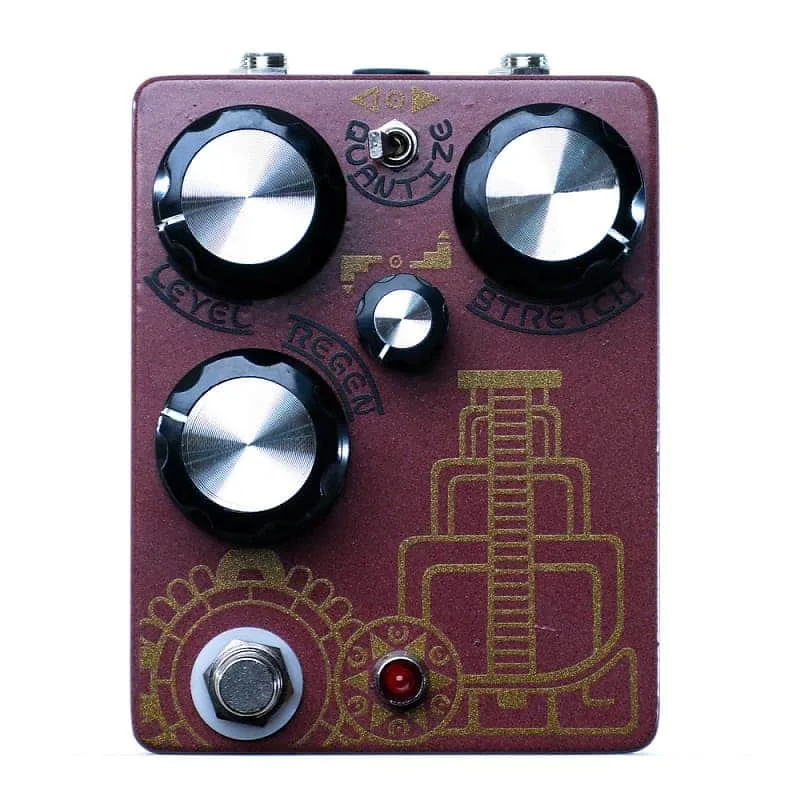
| Control | What it does |
|---|---|
| Level | Controls the volume of the reverb2 |
| Regen | Controls the feedback loop amount of the reverb block2 |
| Stairstep | Controls the pitch of the feedback loop2 |
| Stretch | Sets the amount of delay in the feedback loop2 |
| Pitch | Function set by the mode toggle switch1 |
| Quantize switch | Left: unquantized pitch shifting; right: quantized pitch shifting2 |
The reverb block itself has two controls. The Level control increases the amount of wet signal without affecting the dry signal, while Regen controls how much of the signal feeds back through the loop2.
Quantized and Un-Quantized modes
El Castillo has two modes of operation, Un-Quantized and Quantized, selected by the Quantize toggle switch2. The mode toggle also determines the function of the Pitch knob1.
- Un-Quantized (toggle left): the Pitch knob is free-ranging and can select any pitch interval between -1 octave and +1 octave, with zero pitch-shift at 12 o'clock2.
- Quantized (toggle right): the pitch-shift is locked to -1 octave and +1 octave, and the Pitch knob crossfades between the two. Fully left gives only octave down intervals, fully right gives only octave up intervals, which the press material calls traditional shimmer, and at 12 o'clock there is a 50/50 blend of octave up and octave down intervals21.
Sound range and where it sits
Delicious Audio described the pedal's range this way:
"It can do everything from fairly normal reverb and delay sounds, as well as shimmer. There is an arpeggiator function that can be as beautiful or as haunting as you want"
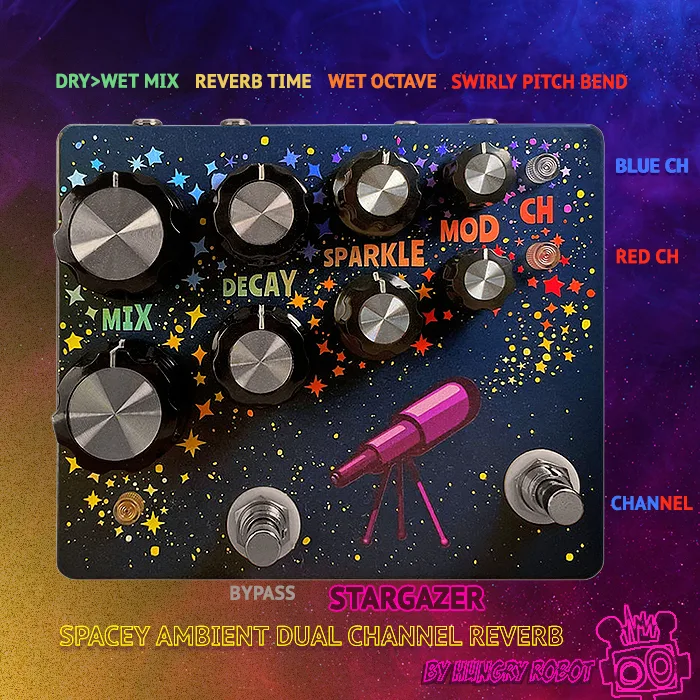
So at one end of its range it behaves like a fairly conventional reverb and delay, and at the other it produces the arpeggiating stair-step textures the circuit is built around. Players comparing it with other Hungry Robot designs will find it sits alongside the ambient side of the range: The Stargazer is a dual-channel ambient reverb, the Borderland is a modulated reverb, and the Wallflower is an all-in-one multi-effects pedal. For the wider category, see the Reverb Pedals and Delay Pedals pages12.
Power and specifications
The El Castillo is powered from a 9V DC center-negative supply with a 2.1mm barrel plug and draws 113 mA2. That current draw is high enough that a weak daisy-chain output may not be suitable; a supply rated for at least 113 mA on that output is the safe choice. The pedal measures 3.7" x 4.7"2.
Videos
aBunchOfPedals
Eirik Stordrange
The Sound Parcel
Questions
What does the Stairstep knob do on the El Castillo?
The Stairstep knob controls the pitch of the feedback loop. The pitch-shift block sits inside the reverb's feedback loop, so each pass through the loop is shifted again, building a stair-step effect of rising or falling intervals. It works together with the Stretch knob, which sets how much delay feeds that loop.
What is the difference between Quantized and Un-Quantized mode?
In Un-Quantized mode (toggle to the left) the Pitch knob is free-ranging and can select any interval between -1 octave and +1 octave, with zero shift at 12 o'clock. In Quantized mode (toggle to the right) the shift is locked to -1 and +1 octave, and the Pitch knob crossfades between them: fully left is octave down only, fully right is octave up only, and 12 o'clock is a 50/50 blend.
What power supply does the Hungry Robot El Castillo need?
The El Castillo runs on a 9V DC center-negative supply with a 2.1mm barrel plug and draws 113 mA. Use a supply that can deliver that current rather than a low-output daisy-chain slot.
Can the El Castillo make shimmer reverb sounds?
Yes. According to Delicious Audio, the pedal can do everything from fairly normal reverb and delay sounds to shimmer. In Quantized mode, turning the Pitch knob fully to the right provides only octave up intervals, which the maker's press material describes as the traditional shimmer sound.
Who designed the Hungry Robot El Castillo?
The El Castillo was designed by Brandon Stoner of Hungry Robot Pedals, and was unveiled in April 2018.
Sources (2)
- Hungry Robot El Castillo Arpeggiating Reverb, Delicious Audio, 2018-04-11
- El Castillo, Hungry Robot Pedals