

The Maestro Bass Brassmaster BB-1 is a bass fuzz and octave pedal that Maestro built in the early 1970s. MusicRadar describes it as "an octave bass fuzz with an onboard dual-voice ring modulator, opening up a full spectrum of harmonically unorth" sounds, and calls it "a super-rare bass octave fuzz from the '70s that sounds great on guitar"12. Performer Mag's retrospective calls it a pedal that "would shed light on the bass player" at a time when few effects were designed for bass2.
What made it unusual was its circuit. Instead of running the whole signal through the fuzz stage, the BB-1 splits the signal at the input and sends it simultaneously through a clean path and a fuzz path, combining the two at the preamp output stage where they can be blended2. That blend can go from a cleaner sound with a touch of harmonic distortion to what the reviewer calls "a gnarly, over-the-top fuzz tone"2.
The controls
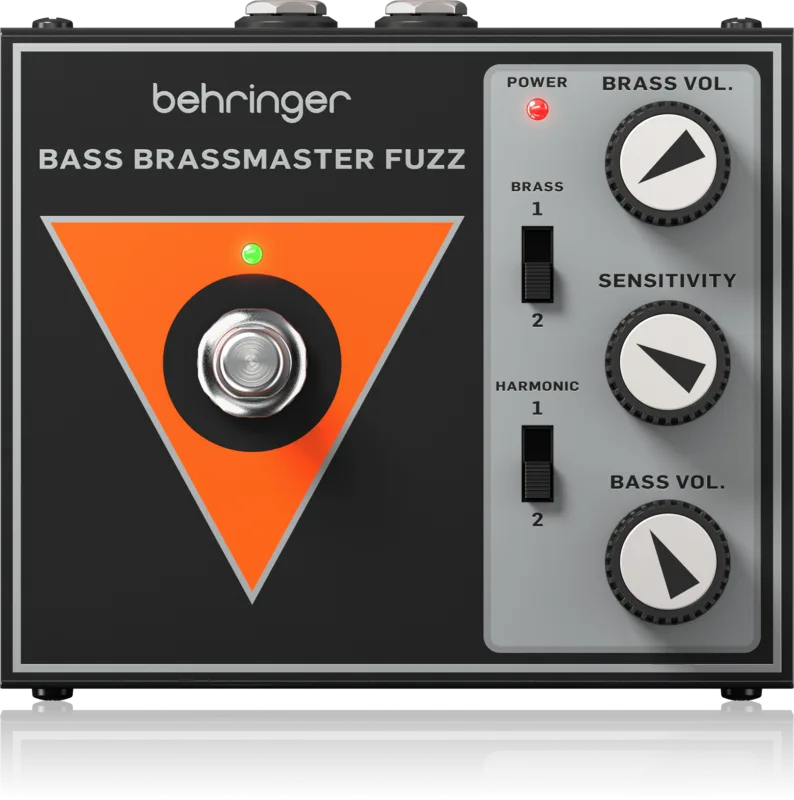
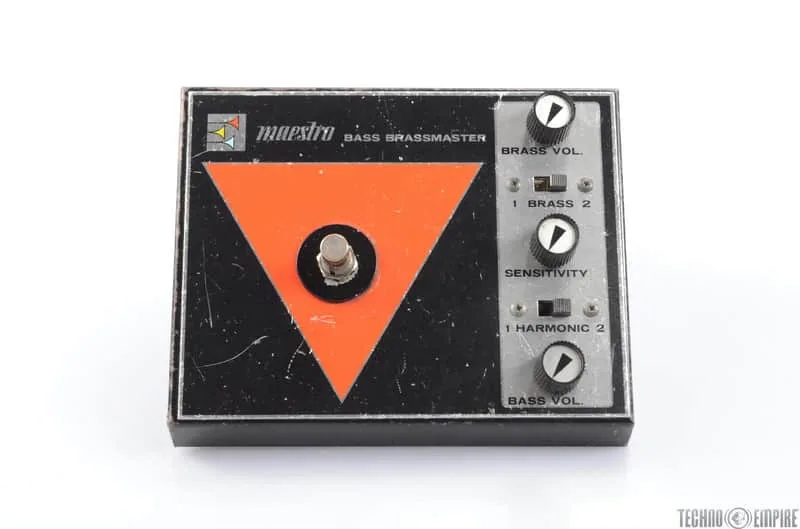
The BB-1's panel is built around blending the clean and fuzz paths, then shaping the fuzz itself. Vintage Guitar notes the pedal "offered controls for fuzz and instrument sensitivity, and switches for tone (Brass 1/2) and Harmonic"3.
| Control | What it does |
|---|---|
| Sensitivity knob | Essentially a mix knob, blending between the dry sound of your instrument and the effected signal2 |
| Brass Vol. knob | Turning it up adds more fuzz to the signal2 |
| Bass Vol. knob | Adds more low end2 |
| Brass switch | A filter controlling the tone of the fuzz; Brass 1 has more bite on the top end, Brass 2 a bit more mid-range2 |
| Harmonic switch | Chooses between two different harmonic characteristics2 |
The Sensitivity knob is the heart of the design. Because the clean and fuzz paths run in parallel, you can keep your fundamental low end intact and layer as much or as little fuzz on top as you want, rather than losing your bass entirely the way a conventional fuzz can do2.
The Harmonic switch changes the character of the effect's harmonics. Performer Mag's reviewer found it "useful for making your instrument sit just right in a mix," since each position emphasizes a different harmonic profile2.
Where it came from and what it's worth
Maestro manufactured the BB-1 from 1971 to 1974, a relatively short production run2. Performer Mag notes it "was not a copy of any other pedal at the time," with circuitry the reviewer calls quite unique2.
That short run and distinctive circuit made it a collector's piece. Vintage Guitar listed the BB-1 among the 25 most valuable effects, with a value of $925 to $1,075 as of December 20123. By 2020, Performer Mag reported that "the vintage Maestro Bass Brassmaster goes for around $2,000 and is nearly impossible to come by"2, and MusicRadar still described it in 2024 as super rare and selling for $2,000 or more1.
"The BB-1 was nasty, weird, brilliant, a threat to your amp's speaker cone and a radical thing to expose your bass signal to."
Clones and modern options
With originals this scarce and expensive, the circuit has reached most players through copies. The vintage Maestro Bass Brassmaster goes for around $2,000 and is nearly impossible to come by2, so for a player curious about the Brassmaster's blendable fuzz and octave sound, a clone is the accessible route; the vintage unit remains a collector's purchase.
Videos
Adrian Täckman
AtomicMusicStore
Travis Jones
Questions
What does the Brass switch do on the Maestro Brassmaster?
The Brass switch is a filter that controls the tone of the fuzz. The Brass 1 position has more bite on the top end, while Brass 2 gives a bit more mid-range. It lets you choose where the fuzz sits before you blend it with your clean signal using the Sensitivity knob.
What does the Harmonic switch do?
The Harmonic switch lets you choose between two different harmonic characteristics. Performer Mag's reviewer found it useful for making your instrument sit just right in a mix, since each position changes which harmonics the fuzz and octave effect emphasize.
When was the Maestro Bass Brassmaster made?
Maestro manufactured the Bass Brassmaster BB-1 from 1971 to 1974, a relatively short production span. MusicRadar describes it as a super-rare bass octave fuzz from the '70s, and vintage units now sell for around $2,000 on the used market.
Is the Brassmaster a copy of another fuzz?
No. Performer Mag's review notes that the BB-1 is quite unique in its circuitry and was not a copy of any other pedal at the time. Its split clean and fuzz signal paths, blended at the preamp output stage, set it apart from other fuzz designs of the early 1970s.
Are there clones of the Maestro Brassmaster?
Yes. In December 2024 Behringer released a $69 replica of the BB-1, which MusicRadar describes as a clone of the rare original. With vintage units selling for around $2,000 and described as nearly impossible to come by, the clone is the practical way most players can try the circuit.
Sources (3)
- “A unique octave bass fuzz with a built-in, 2-voice ring modulator”: The Maestro BB-1 Brassmaster is a super-rare bass octave fuzz from the '70s that sounds great on guitar, sells for $2,000+, and Behringer just made a $69 clone of it, MusicRadar, 2024-12-13
- FLASHBACK: 1970s Maestro Bass Brassmaster BB-1 Fuzz, Performer Mag (performermag.com), 2020-05-26
- 25 Most Valuable Effects, Vintage Guitar magazine, 2015-05-24